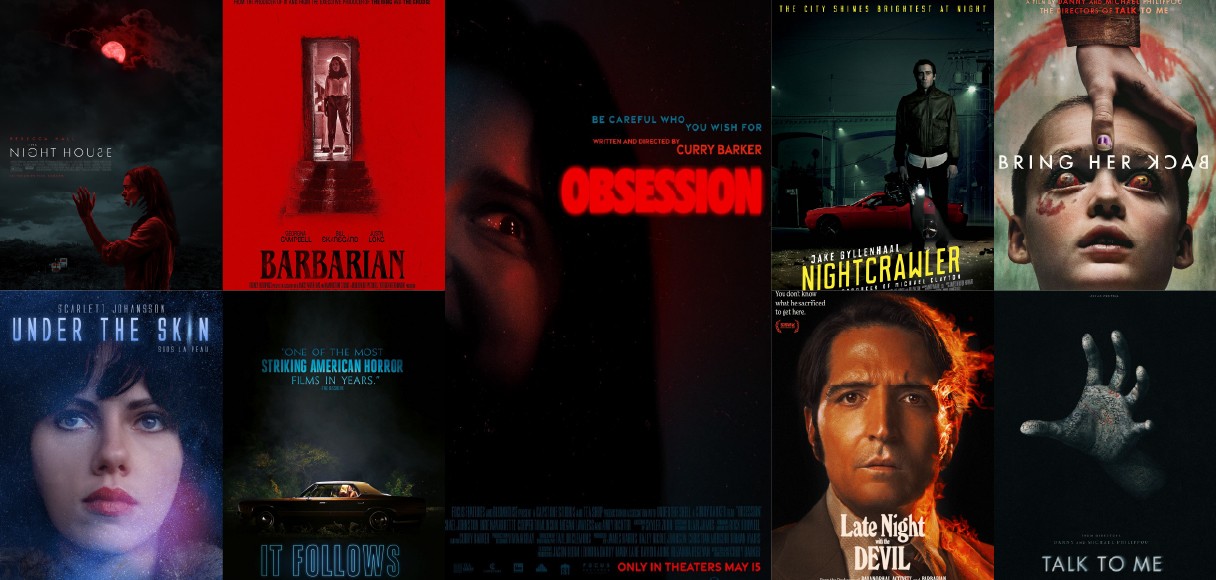



2026 is the biggest horror year of the century, and the receipts are not subtle. Obsession, Curry Barker’s $750,000 debut shot in twenty days, has grossed $403 million worldwide as of mid-July and is still selling tickets. It is already the highest-grossing film ever made on a budget under a million dollars, breaking a record Bruce Lee’s Enter the Dragon held for 53 years.
Backrooms, directed by a filmmaker who started the source material on YouTube at 16, has taken $364 million and is now A24’s highest-grossing film of all time. Iron Lung, self-financed for $3 million by a YouTuber with no distributor at all, cleared $51 million. Three of the year’s biggest horror films were made by people the studio system never trained. The 12 movies below are the year’s best so far, ranked, with the verified platform for each.
Here is the framework. The Six Signals of the 2026 Horror Boom sorts the year into the trends that actually produced it: the YouTube-to-Feature pipeline, the Prestige-Auteur Franchise Sequel, the Studio-Horror Comeback, the International Voice, Subgenre Reinvention, and the Brand Engine. Every film in the ranking represents one. Honorable mentions follow, then the confirmed releases still to come before December. This piece refreshes monthly and the streaming lines are re-verified at every pass. If you want the wider map of what is worth paying for, our complete streaming guide covers the rest.
Why 2026 Is a Landmark Year for Horror
Every year produces a few good horror movies. 2026 has produced twelve notable ones in six months plus an outright phenomenon in Obsession. Depth alongside a defining hit is what makes the year structurally different rather than just a good run.
The financial signal. Independent horror is delivering studio-scale returns and the ratios are becoming absurd. Obsession took $403 million on $750,000, and posted four straight weekends bigger than its opening. Iron Lung returned seventeen times its $3 million budget with no distributor whatsoever, which makes it the most profitable film of the year. Backrooms cost around $10 million and has grossed $364 million, the largest number A24 has ever posted. Talk to Me proved this model in 2023 at $92 million on $4.5 million and Longlegs extended it in 2024, but 2026 confirmed it three times in six months, and at a scale that changes what a studio green-light meeting sounds like.
The filmmaker signal. Three of the year’s top twelve were directed by people who came up on YouTube. Curry Barker was a sketch comedian. Kane Parsons started posting Backrooms videos as Kane Pixels at 16 and directed the feature at 20, which makes him the youngest filmmaker ever to top the box office. Mark Fischbach, better known as Markiplier, wrote, directed, starred in, financed, and then distributed Iron Lung himself, releasing it on YouTube Movies rather than licensing it to anyone. Jason Blum produced both Backrooms and Obsession. The pipeline stopped being a story about exceptions this year and became a category.
The prestige signal. Legacy horror is being handed to serious filmmakers. Nia DaCosta directed 28 Years Later: The Bone Temple from an Alex Garland script. Sam Raimi returned to horror with Send Help after 17 years away, and reportedly fought Sony for a theatrical release before taking the film to 20th Century Studios to get one. Damian McCarthy followed Oddity with Hokum at NEON scale. Maggie Gyllenhaal spent $90 million of Warner Bros money on a Bride of Frankenstein film and lost most of it. Not all of it worked. All of it was authored.
The Six Signals of the 2026 Horror Boom
The 12 films below are best understood through six distinct trends. Every film in the ranking primarily represents one.
Signal 1: The YouTube-to-Feature Pipeline
Signal 1 is 2026’s dominant story. Three of the twelve were directed by YouTubers turned filmmakers. Curry Barker’s Obsession is the anchor, a sketch comedian’s debut that became the highest-grossing film ever made under a million dollars. Kane Parsons’s Backrooms, adapted from his own YouTube series, is now A24’s highest-grossing release ever. Mark Fischbach’s Iron Lung skipped distributors entirely and still cleared $51 million. Horror’s new mainstream is being made by people who never touched the studio pipeline.
Signal 2: The Prestige-Auteur Franchise Sequel
Signal 2 is horror’s franchise economy handed to filmmakers with a point of view, and 2026 ran the experiment three times with three different answers. Nia DaCosta’s 28 Years Later: The Bone Temple is the best-reviewed film its franchise has ever produced and it lost money on a $63 million budget. Maggie Gyllenhaal’s The Bride! rebuilt the oldest Universal monster in the vault as a punk gothic romance and lost $66 million. Lee Cronin’s The Mummy dragged a dormant brand back to horror, drew the year’s most indifferent reviews, and cleared four times its budget. The pattern is uncomfortable: the better the authored franchise film, the worse it did.
Signal 3: The Studio-Horror Comeback
Signal 3 is established horror auteurs returning to studio filmmaking after long absences. Sam Raimi’s Send Help is the clearest example, his first horror film since Drag Me to Hell in 2009, a 17-year gap for the director who defined independent horror with The Evil Dead. That he had to fight for a theatrical window and change studios to get one tells you the fight is not over. That it opened at number one and took $94 million tells you he won it.
Signal 4: The International Voice
Signal 4 is filmmakers outside the Hollywood system making the year’s most acclaimed horror. Ireland’s Damian McCarthy followed 2024’s Oddity with Hokum, an Ireland and United Arab Emirates co-production that NEON put in American theaters. Australia’s Adrian Chiarella made Leviticus, which NEON bought at Sundance for around $5 million and which holds the highest critical approval rating of anything on this list. Both are getting real distribution rather than the festival-only path international horror used to take.
Signal 5: The Subgenre Reinvention
Signal 5 is dormant subgenres coming back because filmmakers found new angles. Johannes Roberts’s Primate revived the animal-attack film and made $41 million doing it. Zak Hilditch’s We Bury the Dead rebuilt the zombie film around grief rather than threat. Neither subgenre was on the industry’s active list five years ago. Both are now.
Signal 6: The Brand Engine
Signal 6 is the smallest of the six, and its size is the argument. The Brand Engine is horror that sells on recognition alone, where the mask moves the ticket and nothing else has to. Kevin Williamson’s Scream 7 is the year’s only pure example: roughly 30% critical approval, the worst in the franchise’s thirty-year history, and $214 million, the biggest gross any Scream has ever posted. It required no new idea and no directorial vision to clear two hundred million. In a year where every other signal rewards authorship, this one is the reminder that Ghostface does not need it and never has.
The 12 Best Horror Movies of 2026 So Far, Ranked
The ranking counts down from 12 to 1. Every entry carries a Signal tag, a verified streaming line, and a defense of its placement.
12. Scream 7 (2026)
Director: Kevin Williamson
Starring: Neve Campbell, Isabel May, Courteney Cox, David Arquette, Matthew Lillard
Year: 2026
Rating: R
Runtime: 114 minutes
Signal: 6, the Brand Engine
Where to Watch: Streaming on Paramount+Rent on Amazon. Also available to rent or buy on major digital platforms.
Why it’s essential: Scream 7 made more money than any film in the franchise’s thirty-year history and got the worst reviews in the franchise’s thirty-year history, which makes it the anchor and the entirety of the Brand Engine, the one signal of 2026 that needs no author at all.
A new Ghostface emerges in the quiet town where Sidney Prescott has built a life, and her daughter becomes the target. Kevin Williamson, who wrote the 1996 original and has produced the series ever since, directs one for the first time. It grossed $214 million against a $45 million budget, passing the original’s $173 million, and its $63.6 million opening was a franchise record. It is the second highest-grossing slasher ever in unadjusted dollars, behind only Freddy vs. Jason, and the seventh biggest film of 2026.
It also holds roughly 30% critical approval, the lowest the series has ever recorded, against a 74% audience score. The production explains some of it: Matt Bettinelli-Olpin and Tyler Gillett left, Christopher Landon came and went, Melissa Barrera was fired and Jenna Ortega departed, and the Carpenter sisters storyline two films had been building was abandoned mid-flight. Neve Campbell returned to a series rebuilt around her at short notice. Scream 8 is already in development.
The Screendollars Take
Scream 7 is not a good film and it is not pretending to be one. It is the year’s control group. Strip out the auteur, the new idea, and the discipline, leave only the mask, and the machine still clears two hundred million dollars. Every other entry on this list argues that 2026 horror rewards authorship; this one is the reminder that Ghostface has never needed it and never will. The cruel joke is that Williamson wrote the original thirty years ago, waited three decades to direct one himself, and the most interesting thing about the result is the number.
11. Lee Cronin’s The Mummy (2026)
Director: Lee Cronin
Starring: Jack Reynor, Laia Costa, May Calamawy, Natalie Grace, Verónica Falcón
Year: 2026
Rating: R
Runtime: 133 minutes
Signal: 2, the Prestige-Auteur Franchise Sequel
Where to Watch: Streaming on HBO Max. Also available to rent or buy on Apple TV, Prime Video, and Fandango at Home.
Why it’s essential: The Mummy took $90 million against a $22 million budget, making it the year’s fifth highest-grossing horror film and the only authored franchise entry of 2026 that actually turned a profit. That it did so with the year’s most indifferent reviews is the point.
A television journalist’s young daughter vanishes into the Egyptian desert. Eight years later the family is told she has been found alive, sealed in a three-thousand-year-old sarcophagus, and they bring her home to New Mexico catatonic and wrong. What she is hosting is the Nasmaranian, an ancient demon, and the film that follows is closer to The Exorcist than to anything with Brendan Fraser in it. Lee Cronin, who made Evil Dead Rise and The Hole in the Ground, wrote and directed it for Blumhouse, Atomic Monster, and New Line, with Jason Blum and James Wan producing and Stephen McKeon scoring.
The reception was the flattest of anything here: 47% from 187 critics, a C+ CinemaScore, and a fall out of the domestic top ten inside a month. It still cleared four times its budget, because $22 million is a number you can recover from.
The Screendollars Take
Lee Cronin’s The Mummy is not a Mummy movie in any sense the last thirty years would recognize. It is a possession film about a family that gets their daughter back and slowly understands they should not have, and the only thing Egyptian about it is the thing inside her. Cronin’s real achievement is structural rather than artistic: he is the one director this year who took a dormant brand, made something with an actual point of view, and still handed the studio a profit. Nobody loved it. Everybody got paid. In 2026 that combination turned out to be the rarest one going.
10. Iron Lung (2026)
Director: Mark Edward Fischbach
Starring: Mark Edward Fischbach, Caroline Kaplan, Troy Baker
Year: 2026
Rating: R
Runtime: 125 minutes
Signal: 1, the YouTube-to-Feature Pipeline
Where to Watch: Rent or buy on YouTube Movies and TV, exclusively.
Why it’s essential: Iron Lung returned seventeen times its budget with no distributor attached to it at any point, which makes it the most profitable film of 2026 and the most radical thing on this list.
After an event called the Quiet Rapture erased every star and planet in the universe, the survivors live on ships. A convict named Simon, played by Fischbach, is sent down in a small submarine to travel an ocean of blood on a dead moon and bring back samples. Fischbach adapted it from David Szymanski’s 2022 game, financed the $3 million himself through Markiplier Studios, and put it into over 3,000 theaters without a studio. It opened to $18.1 million and finished at $51 million worldwide.
Then he refused to license it. Iron Lung is on YouTube Movies and nowhere else, because Fischbach kept distribution on the platform that built him. Critics were split hard, with several reviewers arguing the film cannot sustain two hours on the plot it has, against an 89% audience score from over a thousand verified ratings. That gap is the honest story: it is not as accomplished as the films above it, and it is here for what it proves.
The Screendollars Take
Iron Lung is not a great film, and pretending otherwise would insult you. It is something more interesting: proof that every gatekeeper in the chain is now optional. Fischbach paid for it, shot it, starred in it, booked the theaters, and then put it on his own storefront rather than take Netflix’s cheque. The monster barely appears, which reads as restraint or as budget depending on your mood. Watch it as an industry document that happens to be properly tense inside a metal tube.
9. The Bride! (2026)
Director: Maggie Gyllenhaal
Starring: Jessie Buckley, Christian Bale, Annette Bening, Peter Sarsgaard, Penélope Cruz
Year: 2026
Rating: R
Runtime: 127 minutes
Signal: 2, the Prestige-Auteur Franchise Sequel
Where to Watch: Streaming on HBO Max. Also available to rent or buy on Apple TV, Prime Video, and Fandango at Home.
Why it’s essential: The Bride! is the year’s most expensive horror swing and its most spectacular failure, $24 million worldwide against a $90 million budget, and ambition that fails this loudly is still worth an evening.
Maggie Gyllenhaal wrote and directed a punk gothic reimagining of Bride of Frankenstein set in 1930s Chicago. Christian Bale’s lonely Frank asks Dr. Euphronius, played by Annette Bening, to build him a companion. She resurrects Ida, played by Jessie Buckley, who develops a mind of her own almost immediately and starts dismantling everything around her. Peter Sarsgaard, Penélope Cruz, and Jake Gyllenhaal fill out the cast, Hildur Guðnadóttir scored it, and it was shot for IMAX. It premiered in London in February, opened March 6, and collapsed.
Reviews split hard between people who found it thrilling and people who found it incoherent, and both readings are defensible. Buckley, who had just won an Academy Award for Hamnet, is the reason to watch regardless.
The Screendollars Take
The Bride! is not a bad film so much as an ungovernable one. Gyllenhaal had ninety million dollars and a Universal monster and made something closer to a stage happening than a horror movie, all texture and provocation and almost no plot discipline. It will make studios more cowardly for years, which is its real damage. Buckley is a force in it anyway. In a year defined by tiny budgets beating the house, the biggest swing missing by the widest margin is part of the same story.
8. Primate (2026)
Director: Johannes Roberts
Starring: Johnny Sequoyah, Jessica Alexander, Troy Kotsur, Victoria Wyant
Year: 2026
Rating: R
Runtime: 89 minutes
Signal: 5, Subgenre Reinvention
Where to Watch: Streaming on Paramount+Rent on Amazon, Apple TV. Also available to rent or buy on major digital platforms.
Why it’s essential: Primate revived the animal-attack film, dormant as a studio proposition for decades, and made $41.6 million doing it.
Lucy Pinborough comes home to her family’s isolated house in Hawaii, where Ben, the chimpanzee they adopted, is bitten by a rabid mongoose and turns. What follows is unusually brutal for a studio release, and Johannes Roberts, who made 47 Meters Down, has built a career on contained animal terror and does not blink here.
Troy Kotsur, who won an Academy Award for CODA, gives the film a gravity it has no structural right to, and his signed performance adds a register the subgenre has never had.
The Screendollars Take
Primate is not trying to be about anything, and that is close to a relief. It is a film about a chimpanzee removing people’s faces, executed with total commitment by a director who knows exactly what he is selling. Roberts shoots the Hawaiian mansion as a beautiful glass trap, all sightlines and no exits. Kotsur is the surprise, an Oscar winner grounding a killer-ape movie and somehow making the family real. Sometimes one lean, mean chiller is the correct order.
7. Leviticus (2026)
Director: Adrian Chiarella
Starring: Joe Bird, Stacy Clausen, Mia Wasikowska, Nicholas Hope
Year: 2026
Rating: R
Runtime: 88 minutes
Signal: 4, the International Voice
Where to Watch: In US theaters since June 19. Apple TV. Arriving on digital rental and purchase July 21.
Why it’s essential: Leviticus holds the highest critical approval rating on this list at 92%, and it is the only film here whose monster is an argument about conversion therapy.
Two teenage boys in a devout rural Australian town fall in love. The church’s response is a reverse exorcism, a ritual that calls a demon in rather than casting one out, and the entity it summons hunts each boy wearing the face of the person he desires most. Which is each other. Adrian Chiarella, who is gay and has been open in press about the allegory, made his debut feature into the cruelest possible literalization of what a community does to children who disobey it.
Critics reach for It Follows, but the closer relatives are Australian. It comes from Causeway Films, who made The Babadook and Talk to Me, and Joe Bird, who plays Naim, is the same actor who played Riley in Talk to Me. Jed Kurzel scored it. NEON bought it out of Sundance Midnight for around $5 million.
The Screendollars Take
Leviticus is not a film about a monster. It is a film about a punishment that never stops arriving, designed by adults who believed they were helping, and wearing a boy’s face when it catches you. Chiarella’s reverse exorcism is the sharpest horror premise of the year: the church does not cast the demon out, it calls one in. At 88 minutes he never lets the metaphor go slack. The most devastating thing here is that the entity only looks like love.
6. We Bury the Dead (2026)
Director: Zak Hilditch
Starring: Daisy Ridley, Brenton Thwaites, Mark Coles Smith
Year: 2026
Rating: R
Runtime: 95 minutes
Signal: 5, Subgenre Reinvention
Where to Watch: Streaming on Hulu, Rent on Amazon. Also available to rent or buy on major digital platforms.
Why it’s essential: We Bury the Dead is the year’s zombie reinvention, and it works by pointing the camera at the survivors instead of the dead.
After a catastrophic military accident in Tasmania, the dead return. The official line is that they are harmless and slow, which is exactly the sort of thing that gives grieving people hope. Daisy Ridley plays Ava, driven by hope as she searches for her missing husband. Zak Hilditch treats the risen as a grief mechanism rather than a scare delivery system, which is the choice the subgenre needed after two decades of diminishing returns.
It divided people sharply, 87% with critics against 46% with audiences, and the complaint is always the same: not enough zombie. That complaint is the point of the film.
The Screendollars Take
We Bury the Dead is not a zombie movie, and the audience score is proof it delivered on that promise. It is a film about the specific cruelty of a loss that will not finish happening, where the body comes back but the person does not. Hilditch keeps the scale small and the focus on the living, so the horror is the hope rather than the threat. Ridley builds Ava out of refusing to accept the obvious. The dead walking is the premise. The widow not letting go is the film.
5. Hokum (2026)
Director: Damian McCarthy
Starring: Adam Scott, Peter Coonan, David Wilmot, Florence Ordesh
Year: 2026
Rating: R
Runtime: 107 minutes
Signal: 4, the International Voice
Where to Watch: Rent or buy on Apple TV, Prime Video, Fandango at Home, and Google Play, available since June 2. Still playing in select theaters.
Why it’s essential: Hokum took $24 million against a $5 million budget and moved Damian McCarthy from indie-hit director to a filmmaker working at full prestige scale, in only his third feature.
Ohm Bauman, a reclusive novelist stuck on the last book of his Conquistador trilogy, travels to the remote Bilberry Woods Hotel in rural Ireland to scatter his parents’ ashes. The staff tell him about the witch who haunts the honeymoon suite, and he dismisses the whole thing as hokum. Then a near-death incident on his first night starts pulling his skepticism apart, and a member of staff disappears. McCarthy, who made Caveat and Oddity, builds out of atmosphere and patience, then detonates precisely timed scares inside it. Joseph Bishara scored it, and Spooky Pictures, the company behind Barbarian, produced.
It is Adam Scott’s first horror lead, arriving straight off the second season of Severance, and he plays Ohm’s contempt as armor over grief. Not every critic was convinced: the recurring complaint is that the set pieces are stronger than the plot connecting them, and the climax tangles more than it needs to.
The Screendollars Take
Hokum is not a haunted-inn story. It is a story about a man who has built an entire personality out of refusing to believe in anything, meeting something that does not require his belief. The title is the tell: Ohm says the word out loud, dismissing the witch, and the film spends 107 minutes making him eat it. McCarthy’s trick across three features now is that the whimsy and the dread are the same gesture, delivered with the same hand. Scott plays cynicism as a wound rather than a pose.
4. Send Help (2026)
Director: Sam Raimi
Starring: Rachel McAdams, Dylan O’Brien, Xavier Samuel, Chris Pang, Dennis Haysbert
Year: 2026
Rating: R
Runtime: 113 minutes
Signal: 3, the Studio-Horror Comeback
Where to Watch: Streaming on Hulu, Apple TV. Also available to rent or buy on major digital platforms.
Why it’s essential: Send Help is Sam Raimi’s first horror film in 17 years, it opened at number one, and it took $94 million on a $40 million budget, which is the whole argument that the register was never dated.
Linda Liddle, a hard-working and socially awkward analyst played by Rachel McAdams, is passed over for promotion by Bradley Preston, her company’s newly appointed CEO, played by Dylan O’Brien. Their plane goes down. They are the only two survivors on a deserted island, and the power between them inverts fast. Damian Shannon and Mark Swift wrote it, Bill Pope shot it, Bob Murawski cut it, and Danny Elfman scored it, which is most of the old band. Bruce Campbell turns up.
Raimi reportedly fought Sony for a theatrical release and moved the film to 20th Century Studios to get one. It debuted to $19.1 million and holds 93% critical approval from 285 reviews.
The Screendollars Take
Send Help is not a comeback in the sentimental sense. It is Raimi proving the register was never dated, only unfashionable, and that nobody else ever learned to do it. The camera is the third character, as it always was in the Evil Dead films, lunging and swooping where a normal director would cut. McAdams builds Linda from overlooked to frightening without a single false step. Seventeen years away and the timing is untouched.
3. 28 Years Later: The Bone Temple (2026)
Director: Nia DaCosta
Starring: Ralph Fiennes, Jack O’Connell, Alfie Williams, Erin Kellyman
Year: 2026
Rating: R
Runtime: 109 minutes
Signal: 2, the Prestige-Auteur Franchise Sequel
Where to Watch: Streaming on Netflix. Also available to rent or buy on Apple TV, Prime Video, and Fandango at Home.
Why it’s essential: The Bone Temple is the best-reviewed film in the franchise’s twenty-four-year history at 92% critical approval, it leads the Fangoria Chainsaw Awards nominations, and it lost money so badly that Sony started pulling it from theaters two weeks after release. Both facts belong in the same sentence.
Picking up directly from Danny Boyle’s 2025 reboot and written again by Alex Garland, DaCosta’s film follows Dr. Ian Kelson, played by Ralph Fiennes, as he edges toward something like a cure, while young Spike is saved by Jack O’Connell’s Sir Lord Jimmy Crystal and absorbed into his satanic gang. At 109 minutes it is tighter than the film before it and considerably more violent in its opening minutes. Hildur Guðnadóttir scored it.
O’Connell’s Jimmy has drawn the year’s loudest reviews for a villain. Fiennes, at 63, is doing physical work most actors his age have retired from. DaCosta stages a musical number at the bone temple that has no business working and completely does. And then it grossed $58.5 million against a $63 million budget, opening to $13 million when Sony expected $20 million or more, on the most expensive film the franchise has ever made. Its predecessor took $151 million seven months earlier. Coming back that fast, into January, appears to have been the whole problem.
The Screendollars Take
The Bone Temple is not a franchise obligation. It is a director treating someone else’s apocalypse as a canvas and painting something stranger than the original. DaCosta opens with more visceral horror in three scenes than the 2025 film managed across two hours, then pivots to a tender bromance among the bones, then stages a musical sequence, and holds all three at once. Jimmy Crystal is a Clockwork Orange nightmare in a wig. This is what a sequel is supposed to do and almost never does, and the market punished it for exactly that. Watch it on Netflix, where the audience it deserved has finally found it, and note that the best-reviewed film in the series is also the only one that lost money.
2. Backrooms (2026)
Director: Kane Parsons
Starring: Chiwetel Ejiofor, Renate Reinsve, Mark Duplass, Finn Bennett, Lukita Maxwell
Year: 2026
Rating: R
Runtime: 110 minutes
Signal: 1, the YouTube-to-Feature Pipeline
Where to Watch: Rent for $19.99 or buy for $24.99 on Apple TV, Prime Video, and Fandango at Home, available since July 14. Expected on HBO Max between mid-September and early October.
Why it’s essential: Backrooms has grossed $364 million and is now the highest-grossing film in A24’s history, directed by someone who was posting the source material to YouTube as a sixteen-year-old.
Clark, a struggling furniture store owner played by Chiwetel Ejiofor, finds a door in his basement that opens onto an endless expanse of fluorescent-lit rooms. When he vanishes, his therapist, Dr. Mary Kline, played by Renate Reinsve, goes in after him. It is set in the 1990s. Parsons found the creepypasta on 4chan in 2019, built it into a YouTube series as Kane Pixels starting in January 2022, and A24 eventually handed him thirty thousand square feet of practical set. He opened to $81.4 million domestic, the biggest opening the studio has ever had, and became the youngest director ever to top the box office.
The monster is played by Robert Bobroczkyi, a seven-foot Romanian-Hungarian former professional basketball player, and its design has been called the most frightening of the decade. The film’s own weakness is an ending that withholds more than it resolves.
The Screendollars Take
Backrooms is not really about a maze. It is about a man whose life has already emptied out walking into a space that is the exact shape of that emptiness. Parsons’s instinct is architectural rather than dramatic: the dread comes from wrong ceiling heights and corridors that should have ended, not from anything chasing you. That he understood liminal space this precisely at twenty is the story. That A24 built him thirty thousand square feet to prove it is the industry noticing.
1. Obsession (2026)
Director: Curry Barker
Starring: Michael Johnston, Inde Navarrette, Cooper Tomlinson, Megan Lawless, Andy Richter
Year: 2026
Rating: R
Runtime: 109 minutes
Signal: 1, the YouTube-to-Feature Pipeline
Where to Watch: Rent for $19.99 or buy for $24.99 on Apple TV, Prime Video, and Fandango at Home, available since June 30.
Why it’s essential: Obsession is the highest-grossing film ever made on a budget under a million dollars, and it took eighteen months to get there from YouTube sketch comedy.
Bear, a music store employee and hopeless romantic played by Michael Johnston, breaks a supernatural toy called the One Wish Willow and wishes for his childhood crush Nikki to love him. The wish works. Then it keeps working. Curry Barker wrote, directed, and edited it, shot it in twenty days for $750,000, premiered it in TIFF’s Midnight Madness in September 2025, and watched a bidding war end with Focus Features paying somewhere between $14 and $15 million for it. It broke a 53-year-old record held by Bruce Lee’s Enter the Dragon for the most successful sub-million-dollar production ever made, and it is now Focus Features’ highest-grossing film of all time by a distance.
The run is the story, and it is not finished. It opened to $17 million domestically, then grew, posting four consecutive weekends larger than its opening and a fourth weekend of $25.6 million that is the biggest any horror film has ever had, beating The Blair Witch Project’s 1999 record. Two months in, it was still adding $5 million a weekend at home and $12 million abroad. It holds 94% critical approval from 269 critics, a 98% audience score, and an A-minus CinemaScore. Inde Navarrette is the reason it works. Her turn from ordinary to unbearable is the year’s breakout performance, and Barker is already attached to write and direct A24’s reimagining of The Texas Chain Saw Massacre.
The Screendollars Take
Obsession is not a monster movie. It is a film about consent, and about a nice guy who gets exactly what he asked for and cannot give it back. Barker stages the horror as affection that will not stop escalating, so the dread comes from tenderness curdling rather than from anything with claws. Navarrette plays a woman being erased from inside her own body and makes you watch every stage of it. The budget is the headline. The nerve is the achievement.
Films We Almost Included
Four more 2026 releases were considered for the top 10 and landed just outside. Presented in release order.
Ready or Not 2: Here I Come (2026, dir. Matt Bettinelli-Olpin and Tyler Gillett). Released March 20 through Searchlight, 108 minutes. Grace survived one deadly game; now she and her sister Faith are being hunted by four rival families competing for a throne. Radio Silence return to their 2019 breakout after two Scream revivals, and Samara Weaving’s commitment is what carries it past the sequel curse. It took $20.2 million domestically. Signal 2, the Prestige-Auteur Franchise Sequel.
They Will Kill You (2026, dir. Kirill Sokolov). Released March 27, produced by Andy Muschietti. Zazie Beetz must survive the night at the Virgil, a demonic cult’s death-trap of a lair, before she becomes their next offering, with Myha’la Herrold, Paterson Joseph, and Tom Felton. Sokolov, who made Why Don’t You Just Die!, builds a hyper-stylized gothic battle royale whose cyclical structure wears thin for some critics and never wears thin for Beetz. Signal 5, Subgenre Reinvention.
Faces of Death (2026, dir. Daniel Goldhaber). Released April 10 through IFC Films, 97 minutes, after a 35mm premiere at Beyond Fest. Barbie Ferreira plays Margot Romero, a content moderator at a TikTok-like platform called Kino who starts finding videos that appear to re-enact deaths from the 1978 original, and has to work out whether she is watching fiction or a murder in progress. Dacre Montgomery, Josie Totah, Jermaine Fowler, and Charli XCX co-star. Goldhaber and co-writer Isa Mazzei, who made Cam together, shot it in 2023 and it sat for three years. It grossed $3 million against a $7.4 million budget. Signal 5.
Evil Dead Burn (2026, dir. Sébastien Vaniček). Released July 10, the sixth Evil Dead, produced by Sam Raimi and Rob Tapert. Souheila Yacoub seeks comfort with her in-laws after her husband’s death and the family reunion turns Deadite one member at a time. It took $28.3 million worldwide on a $20 million budget and split critics almost exactly down the middle, 69% from 164 reviews, between those who found it viciously effective and those who found it joyless. There is a hidden Bruce Campbell cameo. Signal 2.
What’s Still Coming in 2026
The second half could reshape this ranking by December. These are confirmed.
Resident Evil (dir. Zach Cregger), September 18. Cregger follows Barbarian and Weapons with a Raccoon City film that is, by his own account, an original screenplay with nothing to do with any previous Resident Evil movie or any character you know from the games. Austin Abrams plays Bryan, a medical courier caught in the outbreak, with Paul Walter Hauser, Zach Cherry, and Kali Reis. Sony is releasing it in IMAX. Given the year’s argument about authored horror, this is the most interesting test case on the calendar.
Clayface (dir. James Watkins), autumn. A DC villain origin written by Mike Flanagan and produced by James Gunn, with Tom Rhys Harries as the shape-shifting actor. Early footage promised body horror rather than a superhero film. Release dates have moved; check before you plan around it.
Insidious: Out of the Further (dir. Jacob Chase), summer. The sixth in the franchise, with Amelia Eve, co-written by David Leslie Johnson.
Other Mommy (dir. Rob Savage), autumn. Adapted from Josh Malerman’s Incidents Around the House, with Jessica Chastain. A young girl starts talking to the thing in her closet.
Werwulf (dir. Robert Eggers), December 25. Eggers follows Nosferatu with a 13th-century England werewolf film starring Aaron Taylor-Johnson, Lily-Rose Depp, Willem Dafoe, and Ralph Ineson, presented in gothic 4:3. He has called it the darkest thing he has ever written. It is the release most likely to enter the top five on arrival, and it lands too late in the year for anyone to be sure.
What 2026 Horror So Far Tells Us
Twelve films across six months is enough to describe the shape of a year. Three YouTube-to-feature breakouts, three authored franchise entries, one veteran’s comeback, two internationally produced hits, two subgenre revivals, and exactly one film that ran on brand recognition alone is not a genre consolidating. It is a genre expanding in every direction at once. The proportion matters as much as the list: eleven of the twelve got there on someone’s point of view, and only Scream 7 got there on a mask.
The money tells a harder story than the ranking does. The two best-reviewed franchise entries of the year, The Bone Temple and The Bride!, lost a combined $130 million between them. The one authored franchise film that profited, Lee Cronin’s The Mummy, is also the one nobody argued about. The film with the worst reviews in thirty years of Scream cleared $214 million. And a $750,000 film with no stars outgrossed all of them put together. Authorship won the year critically and lost it commercially everywhere except at the very bottom of the budget scale, which is either the most hopeful fact about 2026 horror or the most precarious one.
The Six Signals are not a lens imposed on the year. They are the shape the year took. Obsession is the anchor, but the real story of 2026 is that horror has become the one place where a twenty-year-old with a YouTube channel, a Sundance debut from Australia, a legacy franchise, a veteran’s comeback, and a killer chimpanzee movie can all land inside six months. The second half will test whether it holds. Werwulf, Cregger’s Resident Evil, and Clayface are all still coming, and the December revision of this list may look nothing like the July one. That is the best problem a genre can have.