
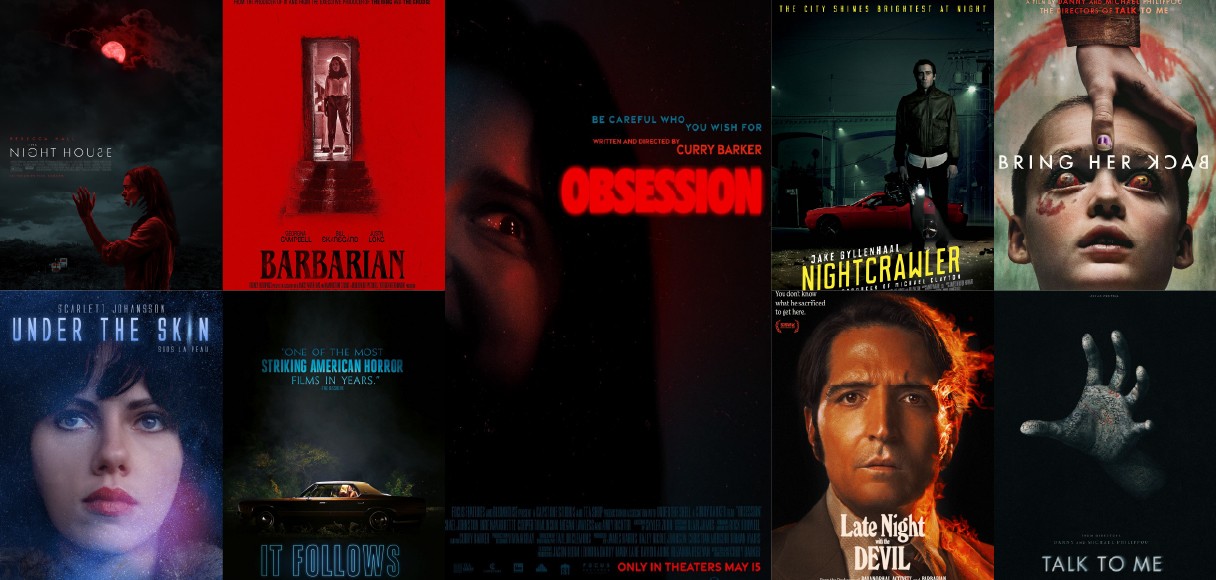
Obsession arrived on Apple TV on June 30, 2026, hit #1 on the Apple TV Store within 24 hours, and confirmed something horror observers have argued for a decade: modern horror is not a genre held together by conventions. It is a form held together by directors. The list below identifies the 16 films currently on Apple TV that share the "watch alone late at night" register, verified via JustWatch as of July 2026, and organizes them by the five auteur signatures that describe how they actually got made. Pick the director tradition you want to spend two hours inside, and the framework points you at the right film.
Here is what the article does. The Five Auteur Signatures, the Formalists, the Interior Explorers, the Viral Wave, the Social Commentators, and the Genre Benders, sort the 16 films into filmmaker traditions. Obsession gets its own section as the current cultural moment. The rest of the piece walks through the signatures and names which films best embody each one. You can navigate by director type instead of by mood.
Why Modern Horror Is an Authored Form Now
The 2010s and 2020s did something to horror that the 1980s and 1990s did not: they turned it into a director's medium. The 16 films on this list all have identifiable filmmakers with recognizable signatures. That has not always been true of the genre. This section explains what changed, why it matters for a viewer choosing what to watch tonight, and why the auteur framing is more useful than the mood framing that dominates most streaming guides.
What the genre used to be. For most of horror's mainstream history, the studio system treated the genre as director-agnostic. A horror film was defined by its conventions, the slasher, the possession, the haunted house, and the director was a technician who executed those conventions. There were exceptions, Carpenter, Craven, Argento, but the norm was that horror is what horror does, not what any particular filmmaker does with it. That norm broke in the streaming era. Once distribution unbundled from theatrical marketing, directors could make horror films that could not have been sold as horror films twenty years earlier.
What changed. The change came from three sources at once. A24 built a distribution model that treated horror as prestige cinema. Streaming platforms produced markets for films that could not have earned wide theatrical releases. And YouTube produced a generation of filmmakers, Curry Barker, the Philippou brothers, the Cairnes brothers, whose horror instincts were formed by short-form internet video rather than by studio pipelines. The result is a landscape in which "modern horror" is not a genre. It is a set of filmmakers whose signatures are as identifiable as any auteur working in prestige drama.
Why the auteur framing is the right one for this list. A viewer picking a film for tonight can absolutely pick by mood, but mood-picking is what most streaming guides already do. Picking by director tradition, by the kind of filmmaking you want to spend two hours inside, is a different exercise. It rewards attention with something more analytical than a rating and more specific than a genre tag. The Five Auteur Signatures framework below is the tool for that kind of picking.
The Five Auteur Signatures of Modern Horror
Modern horror organizes around five distinct filmmaker traditions. Every film in this list belongs to one of them. The framework below names them. Pick the tradition that matches how you want to spend the evening, and the section that follows points you at the specific film.
Signature 1: The Formalists
Formalist horror comes through composition, framing, and disciplined withholding. Jonathan Glazer's Under the Skin is the mode's clearest statement: shots of Scarlett Johansson driving Glasgow streets are held so long the discomfort becomes the subject. Zach Cregger's Barbarian uses architectural formalism, where the Detroit house's basement functions as the film's true co-lead. David Bruckner's The Night House uses spatial formalism, as Rebecca Hall's character discovers her lake house has been geometrically mirrored. Formalist horror rewards viewers who watch closely and stay quiet. What you do not see is doing the work.
Signature 2: The Interior Explorers
Interior Explorer horror locates the threat inside consciousness. Rose Glass's Saint Maud is a religious-consciousness horror, where the fear lives inside Maud's faith, not around it. David Robert Mitchell's It Follows is an anxiety-consciousness horror, where the entity is the anxiety made physical. Osgood Perkins's Longlegs is an inheritance horror, where the threat is what the protagonist has always already been. Dan Gilroy's Nightcrawler is a sociopathic-consciousness horror, where Louis Bloom is not becoming a monster, he already is one. Interior Explorer horror requires the viewer to occupy the protagonist's head.
Signature 3: The Viral Wave
The Viral Wave is filmmakers who came up through YouTube and internet-native genre culture. Curry Barker uploaded Milk & Serial to his YouTube channel in 2024 before Obsession became 2026's cultural moment. Danny and Michael Philippou built RackaRacka into one of horror-YouTube's most-watched channels before Talk to Me (2023) and Bring Her Back (2025). Colin and Cameron Cairnes made Late Night with the Devil (2024) with the found-footage discipline of the YouTube era. Viral Wave horror moves fast, understands attention, and treats the viewer as someone with a phone in the room.
Signature 4: The Social Commentators
Social Commentator horror engages directly with cultural anxieties as the genre's actual subject matter. Ryan Coogler's Sinners (2025) is a Prohibition-era Mississippi vampire film that operates simultaneously as a study of Black musical inheritance and American racial history. Chloe Okuno's Watcher (2022) is a Bucharest paranoia thriller that is also a precise essay on gendered visibility. Social Commentator horror asks the viewer to sit with what the film is arguing. The horror is not incidental to the argument. The horror is how the argument is made.
Signature 5: The Genre Benders
Genre Bender horror refuses to stay in one tonal register. Scott Derrickson's The Gorge (2025) blends sci-fi, romance, and creature-horror. Tilman Singer's Cuckoo (2024) blends body horror, coming-of-age, and Alpine-hotel mystery. Damian McCarthy's Oddity (2024) blends folk horror, murder mystery, and revenge structure. Genre Bender horror rewards viewers who do not need a film to declare itself one thing. The register-switching is the register.
Obsession (2026): The Signature Film of the Viral Wave, Now on Apple TV
https://www.youtube.com/watch?v=xJYoN-fX2j0
Curry Barker was a YouTube sketch comedian before Obsession premiered at TIFF in September 2025. He had made one previous feature, Milk & Serial (2024), which he uploaded to his own channel. In eighteen months, he became the director of 2026's biggest horror phenomenon, a $750,000 film that has grossed $403 million worldwide as of the July 3 to 5 weekend and hit #1 on the Apple TV Store within 24 hours of its June 30 digital release. Obsession is not just the anchor of this Apple TV list. It is the signature film of the Viral Wave.
Director: Curry Barker Starring: Michael Johnston, Inde Navarrette, Cooper Tomlinson Year: 2026 Rating: R Runtime: 108 minutes IMDb: 7.4 Where to Watch: On Apple TV, rent for $19.99 or buy for $24.99.
The signature move
Barker's directorial signature is the compression of internet-era horror instincts into feature form. Obsession moves faster than mainstream studio horror. It trusts the audience to catch what happens without over-explaining. It uses sound design, praised by Benjamin Lee at The Guardian and by Slant Magazine, with the density of a viral video's edit rhythm. And it treats its central premise, a wish-gone-wrong supernatural mechanism inspired by The Simpsons' "Treehouse of Horror II," with the specific mixture of sincerity and self-awareness that YouTube filmmakers of Barker's generation are fluent in. The film could not have been made by a studio-pipeline director. It is a signature film in the strictest sense: the signature is the filmmaker.
The Viral Wave lineage
Curry Barker is not alone in the Viral Wave. Danny and Michael Philippou built RackaRacka on YouTube, past 6 million subscribers, before A24 funded Talk to Me (2023), which grossed $92 million on a $4.5 million budget. Bring Her Back (2025) followed. Colin and Cameron Cairnes came out of Australian genre filmmaking before Late Night with the Devil (2024). What these filmmakers share is a formation outside the traditional studio pipeline, YouTube, streaming platforms, and festival circuits, and a horror instinct that assumes the viewer has already seen everything. The Viral Wave does not reinvent horror. It compresses it. Obsession is the wave's most commercially successful expression to date, and its arrival on Apple TV on June 30, 2026 is a genuine cultural moment.
The setup and reception
Bear (Michael Johnston) is a music-store employee who buys a supernatural toy called the "One Wish Willow" and uses it to make his childhood crush Nikki (Inde Navarrette) fall in love with him. The wish works. Then it works too well. The film premiered at TIFF in September 2025, where Focus Features acquired distribution rights for around $14 million. That is not a record acquisition price, but Obsession has since become the highest-grossing festival acquisition of all time, passing The Blair Witch Project's $248.6 million. Jason Blum came aboard as executive producer through Blumhouse after the deal closed. Theatrical release was May 15, 2026, digital release June 30. Obsession holds a 94% critical approval rating from 286 reviews and an A-minus CinemaScore, and Inde Navarrette has been widely called the year's newest scream queen.
The Apple TV availability specifically
Obsession is available on Apple TV to rent for $19.99 or buy for $24.99, live since June 30, 2026. Apple TV lists its copy as "Unrated," but this is a labeling quirk rather than a new cut: the file is the same 108-minute theatrical version available everywhere else, and no extended or gorier cut currently exists, though the cast has teased one. A 4K, Blu-ray, and DVD release follows on July 14. The film is expected to reach Peacock eventually as a Focus Features title under the Universal umbrella, though no date is confirmed and reporting suggests October or November at the earliest. For now, the Apple TV rental or purchase is the fastest way to watch.
The Screendollars Take
Obsession is not a monster movie. It is a film about getting precisely what you asked for and watching it rot in your hands. Barker stages the horror as affection that keeps escalating past the point of consent, so the scares come from tenderness curdling rather than anything with claws. It is the strongest argument in years that dread costs an idea, not a budget, which is the whole reason a $750,000 film is the anchor of this list.
Signature 1: The Formalists, Horror Through Composition
The three films below are directed by filmmakers whose horror comes through composition rather than through content. What is not shown, not stated, and not explained does the work. These films reward viewers who watch closely and stay quiet. Presented newest to oldest.
1. Barbarian (2022)
https://www.youtube.com/watch?v=Dr89pmKrqkI&pp=ygUYYmFyYmFyaWFuICgyMDIyKSB0cmFpbGVy
Director: Zach Cregger Starring: Georgina Campbell, Bill Skarsgård, Justin Long Year: 2022 Rating: R Runtime: 102 minutes IMDb: 7.0 Where to Watch: On Apple TV, rent or buy.
The signature move: Cregger built Barbarian as three distinct short films joined at the seams. The structural three-act shift, one of the most-discussed compositional moves in modern horror, is not just a plot device. It is the film's central formal argument about what a horror film's shape can be.
The setup: A woman (Georgina Campbell) arrives at her Detroit rental to find it already booked to a stranger (Bill Skarsgård). The situation is not what it appears. Neither is the house.
Why it belongs: Barbarian's composition, the Detroit basement's architecture, the runtime's structural pivots, the withholding of what the underground actually contains, is the film's real subject matter. The horror is not in the reveals. It is in the geometry.
The defining scene: The basement descent in the film's first third, Cregger's camera traveling through architectural space that keeps expanding beyond what the film has established.
The Screendollars Take
Barbarian is not one horror movie. It is three, stacked inside each other, and the scariest is not the thing in the tunnels. Cregger's cruelest trick is proving how often ordinary politeness is the real trap, whether to trust a stranger, whether a locked door is worth the awkwardness. The geometry is the horror, and you will not see the shape of it until you are already inside.
2. The Night House (2020)
https://www.youtube.com/watch?v=2Tshycci2ZA
Director: David Bruckner Starring: Rebecca Hall, Sarah Goldberg, Vondie Curtis-Hall Year: 2020 Rating: R Runtime: 107 minutes IMDb: 6.5 Where to Watch: On Apple TV, rent or buy.
The signature move: Bruckner uses spatial doubling as the film's central mechanism. Rebecca Hall's character discovers her late husband secretly built a mirrored, reversed version of their lake house across the water. The doubling is not a plot twist. It is the film's formal proposition about how grief geographically inhabits its survivors.
The setup: A widow (Rebecca Hall) investigates her late husband's secrets after his death. The lake house may or may not be haunted. What she finds nearby is worse than either.
Why it belongs: The Night House uses architectural composition to externalize an interior state. The house is not a location. It is a form the film argues through. Bruckner trusts Rebecca Hall's face to hold what the dialogue does not explain.
The defining scene: The reveal of the reversed house, Bruckner's cinematography turning negative space itself into the film's antagonist.
The Screendollars Take
The Night House is not a haunted-house film. It is grief looking for a shape to take, and refusing every comforting one. Bruckner hides figures in the negative space of the architecture, so you catch yourself scanning doorways and gaps in the walls for something the film trained you to expect. Hall carries almost every frame by herself, which is exactly why it belongs on a list about watching alone.
3. Under the Skin (2014)
https://www.youtube.com/watch?v=J7bAZCOk0Sc
Director: Jonathan Glazer Starring: Scarlett Johansson Year: 2014 Rating: R Runtime: 108 minutes IMDb: 6.3 Where to Watch: On Apple TV, rent or buy. Also on Netflix.
The signature move: Glazer withholds. The film is nearly silent for long stretches. Scarlett Johansson's alien character drives a van through Glasgow, and the film refuses to translate her mission for the viewer. What is not explained, what is not named, is the film's entire subject.
The setup: An alien in the form of a woman drives Glasgow streets luring men into a black void that consumes them. Nothing about the mechanism is explained. Everything about it is felt.
Why it belongs: Under the Skin is the formalist signature at its most extreme. Mica Levi's atonal score, Daniel Landin's cinematography, Glazer's refusal to psychologize, every choice is a formal one. The film is the mode's clearest statement.
The defining scene: The beach sequence, one of the most-discussed scenes in 21st-century cinema, Glazer's camera holding an event the film refuses to intervene in.
The Screendollars Take
Under the Skin is not really science fiction. It is what it feels like to watch humanity from the outside and, against your own interest, start to want in. Glazer shot real streets with hidden cameras, so the alien's confusion and the film's are the same. The men sinking into the black are among the most indelible images in modern horror. It withholds everything, and it lingers longest.
Signature 2: The Interior Explorers, Horror Through Consciousness
The four films below are directed by filmmakers whose horror lives inside the protagonist's consciousness. The threat is not something the character encounters. The threat is something the character becomes, discovers, or realizes they have always been. Presented newest to oldest.
4. Longlegs (2024)
https://www.youtube.com/watch?v=OG7wOTE8NhE
Director: Osgood Perkins Starring: Maika Monroe, Nicolas Cage, Blair Underwood, Alicia Witt Year: 2024 Rating: R Runtime: 101 minutes IMDb: 6.8 Where to Watch: On Apple TV, rent or buy.
The signature move: Perkins builds horror out of what has always already happened. The FBI agent (Maika Monroe) investigating the occult killer (Nicolas Cage) is uncovering not new events but an inheritance she has been inside her whole life. The film's dread is retrospective.
The setup: An FBI agent investigates a series of family murders connected to an occult figure. The connection may extend to her personally.
Why it belongs: Longlegs is Interior Explorer horror because its central mechanism is realization, not encounter. Perkins directs the film so the viewer's dawning understanding tracks Monroe's. The horror is what the audience learns has always been true.
The defining scene: The first full-face reveal of Cage's Longlegs, Perkins's aspect-ratio and color choices making the moment feel like something recognized rather than seen.
The Screendollars Take
Longlegs is not a procedural. It is a film about a devil who barely has to show up to win. Perkins frames Cage at the very edges of the widescreen, often out of focus, so the withholding does the work, and the movie feels contaminated long before it explains itself. The marketing sold a puzzle. The film is a mood you cannot wash off.
5. Saint Maud (2021)
https://www.youtube.com/watch?v=EXs2-TY9qok
Director: Rose Glass Starring: Morfydd Clark, Jennifer Ehle Year: 2021 Rating: R Runtime: 84 minutes IMDb: 6.7 Where to Watch: On Apple TV, rent or buy.
The signature move: Glass locates the film's horror inside Maud's religious conviction, not around it. The audience sees what Maud sees. The audience's disagreement with what Maud sees is the film's argument.
The setup: A palliative-care nurse (Morfydd Clark) becomes convinced God has assigned her to save the soul of a dying dancer (Jennifer Ehle). Her religious fervor escalates in a small English coastal town.
Why it belongs: Saint Maud is Interior Explorer horror at its most disciplined. Glass never breaks the interior register. The film's horror is that we are trapped inside a consciousness whose logic we do not share. Morfydd Clark's central performance is precise to the millimeter.
The defining scene: The final shot, one of the most-discussed closing images in modern horror, Glass making the interior fully visible for a single second.
The Screendollars Take
Saint Maud is not about God. It is about loneliness dressed up as a calling. Maud has a rented flat, a single mission, and no one to check her against reality, so devotion and delusion become impossible to separate. The final image arrives like a held breath finally released, and it reframes everything before it.
6. It Follows (2014)
https://www.youtube.com/watch?v=HkZYbOH0ujw
Director: David Robert Mitchell Starring: Maika Monroe, Keir Gilchrist, Daniel Zovatto Year: 2014 Rating: R Runtime: 100 minutes IMDb: 6.8 Where to Watch: On Apple TV, rent or buy.
The signature move: Mitchell externalizes anxiety as a slow-walking figure. The entity is the anxiety. The metaphor is not decorative, it is the film's mechanism. Every visual choice, the suburban decay, the anachronistic technology, Disasterpeace's synth score, reinforces the internal state as visible.
The setup: A teenager is passed a supernatural curse that follows her wherever she goes. Only she can see it. The only way to escape is to pass it on.
Why it belongs: It Follows is Interior Explorer horror because the entity is a mental state given physical form. Mitchell refuses to give the entity an origin story or a mythology, because it has no meaning outside the anxiety it represents.
The defining scene: The pool sequence in the climax, Mitchell staging the confrontation as the point where the internal state finally has to be fought externally.
The Screendollars Take
It Follows is not about sex, and it is barely about a monster. It is about the certainty that something is coming and is in no hurry at all. Mitchell stages half the film in wide shots and dares you to scan the background for a walking figure, which turns watching into surveillance. Nothing here rushes, which is why it stays.
7. Nightcrawler (2014)
https://www.youtube.com/watch?v=u1uP_8VJkDQ
Director: Dan Gilroy Starring: Jake Gyllenhaal, Rene Russo, Riz Ahmed Year: 2014 Rating: R Runtime: 117 minutes IMDb: 7.8 Where to Watch: On Apple TV, rent or buy.
The signature move: Gilroy makes Louis Bloom's sociopathic worldview the film's operating system. The camera does not judge Bloom. The soundtrack does not warn about him. The audience is inside his mental architecture for the full runtime, and the horror is that Bloom is not becoming worse. He is executing exactly what he is.
The setup: A drifter (Jake Gyllenhaal) films crime scenes at night in Los Angeles to sell to local news stations. His methods escalate as his success does.
Why it belongs: Nightcrawler is Interior Explorer horror without a supernatural mechanism. The horror is Louis Bloom's mind. Gilroy directs the film so the viewer occupies that mind rather than merely observing it. The technical label of thriller is beside the point.
The defining scene: The restaurant scene between Bloom and Rene Russo, Gilroy holding on Russo's face as she recognizes what she has walked into.
The Screendollars Take
Nightcrawler is not a thriller. It is a success story told without flinching, which is what makes it hard to watch. Gilroy shoots Los Angeles entirely after dark, all sodium light and empty freeways, and Gyllenhaal plays a man with no floor beneath his ambition. There is no ghost and no curse, only a person who has decided other people are footage, and a world that rewards him for it.
Signature 3: The Viral Wave, Horror From the Internet Generation
The three films below are directed by filmmakers who came up through YouTube, streaming, and internet-native genre culture. Their horror instincts were formed by short-form video literacy. Obsession (2026) is also a Viral Wave film, and gets the anchor treatment above. The three here round out the signature. Presented newest to oldest.
8. Bring Her Back (2025)
https://www.youtube.com/watch?v=kBskrYZfhw8
Director: Danny Philippou, Michael Philippou Starring: Sally Hawkins, Billy Barratt, Sora Wong Year: 2025 Rating: R Runtime: 104 minutes IMDb: 7.1 Where to Watch: On Apple TV, rent or buy. Also on HBO Max.
The signature move: The Philippou brothers make the follow-up to Talk to Me structurally colder than the debut. Where Talk to Me raced through possession set pieces, Bring Her Back holds on Sally Hawkins's slow disclosure. The signature is control, internet-generation filmmakers proving they can withhold as well as they can move.
The setup: After their father's death, two foster siblings move in with a new foster mother. Her grief has taken a form the siblings cannot yet name.
Why it belongs: The Philippou brothers built RackaRacka on YouTube, past 6 million subscribers, before A24 funded Talk to Me. Bring Her Back is the Viral Wave's proof of maturity, and Sally Hawkins's career-best performance anchors it.
The defining scene: The bathroom sequence roughly halfway through, when the film's central mechanism becomes explicit and the Philippous hold the frame well past comfort.
The Screendollars Take
Bring Her Back is not a possession story so much as a study in how far a mother's grief will reach and who it uses to get there. Hawkins plays warmth and control as the same gesture, so the gaslighting lands harder than any jump. It is more upsetting than its predecessor, and it earns every bit of it. Keep this one in reserve for a night you can take it.
9. Late Night with the Devil (2024)
https://www.youtube.com/watch?v=Frvyaj1wtNA
Director: Colin Cairnes, Cameron Cairnes Starring: David Dastmalchian, Laura Gordon, Ian Bliss Year: 2024 Rating: R Runtime: 93 minutes IMDb: 7.1 Where to Watch: On Apple TV, rent or buy. Also on Shudder.
The signature move: The Cairnes brothers use the found-footage discipline the YouTube generation grew up with, every visual choice justified by the recording device, to build a talk-show possession that feels authentically 1977. The signature is period-specific formal precision.
The setup: A 1977 Halloween broadcast of a struggling late-night talk show goes wrong. The host (David Dastmalchian) has booked a possession expert and her patient as guests. What looks like a stunt becomes real.
Why it belongs: Late Night with the Devil is the Viral Wave applied to a specific format. The Cairnes brothers' found-footage instincts, how a camera would actually have captured this, are the film's structural argument. Dastmalchian's performance carries what the format releases.
The defining scene: The Christou possession segment, the Cairnes brothers holding the found-footage frame while the supernatural mechanism becomes undeniable.
The Screendollars Take
Late Night with the Devil is not about a demon. It is about a man who would let one onto his stage for a ratings spike. Dastmalchian plays the host as pure showbiz desperation, and the broadcast conceit means the dread plays out live in front of a studio audience that cannot leave. It is the single most on-theme way to honor a late-night viewing: a talk show that turns on the people watching it.
10. Talk to Me (2023)
https://www.youtube.com/watch?v=aLAKJu9aJys
Director: Danny Philippou, Michael Philippou Starring: Sophie Wilde, Alexandra Jensen, Joe Bird, Miranda Otto Year: 2023 Rating: R Runtime: 95 minutes IMDb: 7.1 Where to Watch: On Apple TV, rent or buy.
The signature move: The Philippou brothers build the film around a shareable set piece, an embalmed hand teens pass around at parties. The signature is object-focused shareability. The central mechanism is designed to be discussed, a YouTube-generation instinct about what a horror film needs to plant in the viewer.
The setup: Australian teenagers pass around an embalmed hand at parties. Grasping it lets a ghost briefly possess you. The teenagers push the limit past what is safe.
Why it belongs: Talk to Me is the Viral Wave's breakout. A24 backed it after seeing the Philippous' YouTube work, and the film grossed $92 million on a $4.5 million budget. It made the brothers international names, and Sophie Wilde's central performance is the reason it holds together.
The defining scene: The first extended possession sequence, the Philippous establishing the film's rules with the pacing of a viral video's opening seconds.
The Screendollars Take
Talk to Me is not about a haunted hand. It is about a grieving girl who would rather be possessed than be alone with her loss. The brothers frame the seances like a party drug, complete with an addiction arc, so the scares land as consequences. The opening ninety seconds are the best argument for this whole list: you want to be in that chair, and you should not.
Signature 4: The Social Commentators, Horror as Cultural Argument
The two films below are directed by filmmakers whose horror engages directly with cultural anxieties as the genre's actual subject matter. The horror is how the cultural argument is made. Presented newest to oldest.
11. Sinners (2025)
https://www.youtube.com/watch?v=bKGxHflevuk
Director: Ryan Coogler Starring: Michael B. Jordan, Hailee Steinfeld, Miles Caton, Jack O'Connell Year: 2025 Rating: R Runtime: 138 minutes IMDb: 7.5 Where to Watch: On Apple TV, rent or buy. Also on HBO Max.
The signature move: Coogler builds the vampire film as a formal container for a musical, historical, and spiritual argument about Black American inheritance. The genre elements are load-bearing. The vampire is not a metaphor, it is the mechanism through which the film argues about what gets passed on, what gets stolen, and what survives.
The setup: Twin brothers (both Michael B. Jordan) return to their Prohibition-era Mississippi hometown to open a juke joint. They discover an evil that pre-dates the town.
Why it belongs: Sinners is Social Commentator horror at its most ambitious. Coogler refuses to separate the horror from the historical argument, because one is the other. A 97% critical approval rating, four Academy Awards, and a $370 million global run all underscore that ambitious authored horror can still command mainstream scale.
The defining scene: The extended musical sequence roughly halfway through, Coogler collapsing genre, history, and myth into one visual argument that became one of 2025's most-discussed scenes.
The Screendollars Take
Sinners is not a vampire film. It is a film about what a culture will trade to be heard, with the bloodsuckers standing in for everyone who ever wanted to own Black music without living the cost of it. The horror only starts once you understand what is being taken. It wants to be a great film, not just a scary one, and it gets there.
12. Watcher (2022)
https://www.youtube.com/watch?v=kpebJezzK30
Director: Chloe Okuno Starring: Maika Monroe, Karl Glusman, Burn Gorman Year: 2022 Rating: R Runtime: 96 minutes IMDb: 6.5 Where to Watch: On Apple TV, rent or buy. Also on Shudder and AMC+.
The signature move: Okuno stages voyeurism as gendered epistemology. Whether Julia (Maika Monroe) is really being watched is the plot, but the film's actual argument is about who gets believed when they report what they see. The horror is the institutional dismissal.
The setup: An American woman moves to Bucharest with her husband and becomes convinced she is being watched by a man across the courtyard. Her husband and everyone else dismisses her fear.
Why it belongs: Watcher is a horror film about the specific epistemology of being a woman in shared space. Okuno directs the paranoia so the film's argument, that women's reports are systematically discounted, becomes the horror's structural mechanism rather than its background.
The defining scene: The subway sequence in the final third, Okuno making explicit what the film has been arguing since the opening frame.
The Screendollars Take
Watcher is not about a stalker. It is about how long a woman can be right and still not be believed. Okuno shoots the apartment as a fishbowl and lets the language barrier do the isolating, so Julia is alone even in a room full of people. The slow burn is the point, and so is the ending.
Signature 5: The Genre Benders, Horror That Refuses One Register
The three films below are directed by filmmakers who refuse to keep horror inside horror. Sci-fi, romance, folk mystery, body horror, coming-of-age, every one of these films crosses tonal lines the genre traditionally polices. The register-switching is the register. Presented newest to oldest.
13. The Gorge (2025)
https://www.youtube.com/watch?v=rUSdnuOLebE
Director: Scott Derrickson Starring: Miles Teller, Anya Taylor-Joy, Sigourney Weaver Year: 2025 Rating: PG-13 Runtime: 127 minutes IMDb: 6.7 Where to Watch: Streaming on Apple TV+.
The signature move: Derrickson blends action-thriller, sci-fi horror, and slow-burn romance into a single register that shifts multiple times per scene. The signature is confident tonal management, a director trusting his ensemble and his audience to follow the register wherever it goes.
The setup: Two elite snipers (Miles Teller, Anya Taylor-Joy) are stationed on opposite sides of a mysterious canyon. Their orders are never to cross and never to communicate. They do both.
Why it belongs: The Gorge is the only film on this list on Apple TV+ subscription, the accessibility advantage for existing subscribers. Derrickson's direction blends genres the theatrical marketing would have had to choose between, and its Apple TV+ release is the point: the streaming business model rewards genre-bending in a way theatrical does not.
The defining scene: The first crossing of the canyon, Derrickson pivoting the register from action-thriller to horror to romance in a single sequence.
The Screendollars Take
The Gorge is not really a creature feature, whatever the trailers sold. It is a love story that needed a canyon between the lovers to generate any heat, and Derrickson holds his leads apart for as long as the premise allows. It drew mixed reviews and it is the softest pick here, the one you reach for when you want unease rather than terror.
14. Cuckoo (2024)
https://www.youtube.com/watch?v=qW_Z7Pg18EE
Director: Tilman Singer Starring: Hunter Schafer, Dan Stevens, Jessica Henwick Year: 2024 Rating: R Runtime: 102 minutes IMDb: 6.5 Where to Watch: On Apple TV, rent or buy. Also on Hulu.
The signature move: Singer builds an Alpine-hotel body-horror as if the film could plausibly become a coming-of-age drama at any moment. The German-Austrian production register, Hunter Schafer's tonal control, and the escalating physical-horror mechanics blend into a shape most horror filmmakers would not attempt.
The setup: A teenage girl (Hunter Schafer) is forced to relocate with her family to a mysterious Alpine resort. Strange sounds, disorientation, and physical horror begin. She discovers what the resort actually is.
Why it belongs: Cuckoo has strong Interior Explorer elements, since Schafer's character is trapped inside a body-horror mechanism, but Singer's directorial signature is the tonal blending. It plays like a European horror import while being a genuine hybrid.
The defining scene: The stairwell sequence in the second act, Singer's register shifting mid-scene from mystery into body horror.
The Screendollars Take
Cuckoo is not especially interested in making sense, and that is close to a virtue here. It is interested in a sound, a warbling screech that stutters reality, and Singer weaponizes it until you brace every time the audio thins out. Dan Stevens plays beaming menace. It is strange more than it is scary, which is its own kind of unsettling.
15. Oddity (2024)
https://www.youtube.com/watch?v=pWb5WDyWL3M
Director: Damian McCarthy Starring: Carolyn Bracken, Gwilym Lee, Tadhg Murphy Year: 2024 Rating: R Runtime: 98 minutes IMDb: 6.7 Where to Watch: On Apple TV, rent or buy. Also on Shudder.
The signature move: McCarthy blends folk-horror atmospherics, revenge-thriller structure, and murder-mystery investigation into a single tonal shape. His follow-up to Caveat (2020) proved the signature is portable: he can do this across different premises.
The setup: A blind medium (Carolyn Bracken) whose twin sister was murdered arrives at her brother-in-law's isolated country home carrying a life-size wooden man. She has a plan.
Why it belongs: Oddity was 2024's most-praised independent horror. McCarthy's tonal management, the isolated-country-home register, the folk-horror atmosphere, the revenge-thriller mechanics, is the signature. The film is short at 98 minutes, tight, and structured for maximum tonal impact.
The defining scene: The nighttime hallway sequence with the wooden man, McCarthy delivering one of the year's most efficient scares through folk-horror composition.
The Screendollars Take
Oddity does not rely on jump scares. It relies on a wooden man sitting in a chair and the fact that you cannot stop checking whether he has moved. McCarthy keeps the film to mostly one house and lets the mannequin become the most frightening thing on screen through sheer stillness. Everyone can see it. And then you wait.
Which Auteur Signature Should You Pick Tonight?
Sixteen films is too many to browse. The quick-reference guide below matches specific viewer preferences to specific signatures, and within each signature, to the film that best fits tonight's specific state.
If you want to feel like you are watching capital-C Cinema
Pick a Formalist. Under the Skin (2014) is the mode's most extreme statement and rewards the quietest room you can produce. Barbarian (2022) is the mode's most structurally daring recent film. The Night House (2020) is the mode's most emotionally accessible.
If you want to be inside a character's mind for two hours
Pick an Interior Explorer. Saint Maud (2021) or Longlegs (2024) for religious and occult consciousness. It Follows (2014) for pure anxiety-as-entity. Nightcrawler (2014) if you want the horror to be a real person's real interior.
If you want the current cultural moment
Pick a Viral Wave film. Obsession (2026) is the anchor, the film generating the most conversation right now. Talk to Me (2023) if you want to see where the Viral Wave broke through. Late Night with the Devil (2024) for period-specific found-footage discipline. Bring Her Back (2025) for the maturity turn.
If you want a horror film that is arguing something
Pick a Social Commentator. Sinners (2025) is 138 minutes of ambitious authored horror at prestige scale. Watcher (2022) is a tighter, more focused cultural argument.
If you do not want to be locked into one tonal register
Pick a Genre Bender. The Gorge (2025) is the only film here on Apple TV+ subscription, no rental required. Oddity (2024) is the mode's tightest, most efficient example. Cuckoo (2024) for the strangest tonal shape.
If you want the most critically acclaimed film on the list
Sinners (2025), at a 97% critical approval rating, is the highest on the list, and Obsession (2026) is close behind at 94%. Late Night with the Devil (2024), It Follows (2014), Oddity (2024), and Nightcrawler (2014) round out the most-acclaimed tier.
If you want the shortest
Saint Maud (2021) at 84 minutes, then Late Night with the Devil (2024) at 93 minutes, then Talk to Me (2023) at 95 minutes.
Why Reading Horror by Auteur Signature Changes What You See
Modern horror is not a genre held together by conventions. It is a form held together by directors. Reading the 16 films on this list by auteur signature, Formalist, Interior Explorer, Viral Wave, Social Commentator, Genre Bender, teaches you to spot the same craft moves in each director's next film. That is a durable payoff. Mood-picking chooses tonight. Signature-picking chooses which director you will follow for the next decade.
The Five Auteur Signatures are portable. The same framework applies to the next horror film that lands on Apple TV, the next A24 release, the next TIFF acquisition. Obsession (2026) is the current cultural moment, but the real value here is the tool. Once you can identify Rose Glass as an Interior Explorer, Zach Cregger as a Formalist, and Curry Barker as a Viral Wave director, the horror release calendar becomes navigable in a new way. The framework outlasts the streaming availability of any single film.

.webp)