
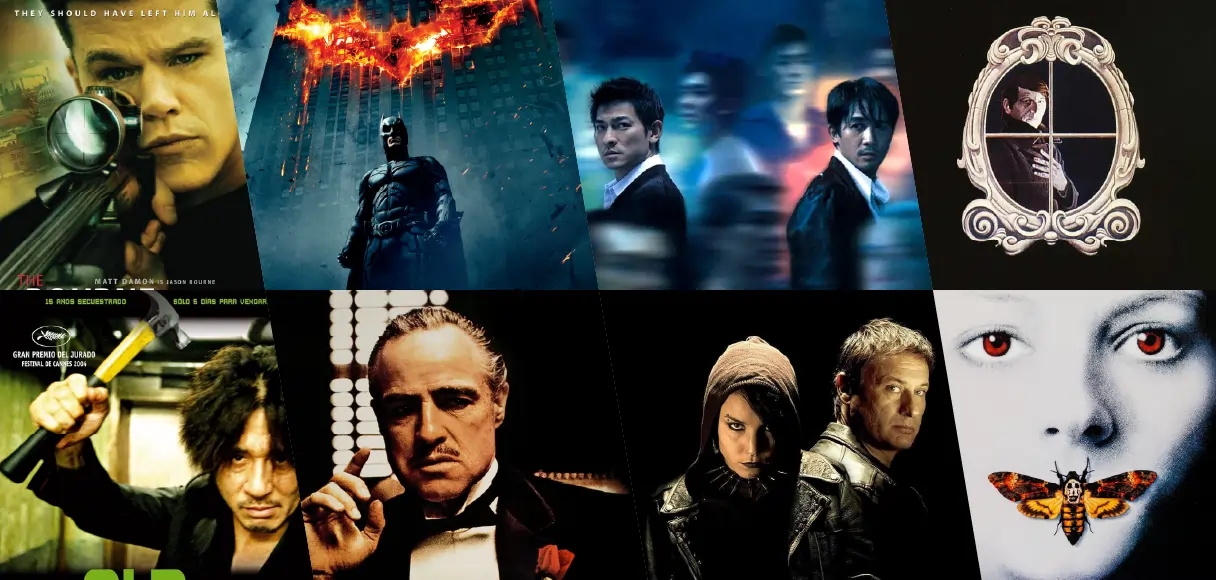

The best thriller trilogies in cinema history span fifty years and ten countries. From Roman Polanski's psychological apartment films that began with Repulsion in 1965, to Park Chan-wook's Vengeance Trilogy that defined Korean thriller cinema in the 2000s, to the Bourne and Dark Knight trilogies that reshaped what mainstream Hollywood thrillers could look like — the form has produced some of the most sustained, ambitious filmmaking in genre cinema.
A thriller trilogy is not just three good films released in sequence. It is three films that work together better than any of them works alone. This guide ranks the 15 strongest, explains what holds each one together, and names the single best individual film in each.
Every entry in this list is tagged with one of five structural engines — the mechanism that gives a trilogy its coherence. Those five engines are:
- Character (a single recurring protagonist)
- World (a shared setting that functions as a character of its own)
- Case (a single narrative arc split across films)
- Theme (a shared preoccupation explored from different angles)
- Antagonist (a recurring villain who anchors otherwise separate films).
Understanding which engine is running helps explain why some trilogies hold and some fall apart when a fourth film arrives.
What Makes a Thriller Trilogy?
A thriller trilogy is three thriller films that cohere as a single artistic statement — meaning the three together do something none of them does alone. The coherence can come from a recurring character, a shared world, a single case split across films, a thematic preoccupation, or a recurring antagonist. The five engines below are the framework this list uses to name each trilogy's structural logic.
What counts as a "trilogy" in thriller cinema?
A trilogy is three films that work together as a unit. The three can be officially marketed as a trilogy (The Bourne Trilogy, The Dark Knight Trilogy), declared retrospectively by the filmmaker (Park Chan-wook's Vengeance Trilogy), or recognized by critical consensus (Polanski's Apartment Trilogy). What disqualifies a series is when it extends past three films and the original three no longer feel like a closed unit — which is why Die Hard counts (the first three), but Lethal Weapon doesn't.
What is the difference between a trilogy and a franchise?
A trilogy is a closed artistic unit. A franchise is an open commercial line that may go on indefinitely. The Dark Knight Trilogy is a trilogy because Christopher Nolan closed it deliberately. Mission: Impossible is a franchise because it kept going. Some trilogies started as franchises and became trilogies retrospectively when the fourth film either never happened or didn't belong — Mad Max and Taken are the clearest cases on this list.
What is the difference between a thriller trilogy and a horror trilogy?
A thriller trilogy generates tension through danger, pursuit, paranoia, or uncertainty. A horror trilogy generates fear through dread, supernatural threat, or visceral upset. The two categories overlap — The Silence of the Lambs sits comfortably in both — but the engine usually makes the distinction clear. The Bourne Trilogy is a thriller because the engine is the chase. The Evil Dead Trilogy is horror because the engine is dread.
What is a thematic trilogy?
A thematic trilogy is three films connected not by plot or characters but by a shared idea explored from different angles. Park Chan-wook's Vengeance Trilogy — Sympathy for Mr. Vengeance, Oldboy, Lady Vengeance — is the canonical thriller example. The three films have no narrative connection. They are unified by their interrogation of revenge as a self-consuming force. Lars von Trier's Europa Trilogy and Polanski's Apartment Trilogy work the same way.
What are the Five Trilogy Engines that make a thriller trilogy hold?
The Five Trilogy Engines are the structural mechanisms that give a thriller trilogy its coherence. Every entry on this list is tagged with the engine — or combination of engines — that explains why the three films work as a unit.
TE-1: Character Engine. A recurring protagonist is the through-line; the threats vary from film to film. Examples: the Bourne, Taken, Die Hard, and Mad Max trilogies.
TE-2: World Engine. A shared setting functions as a character in its own right. The world is as important as the people who inhabit it. Examples: The Dark Knight Trilogy's Gotham, the Infernal Affairs trilogy's Hong Kong police-and-triad ecosystem.
TE-3: Case Engine. A single narrative arc — one investigation, one crime, one conspiracy — is split across three films. Examples: the Millennium Trilogy, the Red Riding Trilogy.
TE-4: Theme Engine. Three films with no narrative connection are unified by a shared preoccupation explored from different vantage points. Examples: the Vengeance Trilogy, the Europa Trilogy, and Polanski's Apartment Trilogy.
TE-5: Antagonist Engine. A recurring villain anchors otherwise separate films. Examples: the Hannibal Lecter films, which span three directors and three lead protagonists, kept Lecter as the structural constant.
The 15 Best Thriller Movie Trilogies of All Time
The 15 trilogies below are ranked editorially, not commercially. Each entry includes the three films, the Trilogy Engine that gives the set its coherence, the arc across the three films, and the single best individual entry. Where a trilogy's framing is genuinely contested — the Hannibal Lecter films, the Godfather's third entry, Polanski's authorship — the disagreement is named in one sentence, and the analysis moves on.
#1. The Bourne Trilogy (2002-2007)
https://www.youtube.com/watch?v=FpKaB5dvQ4g
Films: The Bourne Identity (2002), The Bourne Supremacy (2004), The Bourne Ultimatum (2007).
Where to Watch: Apple TV (rent/buy) — verify current availability via JustWatch
Engine: Character (TE-1).
The character engine is the only engine the Bourne Trilogy needs. Jason Bourne is the through-line — not a city, not a case, not a theme, and the trilogy's coherence lives entirely in him.
What holds it together:
The same protagonist, Jason Bourne, is driven by the same question across all three films: Who am I, and why does the agency want me dead? The three films can be watched in any order and still cohere because the character anchors them. The threats shift — different handlers, different cities, different levels of institutional exposure. But the engine never changes. Bourne's amnesia is not a plot device; it is the structural premise that keeps the trilogy's question open long enough to carry three films.
Arc emphasis:
The Bourne Identity establishes the chase and the question. The Bourne Supremacy flips the dynamic, making the protagonist the pursuer rather than the pursued — a structural inversion that keeps the second film from feeling like a repeat. The Bourne Ultimatum closes the loop with Bourne walking directly into the institution that made him. The trilogy's structural achievement is making the character's interior question — who am I — drive an action thriller's exterior tension across three films without either dimension being sacrificed for the other.
Single best film:
The Bourne Ultimatum (2007) — the most refined version of the trilogy's chase mechanics and the cleanest closure of the three. Paul Greengrass brings the handheld intensity he established in Supremacy to its logical endpoint: a film that moves like it has no room to breathe, which is exactly the point. The Waterloo Station sequence alone is among the finest pieces of sustained thriller construction of the decade.
Why it endures:
The Bourne Trilogy reshaped the espionage thriller for the 2000s. Greengrass's handheld kineticism became the genre's default visual language for the next decade — influencing the James Bond reboot, a generation of action directors, and the broader shift away from the glossy, static composure of 1990s action cinema toward something grittier and more physically immediate. The trilogy also proved that an action franchise could be built on interiority — that audiences would follow a character whose primary conflict was with his own missing self, which is not a lesson the genre had previously learned.
#2. The Vengeance Trilogy (2002-2005) - Park Chan-wook
https://www.youtube.com/watch?v=-6SYb3zsNv4
Films: Sympathy for Mr. Vengeance (2002), Oldboy (2003), Lady Vengeance (2005).
Where to Watch: Prime Video (rent/buy) — verify current availability via JustWatch
Engine: Theme (TE-4).
The three films are not narratively connected. No characters carry over, no events are referenced across entries. The engine is entirely thematic — a single moral preoccupation, explored from three separate vantage points by the same filmmaker.
What holds it together:
A single thematic preoccupation — revenge as a self-consuming force, explored from three different vantage points: a deaf factory worker trying to save his kidnapped sister, a man trying to find the architect of his captivity, and a woman who served prison time for someone else's crime. Each film approaches the same destination from a different direction: the pursuit of vengeance destroys the person who undertakes it without closing the wound it was meant to heal. Park Chan-wook does not moralize; he simply follows each protagonist to the end of their logic and shows what is waiting there.
Arc emphasis:
Sympathy for Mr. Vengeance is the bleak procedural opening — the most stripped-back of the three, closest to social realism, and the one where the revenge cycle feels most accidental and therefore most tragic. Oldboy is the structural masterpiece at the trilogy's center, operatic in scale and formally daring in ways that still surprise on rewatch. Lady Vengeance is the contemplative coda — the most aesthetically controlled of the three, and the entry most interested in whether there is anything left of a person after revenge is complete.
Single best film:
Oldboy (2003) — among the most-cited thrillers of the 21st century, the film that put Park Chan-wook on the global map, and the entry that holds the trilogy's central question at its highest, most unrelenting pitch. The corridor fight sequence is one of the most replicated shots in contemporary action cinema; the film's final revelation remains one of the most structurally airtight gut-punches the genre has produced.
Why it endures:
The Vengeance Trilogy defined Korean New Wave thriller cinema and shaped what an international thriller could look like for a generation of Western filmmakers who had been looking inward. It demonstrated that a thematic trilogy could carry the same emotional weight as a narrative one — that three formally distinct films, connected only by an idea, could accumulate into something heavier than any of them individually. The trilogy's influence on global thriller cinema is difficult to overstate.
#3. The Dark Knight Trilogy (2005-2012) - Christopher Nolan
https://www.youtube.com/watch?v=1T__uN5xmC0
Films: Batman Begins (2005), The Dark Knight (2008), The Dark Knight Rises (2012).
Where to Watch: Prime Video (rent/buy) — verify current availability via JustWatch
Engine: World (TE-2) + Character (TE-1).
Two engines run simultaneously. Gotham City is as much a protagonist as Bruce Wayne — the world generates the character's necessity, and the character's choices reshape the world. Neither engine could sustain the trilogy alone.
What holds it together:
This is a thriller-superhero hybrid, and that framing should be stated plainly — but the thriller argument stands on its own. Gotham in Nolan's trilogy is not a backdrop. It is a city diseased enough to require what Bruce Wayne becomes, morally unstable enough that saving it is never a settled question, and specific enough in its institutional logic — its police corruption, its criminal ecosystems, its class fractures — to feel like a real city under genuine pressure. The world and the character are in constant dialogue: Gotham shapes Batman, and Batman's existence shapes what Gotham becomes.
Arc emphasis:
Batman Begins establishes Gotham as a city that requires what the protagonist becomes. The Dark Knight tests whether the city is worth saving — and answers with a qualified, costly yes. The Dark Knight Rises asks whether the protagonist can be retired, at what price, and what the city does when its protector is gone. The arc is a complete political and moral argument across three films, which is unusual for the genre and rarer still at this scale.
Single best film:
The Dark Knight (2008) — broadly considered the high point not just of the trilogy but of mainstream thriller cinema in the 2000s. Heath Ledger's Joker is one of the great antagonist constructions in the genre: a figure with no comprehensible motive and therefore no negotiable limit, who functions less as a villain and more as a force that reveals what the other characters are made of. The hospital scene, the magic trick, the interrogation room — the film is built from setpieces that are individually among the finest thriller filmmaking of the decade.
Why it endures:
The Dark Knight Trilogy demonstrated that a thriller anchored in moral seriousness could play at a blockbuster scale without softening its themes. That argument had been made before in smaller rooms; Nolan made it in the biggest room available and won. The trilogy also permanently altered what superhero cinema thought it could be — a consequence that extends well beyond the thriller genre but has its roots in the trilogy's willingness to treat its genre questions as genuinely serious ones.
#4. The Godfather Trilogy (1972-1990)
https://www.youtube.com/watch?v=AlBu7t_2okw
Films: The Godfather (1972), The Godfather: Part II (1974), The Godfather: Part III (1990).
Where to Watch: Apple TV (rent/buy) — verify current availability via JustWatch
Engine: World (TE-2) + Character (TE-1).
The American Mafia's internal world and Michael Corleone's trajectory through it are inseparable engines. The world produces the character's corruption; the character's choices reshape the world's moral order.
What holds it together:
The critical consensus problem with The Godfather Part III is real and worth noting once: the third film is a significant step down from the first two, and most serious critics agree on that. The argument for the trilogy as a closed unit rests on Part I and Part II being among the greatest crime-thriller films ever made and on the three together constituting a complete moral arc for Michael Corleone, even when the final chapter didn't fully deliver on what the first two had established. The world — the Corleone family's internal logic, its rituals, its geography of loyalty and betrayal — holds all three films together even when the third film's storytelling falters.
Arc emphasis:
Part I is the inheritance: Michael absorbing the family he swore he would never become, the transformation rendered so gradually it registers as inevitable. Part II is the corruption: two timelines braided together to show what building the empire cost and what it destroyed, with Vito Corleone's rise used as a mirror to Michael's fall. Part III is the reckoning — the weight of everything the first two films accumulated, attempted but not quite achieved.
Single best film:
The Godfather Part II (1974) — frequently named the best sequel ever made and the trilogy's structural and thematic peak. The dual-timeline construction is formally ambitious in a way that still feels contemporary, and Al Pacino's performance across the two films taken together is among the finest sustained character arcs in American cinema.
Why it endures:
The Godfather Trilogy codified the prestige crime thriller as a serious artistic form and remains the reference point against which every subsequent attempt in the genre is measured. Francis Ford Coppola's first two films demonstrated that genre cinema could carry the moral and psychological weight of literary fiction — a demonstration that opened the door for every serious crime film that followed.
#5. The Infernal Affairs Trilogy (2002-2003)
https://www.youtube.com/watch?v=1fbZ2i3A1tk
Films: Infernal Affairs (2002), Infernal Affairs II (2003), Infernal Affairs III (2003).
Where to Watch: Apple TV (rent/buy) — verify current availability via JustWatch
Engine: World (TE-2) + Case (TE-3).
The Hong Kong police-and-triad ecosystem is the world; the double-agent moral structure — the cop posing as a triad, the triad posing as a cop — is the case. Both engines are essential, and neither would hold the trilogy alone.
What holds it together:
A single setting — the Hong Kong police-and-triad ecosystem — and a single moral structure: one cop embedded in a triad, one triad member embedded in the police, both trying to survive long enough to identify the other. All three films were released within a single calendar year, a compressed production pace that kept the world consistent and the institutional logic coherent across entries. The case is not a whodunit; the audience knows the players. The tension is whether the system will resolve them before they resolve each other.
Arc emphasis:
Infernal Affairs establishes the dual deception in its purest form. Infernal Affairs II fills in the decade before the original, expanding the world and giving both the triad and the police force a history that makes the original's events feel inevitable rather than coincidental. Infernal Affairs III completes both timelines simultaneously — a formally ambitious move that doesn't fully pay off but commits to its structural logic throughout.
Single best film:
Infernal Affairs (2002) — the original, the most-cited, and the source material Martin Scorsese adapted into The Departed in 2006. The rooftop sequence is among the finest pieces of thriller construction in Hong Kong cinema; the film's moral architecture — two men trapped in identities they can no longer sustain — is as clean and as airtight as the genre gets.
Why it endures:
The Infernal Affairs Trilogy is the cleanest contemporary example of how a city-and-institution thriller can cohere as a trilogy through worldbuilding alone, and the most influential Hong Kong thriller of the 21st century. Its influence extends beyond the Scorsese remake — it reframed what Hong Kong genre cinema was capable of producing in an era when the industry was still navigating the post-handover transition, and gave the city's thriller tradition a new international visibility.
#6. The Millennium Trilogy (2009) - Swedish Original
https://www.youtube.com/watch?v=WqoIUoEcV9k
Films: The Girl with the Dragon Tattoo (2009), The Girl Who Played with Fire (2009), The Girl Who Kicked the Hornets' Nest (2009).
Where to Watch: Apple TV (rent/buy) — verify current availability via JustWatch
Engine: Case (TE-3) + Character (TE-1).
A single arc — Lisbeth Salander's case against the men who hurt her — and a single character whose trajectory drives it. The case and the character are inseparable: the investigation only matters because of who is conducting it and what it costs her.
What holds it together:
This entry covers the original Swedish trilogy — Niels Arden Oplev directed the first film, Daniel Alfredson the second and third, not David Fincher's 2011 adaptation. The three films were released within the same year, adapting Stieg Larsson's novels with the structural coherence of a very long crime novel broken into three acts. Lisbeth Salander's arc — from isolated, systemically abused individual to someone who takes the systems apart — and Mikael Blomkvist's parallel investigation give the trilogy a single spine that runs from the first frame to the last.
Arc emphasis:
The Girl with the Dragon Tattoo establishes both protagonists and the moral logic of the world they inhabit — a Sweden whose institutions protect abusers and punish those they abuse. The Girl Who Played with Fire raises the personal stakes by making Salander herself the target. The Girl Who Kicked the Hornets' Nest moves the conflict into the institutional open, trading the intimacy of the first two films for something closer to a courtroom thriller.
Single best film:
The Girl with the Dragon Tattoo (2009) — the tightest construction and the strongest individual thriller in the set. The film introduces one of the most fully realized protagonists in contemporary thriller cinema and does so without softening what made her difficult to build a story around in the first place.
Why it endures:
The Millennium Trilogy made Stieg Larsson's novels a global phenomenon, established Noomi Rapace internationally, and provided the template for the Nordic-noir thriller wave that followed across film and television for the better part of a decade. It also demonstrated that a case engine — a single investigation across three films — could carry the emotional weight of a character trilogy when the protagonist was specific enough.
#7. Polanski's Apartment Trilogy (1965-1976)
https://www.youtube.com/watch?v=2Y-4rJJw554
Films: Repulsion (1965), Rosemary's Baby (1968), The Tenant (1976).
Where to Watch: Prime Video (rent/buy) — verify current availability via JustWatch
Engine: Theme (TE-4).
Three films set in apartments — Repulsion in London, Rosemary's Baby in New York, The Tenant in Paris — each one studying a different protagonist's psychological collapse inside a confined urban space. The theme is consistent; nothing else carries over.
What holds it together:
The filmmaker's conviction and subsequent decades of legal evasion are not the subject of this entry. The films are. And as a body of work, they are among the most formally coherent thematic trilogies in thriller history. Three cities, three protagonists, three apartments — and in each case, the space is the engine. The apartment is simultaneously a physical prison and a psychological mirror, and by the end of each film, the boundary between the two has dissolved entirely. The trilogy's subject is not danger from outside but the mind's capacity to generate its own confinement.
Arc emphasis:
Repulsion is the most viscerally disturbing of the three — Carol's breakdown rendered with a clinical precision that makes it unbearable. Rosemary's Baby is the most controlled dread built so gradually through the mundane that the horror arrives feeling inevitable. The Tenant is the most formally strange — a protagonist who begins losing the boundary between himself and the apartment's previous occupant, taking the trilogy's central preoccupation into full psychological dissolution.
Single best film:
Rosemary's Baby (1968) — the most widely seen, the most influential on subsequent thriller and horror cinema, and the trilogy's most controlled exercise in sustained dread. Mia Farrow's performance is a study in making the audience uncertain whether to trust their own reading of events, which is the exact anxiety the film is built to produce.
Why it endures:
Polanski's Apartment Trilogy established the psychological thriller in a room as one of the genre's most durable structural forms. The next sixty years of single-location thrillers — from Rear Window's descendants to contemporary home-invasion films — owe a grammatical debt to what these three films built. The trilogy demonstrated that the most effective source of thriller tension is not external threat but the protagonist's own deteriorating capacity to read reality accurately.
#8. The Hannibal Lecter Films (1986-2001)
https://www.youtube.com/watch?v=Nbpk0pv60DE
Films: Manhunter (1986), The Silence of the Lambs (1991), Hannibal (2001).
Where to Watch: Apple TV (rent/buy) — verify current availability via JustWatch
Engine: Antagonist (TE-5).
The purest expression of the Antagonist Engine in thriller cinema. One recurring figure — Hannibal Lecter — anchors three films with different directors, different protagonists, and different tonal registers. Nothing else is constant.
What holds it together:
This is not an officially marketed trilogy. The Hannibal Lecter films include Red Dragon (2002) and Hannibal Rising (2007), and the NBC television series extended the universe further. The first three are treated here as a spiritual trilogy because they are the strongest, the most thematically coherent, and the most formally distinct. Three directors — Michael Mann, Jonathan Demme, Ridley Scott — three lead protagonists — Will Graham, Clarice Starling, Lecter himself — and one antagonist who functions as the structural constant across all of them. Lecter is compelling enough to bear that weight; most antagonists are not.
Arc emphasis:
Manhunter is the most formally controlled — Michael Mann's cool, neon-lit procedural uses Lecter sparingly and is stronger for it. The Silence of the Lambs centers the Lecter-protagonist dynamic and builds the trilogy's defining relationship, between a monster and a woman who refuses to be afraid of him in the way he wants. Hannibal inverts the premise entirely by making Lecter the protagonist — a risk that Ridley Scott takes with more craft than the film's critical reception acknowledged at the time.
Single best film:
The Silence of the Lambs (1991) — the only horror-thriller to win the Academy Award for Best Picture, the highest-rated of the three, and the film that defined the modern serial-killer thriller as a genre. The scenes between Jodie Foster and Anthony Hopkins remain the clearest illustration of what the Antagonist Engine can do when both the antagonist and the protagonist are constructed with equal precision.
Why it endures:
The Hannibal Lecter films defined the modern serial-killer thriller and demonstrated that a recurring antagonist could anchor a coherent trilogy when no other element — setting, protagonist, director, tone — remained constant. That is the Antagonist Engine at its most extreme, and the Lecter films remain its only fully realized example in mainstream thriller cinema.
#9. The Mad Max Original Trilogy (1979-1985)
https://www.youtube.com/watch?v=caHnaRq8Qlg
Films: Mad Max (1979), Mad Max 2: The Road Warrior (1981), Mad Max Beyond Thunderdome (1985).
Engine: Character (TE-1) + World (TE-2).
Two engines in parallel. Max Rockatansky is the character constant; post-apocalyptic Australia is the world constant — and the world deteriorates visibly across the three films, so both engines are in motion simultaneously.
What holds it together:
Max Rockatansky across three films and a slowly collapsing post-apocalyptic Australia that becomes more elaborately ruined with each entry. The world is not static — it degrades across the trilogy, generating its own internal logic as civilization recedes further. The interaction between the character and the deteriorating world is what gives the three films their coherence: Max does not change the world, but the world changes what Max is willing to do and how far he is willing to go to survive it.
Arc emphasis:
Mad Max is the originating revenge thriller — intimate in scale, set in a world still recognizably connected to civilization, genuinely brutal in ways the genre rarely attempted at the time. Mad Max 2: The Road Warrior opens the canvas to the full wasteland and refines the formula into something mythic. Mad Max Beyond Thunderdome extends the world further than the story can quite support, introducing a scale of spectacle that slightly exceeds the character engine's capacity to anchor it.
Single best film:
Mad Max 2: The Road Warrior (1981) — the most-cited, the most-imitated, and the entry that defined the trilogy's visual language. George Miller's construction of the tanker chase sequence remains a landmark of practical action filmmaking, and the film's mythic register — Max as a figure passing through other people's stories rather than his own — gives it a resonance the more plot-driven entries don't quite reach.
Why it endures:
The Mad Max original trilogy created the post-apocalyptic action thriller as its own subgenre and remains the template that Mad Max: Fury Road (2015) and Furiosa (2024) extended. The fact that Miller returned to the world four decades later and produced one of the finest action films of the 21st century says something about how fully the three original films built a world worth inhabiting.
#10. The Die Hard Original Trilogy (1988-1995)
https://www.youtube.com/watch?v=jaJuwKCmJbY&t=1s
Films: Die Hard (1988), Die Hard 2 (1990), Die Hard with a Vengeance (1995).
Where to Watch: Apple TV (rent/buy) — verify current availability via JustWatch
Engine: Character (TE-1).
A single character engine, and a deliberately stripped-back one. John McClane is the through-line; the settings change with each film by design. The formula's durability is a function of how well-constructed the character is, not how elaborate the situations become.
What holds it together:
John McClane — the wisecracking, consistently underprepared New York cop — across three films, each one a "Die Hard in a location" exercise. Nakatomi Plaza, Dulles Airport, New York City. The formula is transparent, and the trilogy doesn't pretend otherwise; what keeps it from feeling repetitive is that McClane is funny without being a parody, and he gets hurt in ways that matter. He is not superhuman; he survives through stubbornness and luck, and the films are honest about the cost.
Arc emphasis:
Die Hard is the genre-defining single-location action thriller — a film so precisely engineered that it still functions as the template for the form. Die Hard 2 moves the formula to an airport with mixed results, working better as a thriller than as a film. Die Hard with a Vengeance reinvents the formula by opening the canvas to an entire city and pairing McClane with Samuel L. Jackson — a structural decision that gives the third film an energy the second film couldn't locate.
Single best film:
Die Hard (1988) — among the most-cited action thrillers ever made and the film that established the modern genre's basic grammar: confined space, ticking clock, single hero, articulate villain. Alan Rickman's Hans Gruber is the template against which every subsequent thriller villain is still measured — charming, specific, and entirely without the operatic menace that had characterized genre villains before him.
Why it endures:
The original Die Hard established the modern action thriller's basic grammar — confined space, ticking clock, single hero, articulate villain — that the next three decades of the genre worked inside. John McTiernan built an architecture in one building in Los Angeles in 1988 that the industry is still operating within, which is as clear a measure of structural influence as cinema has.
#11. The Mission: Impossible Original Trilogy (1996-2006)
https://www.youtube.com/watch?v=L8Pbjh4EZRk&t=1s
Films: Mission: Impossible (1996), Mission: Impossible 2 (2000), Mission: Impossible III (2006).
Where to Watch: Apple TV (rent/buy) — verify current availability via JustWatch
Engine: Character (TE-1).
A character engine used unusually: the same protagonist handed to three different auteurs, each one bringing a distinct visual sensibility to the same through-line. The trilogy is less interested in narrative continuity than in variation — closer to a jazz standard played by three different musicians than a traditional arc.
What holds it together:
Ethan Hunt across three films directed by three different auteurs — Brian De Palma, John Woo, J.J. Abrams — each one bringing a distinct visual sensibility to the same character. The franchise has continued well past three films; the Christopher McQuarrie era, beginning with Rogue Nation (2015), constitutes its own coherent run. But the first three form a clear unit before the reset — a period in which the series was still figuring out what it wanted to be, and the auteur-rotation model was the answer it landed on.
Arc emphasis:
Mission: Impossible is De Palma's set-piece construction — a film more interested in misdirection and precision than spectacle, and the franchise's cleanest piece of thriller filmmaking. Mission: Impossible 2 is John Woo's formal exercise — operatic, slow-motion, and visually distinct from anything around it, even if it is the trilogy's weakest entry by conventional thriller standards. Mission: Impossible III is J.J. Abrams's course correction — personal stakes, tighter editing, and the introduction of Philip Seymour Hoffman's villain, who remains among the franchise's most effectively understated antagonists.
Single best film:
Mission: Impossible (1996) — De Palma's set-piece construction is the franchise's cleanest piece of thriller filmmaking. The CIA vault sequence is the entry that established the series' identity: precision, silence, and the pleasure of watching a plan executed under impossible constraints.
Why it endures:
The original Mission: Impossible trilogy demonstrated that a recurring action-thriller character could be reinterpreted by different filmmakers without losing the through-line — a structural argument the later McQuarrie films extended with considerably more resources and consistency. The auteur-rotation model it pioneered was unusual for the genre and has not been widely replicated, which makes the trilogy more formally interesting in retrospect than it appeared at the time.
#12. The Red Riding Trilogy (2009)
https://www.youtube.com/watch?v=WrjixmvbxBQ
Films: Red Riding: 1974 (dir. Julian Jarrold), Red Riding: 1980 (dir. James Marsh), Red Riding: 1983 (dir. Anand Tucker).
Engine: Case (TE-3).
A single arc of institutional corruption — no recurring protagonist, no shared world beyond a county, just one truth approached from three different directions across three different decades.
What holds it together:
Originally produced for Channel 4 in the UK and receiving theatrical release in some territories, the Red Riding Trilogy is treated here as a trilogy because that is how it was conceived and how it functions. Three films, three directors, one arc: the Yorkshire Ripper era investigations and the police-corruption scandal that ran alongside them, across 1974, 1980, and 1983. The case engine here is unusually pure — there is no recurring protagonist and no single institutional affiliation that crosses all three films. What crosses them is the truth, and the system's determination to bury it.
Arc emphasis:
Red Riding: 1974 establishes the world and the corruption in their most raw form — a young journalist, a murdered girl, and a police force that does not want the case solved. Red Riding: 1980 moves to the Ripper investigation proper and introduces the institutional scale of the cover-up. Red Riding: 1983 brings all three timelines into convergence, resolving the arc with the moral weight of everything that came before it.
Single best film:
Red Riding: 1974 — the originating entry and the most-cited individually. Andrew Garfield's performance and Julian Jarrold's direction establish the trilogy's moral and visual register with enough precision that the subsequent films can operate within it without having to rebuild it.
Why it endures:
The Red Riding Trilogy is the cleanest contemporary example of a single-case thriller trilogy in English-language cinema and a touchstone for the British social-realist crime tradition. It sits alongside GBH and Our Friends in the North as the form's most uncompromising examples — work that uses genre mechanics not to entertain within an existing moral order but to interrogate the institutions that maintain it.
#13. The Pusher Trilogy (1996-2005) - Nicolas Winding Refn
https://www.youtube.com/watch?v=A4VKaMrvXgk
Films: Pusher (1996), Pusher II: With Blood on My Hands (2004), Pusher III: I'm the Angel of Death (2005).
Where to Watch: Apple TV (rent/buy) — verify current availability via JustWatch
Engine: Theme (TE-4) + World (TE-2).
The Copenhagen drug-trade world stays constant; the lens shifts with each film, rotating to a different character and a different vantage point within the same ecosystem.
What holds it together:
The structural logic of the Pusher Trilogy is rotation: each film takes a peripheral character from the previous entry and makes them the new protagonist. The Copenhagen criminal world remains constant; the angle changes. The first film follows a low-level dealer. The second follows a man recently released from prison, trying to reconnect with his son. The third follows a Serbian crime boss managing a supply crisis while preparing for his daughter's wedding. Same world, three angles, no narrative continuity required — and the world becomes richer with each pass through it.
Arc emphasis:
Pusher is the most kinetic — raw, handheld, and urgent, closer to a thriller about consequences than a thriller about plot. Pusher II is the most emotionally realized character study — Mads Mikkelsen's performance as a man trying to be a father while trapped inside a world that won't let him is the trilogy's emotional peak. Pusher III is the darkest and the most formally controlled — a film that earns the brutality of its final act.
Single best film:
Pusher II: With Blood on My Hands (2004) — the most-cited individually and the most realized character study within the set. Mads Mikkelsen, before Casino Royale and Hannibal, made him internationally visible — a performance that belongs in the conversation about the finest work in Scandinavian thriller cinema.
Why it endures:
The Pusher Trilogy established Nicolas Winding Refn as a filmmaker of genuine consequence before Drive, and Only God Forgives made the argument on a larger scale. It also demonstrated that an ensemble-rotation structure — a different protagonist per film, a shared world — could give a trilogy its coherence without sacrificing character depth, which is a structural argument very few thriller trilogies have attempted, and fewer have pulled off.
#14. Lars von Trier's Europa Trilogy (1984-1991)
https://www.youtube.com/watch?v=5BsU22q8a2Q
Films: The Element of Crime (1984), Epidemic (1987), Europa (1991).
Engine: Theme (TE-4) + World (TE-2).
Three films interrogating the same fractured postwar European consciousness from different formal angles. The world is not a specific place but a shared psychological and historical atmosphere — Europe rendered as dreamlike dread.
What holds it together:
These are arthouse psychological thrillers — hypnotic, hallucinatory, and deliberately estranging and this entry is for readers who have already worked through the more accessible trilogies on this list. Three films, three different formal approaches, one shared subject: the postwar European consciousness, rendered not as history but as atmosphere. The world these films inhabit is the same fractured, noir-lit Europe, even when the geography shifts, and the thematic engine — a continent still processing what it was capable of — gives all three a coherence that transcends narrative.
Arc emphasis:
The Element of Crime is the most genre-adjacent — a neo-noir procedural rendered in amber monochrome, formally beautiful and narratively hypnotic. Epidemic is the most formally strange — a film about making a film about a plague, with von Trier himself appearing as a character — and the most demanding of the three. Europa is the most accomplished: a postwar Germany thriller of dizzying formal ambition, layering black-and-white imagery with isolated color to produce something that feels more like a waking nightmare than a film.
Single best film:
Europa (1991, released in the US as Zentropa) — the most accomplished, the most awarded (Jury Prize at Cannes), and the most-cited of the three. The film's hypnotic voiceover, its formal audacity, and its refusal to resolve into anything comfortable make it one of the most distinctive pieces of thriller filmmaking of its decade.
Why it endures:
The Europa Trilogy established Lars von Trier's directorial voice before Breaking the Waves and Dancer in the Dark made it internationally unavoidable, and remains a key reference point for arthouse thriller cinema's interrogation of European postwar identity. For a certain kind of filmmaker and a certain kind of audience, these three films are foundational — the clearest example of what the thriller form can carry when it is treated as a philosophical instrument rather than a commercial one.
#15. The Taken Trilogy (2008-2014)
https://www.youtube.com/watch?v=XK9zL0ze9O4
Films: Taken (2008), Taken 2 (2012), Taken 3 (2014).
Where to Watch: Apple TV (rent/buy) — verify current availability via JustWatch
Engine: Character (TE-1).
A character engine running on diminishing returns. Bryan Mills is consistent across all three films; the quality of the films around him is not.
What holds it together:
This is the trilogy on this list with the steepest drop-off in quality, and that should be stated plainly. The first film is the only entry with a genuine, unqualified claim to inclusion; the second and third exist because the first made enough money to justify them. What holds all three together — barely, in the case of the sequels — is Bryan Mills, the retired CIA operative whose particular set of skills is deployed in increasingly contrived contexts. The character engine is consistent even when the films around it are not.
Arc emphasis:
Taken is the lean, precisely constructed original — a thriller that earns its action through character specificity and executes its premise without waste. Taken 2 recycles the structure with diminishing returns, inverting the kidnapping premise in a way that generates fewer stakes rather than new ones. Taken 3 abandons the kidnapping premise entirely and becomes more of a conventional fugitive thriller, thereby removing the one formal element that made the first film distinctive.
Single best film:
Taken (2008) — the originating entry, the cleanest construction, and the film whose phone-call monologue became one of the most quoted and parodied lines in 2000s action cinema. The monologue works not because of its threat but because of its specificity: a man who knows exactly what he is capable of and is being precise about it rather than theatrical.
Why it endures:
Taken created the late-career action thriller as its own commercial subgenre and reshaped Liam Neeson's career into something nobody had anticipated — a second act as a thriller lead that spawned enough imitators to constitute its own minor tradition. The film also introduced Pierre Morel and the Luc Besson production approach to a mainstream American audience, demonstrating that a European action aesthetic — faster cuts, more physical consequence, less superheroism — could find a large commercial audience without softening itself.
Thriller Trilogies by Engine
The same 15 trilogies, re-sorted by the Trilogy Engine that gives each one its coherence. Readers looking for character-driven thriller trilogies or thematic thriller trilogies can find them in one place.
Character Engine (TE-1): Thriller trilogies built on a single protagonist
The most common Trilogy Engine in mainstream cinema. The protagonist is the through-line; the threats vary from film to film. The strongest examples on this list: The Bourne Trilogy, The Die Hard Original Trilogy, The Mad Max Original Trilogy, The Mission: Impossible Original Trilogy, The Taken Trilogy. The Dark Knight Trilogy and The Godfather Trilogy use it as a secondary engine alongside World.
World Engine (TE-2): Thriller trilogies built on a shared setting
The World Engine works when the setting is specific enough to function as a character — when what happens could only happen in that place, inside that institutional logic or geography. Strongest examples: The Dark Knight Trilogy (Gotham), The Infernal Affairs Trilogy (Hong Kong's police-triad ecosystem), The Godfather Trilogy (the American Mafia's internal world). The Pusher Trilogy and The Europa Trilogy use it as a secondary engine alongside Theme.
Case Engine (TE-3): Thriller trilogies built on a single investigation
The Case Engine is most common in crime and procedural thrillers, where a single investigation or conspiracy is too large for one film and is split across three. Strongest examples: The Millennium Trilogy (Lisbeth Salander's case against the men who hurt her), The Red Riding Trilogy (the Yorkshire Ripper investigations and the corruption scandal running alongside them), The Infernal Affairs Trilogy (which combines Case with World).
Theme Engine (TE-4): Thriller trilogies built on a shared preoccupation
The Theme Engine produces trilogies with no narrative continuity and no recurring characters — three films that interrogate the same question from different angles. The form demands more from the audience and produces the list's most artistically ambitious entries. Strongest examples: The Vengeance Trilogy (revenge as self-destruction), Polanski's Apartment Trilogy (psychological collapse in confined urban space), The Europa Trilogy (European postwar consciousness as dread), The Pusher Trilogy (the Copenhagen drug trade seen from three vantage points).
Antagonist Engine (TE-5): Thriller trilogies built on a recurring villain
The rarest engine on this list, and the most structurally difficult to sustain. A recurring antagonist can anchor a trilogy when no other element — protagonist, setting, director — stays constant, but only if the antagonist is compelling enough to bear the structural weight alone. The single strongest example: The Hannibal Lecter Films, which kept Hannibal Lecter as the constant across three directors, three lead protagonists, and three distinct tonal registers.
The Single Best Film From Each of These Trilogies
Even the strongest trilogies have an uneven distribution of quality across their three films. The list below names the single best individual entry from each of the 15 trilogies — the film a viewer would recommend if they could only watch one. The picks are based on critical consensus, cultural footprint, and individual filmmaking quality, not on the role each film plays in its trilogy.
| Trilogy | Single Best Film | Year | Why |
| Bourne | The Bourne Ultimatum | 2007 | Most refined chase mechanics, cleanest closure of the identity arc |
| Vengeance | Oldboy | 2003 | Trilogy's structural peak; the most-cited Korean thriller of the 21st century |
| Dark Knight | The Dark Knight | 2008 | The Joker sequences are the trilogy's high-water mark for thriller filmmaking |
| Godfather | The Godfather Part II | 1974 | Most frequently named the best sequel ever made, the trilogy's thematic and structural peak. |
| Infernal Affairs | Infernal Affairs | 2002 | The original, the source for The Departed, the cleanest moral architecture |
| Millennium | The Girl with the Dragon Tattoo | 2009 | Tightest construction; strongest single thriller in the set |
| Apartment | Rosemary's Baby | 1968 | Most influential; most widely seen; trilogy's highest and most controlled pitch |
| Hannibal Lecter | The Silence of the Lambs | 1991 | The only horror-thriller Best Picture winner, the definitive serial-killer film |
| Mad Max | The Road Warrior | 1981 | Most-imitated; the trilogy's visual language definer |
| Die Hard | Die Hard | 1988 | Genre-defining original; the template for the modern action thriller |
| Mission: Impossible | Mission: Impossible | 1996 | De Palma's set-piece construction, the franchise's cleanest thriller filmmaking |
| Red Riding | Red Riding: 1974 | 2009 | The originating entry, most-cited individually, sets the trilogy's moral register |
| Pusher | Pusher II | 2004 | Most-realized character study; Mads Mikkelsen before international visibility |
| Europa | Europa | 1991 | Cannes Jury Prize; the most formally accomplished of the three |
| Taken | Taken | 2008 | The cleanest construction; the trilogy's high point by a significant margin |
Best Thriller Trilogies by Decade
Thriller trilogies cluster around specific eras — Polanski's foundational Apartment work in the 1960s and 1970s, the Mad Max and Die Hard franchise origins in the 1980s, The Godfather completing its arc in 1990, and the explosion of Korean, Hong Kong, and Hollywood thriller trilogies in the 2000s. The decade you live in shapes which trilogy you encounter first; the guide below maps where each one landed.
1960s-1970s
Polanski's Apartment Trilogy spans this era as the foundational thematic thriller trilogy in cinema history — the period in which the psychological thriller in a confined space form was first fully articulated. The Godfather and The Godfather Part II are the cornerstone crime-thriller releases of the early 1970s, establishing the prestige crime film as a serious artistic form in two back-to-back releases that have not been equaled since. Part III would complete the trilogy in 1990, but the trilogy's identity was fixed in this decade.
Trilogies rooted here: Polanski's Apartment Trilogy (1965-1976), The Godfather Trilogy (1972-1990, first two films).
1980s
The decade gave the action-thriller trilogy its modern template. George Miller completed Mad Max's first three films in 1985, establishing the post-apocalyptic action thriller as a genre. Michael Mann's Manhunter arrived in 1986 as the first theatrical Hannibal Lecter adaptation. Die Hard arrived in 1988 and established the modern action thriller's basic grammar in a single film. Lars von Trier began the Europa Trilogy in 1984 with The Element of Crime. The 1980s were the decade in which the genre's infrastructure was built.
Trilogies rooted here: The Mad Max Original Trilogy (1979-1985), The Hannibal Lecter Films (begins 1986), The Die Hard Original Trilogy (begins 1988), Lars von Trier's Europa Trilogy (begins 1984).
1990s
The 1990s completed several trilogies that had begun in the previous decade and launched the ones that would define the next. The Silence of the Lambs arrived in 1991, completing the spiritual Lecter trilogy's defining entry and winning Best Picture. Europa completed von Trier's trilogy in 1991. Die Hard with a Vengeance closed the Die Hard trilogy in 1995 and remains the most formally inventive of the three sequels. Nicolas Winding Refn launched Pusher in 1996 — a film that would not become a trilogy for another nine years. Brian De Palma's Mission: Impossible began in 1996, handing off the character to John Woo four years later.
Trilogies rooted here: Die Hard with a Vengeance (1995, completing the trilogy), The Silence of the Lambs (1991), Europa (1991, completing von Trier's trilogy), Pusher (1996, first of three), Mission: Impossible (1996, first of three).
2000s
The 2000s were the decade for thriller trilogies. No other decade in cinema history produced this concentration of formally ambitious, internationally significant thriller trilogies in such a short span. The Bourne Trilogy began and was completed within five years. Park Chan-wook released all three Vengeance films between 2002 and 2005. Infernal Affairs released all three entries within 18 months. Hannibal completed the spiritual Lecter trilogy in 2001. The Pusher Trilogy was completed in 2005. Mission: Impossible III closed its trilogy in 2006. Taken arrived in 2008. The Millennium Trilogy and The Red Riding Trilogy were both released in 2009. The decade's concentration of output has not been matched before or since.
Trilogies rooted here: The Bourne Trilogy (2002-2007), The Vengeance Trilogy (2002-2005), The Infernal Affairs Trilogy (2002-2003), Hannibal (2001, completing the Lecter trilogy), The Pusher Trilogy (completes 2005), Mission: Impossible III (2006, completing that trilogy), Taken (2008), The Millennium Trilogy (2009), The Red Riding Trilogy (2009).
2010s
The Dark Knight Rises closed Christopher Nolan's trilogy in 2012 — one of the most anticipated trilogy closures in mainstream cinema history. Taken 2 and Taken 3 arrived in 2012 and 2014, diminishing but not fully undermining the original's legacy. The Equalizer launched in 2014, beginning what would become Antoine Fuqua's character-engine trilogy. The decade was defined more by franchises extending past three films — Mission: Impossible, Fast and Furious, and John Wick — than by trilogies closing cleanly. The economics of the 2010s increasingly favored the open franchise over the closed artistic unit.
Trilogies rooted here: The Dark Knight Rises (2012, completing the trilogy), Taken 2 (2012) and Taken 3 (2014), The Equalizer (2014, first of three).
2020s so far
No new thriller trilogy has fully closed in the 2020s yet. The Equalizer 3 completed Antoine Fuqua's trilogy in 2023 — the decade's clearest example of a deliberately closed three-film thriller unit. Several active franchises — John Wick, Mission: Impossible — have moved past the trilogy form or show no sign of closing. The closed three-film thriller has become rarer as streaming, multi-film deals, and continuous-universe storytelling have shifted commercial incentives away from the deliberate ending. The trilogies that do close in the 2020s will be the exception, not the expectation.
Trilogies rooted here: The Equalizer Trilogy (2014-2023, completed)
Honorable Mentions and Debated Trilogies
Five trilogies sit just outside the main list — either too recent to be fully settled, too generically borderline to be thriller-first, or too contested in their trilogy status to anchor a primary entry. Each is worth knowing about. Each is also worth knowing about for a specific reason that the main list cannot quite accommodate.
The Equalizer Trilogy (2014-2023) — Antoine Fuqua
Engine: Character (TE-1).
Films: The Equalizer (2014), The Equalizer 2 (2018), The Equalizer 3 (2023).
The Equalizer Trilogy closed cleanly in 2023, which makes it the most recent completed thriller trilogy on this page and the strongest case for eventual promotion to the main list. Denzel Washington's Robert McCall is a genuine character-engine protagonist — specific, consistent, and compelling enough to sustain three films. It sits just outside the primary 15 because it overlaps too closely with Taken in structure and commercial logic: the late-career action lead, the particular set of skills, the escalating personal stakes. If the editor wants to swap it in for Taken, the structural argument supports that decision. The third film is the strongest of the three, which is unusual and worth noting.
John Carpenter's Apocalypse Trilogy (1982-1994)
Engine: Theme (TE-4).
Films: The Thing (1982), Prince of Darkness (1987), In the Mouth of Madness (1994).
A thematic trilogy united by cosmic-horror dread — the idea that reality is not what it appears to be, that the institutions and frameworks humans use to make sense of the world are fundamentally inadequate in the face of what actually exists. The Thing is one of the greatest horror films ever made; In the Mouth of Madness is underrated and formally interesting. The trilogy sits outside the main list because the films are horror-first, not thriller-first — the engine is dread, not tension. Readers coming from the Hannibal Lecter films or Polanski's Apartment Trilogy will find the horror-thriller overlap they are looking for here.
Krzysztof Kieslowski's Three Colors Trilogy (1993-1994)
Engine: Theme (TE-4).
Films: Blue (1993), White (1994), Red (1994).
A thematic trilogy bound by the colors of the French flag — liberty, equality, fraternity — explored through three separate stories in three separate countries. It sits outside the main list because the films are art-cinema first, with thriller elements surfacing primarily in Red but not sustained throughout. Blue is grief cinema; White is dark comedy. Readers who came to this list through Cache or Tell No One — the French-language psychological thriller tradition — will find the texture they are looking for in the Three Colors Trilogy, even if the genre label doesn't quite fit.
David Fincher's Missing-Women Trilogy (Informal)
Engine: Theme (TE-4), informal.
Films: Se7en (1995), Zodiac (2007), Gone Girl (2014).
Not an official trilogy. Fincher has never claimed it as one, and it was never marketed as a unit. It is a critical-consensus grouping that names the three Fincher thrillers structurally organized around a missing or murdered woman as their central absence — and around the men who orbit that absence. The three films share a thematic preoccupation and a formal sensibility (meticulously controlled, emotionally cool, structurally precise) without sharing characters or narrative. It earns its place here because the grouping is genuinely useful as a way of understanding Fincher's career, even if it doesn't meet the page's formal definition of a trilogy.
The Sicario "Trilogy" (2015-)
Engine: World (TE-2) + Theme (TE-4), incomplete.
Films: Sicario (2015), Sicario: Day of the Soldado (2018), untitled third film (unconfirmed).
Two films exist; a third has been discussed but not made. The trilogy is incomplete and may stay that way. Sicario is one of the finest American thrillers of the 2010s — a film about institutional moral failure rendered with complete formal control. Day of the Soldado is a significant step down, losing the original's moral anchor (Emily Blunt's perspective) without finding an equivalent. A completed third film could change the calculus; for now, the series is excluded because this page covers only completed trilogies, and an incomplete trilogy is just an unfinished sentence.
Where to Start: A Thriller Trilogy Viewing Guide
A viewer new to thriller trilogies should not start with Lars von Trier's Europa Trilogy. The viewing guide below pairs reader profiles to trilogy — from accessible mainstream entry points through to demanding arthouse entries — so the first trilogy a viewer watches is the right one for them. Each tier assumes the previous tiers have been cleared.
Tier 1 — Accessible mainstream entries
For viewers new to thriller cinema or returning after a break. These trilogies prioritize clarity of construction, entertainment value, and self-explanatory premises. No subtitles required, no prior genre knowledge assumed. Start here, and the genre's grammar will be legible by the end of any one of them.
Recommended: The Bourne Trilogy, The Dark Knight Trilogy, The Die Hard Original Trilogy, The Mission: Impossible Original Trilogy, The Taken Trilogy.
Start with: The Bourne Trilogy — the most formally clean entry point and the one that most directly demonstrates what the Character Engine looks like at full stretch.
Tier 2 — Mid-difficulty crime and case trilogies
For viewers who have watched at least one Tier 1 trilogy and want denser, more structurally ambitious work. These trilogies reward patience and pay attention to institutional context — the way police forces, criminal organizations, and legal systems operate as systems, not just as backdrops. The Godfather Trilogy is the most demanding of the four in terms of running time and historical context; the others are accessible to any attentive viewer.
Recommended: The Infernal Affairs Trilogy, The Millennium Trilogy, The Red Riding Trilogy, The Godfather Trilogy.
Start with: The Infernal Affairs Trilogy — two hours per film, subtitles required, and among the most immediately gripping thriller constructions in the genre.
Tier 3 — International auteur and thematic trilogies
For viewers ready for subtitled cinema and thematic-trilogy structure — three films connected by an idea rather than a character or plot. These trilogies do not explain themselves and do not need to. They assume an audience willing to sit with ambiguity, formal experimentation, and endings that do not resolve cleanly. The Hannibal Lecter films are the most accessible of this tier; Polanski's Apartment Trilogy is the most formally controlled.
Recommended: Park Chan-wook's Vengeance Trilogy, The Pusher Trilogy, Polanski's Apartment Trilogy, The Hannibal Lecter Films.
Start with: The Vengeance Trilogy — begin with Oldboy if you need an entry point, then go back to Sympathy for Mr. Vengeance and forward to Lady Vengeance.
Tier 4 — Arthouse and formally demanding entries
Only after the previous three tiers. These trilogies reward viewers who already know the genre's grammar and are looking for filmmakers using the thriller form as a philosophical instrument rather than a commercial one. Lars von Trier's Europa Trilogy is hypnotic, hallucinatory, and deliberately estranging — the kind of cinema that asks more of an audience than it initially appears to offer, and gives more back on a second viewing than it did on the first.
Recommended: Lars von Trier's Europa Trilogy, Park Chan-wook's Vengeance Trilogy on a second viewing.
Start with: Europa (1991) — the most accomplished of the three and the right entry point into von Trier's early formal world.
Why the Thriller Trilogy Endures
A thriller trilogy is, at its best, three films that say something together none of them can say alone. The 15 trilogies on this page represent five different engines holding three films together — character, world, case, theme, antagonist — and they span fifty years and ten countries. The form has become rarer in the 2020s as franchises absorbed the closed three-film unit. The trilogies that did close — Bourne, Dark Knight, Vengeance, Millennium, Equalizer — endure because their makers chose to stop. That choice — to end rather than extend — is itself a structural argument: that what was built was complete, that the third film meant to close a door rather than leave one open.
The framework this page uses — the Five Trilogy Engines — is a tool for understanding why some three-film sets cohere, and some fall apart when a fourth film arrives. Character trilogies fail when the protagonist is exhausted. World trilogies fail when the world is fully mapped. Case trilogies fail when the case is resolved. Theme trilogies fail when the filmmaker runs out of angles.
Antagonist trilogies fail when the antagonist is demystified. The trilogies that endure are the ones where the third film was made with the first two already in view — where the ending was part of the plan. The best thriller trilogies are not three good films in sequence. There are three films in which the final entry makes the first two mean more than they did before you watched it. That is the form at its most ambitious, and it is rarer than it looks.