
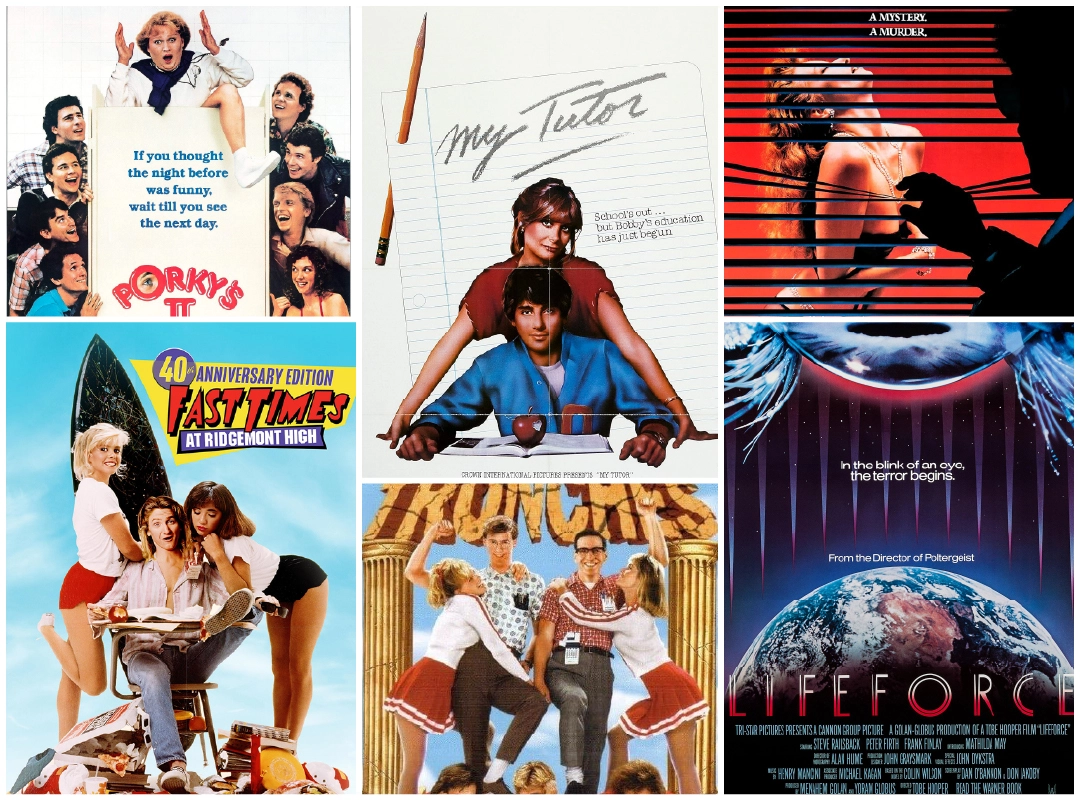

The 1980s had a unique relationship with boundaries. What the decade called a comedy, a romance, or a coming-of-age story, later audiences would call something else entirely.
This is not a takedown list. Some of these films are genuine masterpieces. Some are bottom-of-the-barrel exploitation that nobody would defend today. What they share is content, framing, or premises that the decade normalised and that sit very differently in a modern context.
We are not here to cancel the 80s. We are here to look at it clearly.
Some of these aged like fine wine. Others aged like milk left in a hot car.
What Does "Crossing the Line" Actually Mean?
Not every film on this list is here for the same reason. Some of them, Blue Velvet, Body Double, Cruising, knew exactly what they were doing. They were provocateurs by design, films that intended to disturb and challenge. Others, such as Sixteen Candles, Revenge of the Nerds, and Porky's, had absolutely no idea. They were products of a culture that had not yet developed the language to interrogate what it was normalising. Both categories are on this list. The distinction matters when you are deciding what to think about them.
What Made the 80s Such a Distinctive Era for This?
The decade that produced John Hughes also produced Porky's. That is not a contradiction. It is the point. The 1980s sat at a specific cultural intersection: Reagan-era conservatism on one side, an explosion of home video and loosening theatrical content on the other. The MPAA rating system was still finding its footing mid-decade. The PG-13 rating did not exist until 1984. Before that, content that would now carry an R rating regularly landed in front of teenagers.
Home video changed everything else. Films that might have struggled to sustain a theatrical run could find enormous audiences on VHS, which meant studios were willing to greenlight content that felt too niche or too rough for cinemas. The teen sex comedy was not just a genre. It was a business model. And it ran almost entirely unchallenged for most of the decade.
All 20 Films: Ranked from Wild to Wilder (Not Best to Worst)
These 20 films are presented from the most accessible to the most extreme. This is not a quality ranking. Some of the best films on this list appear toward the end.
#1. Porky's (1981)
https://www.youtube.com/watch?v=_Ej90cyc8Wg
The Blueprint for Every Teen Sex Comedy That Followed. And Everything Wrong With Them.
Director: Bob Clark Starring: Dan Monahan, Mark Herrier, Wyatt Knight, Kim Cattrall Runtime: 94 mins | Rating: R | IMDb: 6.2
Where to Watch: Tubi, Amazon Prime Video (rent/buy) — verify via JustWatch before publishing
Before American Pie, before Superbad, before any of them, there was Porky's. A group of Florida teenagers in the 1950s spends the film trying to lose their virginity, humiliate each other, and exact revenge on a strip club owner who wronged them. It was a massive commercial hit, grossing over $111 million in the US and Canada alone on a budget of just $2.5 million, and it essentially created the template that teen sex comedies followed for the next two decades.
What it normalised is the problem. The infamous locker room peephole scene treats voyeurism as a punchline. Female characters exist almost entirely as objects of pursuit. Consent is not a concept the film is interested in. At the time, none of this registered as anything other than comedy.
Porky's still has defenders, and they are not entirely wrong. There is a genuine anarchic energy to it, and Bob Clark was a more skilled filmmaker than the material suggests. But it set a template that took a long time to undo. Every teen comedy that followed inherited something from this film, including its blind spots.
#2. Fast Times at Ridgemont High (1982)
https://www.youtube.com/watch?v=vzva_I8WPAg
High School, But Brutally Real. Including the Parts Nobody Talks About.
Director: Amy Heckerling Starring: Sean Penn, Jennifer Jason Leigh, Judge Reinhold, Phoebe Cates Runtime: 90 mins | Rating: R | IMDb: 7.1
Where to Watch: Amazon Prime Video — verify via JustWatch before publishing
Fast Times is the rare 80s film on this list that actually knew what it was doing with difficult material, which makes it both more defensible and more complicated than most of its peers. Amy Heckerling's adaptation of Cameron Crowe's book of the same name is genuinely sharp about the pressures teenage girls face, and Jennifer Jason Leigh's performance as Stacy is one of the most honest portrayals of adolescent female experience that decade produced.
And yet. The film contains an abortion subplot handled with more sensitivity than almost anything else in 80s mainstream cinema, and a nude fantasy sequence involving Phoebe Cates that became one of the most discussed images of the decade. The tension between those two things is what makes the film interesting. It saw teenage girls clearly in some scenes and reduced them to fantasy objects in others, sometimes within minutes of each other.
Fast Times holds up better than almost anything else on this list because it was genuinely trying. That does not mean it escapes the era entirely. It just means it is worth the conversation.
#3. Getting It On (1983)
https://www.youtube.com/watch?v=XJCSRf5VVKA
This One Crossed a Line. It Knew It. It Did Not Care.
Director: William Olsen Starring: Martin Yost, Heather Kennedy Runtime: 96 mins | Rating: R | IMDb: 3.7
Where to Watch: Tubi, Amazon Prime Video — verify via JustWatch before publishing
There is no case to be made for Getting It On. It sits at the lowest-budget, least-defended end of the teen sex comedy spectrum, and unlike some of its peers, it has not acquired cult status or retrospective reappraisal. A teenage boy secretly films his sexual encounters and those of people around him. The film treats this entirely as comedy. It is not.
What Getting It On reveals is how wide the genre's tent was in the early 80s. Porky's was a studio film with craft behind it. This was the direct-to-video underbelly of the same cultural moment, made faster and cheaper and with even less concern for the implications of its own content.
It is on this list not because it deserves attention but because it is honest evidence of what the era permitted without question. The fact that it exists, got made, got distributed, and nobody raised an eyebrow is the whole story.
#4. My Tutor (1983)
https://www.youtube.com/watch?v=mmRCI1UdJsE
A Premise That Would Not Get a Greenlight in Any Decade But the 80s
Director: George Bowers Starring: Matt Lattanzi, Caren Kaye, Crispin Glover, Kevin McCarthy Runtime: 97 mins | Rating: R | IMDb: 5.2
Where to Watch: Amazon Prime Video — verify via JustWatch before publishing
A wealthy teenager fails his French exam, and his father hires a female tutor to help him prepare for a retake. The tutor is an adult woman. The student is a teenage boy about to start college. They have a sexual relationship that the film frames entirely as the boy's romantic awakening and the woman's gift to him. This is presented without irony, without complication, and without any acknowledgment that the dynamic it is depicting would today be understood as a serious breach of professional and ethical boundaries at a minimum.
The consent issues are not subtle, and they are not buried. They are the entire premise. My Tutor is a film whose plot would trigger an immediate institutional response in any contemporary setting, and the 80s packaged it as a coming-of-age fantasy.
Lattanzi had already met Olivia Newton-John on the set of Xanadu three years before this film was made and would marry her the following year. He has been largely absent from public life since the mid-90s. The film is forgotten outside of retrospective lists exactly like this one. It deserves to be on them.
#5. Revenge of the Nerds (1984)
https://www.youtube.com/watch?v=kIZH5TKnEeg
Problematic Today, Iconic Back Then. The Gap Between Those Two Things Is the Whole Story.
Director: Jeff Kanew Starring: Robert Carradine, Anthony Edwards, John Goodman, Ted McGinley, Julia Montgomery Runtime: 90 mins | Rating: R | IMDb: 6.6
Where to Watch: Netflix, Amazon Prime Video — verify via JustWatch before publishing
Revenge of the Nerds was a genuine cultural phenomenon. A group of socially outcast college students fights back against the jocks who have dominated campus life. It is a film about underdogs winning, about the outsiders getting their moment. That reading is real, and it is why the film has retained its defenders.
The hidden camera scene is the problem. The nerds install cameras in the sorority house and broadcast footage of the women inside without their knowledge or consent. The film plays this as triumph. There is also a scene in which one of the nerds impersonates a woman's boyfriend to sleep with her without her knowing. She discovers the deception and decides she enjoyed it. The film frames this as romantic.
Revenge of the Nerds is the clearest example on this list of a film whose underdog politics and sexual ethics are in complete contradiction. The nerds are the heroes. The nerds are also doing things that would be prosecutable today. The decade did not notice the tension. We do not have that excuse.
#6. Hardbodies (1984)
https://www.youtube.com/watch?v=U5Il4fjJ1ig
A Time Capsule of Exactly What the 80s Thought Was Acceptable Male Behaviour
Director: Mark Griffiths Starring: Grant Cramer, Teal Roberts, Gary Wood, Courtney Gains Runtime: 88 mins | Rating: R | IMDb: 4.9
Where to Watch: Tubi, Netflix, Amazon Prime Video — verify via JustWatch before publishing
Three middle-aged men rent a California beach house and hire a young surfer named Scotty to teach them how to attract younger women. That is the entire premise. Nobody in the film questions it. The men are not presented as pathetic or predatory. They are presented as aspirational: ordinary guys who just need a little coaching to land the kind of women they feel entitled to.
What dates it most is not the nudity, which is considerable, but the framing. The women on screen exist entirely as targets to be acquired. They have no interiority, no story, and no say in the arrangements being made around them. The film was originally produced for the Playboy Channel and deemed too soft for that audience, which tells you something about the spectrum this film occupies. Columbia Pictures picked it up for theatrical release.
Hardbodies is not a film that knew it was doing anything wrong. It is a film that did not have the framework to ask the question. That is a different kind of problem from the deliberate provocateurs on this list, and in some ways a more revealing one.
#7. Body Double (1984)
https://www.youtube.com/watch?v=zMNCCun-dYY
Voyeurism Turns Into Something Much Darker. De Palma Knew Exactly What He Was Doing.
Director: Brian De Palma Starring: Craig Wasson, Melanie Griffith, Gregg Henry, Deborah Shelton Runtime: 114 mins | Rating: R | IMDb: 6.8
Where to Watch: Tubi, Amazon Prime Video, Netflix — verify via JustWatch before publishing
An unemployed actor named Jake is house-sitting in the Hollywood Hills when he starts watching a woman through a telescope from the window. What begins as an obsession turns into something far darker when he witnesses a murder and finds himself drawn into the world of adult film. Brian De Palma directed it as a deliberate provocation, a film explicitly about the male gaze and the way cinema trains audiences to watch.
Body Double is the most self-aware film on this list by a significant margin. De Palma is not accidentally making a film about voyeurism. He is making a film that implicates the audience in the act of watching. The telescope scenes, the extended surveillance sequence, the way the camera lingers: all of it is designed to make the viewer uncomfortable about their own spectatorship. Whether that makes it a masterwork of critical cinema or a film that has its cake and eats it is a debate that has not been resolved in forty years.
It remains one of the most formally interesting films of the decade. It also remains genuinely difficult to watch. Both things are true, and neither cancels the other out.
#8. Lifeforce (1985)
https://www.youtube.com/watch?v=B18wv1oAJGc
Space Vampires. And Way More Than the Sci-Fi Premise Prepared You For.
Director: Tobe Hooper Starring: Steve Railsback, Mathilda May, Peter Firth, Patrick Stewart Runtime: 116 mins | Rating: R | IMDb: 6.2
Where to Watch: Amazon Prime Video, Tubi — verify via JustWatch before publishing
A British and American joint space mission discovers an alien spacecraft near Halley's Comet. Inside, they find three humanoid figures in suspended animation, including a young woman. They bring them back to Earth. The young woman wakes up and begins draining the life force from anyone she encounters. This is not a metaphor. It is a very expensive Cannon Films production directed by Tobe Hooper,r fresh off Poltergeist, with special effects by John Dykstra and a screenplay co-written by Dan O'Bannon.
The female lead, played by French actress Mathilda May, spends virtually the entire film unclothed. The camera treats her body as a spectacle from the first frame she appears in. May was 21 during filming. The film's male characters are consistently depicted as helpless in the face of her, which the screenplay frames as a supernatural compulsion, but which reads as something less defensible when you watch how the camera is deployed.
Lifeforce is a genuinely ambitious film that aimed for the scale of 2001 and landed somewhere stranger. Patrick Stewart's appearance alone makes it worth seeing. But the way it treats its female lead as a body first and a character never is hard to separate from the ambition, and harder still to overlook.
#9. Blue Velvet (1986)
https://www.youtube.com/watch?v=rAA6imfqMYQ
Dark, Disturbing, Deeply Unsettling. And One of the Greatest American Films Ever Made.
Director: David Lynch Starring: Isabella Rossellini, Kyle MacLachlan, Dennis Hopper, Laura Dern Runtime: 120 mins | Rating: R | IMDb: 7.7
Where to Watch: Amazon Prime Video, Tubi, The Roku Channel — verify via JustWatch before publishing
A college student named Jeffrey finds a severed ear in a field near his hometown. Following the mystery leads him to Dorothy Vallens, a nightclub singer being terrorised by a sexually violent criminal named Frank Booth. Dennis Hopper's performance as Frank Booth is one of the most viscerally frightening in American cinema. Lynch was nominated for a Best Director Oscar. Roger Ebert gave it one star. Both reactions make complete sense.
Blue Velvet is on this list not because it crossed a line carelessly but because it crossed it with full awareness and full intent. The scenes involving Isabella Rossellini's Dorothy are brutal and designed to be. Lynch is not presenting abuse as entertainment. He is presenting the suburban American surface and the violence underneath it as inseparable. That is a serious artistic argument made with serious craft. It is also deeply uncomfortable to watch, and that discomfort is the point.
The most artistically defensible film on this list is also the most genuinely disturbing. Lynch knew exactly what he was making. Audiences who came for a thriller did not always get what they expected, and several walked out. The film survived all of it and aged into a masterpiece. Not every film that crosses a line earns that outcome. This one did.
#10. Wild Orchid (1989)
https://www.youtube.com/watch?v=6WK8hTsaOjA
One of the Most Controversial Erotic Dramas the Decade Produced. And Now You Can Stream It.
Director: Zalman King Starring: Mickey Rourke, Carré Otis, Jacqueline Bisset Runtime: 111 mins | Rating: R | IMDb: 4.5
Where to Watch: Netflix, Amazon Prime Video — verify via JustWatch before publishing
A young American lawyer travels to Rio de Janeiro on a business deal and becomes entangled with a mysterious, controlling millionaire played by Mickey Rourke. Zalman King, who also made 9½ Weeks, directed it as a deliberate exercise in erotic cinema. The MPAA threatened an X-rating on the original cut. King removed footage. The removed footage was widely rumoured to be unsimulated sex between Rourke and Carré Otis, who were in a real romantic relationship during filming. Both denied it. King was ambiguous.
The on-set relationship between Rourke and Otis did not survive the film or the years that followed. Otis later wrote about the relationship in her memoir, describing control, coercion, and abuse that extended well beyond the production. The film cannot be fully separated from that account. What was marketed as an erotic fantasy was, for at least one person on screen, something considerably darker.
Wild Orchid holds a 9% on Rotten Tomatoes. It received two Razzie nominations. It is not a good film by any conventional measure. But it is a film whose off-screen story is more disturbing than anything in the actual footage, and that context matters when you watch it.
#11. Sixteen Candles (1984)
https://www.youtube.com/watch?v=HGLtBJupFFM
John Hughes Made One of the Most Beloved Teen Films of the Decade. Then There Is the Ted and Caroline Scene.
Director: John Hughes Starring: Molly Ringwald, Anthony Michael Hall, Michael Schoeffling, Gedde Watanabe, John Cusack Runtime: 93 mins | Rating: PG | IMDb: 7.0
Where to Watch: Netflix, AMC+, Fubo, Amazon Prime Video — verify via JustWatch before publishing
Samantha Baker turns sixteen, and her entire family forgets. She pines for Jake Ryan, the most popular boy in school, while being tormented by a freshman called The Geek. John Hughes directed it as a warm, sharp, genuinely funny portrait of adolescent embarrassment, and Molly Ringwald made Samantha one of the most recognisable teen protagonists of the decade. All of that is real,l and none of it has disappeared.
The Ted and Caroline subplot is the problem. Jake, the object of Samantha's affection, hands his drunk, unconscious girlfriend, nd Caroline over to Ted, whom he barely knows, and tells him he can do whatever he wants with her. What follows is played for laughs. Caroline wakes up the next morning, not knowing what happened, and decides she probably had a good time. The film does not register any of this as assault. It registers it as a charming resolution. In 2024 terms, that subplot describes a serious crime treated as a romantic footnote.
Sixteen Candles is the most jarring film on this list precisely because everything around that subplot is so genuinely good. The contrast makes it harder to dismiss, not easier.
#12. Risky Business (1983)
https://www.youtube.com/watch?v=3JXcqzJjHf0
Tom Cruise's Star-Making Role Involves a Teenager Running a Brothel From His Parents' House. Nobody in the Film Questions This.
Director: Paul Brickman Starring: Tom Cruise, Rebecca De Mornay, Joe Pantoliano, Curtis Armstrong, Bronson Pinchot Runtime: 98 mins | Rating: R | IMDb: 6.8
Where to Watch: Available to rent or buy on Amazon Video and Apple TV — verify via JustWatch before publishing
Joel Goodson is a high school senior whose parents leave him alone for a weekend. He hires a sex worker named Lana, crashes his father's Porsche, and runs out of money. His solution is to turn the family home into a brothel for one night, inviting his prep school classmates as clients. The plan works. Joel gets into Princeton. The film ends with him essentially rewarded for everything he did.
What makes Risky Business more interesting than a straightforward teen sex comedy is that Paul Brickman clearly intended a darker, more ambiguous film than the one that reached audiences. The original ending was bleaker. The studio pushed for something more upbeat. What remains is a genuinely well-made film with a sharp satirical edge about wealth, ambition, and the ways privileged teenagers absorb the ethics of the system they are about to enter. The prostitution-as-enterprise premise functions as a comment on capitalism. That reading is legitimate.
It is also a film in which a teenager runs a brothel and faces zero consequences. Both things are true. Risky Business is the most intellectually defensible, morally bankrupt film on this list, and that combination is what makes it worth watching in 2025.
#13. Weird Science (1985)
https://www.youtube.com/watch?v=9qd04u2Yj44
Two Teenage Boys Build a Woman on Their Computer to Do What They Want With Her. John Hughes Directed It.
Director: John Hughes Starring: Anthony Michael Hall, Kelly LeBrock, Ilan Mitchell-Smith, Bill Paxton, Robert Downey Jr. Runtime: 94 mins | Rating: PG-13 | IMDb: 6.6
Where to Watch: Netflix, AMC+, Amazon Prime Video — verify via JustWatch before publishing
Gary and Wyatt are unpopular teenagers who cannot talk to girls. Using a home computer and a freak electrical storm, they create Lisa: a perfect woman who exists to improve their social lives, teach them confidence, and help them become the men they want to be. Kelly LeBrock plays Lisa with genuine warmth and comic timing. Bill Paxton plays the terrifying older brother, Chet. Robert Downey Jr. appears as a bully. The film is funny and fast-moving and deeply strange.
The premise is the issue. Two boys create a woman specifically to serve their needs. Her wants, her interiority, her existence outside of what she does for them: the film is not interested in any of it. Lisa has no life before Gary and Wyatt and no apparent purpose except to make them feel better about themselves. The film never interrogates this. It does not notice it. That is the 80s in miniature: a premise that would generate significant critical conversation today, assembled with total innocence and considerable craft.
Weird Science is charming enough that it is easy to watch without noticing the argument it is implicitly making about women and male entitlement. That ease is itself the most revealing thing about it.
#14. Blame It on Rio (1984)
https://www.youtube.com/watch?v=cJ4u1y-8njU
Michael Caine Has an Affair With His Best Friend's Teenage Daughter on a Brazilian Holiday. This Is a Romantic Comedy.
Director: Stanley Donen Starring: Michael Caine, Michelle Johnson, Joseph Bologna, Demi Moore, Valerie Harper Runtime: 100 mins | Rating: R | IMDb: 5.8
Where to Watch: Tubi, MGM+, Pluto TV, Amazon Prime Video — verify via JustWatch before publishing
Two middle-aged men take a holiday in Rio de Janeiro with their teenage daughters. Matthew, played by Michael Caine, begins a sexual relationship with his best friend's daughter, Jennifer, who is considerably younger than him. When the friendship is threatened by discovery, the film treats Matthew's guilt and his attempts to end the affair as its primary dramatic engine. The age gap, the betrayal of a close friend, the power differential: none of it is presented as disqualifying. The film is a comedy. Matthew is the sympathetic lead.
Stanley Donen directed Singin' in the Rain and Funny Face. This is not that. Roger Ebert wrote that the film was "clearly intended to appeal to the prurient interests of dirty old men of all ages." The Washington Post called it "listless and unsavory." Even at the time, critics were not buying it. Michael Caine looked uncomfortable throughout. Demi Moore, in an early supporting role as Caine's own daughter, has largely declined to discuss the film.
Blame It on Rio is the least defensible entry on this list. There is no artistic argument to be made for it. It is an uncomfortable premise, executed without irony, by filmmakers who should have known better.
#15. Class (1983)
https://www.youtube.com/watch?v=C5jZnTC3Tew
It Marks the Feature Film Debut of Rob Lowe, Andrew McCarthy, John Cusack, and Virginia Madsen. It Is Also About a Teenager Having Sex With His Roommate's Mother.
Director: Lewis John Carlino Starring: Jacqueline Bisset, Rob Lowe, Andrew McCarthy, Cliff Robertson, John Cusack Runtime: 98 mins | Rating: R | IMDb: 6.0
Where to Watch: Tubi, Amazon Prime Video, The Roku Channel — verify via JustWatch before publishing
Jonathan arrives at a prestigious prep school and is taken under the wing of his worldly roommate,e Skip. At Skip's encouragement, Jonathan seeks out older women in Chicago bars and begins an affair with Ellen, a sophisticated and troubled woman who turns out to be Skip's mother. The film treats this as a rite-of-passage story. The friendship between the two boys, and how it survives the revelation, is the film's emotional centre.
What Class is remembered for now is not so much the Bisset storyline as what happened on set around it. Virginia Madsen, who appears in a supporting role, has said in interviews that her experience on the film was deeply unpleasant, specifically that her "big part" involved having her shirt ripped off by a group of laughing actors on set. Rob Lowe acknowledged her account was justifiable. The film exists as a document of how young male actors behaved on set in the early 80s when nobody was watching.
Class was the first film for half the Brat Pack. It is also one of the clearest windows into the culture that produced them.
#16. Fatal Attraction (1987)
https://www.youtube.com/watch?v=nf8gh_d7Z6k
The highest-grossing film worldwide in 1987, and a film that stigmatised mental illness for a generation
Director: Adrian Lyne Starring: Michael Douglas, Glenn Close, Anne Archer Runtime: 119 mins | Rating: R | IMDb: 6.9
Where to Watch: Paramount+, Netflix, Amazon Prime Video, Tubi — verify via JustWatch before publishing
A married New York lawyer has a weekend affair with a colleague named Alex Forrest while his wife is away. When he ends it, Alex refuses to accept the conclusion and begins inserting herself into his life with escalating intensity. The film was a phenomenon: a $320 million worldwide hit, nominated for six Academy Awards, including Best Picture, and one of the most discussed films of the late 1980s. Glenn Close's performance is extraordinary.
The problem is what the film does with Alex. She is presented as the consequence of adultery, the embodiment of male anxiety about female autonomy, and eventually a horror movie monster dispatched in the final reel. Her mental illness is used entirely as a threat delivery mechanism. The film never once asks what she is experiencing. It asks only what she is going to do next. The result is a film that shaped how popular culture understood unstable women for at least a decade, and not in a way that served anyone experiencing what Alex was experiencing.
Fatal Attraction is a genuinely well-made thriller. It is also a film that used mental illness as a villain costume and then buried it in a bathtub. The two things coexist, and the second is the more consequential legacy.
#17. Angel Heart (1987)
https://www.youtube.com/watch?v=x2DBx2ca_Ck
Lisa Bonet Was 18 During Filming and Known Across America as One of Television's Most Beloved Daughters. Then She Made This.
Director: Alan Parker Starring: Mickey Rourke, Robert De Niro, Lisa Bonet, Charlotte Rampling Runtime: 113 mins | Rating: R | IMDb: 7.2
Where to Watch: Netflix, Amazon Prime Video — verify via JustWatch before publishing
Harry Angel is a New York private detective hired by a mysterious man named Louis Cyphre to track down a missing singer named Johnny Favorite. The investigation takes him to 1950s New Orleans, into a world of voodoo, jazz, and violence, and toward a revelation that recontextualises everything the film has shown. Robert De Niro plays Louis Cyphre with a quiet, coiled menace that makes every scene he is in unbearable in the best possible way. Mickey Rourke has never been better.
The controversy centred on Lisa Bonet. She was 18 during production, playing Epiphany Proudfoot, and was known to American audiences almost exclusively as Denise Huxtable on The Cosby Show. The film contains an explicit sex scene between her character and Rourke's that the MPAA initially rated X, requiring Parker to cut ten seconds before an R rating was granted. The casting caused a national conversation. Bill Cosby, it later emerged, had actually encouraged Bonet to take the role. The irony of that fact, given what has since become known about Cosby, is not lost on anyone revisiting the film today.
Angel Heart is a serious, accomplished piece of noir filmmaking that earns its darkness. The controversy around Bonet was at least partly manufactured outrage about a young Black woman making adult choices about her career. The film deserved a better reception than it got.
#18. Dressed to Kill (1980)
https://www.youtube.com/watch?v=AE37peg5fTU
Brian De Palma's Hitchcock Homage Built Its Entire Twist Around a Transgender Woman as a Violent Killer. The Artistic Achievement Does Not Neutralise the Harm.
Director: Brian De Palma Starring: Michael Caine, Angie Dickinson, Nancy Allen, Keith Gordon, Dennis Franz Runtime: 105 mins | Rating: R | IMDb: 7.0
Where to Watch: The Roku Channel, Hoopla, Amazon Prime Video (rent/buy) — verify via JustWatch before publishing
A Manhattan psychiatrist's patient is murdered by a mysterious blonde woman wielding a straight razor. A high-class sex worker who witnesses the killing becomes the killer's next target. Brian De Palma directs it as a full Hitchcock homage: split diopter shots, voyeuristic camera placement, a Pino Donaggio score that echoes Bernard Herrmann, and a twist that the film withholds until the final act. The elevator sequence is one of the most technically accomplished set pieces De Palma ever staged.
The twist reveals that the killer is the psychiatrist's transgender patient, whose female identity is framed as the source of violent instability. This was not an unusual narrative choice for mainstream cinema in 1980. That does not make it a neutral one. The film contributed to a cultural pattern of portraying transgender characters as inherently threatening, deceptive, or mentally unstable that was already well established in American film and would persist for decades. GLAAD protested the film on release. The protests were largely ignored.
De Palma is a technically brilliant filmmaker who made an aesthetically accomplished thriller that also caused measurable harm to how transgender people were perceived and portrayed in mainstream media. The craftsmanship and the damage are both real.
#19. Cruising (1980)
https://www.youtube.com/watch?v=bn31G2SHkVE
Al Pacino Goes Undercover in New York's Gay S&M Bars. The Gay Community Protested Before the Film Even Opened. They Were Not Wrong to.
Director: William Friedkin Starring: Al Pacino, Paul Sorvino, Karen Allen, Richard Cox, Ed O'Neill, James Remar Runtime: 102 mins | Rating: R | IMDb: 6.4
Where to Watch: Netflix, Amazon Prime Video (rent/buy) — verify via JustWatch before publishing
Steve Burns is a young New York police officer assigned to go undercover in the city's gay leather bar scene to catch a serial killer targeting gay men. As the assignment continues, the boundaries between undercover work and personal identity begin to blur. William Friedkin, who directed The French Connection and The Exorcist, intended the film as an ambiguous, morally complex thriller. The gay community saw something different: a major Hollywood film depicting their community as a world of violence, predation, and psychological disintegration, released at a moment when that community was already under enormous social pressure.
Gay rights activists disrupted filming throughout production, using whistles and mirrors to ruin location sound. Forty minutes of footage were reportedly cut before release, which Friedkin has acknowledged left the film narratively incoherent in places. The ambiguity that remains, Burns's shifting identity, the unresolved ending, reads either as artistic complexity or as a film that could not decide what it was saying. Both readings have serious advocates.
Cruising is more complicated than either its defenders or its detractors have allowed. It is also a film that depicts a real community at one of the most vulnerable moments in its history as a landscape of danger and moral corruption. That context does not disappear because the filmmaking is sometimes interesting.
#20. Private Lessons (1981)
https://www.youtube.com/watch?v=Qfxl1t3iZTc
A 15-Year-Old Boy Is Seduced by His French Housekeeper. The 80s Called It a Coming-of-Age Film.
Director: Alan Myerson Starring: Sylvia Kristel, Howard Hesseman, Eric Brown, Ed Begley Jr. Runtime: 87 mins | Rating: R | IMDb: 5.1
Where to Watch: Tubi, Netflix, Plex — verify via JustWatch before publishing
Phillip is 15, wealthy, and home alone for the summer while his father travels on business. Nicole, the French housekeeper, begins a sexual relationship with him. The family chauffeur, played by Howard Hesseman, uses the situation to run a blackmail scheme. The film presents Phillip's seduction as a wish-fulfillment fantasy and his infatuation with Nicole as romantic rather than exploitative. The character's age is not implied or approximate. It is stated clearly. He is 15.
Sylvia Kristel, who played Emmanuelle in the European erotic film series, brought that association with her into a film that was marketed largely on the basis of the resulting expectation. The film grossed significantly more than its budget. It found a large audience. Nobody in a position of institutional authority appears to have raised a serious objection to a film built around the sexual seduction of an explicitly 15-year-old boy by an adult woman in a position of care.
Private Lessons is the purest example on this list of what the era permitted without question. It is not a film that crossed a line despite knowing where the line was. It is a film that crossed a line because the line did not yet exist in the cultural consciousness. That is a different kind of problem, and in some ways a more disturbing one.
The Two Categories — Knowing vs Unknowing
Not every film on this list crossed a line in the same way. That distinction matters when you are deciding what to do with them.
Some of these films knew exactly what they were doing. Blue Velvet, Body Double, Cruising, Dressed to Kill, Wild Orchid, Angel Heart, Fatal Attraction: these are films made by directors who understood they were working with transgressive material and made deliberate artistic choices about how to handle it. You can argue with those choices. You can find them harmful or irresponsible. But the intent was conscious. The provocation was the point.
The second category is more revealing. Porky's, Revenge of the Nerds, Sixteen Candles, My Tutor, Hardbodies, Blame It on Rio, Private Lessons, and Weird Science: these films had no idea. They were not trying to disturb or challenge. They were trying to entertain, and the entertainment they offered was built on assumptions so thoroughly embedded in the culture that nobody making the films thought to question them. That is the more interesting category. Deliberate transgression tells you about a filmmaker. Accidental transgression tells you about an era.
The deliberately provocative films are easier to defend artistically, even when the content is uncomfortable, because at least someone was making a conscious argument. The accidentally revealing ones are harder to dismiss precisely because they were not trying to say anything. They were just reflecting what the decade believed without examination. That reflection is a document. It is also a mirror.
Which Ones Actually Hold Up?
Complicated does not mean without value. Several films on this list are genuinely worth watching in 2025, not despite their difficulty but sometimes because of it.
Blue Velvet, Fast Times at Ridgemont High, Fatal Attraction, Angel Heart, Risky Business, and Body Double all hold up. Not because their issues have disappeared but because they were made with enough craft, intelligence, and self-awareness that the discomfort they generate is productive rather than gratuitous. Blue Velvet is a masterpiece that earns every uncomfortable frame. Fast Times saw its teenage characters with unusual clarity for the era, even when it failed them. Fatal Attraction remains a technically brilliant thriller whose cultural damage does not erase Glenn Close's performance. Angel Heart is a serious noir that deserved a better reception than the controversy allowed. Risky Business has more to say about capitalism and privilege than most films three times its budget. Body Double implicates the audience in a way that still works.
The rule is straightforward. A film that crosses a line with awareness and craft can produce something that outlasts the controversy. A film that crosses a line by accident, without awareness or intent, tends to age into a document rather than a film. Both have value. They are just different kinds of value.
Final Takeaway
The 1980s did not invent bad behaviour on screen. Every decade has its version of this list. What made the 80s distinctive was the cheerfulness. The films that normalised the most were not dark or transgressive in tone. They were sunny, fast-moving, commercially successful entertainments that packaged harmful assumptions in the most accessible formats available. The horror films and erotic thrillers at least announced themselves as something adults should approach with awareness. The teen comedies did not. They arrived with a PG or PG-13 rating and a soundtrack full of pop songs, and the assumptions they carried went largely unexamined for a decade.
These films are worth watching precisely because they reveal something about what a culture chooses not to notice. The ones who knew what they were doing are worth watching for the craft. The ones that had no idea are worth watching for the document. Between those two categories, you get a complete picture of what the 1980s believed about gender, desire, consent, and power, stated plainly and without apology, in films that millions of people watched and loved.
That is not a reason to cancel them. It is a reason to look clearly.