

Hollywood has been wrong about queer cinema for over 30 years. Not occasionally wrong. Structurally wrong. The assumption was baked into budget approvals, distribution deals, and marketing spend: queer stories played in New York and Los Angeles and did not travel. Straight audiences in the rest of the country would not show up. For the better part of the 2010s, studios simply stopped making wide-release queer films entirely.
The last film with a primary LGBTQ character to reach 1,000 screens before Love, Simon was Brokeback Mountain in 2006. In 2013, Steven Soderbergh could not get a single Hollywood studio to finance a Liberace biopic starring Michael Douglas and Matt Damon.
He was told it was too gay for the multiplex. He made it for HBO instead. In 2018, The Miseducation of Cameron Post won the Grand Jury Prize at Sundance and spent two months without a distributor because, as Rolling Stone reported, distributors had privately expressed skepticism about the commercial prospects of a lesbian coming-of-age film. By 2024, LGBTQ-inclusive films from major studios had dropped to 23.6% of all releases: a three-year low, down from a record high of 28.5% in 2022.
The films on this list are the receipts. Not critical receipts, though most of these are among the most acclaimed films of their eras. Box office receipts. Films that filled cinemas, beat projections, set per-theater records, and in one case grossed more than $1 billion worldwide. Films that proved, repeatedly and in every genre, that the ceiling Hollywood kept applying to queer stories was a choice, not a fact of the market.
This list updates every Pride Month as new films qualify. The criteria are simple: did the film make a genuine impact at the box office relative to its budget, its release scale, and the expectations that surrounded it? A $910 million gross proves Hollywood wrong one way. A $66 million gross on a $1.5 million budget proves it again. Both count.
Why Hollywood Kept Getting This Wrong
The skepticism had a structure. Queer-led projects were categorized as specialty films: awards-circuit material at best, niche at worst. Even when they won Oscars. Even when they broke records. The industry's response to each success was to treat it as an exception rather than evidence. Brokeback Mountain grossed $179 million worldwide in 2005, and the takeaway was not that queer romance could travel.
The takeaway was that Ang Lee and two A-list stars could overcome the material. Moonlight won Best Picture in 2017 on a $1.5 million budget, and the takeaway was not that intimate, specific Black queer cinema had genuine commercial reach. The takeaway was that A24 was very good at awards campaigning.
GLAAD's 13th annual Studio Responsibility Index found that only 59 out of 250 films released by the ten largest studio distributors in 2024 featured LGBTQ characters: 23.6%, down from 27.3% in 2023 and a record high of 28.5% in 2022. Only 27% of those LGBTQ characters had more than ten minutes of screen time, down from 38% the year before. A24 was the only major distributor to receive a 'good' rating. The industry has had 30 years of box office evidence that queer stories work. It keeps misreading the data. What follows is the argument the data has been making all along.
The Films That Proved Queer Stories Could Win at Any Scale
Wide release. Mainstream audiences. The box office demanded the industry pay attention.
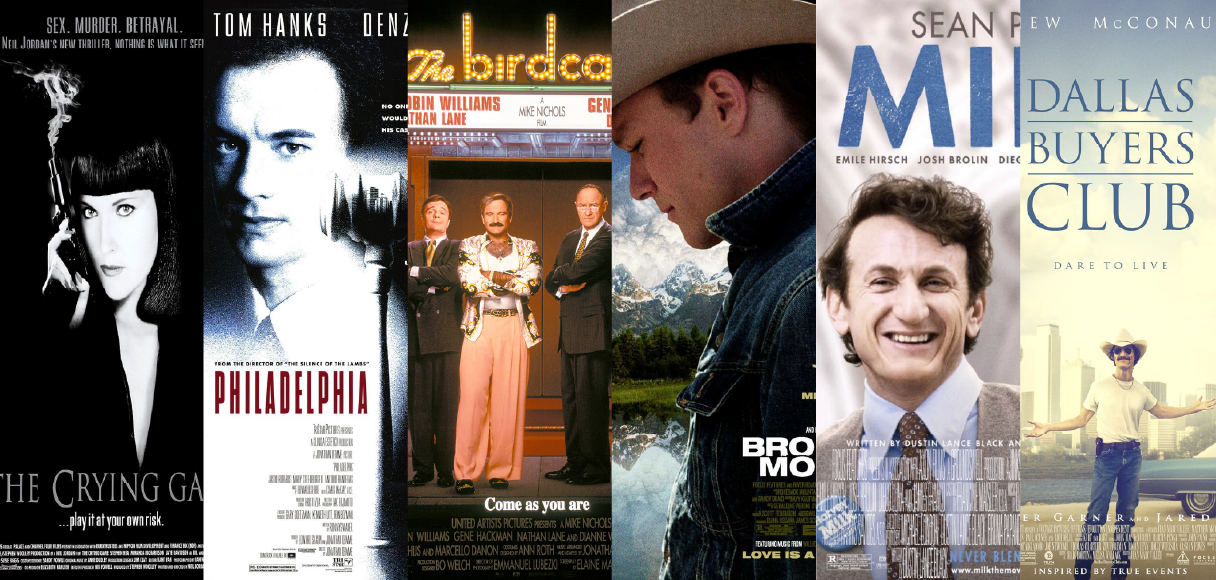
#1. The Crying Game (1992)
The film America was told not to spoil. And then went to see anyway.
https://www.youtube.com/watch?v=F6N426QCQ-Y
Director: Neil Jordan
Starring: Stephen Rea, Jaye Davidson, Forest Whitaker, Miranda Richardson
Runtime: 111 mins | Rating: R | IMDb: 7.8 | RT: 95%
Box Office: $71M worldwide | Budget: £2.3M
Where to Watch: MGM+, fuboTV, Plex (free), Kanopy (free), Prime Video (rent/buy), Apple TV (rent/buy) — verify current availability via JustWatch
The Crying Game arrived in American cinemas in late 1992, carrying a secret so effectively guarded that Miramax built its entire marketing campaign around protecting it. 'Please don't reveal the ending' became one of the most successful pieces of film marketing of the decade. Neil Jordan's film begins as a political thriller: IRA operative Fergus forms an unlikely bond with a British soldier he is assigned to guard, then tracks down the soldier's lover, Dil, in London after the mission goes wrong. Jaye Davidson, a non-professional actor discovered through a friend of the production designer, plays Dil. What Davidson brought to the role is not something any amount of studio development could have manufactured.
The film earned six Academy Award nominations,s including Best Picture and Best Director, and won Best Original Screenplay for Jordan. On a budget of approximately £2.3 million, it grossed $71 million worldwide, nearly all of it driven by word of mouth in a pre-social-media landscape where audiences genuinely kept the secret from their friends. The Hollywood calculus said a British political thriller with a transgender character at its centre was an awards-circuit curiosity, not a commercial proposition. The Crying Game ran in American cinemas for the better part of a year.
The Screendollars Take
The Crying Game's lesson is not about representation. It is about mystery.
The marketing did not hide what the film contained. It made the most talked-about element of the film a reason to buy a ticket rather than stay away. Jordan's direction never editorializes. Dil is not explained to the audience. She simply exists, and the film trusts that to be enough. It was.
Hollywood has spent 30 years failing to understand why this film worked. The Criterion Collection understood it fine.
#2. Philadelphia (1993)
The first major Hollywood film about AIDS. It grossed $207 million.
https://www.youtube.com/watch?v=CKDz2LVHz0Y
Director: Jonathan Demme
Starring: Tom Hanks, Denzel Washington, Jason Robards, Antonio Banderas
Runtime: 125 mins | Rating: PG-13 | IMDb: 7.7 | RT: 80%
Box Office: $207M worldwide | Budget: $26M
Where to Watch: Pluto TV (free with ads), Prime Video (rent/buy), Apple TV (rent/buy), Fandango at Home (rent/buy) — verify current availability via JustWatch.
Philadelphia is the film that put AIDS on a multiplex screen and dared a mainstream American audience to sit with it for two hours. Jonathan Demme's 1993 drama follows Andrew Beckett, a gay lawyer with AIDS who sues his firm for wrongful dismissal after they discover his diagnosis. Tom Hanks plays Beckett with a physical specificity that the Academy had never rewarded for a queer role before: weight loss, lesions, the particular posture of a man managing pain in public. Denzel Washington plays the homophobic attorney who takes his case and gradually, visibly, changes. The film does not pretend that the discomfort is not there. It makes the discomfort the point.
Philadelphia grossed $207 million worldwide on a $26 million budget, becoming the ninth highest-grossing film of 1993. Tom Hanks won Best Actor at the Academy Awards. Bruce Springsteen's Streets of Philadelphia won Best Original Song. The film was the first major Hollywood production to confront the AIDS epidemic directly, arriving at a moment when the epidemic had killed more than 200,000 Americans and the federal government had spent most of the preceding decade looking away. The studio had every commercial reason to hedge. Jonathan Demme made a film that did not.
The Screendollars Take
Philadelphia did not make AIDS comfortable. It made it visible.
Demme's decision to shoot Hanks' deterioration in real time, in direct lighting, without the softening of conventional illness cinematography, was a political act dressed as a stylistic one. The scene in which Beckett plays opera for Miller in his apartment and narrates it as his body fails him is not there to generate sympathy. It is there to make the audience understand what it costs a person to be this specific, this honest, in a world that would prefer them invisible.
Hollywood made one film like this in 1993. It took 30 years to make another.
#3. The Birdcage (1996)
A film about a gay couple that made $185 million. The industry called it a fluke.
https://www.youtube.com/watch?v=83kTQ6chG4o
Director: Mike Nichols
Starring: Robin Williams, Nathan Lane, Gene Hackman, Dianne Wiest, Hank Azaria
Runtime: 117 mins | Rating: R | IMDb: 7.2 | RT: 84%
Box Office: $185M worldwide | Budget: $31M
Where to Watch: MGM+, fuboTV, Tubi (free), Plex (free), Pluto TV (free), Prime Video (rent/buy), Apple TV (rent/buy) — verify current availability via JustWatch
The Birdcage is the film that proved queer-centered comedy could anchor a mainstream American blockbuster, and the industry responded by not making another one for two decades. Mike Nichols' adaptation of the French farce La Cage aux Folles stars Robin Williams as Armand Goldman, a gay nightclub owner in South Beach, and Nathan Lane as his drag-performer partner Albert. When Armand's son announces he is marrying the daughter of an ultra-conservative senator played by Gene Hackman, the comedy that follows requires the entire household to pretend to be something it is not. The film does not require the audience to do the same.
The Birdcage opened at number one in March 1996 and grossed $185 million worldwide, making it one of the highest-grossing comedies of the year. Nathan Lane and Hank Azaria's performances are among the most precisely timed comic works either actor has done. Gene Hackman's senator is not a cartoon: he is a specific portrait of a man who holds his convictions sincerely and is wrong about almost everything. The comedy works because Nichols takes all of it seriously.
The Screendollars Take
The Birdcage is not a film that asks for tolerance. It is a film that assumes love.
The dynamic between Williams and Lane is not played for pathos or political statement. It is played as a long marriage: the bickering, the codependence, the specific exhaustion and specific tenderness of two people who have chosen each other for a long time. Nichols frames it that way from the first scene. The audience does not need to be persuaded that this relationship is real. It already is.
The industry called The Birdcage's $185 million gross a Robin Williams vehicle. Robin Williams was in a lot of films. This is the one where he played someone's husband.
#4. Brokeback Mountain (2005)
They called it the gay cowboy movie. It grossed $179 million and won three Oscars.
https://www.youtube.com/watch?v=z89xU8l5wn8&t=1s
Director: Ang Lee
Starring: Heath Ledger, Jake Gyllenhaal, Michelle Williams, Anne Hathaway
Runtime: 134 mins | Rating: R | IMDb: 7.7 | RT: 87%
Box Office: $179M worldwide | Budget: $14M
Where to Watch: Prime Video (rent/buy), Apple TV (rent/buy), Fandango at Home (rent/buy) — verify current availability via JustWatch
Brokeback Mountain arrived in December 2005 pre-loaded with a dismissal. 'The gay cowboy movie' was the phrase that circulated before anyone had seen it, intended to reduce Ang Lee's film to a punchline before it could become a phenomenon. It became a phenomenon anyway.
The film follows Ennis Del Mar and Jack Twist, two ranch hands who fall into a decades-long love affair they can neither name nor leave behind, across 20 years of marriages, children, and the particular violence of the American West's expectations of men. Lee shoots the landscape as a third character: enormous, indifferent, beautiful in the way that things are beautiful when they will outlast everyone in them.
Brokeback Mountain grossed $179 million worldwide on a $14 million budget, a nearly 13x return. It received eight Academy Award nominations and won three: Best Director for Ang Lee, Best Adapted Screenplay for Larry McMurtry and Diana Ossana, and Best Original Score for Gustavo Santaolalla.
It lost Best Picture to Crash in one of the most contested upsets in Oscar history. Heath Ledger's performance as Ennis is built almost entirely from what he withholds: the words that do not come, the feelings that find no form, the single scene near the end of the film where his face does everything the story has been denying him for two hours.
The Screendollars Take
Brokeback Mountain is not a film about being gay. It is a film about the cost of not being allowed to be.
Lee's most precise directorial decision is that he never shows Ennis and Jack's love as a problem to be solved. It simply exists, fully formed, from the first night on the mountain. What the film is actually about is everything that comes after: the specific cruelty of a life lived in the wrong shape. Ledger earns his final scene by never once playing for sympathy in the 130 minutes before it.
The people who called it the gay cowboy movie saw the cowboy hats. They missed the film.
#5. Milk (2008)
Sean Penn played a gay activist and won the Oscar. The film made $54 million.
https://www.youtube.com/watch?v=w5D07rmfwG0
Director: Gus Van Sant
Starring: Sean Penn, Josh Brolin, Emile Hirsch, James Franco, Diego Luna
Runtime: 128 mins | Rating: R | IMDb: 7.5 | RT: 94%
Box Office: $54.7M worldwide | Budget: $20M
Where to Watch: Prime Video (rent/buy), Apple TV (rent/buy) — verify current availability via JustWatch.
Milk is Gus Van Sant's biographical film about Harvey Milk, the San Francisco city supervisor who became the first openly gay elected official in California history and was assassinated in November 1978. Sean Penn plays Milk with a quality that is easy to underestimate on first viewing: joy.
Not the performed optimism of a political figure managing a public image, but the specific delight of a man who has found his purpose late and is running toward it as fast as he can. Dustin Lance Black's screenplay does not sentimentalize Milk or make him a saint. It makes him a politician: strategic, charismatic, occasionally ruthless, consistently right.
Milk grossed $54.7 million worldwide on a $20 million budget. Sean Penn won Best Actor at the Academy Awards. Dustin Lance Black won Best Original Screenplay. The film was released in November 2008, the same week California voters passed Proposition 8, banning same-sex marriage. The timing was not coincidental. Van Sant and Black understood that a film about a man who spent his life telling gay people they had to be visible, made during a year when the right to marry was being voted away, was not history. It was current events.
The Screendollars Take
Milk works because Van Sant refuses to make it a tragedy while showing you a tragedy.
Penn's performance never plays for the ending. He is always in the present tense: rallying, arguing, laughing, winning small things. The assassination arrives as it arrived in reality: abruptly, in a corridor, between two people who had known each other for years. The film's final image is of the candles. Not the man. The choice the people who loved him made.
You cannot watch Milk and believe that queer stories are too niche. What you can watch and believe is that Hollywood should have made more of them sooner.
#6. Dallas Buyers Club (2013)
A $5 million film. Two Oscars. $55 million at the box office.
https://www.youtube.com/watch?v=KDvPcBeOn8E
Director: Jean-Marc Vallee
Starring: Matthew McConaughey, Jared Leto, Jennifer Garner
Runtime: 117 mins | Rating: R | IMDb: 7.9 | RT: 94%
Box Office: $55.2M worldwide | Budget: $5M
Where to Watch: Netflix, Prime Video (rent/buy), Apple TV (rent/buy) — verify current availability via JustWatch
Dallas Buyers Club tells the story of Ron Woodroof, a homophobic Texas electrician diagnosed with HIV in 1986 and given 30 days to live, who responded by building an underground pharmaceutical distribution network to supply unapproved AIDS medications to patients the FDA had effectively abandoned.
Matthew McConaughey lost 47 pounds for the role. Jared Leto plays Rayon, a transgender woman and Woodroof's business partner. Jean-Marc Vallee shot the film on a $5 million budget over 25 days. The makeup budget for the entire production was $250. It won Best Makeup and Hairstyling at the Academy Awards.
Dallas Buyers Club grossed $55.2 million worldwide, a return of more than eleven times its production budget. McConaughey won Best Actor. Leto won Best Supporting Actor. The film arrives in the tradition of Philadelphia: a queer-adjacent story told from the perspective of a reluctant ally, built to bring a mainstream audience inside an epidemic it has preferred not to think about. It works for the same reason Philadelphia works. It does not make the audience comfortable. It makes them pay attention.
The Screendollars Take
Dallas Buyers Club is not a film about Ron Woodroof's redemption. It is a film about what survival actually looks like.
Woodroof does not become a good person by the end. He becomes a less narrow one. McConaughey plays the difference with precision: the hostility does not disappear, it just stops being directed at the people he has come to depend on. At $5 million, this film got made, and it got seen.
Eleven times its budget. The industry still treats stories like this as commercial risks.
#7. The Imitation Game (2014)
A film about a gay man who saved millions of lives. It made $233 million.
https://www.youtube.com/watch?v=3iRwiR-qrXM
Director: Morten Tyldum
Starring: Benedict Cumberbatch, Keira Knightley, Matthew Goode, Rory Kinnear
Runtime: 114 mins | Rating: PG-13 | IMDb: 8.0 | RT: 90%
Box Office: $233.6M worldwide | Budget: $14M
Where to Watch: Prime Video (rent/buy), Apple TV (rent/buy), Fandango at Home (rent/buy) — verify current availability via JustWatch
The Imitation Game is the story of Alan Turing, the British mathematician who cracked Nazi Germany's Enigma code at Bletchley Park during the Second World War, and was subsequently prosecuted by the British government for gross indecency, for being gay. Benedict Cumberbatch plays Turing with a particular kind of restlessness: a man whose mind is several steps ahead of every conversation he is in, who has learned to perform social competence he does not feel, who carries the double weight of a secret genius and a secret sexuality in a world that would destroy him for both. Morten Tyldum structures the film across three timelines, braiding the code-breaking with Turing's school years and his 1951 prosecution.
The Imitation Game grossed $233.6 million worldwide, making it the highest-grossing independent film release of 2014. It received nine Academy Award nominations and won Best Adapted Screenplay for Graham Moore. The film compresses and fictionalizes events in ways that historians have documented extensively. What it does do is put a gay man's story at the centre of one of the most commercially successful prestige films of its decade and make his persecution by the state a matter of mainstream historical record.
The Screendollars Take
The Imitation Game's greatest achievement is making Turing's prosecution feel like the injustice it was, to an audience that might not have walked in knowing it was.
Moore's screenplay delivers the reveal about the chemical castration Turing was forced to undergo in a single flat exchange, then holds on Cumberbatch's face. The audience does the rest of the work. That is the most technically precise thing the film does.
Alan Turing shortened the war by an estimated two years. The government that employed him killed him. The $233 million gross means millions of people now know it.
#8. Moonlight (2016)
Made for $1.5 million. Won Best Picture. Grossed $66 million. The ceiling was never real.
https://www.youtube.com/watch?v=9NJj12tJzqc
Director: Barry Jenkins
Starring: Trevante Rhodes, Andre Holland, Janelle Monae, Naomie Harris, Mahershala Ali
Runtime: 111 mins | Rating: R | IMDb: 7.4 | RT: 98%
Box Office: $66.7M worldwide | Budget: $1.5M
Where to Watch: Paramount+, Prime Video (rent/buy), Apple TV (rent/buy) — verify current availability via JustWatch
Moonlight is Barry Jenkins' film in three chapters, each following Chiron at a different stage of his life: a child called Little in Liberty City, Miami, guided by a drug dealer named Juan who becomes a father figure; a teenager called Chiron who experiences his first act of love and his first act of violence on the same night; and an adult called Black who has rebuilt himself from the outside in, until someone calls him from the past. Three different actors play the same person across the three chapters. The continuity between them is not achieved through resemblance. It is achieved through a way of carrying pain.
Moonlight was made on a budget of $1.5 million and grossed $66.7 million worldwide, a 44x return. It won the Academy Award for Best Picture in 2017: the first film with an all-Black cast and the first explicitly LGBTQ film to win the top prize in the Academy's 89-year history. James Laxton's cinematography treats Black skin as luminous rather than dark, a political decision embedded in a technical one.
Nicholas Britell's score uses classical chamber music and hip-hop production as the same instrument. Jenkins made a film about a Black gay man growing up in the American drug trade, and every choice he made said: " This is worth your full attention.
The Screendollars Take
Moonlight is the film that made the ceiling argument impossible to sustain. Hollywood has been trying to forget that ever since.
The scene in which adult Chiron sits across from Kevin in a diner and neither of them says what they mean for four full minutes is the film's emotional summit. Jenkins shoots it almost entirely in close-up, cutting between faces. They are together and not together at the same time. The restraint is absolute. Nothing is resolved. The film ends on Chiron's face as a child, looking out.
A $1.5 million budget. A $66 million gross. A Best Picture win. The ceiling was a lie.
#9. Love, Simon (2018)
The first gay teen rom-com from a major Hollywood studio. It had been waiting to exist for decades.
https://www.youtube.com/watch?v=gw4fT1swGBs
Director: Greg Berlanti
Starring: Nick Robinson, Jennifer Garner, Josh Duhamel, Katherine Langford
Runtime: 110 mins | Rating: PG-13 | IMDb: 7.5 | RT: 91%
Box Office: $66.7M worldwide | Budget: $17M
Where to Watch: Disney+, Prime Video (rent/buy), Apple TV (rent/buy) — verify current availability via JustWatch
Love, Simon is, by several accounts, the first film from a major Hollywood studio to centre a gay teenage romance as the primary storyline of a wide-release mainstream comedy. That this did not happen until 2018 is the argument the film makes without making it. Greg Berlanti's adaptation of Becky Albertalli's novel follows Simon Spier, a closeted high school student whose anonymous online correspondence with another closeted classmate is used as blackmail leverage. The film is warm, precisely calibrated, funny in the way that John Hughes comedies were funny: by taking its characters' emotional lives completely seriously.
Love, Simon grossed $66.7 million worldwide on a $17 million budget, earned an A CinemaScore, and achieved a 91% score on Rotten Tomatoes. It opened in 2,401 theatres. Nick Robinson's performance is built on a quality that the genre rarely asks of its leads: the specific loneliness of someone who has curated a version of themselves for public consumption and has almost forgotten who is underneath. The film understands that coming out is not an ending. It is a beginning with costs attached.
The Screendollars Take
Love, Simon is a film about relief. Not triumph. Relief.
Berlanti understands that the gay teen romantic comedy is not a new genre with new rules. It is the same genre that existed for straight teenagers throughout the 1980s and 1990s, finally extended to include someone who was always there in the audience, watching. The film's most important scene is not the coming out. It is the scene after, where Simon's friends react, and the world does not end.
Every queer teenager who grew up watching straight love stories on screen and wondering when theirs would come: this is why this film matters.
#10. The Favourite (2018)
Three women. Two rivals. One queen. Ninety-six million dollars.
https://www.youtube.com/watch?v=dU__gQYE7BQ
Director: Yorgos Lanthimos
Starring: Olivia Colman, Emma Stone, Rachel Weisz
Runtime: 119 mins | Rating: R | IMDb: 7.5 | RT: 94%
Box Office: $96M worldwide | Budget: $15M
Where to Watch: HBO Max, Prime Video (rent/buy), Apple TV (rent/buy) — verify current availability via JustWatch.
The Favourite is Yorgos Lanthimos's period dark comedy set in the court of Queen Anne in the early 18th century, in which two women compete for the affection and political influence of a physically ailing, emotionally volatile queen. Olivia Colman plays Anne with an authority the film's promotional material undersells: she is not a figure of pity or comedy but a person in genuine pain, genuine power, and genuine need, making decisions that affect a nation from a body and a mind that are both failing her. Emma Stone and Rachel Weisz play the rivalry as a chess match between two people who both understand the game completely, and both underestimate each other.
The Favourite grossed $96 million worldwide on a $15 million budget, a six-fold return on a film that is formally strange, sexually explicit in the context of a studio prestige release, and entirely led by three women. It received ten Academy Award nominations, and Olivia Colman won Best Actress. The film was shot entirely on wide-angle lenses that distort the edges of the frame: a stylistic choice that functions as a psychological one, making the beautiful rooms of the palace feel slightly wrong, as if the grandeur itself is a kind of trap. For all three women in the film, it is.
The Screendollars Take
The Favourite is a film about power dressed as a film about love. Lanthimos never lets you forget which is which.
The sexual relationships between the three women are presented with the same flat affect as every other transaction in the film. This is precision, not neutrality. Lanthimos is saying that desire and ambition operate by the same logic in this environment. Colman's final scene is extraordinary, not because of what she does but because of what she has stopped doing.
The Favourite made $96 million by being exactly as strange as it needed to be. The market did not require it to be simpler. The industry assumed it would.
#11. Bohemian Rhapsody (2018)
Nine hundred and ten million dollars. For six years, the most anyone had ever spent on a music biopic ticket.
https://www.youtube.com/watch?v=UXBlaizv_Dw
Director: Bryan Singer / Dexter Fletcher
Starring: Rami Malek, Lucy Boynton, Gwilym Lee, Ben Hardy, Joe Mazzello
Runtime: 134 mins | Rating: PG-13 | IMDb: 7.9 | RT: 61%
Box Office: $910.8M worldwide | Budget: $50-55M
Where to Watch: Disney+, Prime Video (rent/buy), Apple TV (rent/buy) — verify current availability via JustWatch
Bohemian Rhapsody is not the most critically acclaimed film on this list. It holds a 61% score on Rotten Tomatoes. It compresses, fictionalizes, and reorders events in Freddie Mercury's life in ways that Mercury's bandmates and biographers have disputed. The film's treatment of Mercury's sexuality has been criticized for presenting it as a corrupting influence rather than an integral part of who he was.
These are real criticisms. They do not change what the film did at the box office. Bohemian Rhapsody grossed $910.8 million worldwide on a budget of $50 to $55 million. When it was released in 2018, it was the highest-grossing music biopic in cinema history. It held that record until 2026, when the Michael Jackson biopic Michael overtook it with over $1.1 billion worldwide.
Rami Malek won Best Actor at the Academy Awards. The Live Aid sequence at the end of the film, 20 minutes of reconstructed concert footage, is one of the most technically accomplished set-pieces in the biopic genre. Audiences returned to see it multiple times in the way people return to concert films: to experience the music in a room full of other people. Whatever the film's creative failures, it demonstrated that a story centred on a gay man's life and artistry, marketed as broad entertainment, could reach an audience of hundreds of millions.
The Screendollars Take
Bohemian Rhapsody is a flawed film that made an irrefutable argument.
Its commercial success was built on the same strategy the industry kept refusing to apply to queer films: treat the story as entertainment first and let the identity be part of who the character is rather than the thing the film is about. Freddie Mercury is gay in Bohemian Rhapsody, the way Freddie Mercury was gay in real life: completely, centrally, without apology and without it being the only thing about him. The film gets a lot wrong. It gets that right.
Nine hundred and ten million dollars. Then Michael came along and did a billion. The argument ended a long time ago.
#12. Rocketman (2019)
The explicitly queer rock musical that Bohemian Rhapsody was afraid to be.
https://www.youtube.com/watch?v=AjH0LwsmOrg
Director: Dexter Fletcher
Starring: Taron Egerton, Jamie Bell, Richard Madden, Bryce Dallas Howard
Runtime: 121 mins | Rating: R | IMDb: 7.3 | RT: 89%
Box Office: $195.3M worldwide | Budget: $40M
Where to Watch: Paramount+, Prime Video (rent/buy), Apple TV (rent/buy) — verify current availability via JustWatch
Rocketman arrived seven months after Bohemian Rhapsody, carrying an implicit challenge: the same director, the same musical biopic genre, but an entirely different relationship with its subject's sexuality. Where Bohemian Rhapsody softened and delayed the depiction of Mercury's queerness, Rocketman opens with Elton John walking into a group therapy session in full theatrical costume and proceeds through his childhood, his relationship with lyricist Bernie Taupin, his drug and alcohol addiction, and his sexuality without flinching at any of them. Taron Egerton does not impersonate Elton John. He inhabits him: the performance is from the inside out.
Rocketman grossed $195.3 million worldwide on a $40 million budget, a five-fold return. It earned an R rating for a same-sex love scene that remained in the final cut despite industry pressure to remove it. Dexter Fletcher and Egerton both publicly refused to cut it. The film won the Academy Award for Best Original Song for '(I'm Gonna) Love Me Again.' The film is structured not as a conventional biopic but as a musical fantasy, with songs used to externalize emotional states rather than recreate performances. It is the choice that makes it work.
The Screendollars Take
Rocketman is what happens when a studio lets a queer story be told on its own terms rather than the market's.
The love scene between Elton and John Reid exists in the film because Fletcher and Egerton understood that removing it would make the film dishonest. Elton John's sexuality is not a subplot. It is the context for everything: the loneliness, the extravagance, the performance, the need. The scene is not explicit. It is a matter-of-fact. That matter-of-factness is the political act.
Rocketman made $195 million by refusing to apologize for what it was. The film, after it, should take notes.
#13. Everything Everywhere All at Once (2022)
A24's first film to cross $100 million. Queer love at the centre of every universe.
https://www.youtube.com/watch?v=wxN1T1uxQ2g&t=3s
Director: Daniel Kwan and Daniel Scheinert (Daniels)
Starring: Michelle Yeoh, Stephanie Hsu, Ke Huy Quan, Jamie Lee Curtis
Runtime: 139 mins | Rating: R | IMDb: 7.8 | RT: 94%
Box Office: $143.4M worldwide | Budget: $14-25M
Where to Watch: Max, Prime Video (rent/buy), Apple TV (rent/buy) — verify current availability via JustWatch.
Everything Everywhere All at Once follows Evelyn Wang, a Chinese-American laundromat owner whose failing business, failing marriage, and strained relationship with her daughter collide with a crisis across the multiverse that only she can resolve. Joy Wang, Evelyn's daughter, is gay. Her girlfriend Becky is a recurring presence across the film. The film does not treat this as the source of the conflict between them. It treats Joy's fear that her mother cannot accept her fully as the source of the conflict. That is a more precise, more painful distinction.
Everything Everywhere All at Once grossed $143.4 million worldwide, making it the first A24 film to cross $100 million at the global box office. It received eleven Academy Award nominations and won seven, including Best Picture, Best Director, Best Original Screenplay, Best Actress for Michelle Yeoh, and Best Supporting Actor for Ke Huy Quan. GLAAD cited it as one of the standout films for LGBTQ representation of the year. The film was made for under $25 million by two directors working outside the studio system, in 2,220 theatres on opening weekend.
The Screendollars Take
Everything Everywhere All at Once proves that queer inclusion does not narrow a film's audience. It deepens it.
Joy's storyline is not a subplot. It is the engine. The entire multiverse metaphor, every fight scene, every absurdist sequence, every googly eye, exists to carry the weight of a mother learning to see her daughter completely. Stephanie Hsu plays Joy's grief and anger without softening either. The reconciliation earns every chaotic minute that preceded it.
The first A24 film to cross $100 million had a queer daughter at its centre. File that under evidence.
The Films That Made Waves Beyond Their Box Office
Smaller grosses. Bigger cultural moments. Films that moved the conversation, even when the numbers were modest.
#14. Boys Don't Cry (1999)
A $2 million film. An Oscar for Hilary Swank. A story that should not have needed to be told.
https://www.youtube.com/watch?v=KgNPkF4pdwE
Director: Kimberly Peirce
Starring: Hilary Swank, Chloe Sevigny, Peter Sarsgaard
Runtime: 118 mins | Rating: R | IMDb: 7.5 | RT: 90%
Box Office: $11.5M domestic | Budget: $2M
Where to Watch: Prime Video (rent/buy), Apple TV (rent/buy) — verify current availability via JustWatch.
Boys Don't Cry is Kimberly Peirce's debut feature, based on the true story of Brandon Teena, a young transgender man living in rural Nebraska in 1993 who was raped and murdered after his identity was discovered. Hilary Swank plays Brandon as a person fully present in his life: the flirtations, the small cons, the particular happiness of someone who has found a place where he can be himself. Peirce does not make Brandon a symbol. She makes him a person with specific desires and specific fears, and the violence that ends the film arrives not as a horror film set-piece but as the kind of ordinary, ugly, preventable act that it actually was.
Boys Don't Cry grossed $11.5 million domestically on a $2 million budget, a more than five-fold return. Hilary Swank won Best Actress at the Academy Awards. Chloe Sevigny was nominated for Best Supporting Actress. The film's impact on trans representation in cinema is difficult to overstate and also complicated: a cisgender actress playing a transgender man in a story that ends in his murder raises questions about who gets to tell which stories, and whose suffering gets to be the subject of prestige filmmaking, that the industry has not fully resolved.
The Screendollars Take
Boys Don't Cry is the film that proved queer tragedy could win the Academy Award. The harder question is what the industry did with that proof.
Peirce shoots the romance between Brandon and Lana with the same handheld intimacy she uses for everything else: no soft focus, no special lighting. The tenderness is in the ordinary details, the way two people learn each other's habits. What makes the violence unbearable is not its graphic nature but its complete contrast with what preceded it.
The Oscars noticed. The industry moved on. It took another 18 years before a transgender character appeared in a Best Picture winner.
#15. The Kids Are All Right (2010)
The first lesbian couple to lead a mainstream studio comedy. They made $34 million.
https://www.youtube.com/watch?v=RixlpHKfb6M
Director: Lisa Cholodenko
Starring: Annette Bening, Julianne Moore, Mark Ruffalo, Mia Wasikowska, Josh Hutcherson
Runtime: 106 mins | Rating: R | IMDb: 7.0 | RT: 87%
Box Office: $34M worldwide | Budget: $4M
Where to Watch: Prime Video (rent/buy), Apple TV (rent/buy), Fandango at Home (rent/buy) — verify current availability via JustWatch
The Kids Are All Right is Lisa Cholodenko's film about a lesbian couple, Nic and Jules, whose teenage children locate their sperm donor and invite him into their lives. Annette Bening plays Nic as a doctor: controlled, occasionally rigid, deeply loving in a way that manifests as worry. Julianne Moore plays Jules as someone who has absorbed years of being the less successful partner and is looking, not always consciously, for a way out. Mark Ruffalo plays Paul, the donor, as a man who is charming and genuinely decent, and still a disruption that the family did not need. The film understands that the threat to the marriage is not external. It was already there.
The Kids Are All Right grossed $34 million worldwide on a $4 million budget, a nine-fold return. It received four Academy Award nominations, including Best Picture: the first film with a lesbian couple as its central relationship to receive a Best Picture nomination. The film does not present Nic and Jules's relationship as a political statement or an example to follow. It presents it as a long marriage with the specific problems of long marriages: competing needs, accumulated resentments, and the particular difficulty of maintaining desire for someone you know completely.
The Screendollars Take
The Kids Are All Right made a political argument by refusing to make a political argument.
Cholodenko's most important directorial decision was to make the family's lesbian parenthood the least interesting thing about them. The film is about the ordinary damage and ordinary repair of a family under pressure. Nic and Jules have a mortgage and a teenager with college applications and a disagreement about the garden. They also happen to be married to each other.
A Best Picture nomination for a film about a lesbian couple. In 2010. The families it was describing had been there all along.
#16. Blue Is the Warmest Colour (2013)
Three hours. The Palme d'Or. The most talked-about film at Cannes in a decade.
https://www.youtube.com/watch?v=uKmWi_T3QWE
Director: Abdellatif Kechiche
Starring: Adele Exarchopoulos, Lea Seydoux
Runtime: 180 mins | Rating: NC-17 | IMDb: 7.6 | RT: 89%
Box Office: $19.5M worldwide | Budget: EUR 4M
Where to Watch: Plex (free), Prime Video (rent/buy), Apple TV (rent/buy) — verify current availability via JustWatch
Blue Is the Warmest Colour won the Palme d'Or at the 2013 Cannes Film Festival unanimously, with jury president Steven Spielberg making the unprecedented decision to award the prize jointly to director Abdellatif Kechiche and both lead actresses, Adele Exarchopoulos and Lea Seydoux. The film follows Adele across several years of her adolescence and young adulthood, from her first sexual encounter with a woman through a consuming love affair with Emma. Kechiche shoots almost everything in close-up: faces, hands, food, the physical texture of daily life. The intimacy is not comfortable. That is the point.
Blue Is the Warmest Colour grossed $19.5 million worldwide on a budget of approximately EUR 4 million. Both Seydoux and Exarchopoulos subsequently gave interviews describing the filming conditions as exploitative and physically exhausting, and distanced themselves from the finished film. The controversy did not diminish the film's standing in critical discourse. It complicated it in ways that remain unresolved. The Palme d'Or has not been taken back. The actresses' statements have not been retracted.
The Screendollars Take
Blue Is the Warmest Colour is the most complicated film on this list to write about, honestly, and that complication is part of what it contributed.
The performances Kechiche extracted from Exarchopoulos and Seydoux are genuinely extraordinary. The methods by which he extracted them are, by the actresses' own accounts, something between difficult and unacceptable. The film forces a question that queer cinema has to sit with alongside everyone else: can you separate the achievement from the conditions of its making?
The most awarded lesbian love story in cinema history was made under conditions that the people in it do not recommend. Film is full of contradictions like this. This one is louder than most.
#17. Carol (2015)
The best-reviewed film of 2015. Two women in 1950s New York. Forty-two million dollars.
https://www.youtube.com/watch?v=EH3zcuRQXNo
Director: Todd Haynes
Starring: Cate Blanchett, Rooney Mara, Sarah Paulson, Kyle Chandler
Runtime: 118 mins | Rating: R | IMDb: 7.3 | RT: 94%
Box Office: $42M worldwide | Budget: $11.8M
Where to Watch: Netflix, Prime Video (rent/buy), Apple TV (rent/buy) — verify current availability via JustWatch
Carol is Todd Haynes's adaptation of Patricia Highsmith's 1952 novel The Price of Salt, set in 1950s New York and following the romance between Therese, a young department store clerk, and Carol, an older married woman in the process of a difficult divorce. Haynes shoots the film through glass: windows, mirrors, car windshields, the camera always at a slight remove from the subjects, as if the world outside their relationship is always watching. Cate Blanchett plays Carol with a precision that requires watching twice: the performance is in the small adjustments she makes when other people enter a room, the constant recalibration for an audience she resents but cannot ignore.
Carol was the best-reviewed film of 2015, topping the Rotten Tomatoes average for the year with a 94% score. It received six Academy Award nominations, including Best Actress for Blanchett and Best Supporting Actress for Mara. It grossed $42 million worldwide on an $11.8 million budget. Rooney Mara won Best Actress at the Cannes Film Festival, sharing the prize with Emmanuelle Bercot. The film set a record for the highest per-screen average for a limited release opening in 2015.
The Screendollars Take
Carol is the only film on this list where the cinematography is doing political work in every single shot.
Ed Lachman's decision to shoot on Super 16mm film rather than digital gives the image a softness and grain that evokes the era without imitating it. Every time the camera holds at a distance from Carol and Therese, framing them through glass or across a room, it is reproducing the external pressure the film is about: the constant awareness of being watched, the performance of normalcy both women have to maintain.
The best-reviewed film of 2015 was a love story between two women. The industry treated it as a specialty release. The audience that found it did not.
#18. Tangerine (2015)
Shot on three iPhone 5S handsets for $100,000. It changed independent filmmaking.
https://www.youtube.com/watch?v=ALSwWTb88ZU
Director: Sean Baker
Starring: Kitana Kiki Rodriguez, Mya Taylor, Karren Karagulian
Runtime: 88 mins | Rating: R | IMDb: 7.1 | RT: 96%
Box Office: $935K worldwide | Budget: $100,000
Where to Watch: Netflix, Prime Video (rent/buy), Apple TV (rent/buy) — verify current availability via JustWatch
Tangerine follows Sin-Dee Rella, a transgender sex worker who has just been released from a 28-day prison stint, on Christmas Eve in Los Angeles, as she tears through Tinseltown looking for the pimp who cheated on her while she was inside. Sean Baker shot the film on three iPhone 5S handsets with a $8 Filmic Pro app and a Moondog Labs anamorphic clip-on lens, for a total production budget of $100,000. The technical ingenuity is secondary to the specific, affectionate, unsentimental portrait of a community that mainstream cinema had never looked at directly. Baker cast first-time actors Kitana Kiki Rodriguez and Mya Taylor, whom he found at the Los Angeles LGBT Center. Both are transgender women. Neither had acted before.
Tangerine grossed $935,000 at the box office, a modest figure that understates the film's impact considerably. It premiered at Sundance 2015 and became one of the most discussed independent films of the year. The film triggered industry-wide conversation about smartphone filmmaking that changed production practices for low-budget cinema. It launched Sean Baker's career: he went on to make The Florida Project, Red Rocket, and Anora, which won the Palme d'Or at Cannes 2024, a decade after Tangerine.
The Screendollars Take
Tangerine proved that the barrier to queer cinema was never the audience. It was the equipment budget.
Baker makes no aesthetic apologies for the iPhone footage. The image is hyperreal, slightly too vivid, the colours of Los Angeles neon on a winter afternoon rendered with an intensity that a more expensive camera might have softened. That intensity suits Sin-Dee's experience of the world. The film moves at her pace: fast, funny, furious, and then briefly, unexpectedly, tender.
One hundred thousand dollars. A Sundance premiere. An industry conversation that lasted years. Sean Baker went on to win the Palme d'Or. Sin-Dee was the beginning.
#19. Call Me By Your Name (2017)
The year's highest per-theatre average. Forty-three million dollars. Timothee Chalamet became a star.
https://www.youtube.com/watch?v=3AMgliTBFKU
Director: Luca Guadagnino
Starring: Timothee Chalamet, Armie Hammer, Michael Stuhlbarg
Runtime: 132 mins | Rating: R | IMDb: 7.8 | RT: 95%
Box Office: $43M worldwide | Budget: $3.5M
Where to Watch: Prime Video (rent/buy), Apple TV (rent/buy), Fandango at Home (rent/buy) — verify current availability via JustWatch
Call Me By Your Name is Luca Guadagnino's adaptation of Andre Aciman's 2007 novel, set in northern Italy in the summer of 1983, following 17-year-old Elio as he falls in love with Oliver, the American graduate student staying with his family for the season. Guadagnino shoots the film as if summer itself has a texture: the heat is physical, the light is generous, the landscape is a participant. Timothee Chalamet plays Elio's desire as accumulation: every conversation, every accidental touch, every moment of proximity building toward an inevitability that neither character can name first. The waiting is the film.
Call Me By Your Name opened in four theatres in November 2017 and achieved the year's highest per-theatre average at $101,219 per screen on opening weekend, per Deadline. It went on to gross $43 million worldwide on a $3.5 million budget, a twelve-fold return. Timothee Chalamet received a Best Actor Academy Award nomination. Michael Stuhlbarg's monologue near the end of the film, in which he tells his son what he has noticed and what he has not said, is one of the most purely moving scenes of its decade.
The Screendollars Take
Call Me By Your Name is a film about desire before it has a name. Guadagnino understands that the naming is not the point.
The film's most important formal choice is that it ends not at the moment of loss but after it: Chalamet's face in close-up at the fireplace, in real time, for four unbroken minutes, as the credits begin to roll. The audience sits with him. There is nothing to interpret. The performance is simply grief, rendered without decoration.
A $3.5 million film. A twelve-fold return. The year's best per-theatre average. The industry had the numbers in front of it. It still took years to commission more films like it.
#20. Portrait of a Lady on Fire (2019)
Cannes Best Screenplay. Ninety-eight percent on Rotten Tomatoes. The best-reviewed film of 2019.
https://www.youtube.com/watch?v=UrjP5T_IBFo
Director: Celine Sciamma
Starring: Noemie Merlant, Adele Haenel
Runtime: 122 mins | Rating: R | IMDb: 8.0 | RT: 98%
Box Office: $10.4M worldwide | Budget: EUR 4.8M
Where to Watch: Hulu, Prime Video (rent/buy), Apple TV (rent/buy) — verify current availability via JustWatch
Portrait of a Lady on Fire is Celine Sciamma's film about a painter commissioned to produce a secret wedding portrait of a young Breton noblewoman who does not wish to be married, set in late 18th-century France. The film operates on a principle of mutual regard: Marianne watches Heloise to paint her, and Heloise learns that she is being watched and begins to watch back, and from that exchange of looking, something that neither woman can say openly becomes visible. Sciamma's screenplay and direction are entirely without ornament. There is no score for the first hour of the film. The silence makes every sound consequential.
Portrait of a Lady on Fire won Best Screenplay at the 2019 Cannes Film Festival, where it also received the Queer Palm. It holds a 98% score on Rotten Tomatoes based on 301 reviews and a Metacritic score of 95, making it the second best-reviewed film of 2019 behind Parasite. It grossed $10.4 million worldwide on a budget of EUR 4.8 million. Adele Haenel, who plays Heloise, retired from the film industry in 2023. The film is the last major work of her career.
The Screendollars Take
Portrait of a Lady on Fire is the most formally precise film on this list. Every frame is a painting, and every painting is an argument.
Sciamma's decision to withhold music for the first hour, then introduce it as a sudden overwhelming presence when the women sing together, is the film explaining its own theme through its own structure. The final shot gives Heloise the gaze she has been denied throughout the film. She watches. She is not painted. She chooses.
A 98% on Rotten Tomatoes. The second-best reviewed film of 2019. Grossed $10 million on a EUR 4.8 million budget. This is what queer cinema looks like when it is made on its own terms.
#21. All of Us Strangers (2023)
Andrew Scott. Paul Mescal. A ghost story about the cost of living quietly.
https://www.youtube.com/watch?v=ywf3dOFzZwM
Director: Andrew Haigh
Starring: Andrew Scott, Paul Mescal, Jamie Bell, Claire Foy
Runtime: 105 mins | Rating: R | IMDb: 7.7 | RT: 97%
Box Office: $20.2M worldwide
Where to Watch: Disney+, Prime Video (rent/buy), Apple TV (rent/buy) — verify current availability via JustWatch
All of Us Strangers is Andrew Haigh's film about Adam, a screenwriter living alone in a near-empty London tower block, who strikes up a tentative relationship with his only apparent neighbour, Harry, while also beginning to visit the house in the suburbs where his parents live. His parents died in a car accident when he was twelve. The film is not straightforwardly a ghost story. It is a film about what it costs a person to grow up gay in a world that did not prepare for it, made as a conversation between an adult man and the parents who never got to see who he became. Andrew Scott plays Adam with a quality of held-in grief that has become a habit. Paul Mescal plays Harry as someone who understands loneliness from the inside.
All of Us Strangers grossed $20.2 million worldwide. It received widespread year-end critical recognition as one of the best films of 2023, finishing on the majority of major critics' lists. Andrew Scott's performance earned him a BAFTA nomination. The film arrived at a moment of renewed political hostility toward LGBTQ rights in both the UK and the United States, and its subject: the specific grief of growing up without a language for who you are, finding it too late, trying to go back, was received as contemporary rather than historical.
The Screendollars Take
All of Us Strangers is a film about the conversations that never happened. Haigh makes you feel what it would have meant for them to happen.
The scenes between Adam and his parents are fully inhabited. Jamie Bell and Claire Foy play the parents as people who have also been waiting. The moment when Adam's mother asks him to describe what it was like and sits quietly while he does is the centre of the film. She was not alive to hear it. The film is the hearing.
This is the cinema that exists because enough films before it proved audiences would show up.
#22. Love Lies Bleeding (2024)
Kristen Stewart. A bodybuilder. A crime family. A 94% on Rotten Tomatoes.
https://www.youtube.com/watch?v=BF_J3-DmiS0&t=1s
Director: Rose Glass
Starring: Kristen Stewart, Katy O'Brian, Ed Harris, Jena Malone, Dave Franco
Runtime: 104 mins | Rating: R | IMDb: 6.6 | RT: 94%
Box Office: $12.8M worldwide
Where to Watch: Prime Video (rent/buy), Apple TV (rent/buy), Fandango at Home (rent/buy) — verify current availability via JustWatch
Love Lies Bleeding is Rose Glass's second feature, set in New Mexico in 1989, following Lou, a reclusive gym manager estranged from her crime family, who falls for Jackie, a bodybuilder passing through on her way to a Las Vegas competition. Glass constructs the film as a noir: the landscape is arid, the light is harsh, the family Lou is trying to escape keeps finding ways back into her life. Kristen Stewart plays Lou with the specific energy of someone who has learned to take up less space and has not decided yet whether that was the right choice. Katy O'Brien plays Jackie as pure physical ambition, someone whose body is her project and her escape.
Love Lies Bleeding premiered at Sundance 2024 and was released theatrically by A24 in March 2024. It grossed $12.8 million worldwide on per-screen averages that placed it among A24's stronger limited releases of the year. It earned a 94% score on Rotten Tomatoes and was named one of the Top Ten Independent Films of 2024 by the National Board of Review. The film's Brussels premiere was marred by a homophobic incident outside the venue, which Variety reported involved violence and threats directed at attendees.
The Screendollars Take
Love Lies Bleeding is the most genre-committed film on this list. Glass is making a crime film, not a queer film, and the distinction matters.
The love story between Lou and Jackie is the centre, but Glass never lets the film become a romantic drama with action sequences attached. The crime plot is real. The danger is real. The women's relationship exists inside a world that is trying to crush them both, and the film's refusal to soften that world is what gives the love story its weight.
A Sundance premiere. A 94% score. $12.8 million at the box office. Love Lies Bleeding is the latest evidence in a 30-year case. The verdict has been in for a while.
The Limits of the Story: What Bros Taught Us
Bros deserves its own section because it complicates the argument this piece is making, and the argument is only worth making if it is honest about where it gets complicated. Billy Eichner and Nicholas Stoller's 2022 romantic comedy was marketed by Universal as a historic first: the first gay rom-com from a major Hollywood studio with an entirely LGBTQ cast. It received positive reviews, an A CinemaScore from audiences who saw it, and an 88% score on Rotten Tomatoes. It opened in 3,350 theatres in September 2022. It grossed $4.8 million in its opening weekend, roughly half of the studio's minimum projection of $8 to $10 million.
Eichner's public response attributed the underperformance to homophobia and the absence of straight audiences in certain parts of the country. Variety's analysis pointed to a more complicated picture: the star power was not there, the marketing leaned into the film's historical importance rather than its comedy, and the broad studio rom-com had been struggling commercially across the board in 2022, regardless of subject matter. None of these explanations is mutually exclusive. The underperformance of one film does not erase the commercial record of the 22 films above it. But it does confirm that the formula is not automatic. Genre, star power, marketing, and release timing matter for queer films for the same reasons they matter for everything else.
Where Is Queer Cinema in 2026?
The commercial case has been made repeatedly, and the industry has not fully internalized it. GLAAD's 2025 Studio Responsibility Index found that LGBTQ inclusion in studio films fell to a three-year low in 2024, with 23.6% of releases from the ten largest distributors featuring LGBTQ characters, down from a record high of 28.5% in 2022. Only 27% of those characters had more than ten minutes of screen time. Only A24 received a 'good' rating across the entire study. Disney, Netflix, and Paramount all pulled back their Pride Month messaging in 2025. The political environment in both the United States and the United Kingdom has made studio risk-calculation on LGBTQ content more conservative, not less, despite the consistent box office evidence that queer stories find audiences when they are given the resources to reach them.
The films to watch in 2026 include the Heartstopper feature film, which will test whether the franchise's streaming audience translates to theatrical numbers, and Andrew Haigh's next project, which will be measured against All of Us Strangers from a director who has now proven he can make queer cinema that travels. The case is not closed. It updates every Pride Month because the industry keeps providing new evidence on both sides. What does not change is the 30-year record: queer stories, made well and released with genuine commitment, find audiences. The ceiling was always a choice.
Where to Watch Every Film on This List
All streaming information verified via JustWatch, June 2026. Availability changes frequently. Confirm all platforms before publishing.
| Film | Where to Watch (June 2026) |
| The Crying Game (1992) | MGM+, fuboTV, Plex (free), Kanopy (free), Prime Video (rent/buy), Apple TV (rent/buy) |
| Philadelphia (1993) | Pluto TV (free with ads), Prime Video (rent/buy), Apple TV (rent/buy), Fandango at Home (rent/buy) |
| The Birdcage (1996) | MGM+, fuboTV, Tubi (free), Plex (free), Pluto TV (free), Prime Video (rent/buy), Apple TV (rent/buy) |
| Brokeback Mountain (2005) | Prime Video (rent/buy), Apple TV (rent/buy), Fandango at Home (rent/buy) |
| Milk (2008) | Prime Video (rent/buy), Apple TV (rent/buy) |
| Dallas Buyers Club (2013) | Netflix, Prime Video (rent/buy), Apple TV (rent/buy) |
| The Imitation Game (2014) | Prime Video (rent/buy), Apple TV (rent/buy), Fandango at Home (rent/buy) |
| Moonlight (2016) | Paramount+, Prime Video (rent/buy), Apple TV (rent/buy) |
| Love, Simon (2018) | Disney+, Prime Video (rent/buy), Apple TV (rent/buy) |
| The Favourite (2018) | HBO Max, Prime Video (rent/buy), Apple TV (rent/buy) |
| Bohemian Rhapsody (2018) | Disney+, Prime Video (rent/buy), Apple TV (rent/buy) |
| Rocketman (2019) | Paramount+, Prime Video (rent/buy), Apple TV (rent/buy) |
| Everything Everywhere All at Once (2022) | Max, Prime Video (rent/buy), Apple TV (rent/buy) |
| Boys Don't Cry (1999) | Prime Video (rent/buy), Apple TV (rent/buy) |
| The Kids Are All Right (2010) | Prime Video (rent/buy), Apple TV (rent/buy), Fandango at Home (rent/buy) |
| Blue Is the Warmest Colour (2013) | Plex (free), Prime Video (rent/buy), Apple TV (rent/buy) |
| Carol (2015) | Netflix, Prime Video (rent/buy), Apple TV (rent/buy) |
| Tangerine (2015) | Netflix, Prime Video (rent/buy), Apple TV (rent/buy) |
| Call Me By Your Name (2017) | Prime Video (rent/buy), Apple TV (rent/buy), Fandango at Home (rent/buy) |
| Portrait of a Lady on Fire (2019) | Hulu, Prime Video (rent/buy), Apple TV (rent/buy) |
| All of Us Strangers (2023) | Disney+, Prime Video (rent/buy), Apple TV (rent/buy) |
| Love Lies Bleeding (2024) | Prime Video (rent/buy), Apple TV (rent/buy), Fandango at Home (rent/buy) |
The Verdict
The 22 films on this list span three decades, six countries, every major genre, and budgets ranging from $100,000 to $55 million. Between them, they have grossed well over $2.5 billion at the worldwide box office. They have won 23 Academy Awards. They include the first film from a major studio to center a gay teenager, the first explicitly LGBTQ film to win Best Picture, and a film that for six years held the record as the highest-grossing music biopic in history.
The ceiling Hollywood kept applying to queer cinema was never a market reality. It was a failure of imagination, sustained by an industry that mistook its own assumptions for evidence. The films on this list are the evidence. They were there all along. The industry just kept looking away.

.webp)