

Most rankings of the Mission: Impossible films grade them on a single curve: How big is the stunt? How loud is the climax? How high did Tom Cruise jump this time? This misses the more interesting story. The Mission: Impossible film series is one of the rare blockbuster franchises that hands the keys to a different filmmaker every few years, and you can actually feel each one's fingerprints on the final cut. Brian De Palma brought operatic suspense. John Woo brought slow-motion doves. J.J. Abrams brought TV-trained character work. Brad Bird brought animators' geometry. Christopher McQuarrie brought sustained craftsmanship across four films and counting.
Across nearly three decades, Tom Cruise has stayed constant, both as Ethan Hunt and as the producer steering the ship. But the films themselves are wildly different. Some are tight thrillers. Some are romantic action films. Some are pure spectacle delivery. If you want to watch Mission Impossible sequentially, the Mission Impossible chronological order matches the release order—there's no trickery here.
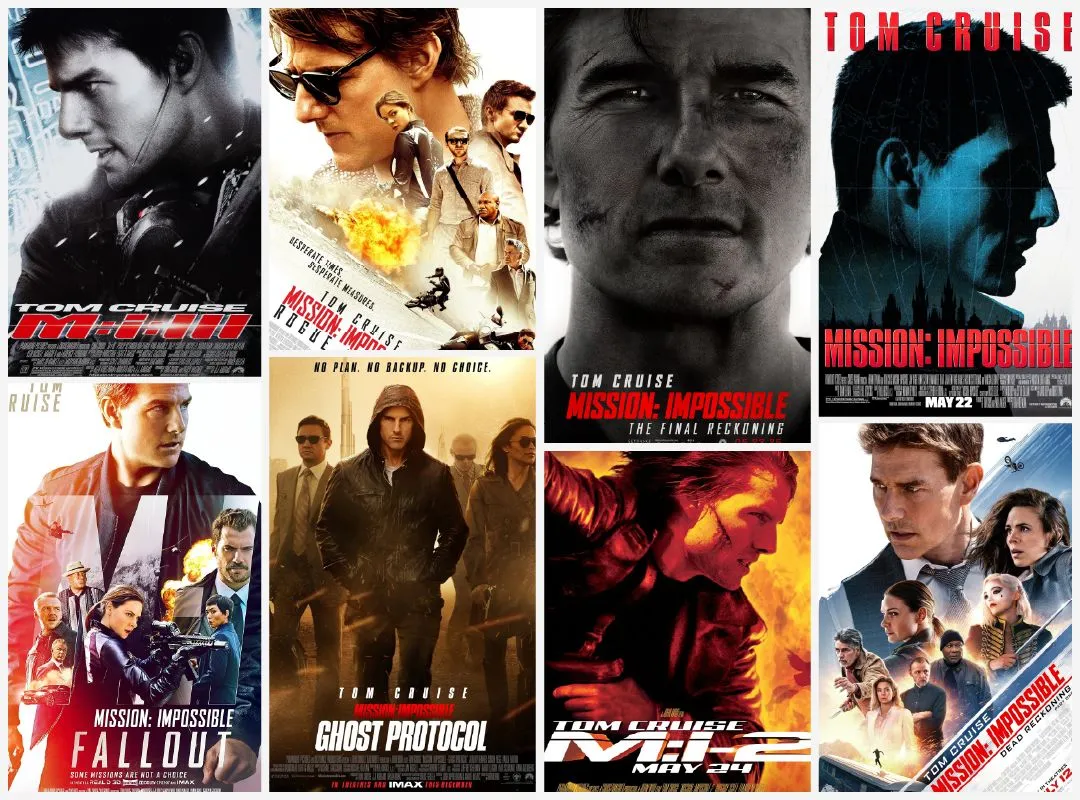
This ranking looks at direction, how stunts function as storytelling, score, screenplay, and how each film holds up on rewatch. Below is the full lineup of all eight Mission Impossible movies, ordered by craft.
The Ranking (By Craft) at a Glance
| Rank | Film | Year | Director |
| 1 | Mission: Impossible – Fallout | 2018 | Christopher McQuarrie |
| 2 | Mission: Impossible (1996) | 1996 | Brian De Palma |
| 3 | Mission: Impossible – Rogue Nation | 2015 | Christopher McQuarrie |
| 4 | Mission: Impossible – Ghost Protocol | 2011 | Brad Bird |
| 5 | Mission: Impossible III | 2006 | J.J. Abrams |
| 6 | Mission: Impossible – Dead Reckoning Part One | 2023 | Christopher McQuarrie |
| 7 | Mission: Impossible – The Final Reckoning | 2025 | Christopher McQuarrie |
| 8 | Mission: Impossible 2 | 2000 | John Woo |
1. Mission: Impossible – Fallout (2018) — Dir. Christopher McQuarrie
“The bar, now buried six feet under.”
https://www.youtube.com/watch?v=G7iQIfVr8Bk
If you're going to argue that an action movie can be a genuine work of craft, Mission: Impossible – Fallout (2018) is the film you put on the table. Christopher McQuarrie had already directed Rogue Nation, but Fallout is where everything locked in—script, stunt design, score, and performance. The plot is a direct continuation of Rogue Nation, with Solomon Lane back in play and a new threat involving plutonium cores, but McQuarrie's screenplay treats the action as character work. Every set piece reveals something. Ethan Hunt isn't shown saving the world for nothing; he's shown saving the world even when it costs him.
The HALO jump over Paris is the stunt everyone remembers. Tom Cruise became the first actor to perform a HALO (High Altitude, Low Open) jump on camera, leaping from 25,000 feet at speeds reaching 200 mph. The sequence required 106 jumps over multiple shoots to capture the three usable takes that ended up in the film. The Paris motorcycle chase, the bathroom fight in Paris, and the helicopter finale in Kashmir (filmed in New Zealand) are all built on the same principle: the camera stays close, the cuts are minimal, and the geography is always legible. You always know where everyone is. That clarity is craft.
Lorne Balfe's score borrows Lalo Schifrin's original theme but pushes it into something genuinely propulsive, especially in the final helicopter sequence. The film grossed over $791 million worldwide, the highest of the franchise at the time. As an entry point, it's the cleanest case for the series being more than just stunts.
2. Mission: Impossible (1996) — Dir. Brian De Palma
“Suspense, latex masks, and that iconic wire drop”
https://www.youtube.com/watch?v=L8Pbjh4EZRk
The film that started everything. Mission: Impossible (1996) was directed by Brian De Palma, a filmmaker who built his career on Hitchcockian suspense, voyeurism, and split diopter shots, and he brought all of it to the franchise reboot. This isn't an action movie in the modern sense. It's a paranoid spy thriller with one big heist scene that everyone has seen parodied a hundred times—Ethan Hunt, suspended on a wire, sweat dripping toward a pressure-sensitive floor in the CIA's Langley vault.
The film established Tom Cruise as Ethan Hunt, an IMF agent framed for the murder of his team in Prague after a botched mission. The script, by David Koepp and Robert Towne, is dense and unforgiving. Names get dropped, double-crosses pile up, and the audience is expected to keep up. De Palma frames everything with intent—close-ups linger, wide shots reveal information, and the train sequence in the climax uses real models and minimal CGI in a way that has aged remarkably well.
Danny Elfman composed the score, weaving Lalo Schifrin's iconic theme into a darker, more orchestral palette. The 5/4 time signature of the original theme—written by Schifrin in 1966—gets preserved here in a way no later film matches. The U2-adjacent techno version of the theme by Larry Mullen Jr. and Adam Clayton plays over the end credits, but Elfman's actual score is moodier and more restrained. Of all the Mission: Impossible movies, this is the one that feels least like a franchise entry and most like a standalone film. That's a compliment.
3. Mission: Impossible – Rogue Nation (2015) — Dir. Christopher McQuarrie
“The opera, the plane, and the birth of the modern Ethan”
https://www.youtube.com/watch?v=TUrJ5x43AQU
Rogue Nation is the film where the franchise found its long-term director. Christopher McQuarrie, an Oscar winner for The Usual Suspects screenplay, took the reins and stayed. The film introduces the Syndicate, a shadow organization of disavowed agents, led by Solomon Lane (Sean Harris). It also introduces Rebecca Ferguson as Ilsa Faust, the most fully realized non-Ethan character the series has produced.
The plane stunt opens the film. Tom Cruise hangs off the side of an Airbus A400M Atlas as it takes off from RAF Wittering in the UK, with no stunt double and no CGI plane. Cruise was strapped to the aircraft via a body harness that was digitally removed in post. The plane took off eight times to get the shot, with Cruise at times suspended over 5,000 feet in the air. But the standout sequence isn't the plane — it's the Vienna State Opera scene, where an assassination attempt during a performance of Turandot turns into a five-way standoff scored to Puccini. It's pure De Palma in spirit, and McQuarrie handles it with patience.
Joe Kraemer's score is the most theme-faithful of the series after Elfman's. He broke down Schifrin's original measure by measure and rebuilt it, leaning into the campiness rather than running from it. Benji Dunn (Simon Pegg) gets his own theme, derived from Schifrin's TV cue "The Plot." The film is leaner than Fallout, and some prefer it for that reason. It made $710.9 million worldwide.
4. Mission: Impossible – Ghost Protocol (2011) — Dir. Brad Bird
“One skyscraper. One glove. Zero safety net.”
https://www.youtube.com/watch?v=TUrJ5x43AQU
Brad Bird had never directed a live-action film before Ghost Protocol. He came from Pixar, where he made The Incredibles and Ratatouille, and his animator's instinct for spatial storytelling shows in every set piece. The Burj Khalifa sequence with Tom Cruise climbing the world's tallest building in Dubai using suction gloves is the obvious centerpiece, but the real craft is in the smaller geometry. The Kremlin escape. The sandstorm chase. The automated parking garage finale. Bird stages each one like an animator: clean lines, clear stakes, and visible cause and effect.
The plot follows Ethan Hunt and his team after the IMF is disavowed for allegedly bombing the Kremlin. They're forced to operate without backup as they hunt a nuclear extremist. Jeremy Renner joins the cast as William Brandt, and Simon Pegg's Benji is promoted from technician to field agent. Michael Giacchino's score, his second for the franchise after Mission: Impossible III, is muscular and direct. Ghost Protocol revitalised the series after a gap, grossing $694 million worldwide and becoming the franchise's highest earner until Fallout topped it in 2018.
What keeps it just outside the top three is its plot, which is functional rather than memorable. The villain is forgettable. But as a directorial showcase, this is one of the cleanest action films of the 2010s.
5. Mission: Impossible III (2006) — Dir. J.J. Abrams
“Philip Seymour Hoffman made Ethan Hunt bleed.”
https://www.youtube.com/watch?v=4oVva0muTE8
J.J. Abrams made his feature directing debut on Mission: Impossible III, fresh off Lost and Alias. The TV instinct shows. This is the most character-driven film in the series. It is the first to give Ethan Hunt a personal life, a fiancée (Julia, played by Michelle Monaghan), and a sense of cost. It's also the film that introduced Simon Pegg as Benji Dunn and brought Ving Rhames' Luther back into the foreground.
Philip Seymour Hoffman plays the villain, Owen Davian, an arms dealer whose menace is built from stillness rather than action. The opening scene — Davian threatening to count to ten while Julia is held at gunpoint is one of the best villain introductions in any franchise film, full stop. Abrams structures the film around emotion in a way none of the previous entries had attempted. The Vatican break-in is fun. The Shanghai sequence is well-staged. But the film's real engine is the relationship between Ethan and Julia.
The film grossed over $399 million globally, the lowest take of the franchise to that point, but critically, it was a step up from Mission: Impossible 2. Michael Giacchino's first score for the series leans on Lalo Schifrin's theme more reverentially than Hans Zimmer's did in the previous film. Abrams went on to direct Star Trek, Star Wars: The Force Awakens, and The Rise of Skywalker, but Mission: Impossible III remains one of his sharpest pieces of work.
6. Mission: Impossible – Dead Reckoning Part One (2023) — Dir. Christopher McQuarrie
“A train, a cliff, and a very bad day for AI”
https://www.youtube.com/watch?v=oCurvEP1zA4
Mission: Impossible – Dead Reckoning Part One is Christopher McQuarrie's third film as director in the franchise. It introduces the Entity, a rogue AI that's compromised global intelligence networks, and frames it as the most existential threat Ethan Hunt has ever faced. The film also brings back Henry Czerny as Eugene Kittridge, last seen in the 1996 original, and adds Hayley Atwell as Grace, a pickpocket pulled into Ethan's orbit.
The motorcycle BASE jump in Norway is the headline stunt. Tom Cruise rode a motorcycle off a cliff at Helsetkopen, separated cleanly in mid-air, and parachuted to the ground. It was filmed on the first day of principal photography — a deliberate choice by McQuarrie, who wanted to know whether they had a movie before committing months to it. The preparation involved over 13,000 motocross jumps and 500 skydives.
So why is it ranked here and not higher? The pacing. The film is 163 minutes long, and the middle stretches under the weight of exposition. The Entity is conceptually interesting but visually inert — there's no face to fight, no body to chase. The Venice sequence is gorgeous. The train climax is a marvel of practical effects, with a real steam locomotive plunging off a real bridge in Derbyshire. But the film's status as Part One means it's structurally incomplete by design, and that's a weight no amount of craft can fully lift. The film grossed $567.5 million worldwide, below studio expectations.
7. Mission: Impossible – The Final Reckoning (2025) — Dir. Christopher McQuarrie
“The last run. No masks. No backup.”
https://www.youtube.com/watch?v=dOst_jNFpPY
Mission: Impossible – The Final Reckoning is the eighth and, per Tom Cruise's own statements, final film in the franchise. Christopher McQuarrie returns as director and co-writer with Erik Jendresen. The film picks up two months after Dead Reckoning Part One, with Ethan Hunt racing to retrieve the Entity's source code from a sunken Russian submarine in the Arctic. It had its world premiere in Tokyo on May 5, 2025, before screening out of competition at the 78th Cannes Film Festival on May 14, 2025, ahead of its theatrical release on May 23.
The set pieces deliver. The underwater submarine sequence is one of the most original action sequences the franchise has produced, with Cruise navigating a flooded, tilting wreck with practical ingenuity. The biplane finale, in which Cruise hangs off the wing of a vintage aircraft mid-flight, is genuinely spectacular and was shot for real in South Africa. But the film's biggest weakness is its screenplay. The first hour is dense with exposition, recapping events from earlier films through flashbacks and dialogue that explain rather than dramatise. Several reviews flagged the same issue: too much setup, not enough forward motion.
The score was originally composed by Lorne Balfe, who scored both Fallout and Dead Reckoning Part One, but he was replaced in April 2025 by Max Aruj and Alfie Godfrey. The film grossed $598.8 million worldwide on a reported $300–400 million budget, making it a box office disappointment despite having the franchise's largest opening weekend at $79 million. As a sendoff, it gets the job done. As a piece of craft, it's the weakest of McQuarrie's four entries.
8. Mission: Impossible 2 (2000) — Dir. John Woo
“Doves, slow-motion kicks, and a motorcycle joust”
https://www.youtube.com/watch?v=hSPtsCQq52k
There's no kind way to put this: Mission: Impossible 2 is the weakest film in the franchise, and most fans, critics, and even the people who made the later films would agree. John Woo, the Hong Kong action master behind Hard Boiled and The Killer, was a fascinating choice on paper. In practice, his style with slow-motion, doves, two-handed gunplay, and operatic excess doesn't fit the espionage DNA of Mission: Impossible. The film plays as a Woo film with Tom Cruise dropped into it.
The plot, written by Robert Towne from a story by Ronald D. Moore and Brannon Braga, follows Ethan Hunt as he's sent to retrieve a bioweapon called Chimera from a rogue IMF agent, Sean Ambrose, played by Dougray Scott. Thandiwe Newton plays Nyah Nordoff-Hall, a thief recruited as bait. The romance subplot is meant to give the film emotional weight, but instead grinds the pacing to a halt. The motorcycle showdown in the climax leans so heavily on slow motion that it borders on parody.
Hans Zimmer's score is the loudest of the series, leaning into Spanish guitar and Limp Bizkit-adjacent rock textures that date the film hard. Despite all this, Mission: Impossible 2 grossed over $546 million globally, the highest of the franchise at the time. It exists as a curiosity — proof that auteur filmmaking and franchise filmmaking don't always mix.
Final Thoughts
If you want to watch Mission Impossible sequentially, start with Mission: Impossible (1996) and work forward. The Mission Impossible chronological order matches the release order, which makes things simple. The franchise's biggest strength is also its biggest oddity: each film is genuinely a different filmmaker's vision of what an Ethan Hunt movie can be. Brian De Palma's paranoid thriller, John Woo's romantic action opera, J.J. Abrams's character study, Brad Bird's geometric spectacle, and Christopher McQuarrie's sustained craftsmanship — they all add up to one of the most stylistically varied action franchises ever made.
The fact that Tom Cruise is in every frame of every film, doing his own stunts, and pushing each director toward bigger and more practical sequences, is what holds it together. The fact that the films keep arguing with each other about what kind of franchise this is that's what makes ranking them by craft worth doing in the first place.

.webp)