

Streaming availability verified via JustWatch for the United States, July 2026. Streaming rights change frequently. Always check JustWatch.com for current availability in your region before watching.
Cinema's most durable philosophical question isn't "what is love" or "what is death." It's "what is real." From Ingmar Bergman's Persona (1966) to the Daniels' Everything Everywhere All at Once (2022), filmmakers have used the medium to blur the line between reality and illusion, because film, as a form, is uniquely suited to the question. The 25 movies below are the essential ones. They are not the 25 weirdest films ever made, and they are not the 25 hardest to follow.
They are the 25 that operate in four distinct structural modes: dream-and-waking merger, character-perception distortion, world-scale simulation, and metaphysical destabilization. And they do it at the highest level of craft.This article introduces the Four Ways Cinema Blurs Reality: a framework that sorts the genre into the Dream Blur, the Mind Blur, the World Blur, and the Metaphysical Blur. The 25 films are distributed across the four modes (5, 8, 5, and 7 films respectively). Recognizing which mode a film operates in is what turns a viewing into film literacy. Each section below explains one mode's mechanism, then walks through the films that exemplify it.
Why "Reality vs. Illusion" Is Cinema's Most Cinema-Specific Theme
Every art form can address the reality-illusion question in some way. Literature can describe dreams; theater can stage them; painting can render them. But cinema does something the other forms can't: it presents images and sounds to a viewer with the same immediacy that reality itself has. When a film cuts from a "real" scene to a "dream" scene, both arrive through the same channel, light on a screen and sound in the room. That structural fact is why reality-illusion is cinema's most cinema-specific theme.
The medium is the mechanism: A novel that describes a dream still uses words, the same words the "real" scenes use, but the reader knows the dream is a dream because the language marks it. Film has no equivalent structural marker. When Mulholland Drive cuts from Betty's Hollywood ambition to Diane's Los Angeles collapse, both halves are equally photographed, equally scored, equally continuous with the film's aesthetic universe. The technology itself does not distinguish between real and imagined. The audience has to.
The audience is the second author: Every reality-blur film requires the viewer to actively decide what's real. Novels give you a narrator; paintings give you a stable representation. Reality-blur films withhold that stability. Watch Fight Club and you are being asked, in real time, to determine what has actually happened. The best films in this space design their images and their editing to allow multiple defensible readings, which is why they reward rewatching in ways ordinary films don't.
The theme keeps returning: Because the medium keeps making it possible. Every decade of the past 60 years has produced canonical reality-blur cinema: Bergman in the 60s, Polanski across the 60s and 70s, Kubrick in the 80s, Cronenberg through the 80s and 90s, Lynch and Kaufman in the 90s and 2000s, Nolan and Villeneuve in the 2010s, the Daniels in the 2020s. As long as cameras keep rolling, filmmakers will keep asking "what is real," because cinema is the form that can literalize the question.
The Four Ways Cinema Blurs Reality
Films that blur reality and illusion do so through four structurally distinct mechanisms, and the framework below names them. Every film in this article's 25 sits primarily in one mode. Understanding which mode a film operates in is what turns viewing into literacy.
Mode 1: The Dream Blur
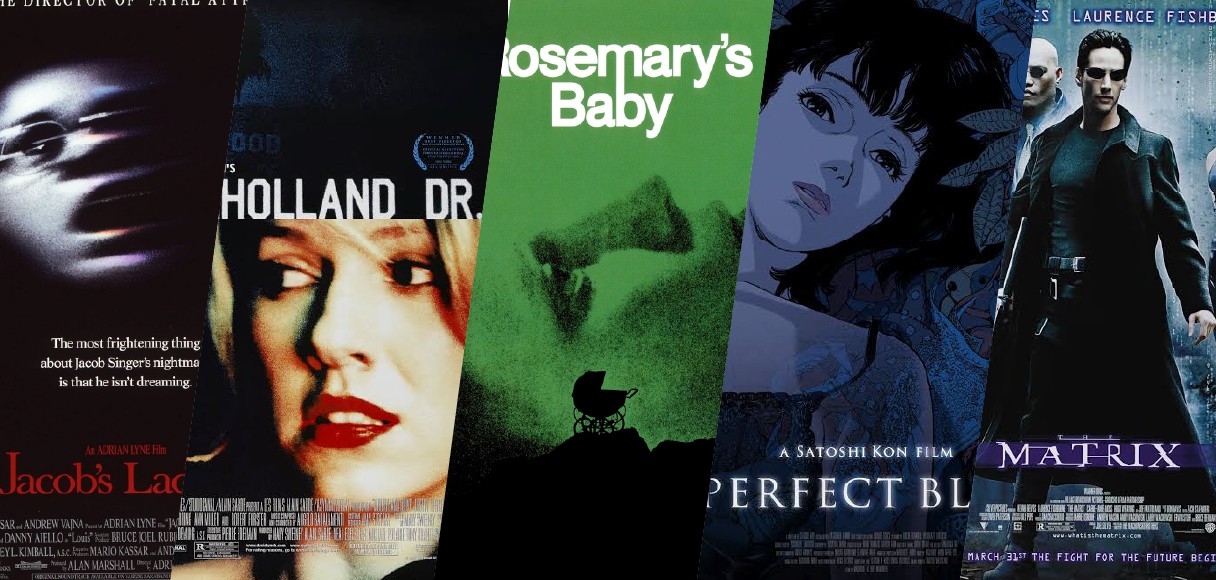
Mode 1 is temporal-structural. Films in this mode include sequences that are, or might be, dreams, hallucinations, afterlives, or memories that the film treats as diegetically ambiguous: the audience isn't sure whether what's on screen is happening in the story's "reality" or in some layer beneath it. Jacob's Ladder (1990), Mulholland Drive (2001), Vanilla Sky (2001), Paprika (2006), and Inception (2010) are the mode's canonical examples. The Dream Blur has been cinema's most-explored mode since German Expressionism; every era of film has produced classics of the type.
Mode 2: The Mind Blur
Mode 2 is character-anchored. Films in this mode locate the reality-illusion mechanism inside a specific character's perception: mental illness, trauma, isolation, or delusion has systematically distorted what that character, and through them the audience, sees. Rosemary's Baby (1968), The Shining (1980), Perfect Blue (1997), Fight Club (1999), The Sixth Sense (1999), Donnie Darko (2001), Shutter Island (2010), and Black Swan (2010) are the mode's canonical examples. Mode 2 is this article's largest category because it is horror-adjacent, and horror is where character-perception distortion most commonly lives.
Mode 3: The World Blur
Mode 3 is world-scale. Films in this mode reveal that the reality the characters inhabit is itself manufactured: a simulation, a controlled environment, a designed test. When the ontological rug gets pulled, everything the audience thought they knew about the film's universe is destabilized. Videodrome (1983), Total Recall (1990), The Truman Show (1998), The Matrix (1999), and eXistenZ (1999) are the mode's canonical examples. Mode 3 is science fiction's specific contribution to the reality-illusion theme.
Mode 4: The Metaphysical Blur
Mode 4 is conceptual. Films in this mode make a philosophical argument that the reality-illusion question is malformed: identity, causation, memory, or existence itself doesn't work the way we assume. These films typically refuse to resolve which layer is "real" because they are arguing that "real" was never the right category. Persona (1966), Being John Malkovich (1999), Memento (2000), Eternal Sunshine of the Spotless Mind (2004), Synecdoche, New York (2008), Enemy (2013), and Everything Everywhere All at Once (2022) are the mode's canonical examples. Mode 4 films are the most cinephile-loved and reward repeat viewings more than any other mode. For adjacent picks across our psychological catalogue, see [INTERNAL LINK: most closely related psychological/mind-bending cluster piece].
Mode 1: The Dream Blur. Where Dreams and Waking Life Merge
The five films below merge dream states and waking reality until neither remains stable. The mechanism is temporal-structural: the film's timeline includes sequences the audience can't confidently locate as real or dreamt. Presented in chronological order.
Jacob's Ladder (1990) Mode 1: The Dream Blur
https://www.youtube.com/watch?v=tLulu1Ovi2c
Where to Watch (US): Streaming on MGM+. Free with ads on YouTube. Free with a library card on Kanopy and Hoopla. Rent or buy on Apple TV, Amazon Video and Fandango at Home.
The premise: Jacob Singer (Tim Robbins), a Vietnam War veteran working as a postal employee in New York, begins experiencing hallucinations that suggest his mind is being pulled between multiple realities: the war, his current life, and something else.
The specific blur: The timeline includes sequences the audience is meant to distrust from the start, but the film refuses to identify which are "real" until its final reveal. Every scene could be Jacob's actual life, his war-induced hallucination, his post-mortem experience, or something else entirely.
Why it belongs in this mode: Jacob's Ladder is the mode's clearest late-20th-century statement. Adrian Lyne treats every reality layer with equal weight; the mundane and the horrific look and sound like each other. The film's visual influence on later Dream Blur horror, particularly the Silent Hill video game series, is substantial and well documented.
The scene that crystallizes the blur: The hospital gurney sequence, in which Jacob is wheeled through a corridor that keeps distorting, Lyne's camera making the environment itself unreliable.
The Screendollars Take: Jacob's Ladder is not a horror film about demons. It is a film about a mind negotiating its own exit. Lyne shoots the hospital corridor with the same flat naturalism he gives the post office, which is precisely why the horror lands: nothing announces itself as unreal, so nothing can be dismissed as unreal. The vibrating faces, achieved in-camera at low frame rates, feel wrong in a way digital effects never manage. The ladder goes down before it goes up. Watch where Jacob stops climbing.
Mulholland Drive (2001) Mode 1: The Dream Blur
https://www.youtube.com/watch?v=jbZJ487oJlY
Where to Watch (US): No subscription streaming in the US. Rent or buy on Apple TV, Amazon Video and Fandango at Home.
The premise: Betty Elms (Naomi Watts), a bright-eyed young actress newly arrived in Los Angeles, encounters an amnesiac woman (Laura Harring) hiding in her aunt's apartment. Together they try to piece together the amnesiac's identity, until the film pivots into something structurally different.
The specific blur: The first two-thirds is a coherent Hollywood dream. The final third is what fans have argued about for two decades: either the "real" story the dream was covering, another dream layer, or a metaphysical statement about identity. The film refuses to resolve the ambiguity.
Why it belongs in this mode: Mulholland Drive is the mode's masterwork, ranked the greatest film of the 21st century in BBC Culture's 2016 critics poll and placed in the top ten of Sight and Sound's 2022 decennial poll. David Lynch gives every scene the same aesthetic weight, which is the mode's central technique. Naomi Watts's dual performance across the film's two layers is one of the most-cited acting achievements of the century.
The scene that crystallizes the blur: The Club Silencio sequence, where Lynch makes the film's structural argument explicit: "No hay banda. Il n'y a pas d'orchestre." It is all recorded.
Vanilla Sky (2001) Mode 1: The Dream Blur
https://www.youtube.com/watch?v=k09OX40NLUw
Where to Watch (US): Streaming on Paramount+, fuboTV and MGM+. Free with a library card on Kanopy. Rent or buy on Apple TV, Amazon Video and Fandango at Home.
The premise: David Aames (Tom Cruise), a wealthy Manhattan magazine publisher, is disfigured in a car crash caused by a jealous lover (Cameron Diaz). Dreams, memories, and possibly a cryogenically preserved lucid dream then layer over what he thinks is happening. Penélope Cruz reprises her role from Abre los ojos (1997).
The specific blur: The central mechanism is that David may be inside a lucid dream supplied by a cryonics company after his death. The audience is meant to stay uncertain until near the end about which sequences are lived, which are the dream, and which are the dream corrupting.
Why it belongs in this mode: Vanilla Sky remakes Alejandro Amenábar's Abre los ojos (1997) yet stands as Cameron Crowe's most ambitious film and one of the mode's most-underrated entries. Critics were divided at release, and the 41 percent critical approval rating still undersells it; the 72 percent audience score and two decades of cult reappraisal have moved its stature upward.
The scene that crystallizes the blur: The empty Times Square opening, Crowe telegraphing the dream logic from the very first sequence.
Paprika (2006) Mode 1: The Dream Blur
https://www.youtube.com/watch?v=PIUqozzyW2k
Where to Watch (US): Streaming on Sony Pictures Core via Amazon Channels. Free with ads on Tubi. Rent or buy on Apple TV, Amazon Video and Fandango at Home.
The premise: A device called the DC Mini lets therapists enter their patients' dreams. When several DC Minis are stolen, dreams and waking life begin to bleed into each other, endangering both. Dr. Chiba, whose dream avatar is the fearless Paprika, navigates the collapse.
The specific blur: Paprika is the mode's animated masterwork, a film whose visual grammar makes the dream-reality collapse literally undrawable in any other medium. When dreams begin invading waking life, Kon's animation renders the invasion visible in ways live action cannot.
Why it belongs in this mode: Satoshi Kon, who died in 2010, is the mode's most consistent auteur; Perfect Blue, Millennium Actress, Paprika, and the series Paranoia Agent all work overlapping reality-illusion territory. Paprika's dream-invasion imagery is widely cited as an influence on Christopher Nolan's Inception (2010), a lineage legible on screen even without confirmation.
The scene that crystallizes the blur: The parade sequence, a marching procession of dream imagery flooding the waking world, one of the most-referenced animation sequences of the 2000s.
Inception (2010) Mode 1: The Dream Blur
https://www.youtube.com/watch?v=YoHD9XEInc0
Where to Watch (US): Streaming on HBO Max. Rent or buy on Apple TV, Amazon Video and Fandango at Home.
The premise: Dom Cobb (Leonardo DiCaprio) leads a team of specialists who enter people's dreams to steal ideas, or, in the film's central heist, to plant one. A corporate client's job sends the team into a dream within a dream within a dream.
The specific blur: Inception's architecture is nested, from a waking world down through dream levels to limbo. The famous ambiguous ending refuses to identify which layer Cobb finishes the story in, keeping the reality question open by design.
Why it belongs in this mode: Inception is the mode's biggest mainstream expression, a roughly $160 million production that made reality-blur commercially viable at studio scale. Nolan gives every dream layer distinct visual and physics rules while keeping the structure legible to a global audience that pushed it past $828 million worldwide in its original run, and to $839.8 million lifetime after rereleases as of July 2026.
The scene that crystallizes the blur: The final spinning-top shot, Nolan cutting to black before the top falls or keeps spinning, forcing the audience to complete the reality question themselves.
Mode 2: The Mind Blur. When a Character's Perception Becomes the Prison
The eight films below locate the reality-illusion mechanism inside a single character's perception. Mental illness, trauma, isolation, delusion, or supernatural interference has distorted what the character, and through them the audience, sees. Presented in chronological order.
Rosemary's Baby (1968) Mode 2: The Mind Blur
https://www.youtube.com/watch?v=BjpA6IH_Skc
Where to Watch (US): Streaming on Paramount+ and fuboTV. Free with a library card on Kanopy. Rent or buy on Apple TV, Amazon Video and Fandango at Home.
The premise: Newlywed Rosemary Woodhouse (Mia Farrow) and her actor husband Guy (John Cassavetes) move into a New York apartment building whose elderly neighbors take an unusual interest in her pregnancy. Rosemary becomes convinced something is very wrong.
The specific blur: The central question, whether Rosemary's paranoia is justified or she is misreading her environment through pregnancy-related distress, is deliberately unresolved until the final act. Every scene works whether Rosemary is right or delusional.
Why it belongs in this mode: Rosemary's Baby is the mode's foundational modern statement. Polanski stays inside Rosemary's perceptual world without ever confirming or denying her reading of it. Mia Farrow's performance carries the film; every look she gives has to work as either justified terror or hormonal paranoia, and it does.
The scene that crystallizes the blur: The dream sequence aboard the yacht that becomes a Satanic rite, Polanski showing Rosemary's mental state while keeping the audience unsure whether it is revelation or breakdown.
The Shining (1980) Mode 2: The Mind Blur
https://www.youtube.com/watch?v=S014oGZiSdI
Where to Watch (US): No subscription streaming in the US. Rent or buy on Apple TV, Amazon Video, Fandango at Home and Plex.
The premise: Jack Torrance (Jack Nicholson), his wife Wendy (Shelley Duvall), and their psychic son Danny (Danny Lloyd) take winter caretaker duties at the isolated Overlook Hotel. The hotel's supernatural presence, or Jack's collapse into violence, or both, begins to consume the family.
The specific blur: The ambiguity here is not "is it real or in his head" but "which is worse." Kubrick refuses to identify the Overlook's ghosts as clearly supernatural or clearly hallucinatory; the film's power depends on both readings staying simultaneously available.
Why it belongs in this mode: The Shining is the mode's most-analyzed film; the documentary Room 237 (2012) exists purely to catalogue the interpretations viewers have brought to it. Kubrick builds every shot to work at multiple reading levels, making this the mode's most technically ambitious version.
The scene that crystallizes the blur: The "Here's Johnny!" bathroom door, Kubrick collapsing Jack's psychological state and the hotel's supernatural pressure into a single unforgettable image.
Perfect Blue (1997) Mode 2: The Mind Blur
https://www.youtube.com/watch?v=2O09gQC-KvA
Where to Watch (US): Streaming on HBO Max. Rent or buy on Apple TV, Amazon Video and Fandango at Home.
The premise: Mima Kirigoe, a J-pop idol turning to serious acting, begins losing her grip on reality. A stalker impersonates her online, her acting role demands disturbing material, and her identity fractures between the pop star she was, the actress she is becoming, and the fan-owned version she can no longer control.
The specific blur: Perfect Blue is the mode's animated masterwork. Kon uses animation's specific capabilities, impossible cuts, subjective transitions, and character-swap moments, to render Mima's psychological fragmentation in ways live action can't match.
Why it belongs in this mode: Perfect Blue has been widely cited as an influence on Black Swan (2010) and Requiem for a Dream (2000), and Kon's debut remains the most-referenced example of what animation can do for the reality-blur theme. Its pre-broadband portrait of online identity has aged into prophecy.
The scene that crystallizes the blur: The mirror-and-double sequence, where Mima confronts a version of herself who claims to be the "real" Mima.
Fight Club (1999) Mode 2: The Mind Blur
https://www.youtube.com/watch?v=qtRKdVHc-cE
Where to Watch (US): No subscription streaming in the US. Rent or buy on Apple TV, Amazon Video and Fandango at Home.
The premise: An unnamed insomniac narrator (Edward Norton) drowning in consumerist ennui meets Tyler Durden (Brad Pitt), a soap maker with an anarchist streak. The two start a fight club that becomes a movement.
The specific blur: The narrator's reality is corrupted, but the film reveals how corrupted only in its final act. Every scene between the narrator and Tyler retroactively takes on new meaning after the reveal, which is the mode's specific pleasure.
Why it belongs in this mode: Fight Club is the mode's most-quoted late-1990s entry. Fincher seeds the fracture throughout the runtime: subliminal single frames of Tyler in the early reels, staging that keeps the two men from ever being addressed together, sound design that isolates them. The reveal is engineered to survive the rewatch.
The scene that crystallizes the blur: The moment the narrator understands what Tyler is, Fincher cutting back through earlier scenes to show what was always visible if the audience knew where to look.
The Sixth Sense (1999) Mode 2: The Mind Blur
https://www.youtube.com/watch?v=3-ZP95NF_Wk
Where to Watch (US): Streaming on AMC+ and Philo. Rent or buy on Apple TV, Amazon Video and Fandango at Home.
The premise: Child psychologist Malcolm Crowe (Bruce Willis) works to help a troubled young boy, Cole Sear (Haley Joel Osment), who claims to see dead people.
The specific blur: The twist, one of cinema's most-cited, recontextualizes the entire viewing experience. Every scene the audience has watched must be reread in light of what turns out to have been true from the beginning.
Why it belongs in this mode: The Sixth Sense is the mode's most commercially successful entry, taking roughly $672.8 million worldwide on an approximately $40 million budget. Shyamalan seeds the reality clue through the whole film, and the dual-reading design is exemplary: every scene works twice.
The scene that crystallizes the blur: The final wedding-ring revelation, Shyamalan letting Malcolm Crowe understand what the audience is simultaneously being shown.
Donnie Darko (2001) Mode 2: The Mind Blur
https://www.youtube.com/watch?v=bzLn8sYeM9o
Where to Watch (US): Streaming on Prime Video and Hulu. Free with ads on Pluto TV and The Roku Channel. Rent or buy on Apple TV, Amazon Video and Fandango at Home. Listings cover the theatrical cut and the Director's Cut interchangeably, so confirm which version a platform is carrying.
The premise: Donnie Darko (Jake Gyllenhaal), a troubled suburban teenager, is visited by a man in a monstrous rabbit suit named Frank, who tells him the world will end in 28 days, 6 hours, 42 minutes, and 12 seconds. The timeline and Donnie's mental state deteriorate in parallel.
The specific blur: The core question, whether Donnie is schizophrenic, a time-traveling prophet, or already dead, remains contested more than two decades after release. Kelly's later Director's Cut clarified his own intent, but the theatrical ambiguity remains the point.
Why it belongs in this mode: Donnie Darko is the mode's cult classic, a film whose reputation grew steadily from its 2001 theatrical failure to defining-film-of-its-era status. Gyllenhaal's central performance is his breakthrough, holding medicated flatness and messianic certainty in the same face.
The scene that crystallizes the blur: The "Head Over Heels" hallway tracking shot, Kelly's camera making Donnie's world simultaneously beautiful and ominously wrong.
Shutter Island (2010) Mode 2: The Mind Blur
https://www.youtube.com/watch?v=v8yrZSkKxTA
Where to Watch (US): Streaming on MGM+, fuboTV and Philo. Rent or buy on Apple TV, Amazon Video and Fandango at Home.
The premise: U.S. Marshals Teddy Daniels (Leonardo DiCaprio) and Chuck Aule (Mark Ruffalo) travel to Shutter Island's Ashecliffe Hospital for the criminally insane to investigate a patient's disappearance. What they find undermines Teddy's sense of reality.
The specific blur: Shutter Island is one of the mode's most controlled entries; Scorsese seeds the reality clues from the film's opening minutes. Every scene retroactively works differently after the reveal, the mode's central pleasure executed with old-studio confidence.
Why it belongs in this mode: Scorsese handles the mechanism like a filmmaker who knows he is working inside a tradition, borrowing the vocabulary of 1950s noir and gothic melodrama on purpose. The film has been reassessed upward since 2010; its 69 percent critical approval rating undersells what it achieves.
The scene that crystallizes the blur: The lighthouse revelation, Scorsese collapsing Teddy's investigation and his psychiatric reality into a single scene.
Black Swan (2010) Mode 2: The Mind Blur
https://www.youtube.com/watch?v=5jaI1XOB-bs
Where to Watch (US): No subscription streaming in the US. Rent or buy on Apple TV, Amazon Video and Fandango at Home.
The premise: Nina Sayers (Natalie Portman), a technically precise but emotionally repressed ballerina at a New York company, is cast as both the White Swan and the Black Swan in Swan Lake. The role demands she access something dangerous in herself, and the demand fractures her sanity.
The specific blur: Nina's perceptual world grows steadily unreliable. The audience sees her transformations, doppelgangers, and physical distortions from inside her perspective, and the film refuses to confirm what is real and what is her breakdown.
Why it belongs in this mode: Black Swan is the mode's most-cited modern female-lead entry, and it owes a reported debt to Perfect Blue; Aronofsky is reported to have acquired remake rights to Kon's film years earlier. Portman won the Academy Award for Best Actress for the performance.
The scene that crystallizes the blur: The dressing-room mirror sequence during the final performance, Aronofsky making Nina's transformation into the Black Swan literally visible.
Mode 3: The World Blur. When the Entire Reality Turns Out to Be Fake
The five films below reveal that the reality the characters inhabit is itself manufactured: a simulation, a controlled environment, or a designed test. When the ontological rug gets pulled, everything about the film's universe is destabilized. Presented in chronological order. It is worth noting that 1999 alone supplies two of these five films, with The Thirteenth Floor narrowly missing the list from the same year; the pre-millennium moment produced simulation cinema in a concentrated burst.
Videodrome (1983) Mode 3: The World Blur
https://www.youtube.com/watch?v=wFRAwig4rU8
Where to Watch (US): No subscription streaming in the US. Rent or buy on Apple TV, Amazon Video and Fandango at Home.
The premise: Max Renn (James Woods), a sleazy Toronto cable television executive, discovers a mysterious broadcast signal called Videodrome that appears to show real torture and murder. As he investigates, the boundary between the broadcast and his own life dissolves.
The specific blur: Videodrome is the mode's most prescient entry, a 1983 film about media technology rewriting reality that has aged into prophecy. Max's world is being manipulated by broadcast signals, corporate conspiracy, and possibly his own hallucinations, and the film refuses to separate them.
Why it belongs in this mode: Cronenberg stages the World Blur as body horror: Max's hand becomes a gun, his stomach becomes a videocassette slot, reality itself becomes a media artifact. Nearly every subsequent media-critical horror film sits downstream of it, and "long live the new flesh" has entered cinematic vocabulary.
The scene that crystallizes the blur: The moment Max's stomach opens to receive a VHS tape, Cronenberg literalizing the theme in a single image.
Total Recall (1990) Mode 3: The World Blur
https://www.youtube.com/watch?v=Mw1V8wxtnA0
Where to Watch (US): Streaming on MGM+, Paramount+, fuboTV and Philo. Rent or buy on Apple TV, Amazon Video and Fandango at Home.
The premise: In 2084, construction worker Douglas Quaid (Arnold Schwarzenegger) buys an implanted memory vacation to Mars from a company called Rekall. Something goes wrong in the chair, and Quaid discovers he may already be a Martian secret agent whose memories were suppressed. Or he may still be in the implant.
The specific blur: Total Recall refuses to confirm which interpretation is correct. The entire second half reads either as a real spy adventure Quaid was pulled back into or as the purchased vacation running to its programmed conclusion.
Why it belongs in this mode: Verhoeven's adaptation of Philip K. Dick's story "We Can Remember It for You Wholesale" is the mode's most successful mainstream blockbuster, earning roughly $261 million worldwide as 1990's fifth-highest grosser and a Special Achievement Academy Award for its effects. Schwarzenegger's performance holds both readings at once.
The scene that crystallizes the blur: The visit from Rekall's Dr. Edgemar, a "programmed reality" salesman appearing inside what is supposedly the real world to offer Quaid a pill.
The Truman Show (1998) Mode 3: The World Blur
https://www.youtube.com/watch?v=dlnmQbPGuls
Where to Watch (US): Streaming on Paramount+ and fuboTV. Free with a library card on Kanopy. Rent or buy on Apple TV, Amazon Video and Fandango at Home.
The premise: Truman Burbank (Jim Carrey), a cheerful insurance salesman in the idyllic town of Seahaven, doesn't know his entire life is broadcast as a reality television show: every person he knows is an actor, every event is arranged, and his world is a massive domed set.
The specific blur: The Truman Show runs the World Blur through comedy-drama rather than horror or science fiction. Truman's growing awareness of his artificial world drives the plot, and Weir keeps us inside Truman's perception until we grasp what he is inside.
Why it belongs in this mode: The Truman Show is the mode's most critically acclaimed entry at a 94 percent critical approval rating, and one of the most-referenced films of the late 1990s. Carrey's performance remade him as a dramatic actor, and the film has entered ordinary language: "Truman Show delusion" is now an informal clinical term for the belief that one's life is a staged broadcast.
The scene that crystallizes the blur: Truman's sailboat striking the painted wall of the dome, Weir letting the character discover what the audience has known all along.
The Matrix (1999) Mode 3: The World Blur
https://www.youtube.com/watch?v=vKQi3bBA1y8
Where to Watch (US): No subscription streaming in the US. Rent or buy on Apple TV, Amazon Video, Fandango at Home and Plex.
The premise: Thomas Anderson (Keanu Reeves), a programmer who moonlights as the hacker Neo, is contacted by figures who tell him his reality is a computer simulation. He must choose between his manufactured world and a devastated actual one where machines farm humans for energy.
The specific blur: The Matrix is the mode's most culturally dominant expression. Its red pill / blue pill mechanism has become permanent shorthand for the choice between comfortable illusion and uncomfortable truth.
Why it belongs in this mode: The Wachowskis stage the World Blur at blockbuster scale with Hong Kong action choreography, cyberpunk aesthetics, and a philosophical earnestness mainstream science fiction rarely sustains all at once. No subsequent World Blur film escapes its shadow.
The scene that crystallizes the blur: Neo's awakening in the pod, the Wachowskis showing the "real" world for the first time and letting the audience see what the simulation was covering.
eXistenZ (1999) Mode 3: The World Blur
https://www.youtube.com/watch?v=CXgOUa91GHg
Where to Watch (US): No subscription streaming in the US. Rent or buy on Apple TV, Amazon Video and Fandango at Home.
The premise: Allegra Geller (Jennifer Jason Leigh), a superstar game designer, is nearly assassinated while demonstrating her organic virtual-reality game eXistenZ. She and her reluctant bodyguard (Jude Law) plug into the game to protect it, and quickly can't tell where the game ends and reality begins.
The specific blur: Released in the same year as The Matrix, eXistenZ covers similar territory from a distinctly Cronenberg angle: fleshy, organic technology rather than clean digital code. Its nested structure refuses to resolve which layer is the real one.
Why it belongs in this mode: eXistenZ is Cronenberg's second entry in the mode after Videodrome, and it earned him the Silver Bear for outstanding artistic contribution at the 1999 Berlinale. The layers collapse into each other rather than stacking neatly, and the film's reputation has climbed steadily since release; some critics now rank it among his most underrated features.
The scene that crystallizes the blur: The final question, "are we still in the game?", aimed as much at the audience as at the characters, with Cronenberg refusing to answer.
Mode 4: The Metaphysical Blur. When Reality Itself Is the Wrong Category
The seven films below make a philosophical argument that the reality-illusion question is malformed: identity, causation, memory, or existence itself doesn't work the way we assume. These films typically don't resolve which layer is "real" because they argue that "real" was never the right category. Presented in chronological order.
Persona (1966) Mode 4: The Metaphysical Blur
https://www.youtube.com/watch?v=YEfJopPIbQg
Where to Watch (US): Streaming on HBO Max and Criterion Channel. Rent or buy on Apple TV, Amazon Video and Fandango at Home.
The premise: Elisabet Vogler (Liv Ullmann), a stage actress who has suddenly gone mute, retreats to a coastal cottage with her nurse, Alma (Bibi Andersson). Alma talks; Elisabet listens. As isolation compounds, the two women's identities begin to merge.
The specific blur: Persona is the mode's foundational text. Bergman blurs reality not through plot mechanism but through the film's grammar itself, using formal devices such as identical framing, superimposed faces, and a film strip that burns mid-scene to argue that individual identity is a fiction.
Why it belongs in this mode: Persona is one of the most-cited films of the 20th century. Bergman's direction, Sven Nykvist's cinematography, and Ullmann's and Andersson's performances produce a reality-blur that operates at a purely formal level; no character has to be "wrong" about anything for the film's central argument to land.
The scene that crystallizes the blur: The superimposition of Alma's and Elisabet's faces, Bergman making his metaphysical claim in a single composite frame.
Being John Malkovich (1999) Mode 4: The Metaphysical Blur
https://www.youtube.com/watch?v=LEtlqumjXLw
Where to Watch (US): No subscription streaming in the US. Rent or buy on Apple TV, Amazon Video and Fandango at Home.
The premise: Craig Schwartz (John Cusack), a struggling puppeteer, discovers a portal in his office building that drops whoever enters it into John Malkovich's head for fifteen minutes before ejecting them beside the New Jersey Turnpike. He and a coworker begin selling access.
The specific blur: Being John Malkovich turns the reality-illusion question into a comedy of identity. If you can occupy another person's perceptual apparatus, what happens to "you"? Charlie Kaufman's screenplay treats the question as generative rather than resolvable.
Why it belongs in this mode: Jonze handles Kaufman's high-concept material with deadpan visual precision, and Malkovich playing "John Malkovich" is one of the era's great comic performances. The film is Kaufman's calling card, the start of a filmography that runs through Adaptation (2002), Eternal Sunshine of the Spotless Mind (2004), and Synecdoche, New York (2008), two of which also appear in this article.
The scene that crystallizes the blur: Malkovich entering his own portal: a restaurant of Malkoviches, where everyone he sees is Malkovich and the only word anyone says is "Malkovich."
Memento (2000) Mode 4: The Metaphysical Blur
https://www.youtube.com/watch?v=4CV41hoyS8A
Where to Watch (US): Streaming on Netflix, Prime Video, Hulu, Peacock and AMC+. Free with ads on Tubi, Pluto TV and The Roku Channel. Free with a library card on Kanopy and Hoopla. Rent or buy on Apple TV, Amazon Video and Fandango at Home.
The premise: Leonard Shelby (Guy Pearce), a former insurance investigator with anterograde amnesia, is hunting the man who raped and murdered his wife. He communicates with himself through tattoos, notes, and Polaroids because he cannot retain new memories for more than minutes.
The specific blur: Memento structures itself so the audience shares Leonard's amnesia: the color scenes run in reverse chronological order, so we never know what happened just before each scene begins. Whether Leonard can know the truth about his wife's killer is inseparable from whether we can.
Why it belongs in this mode: Nolan's second feature is his structural masterwork. The reverse-chronology conceit isn't a gimmick; it is how the film makes its philosophical claim about memory, identity, and self-deception, and it holds a 93 percent critical approval rating a quarter century on.
The scene that crystallizes the blur: The final revelation about who Leonard has been all along, Nolan collapsing the structure into an ethical question the audience must answer alone.
Eternal Sunshine of the Spotless Mind (2004) Mode 4: The Metaphysical Blur
https://www.youtube.com/watch?v=07-QBnEkgXU
Where to Watch (US): No subscription streaming in the US. Free with ads on YouTube. Rent or buy on Apple TV, Amazon Video and Fandango at Home.
The premise: Joel (Jim Carrey) discovers his ex-girlfriend Clementine (Kate Winslet) has used a company called Lacuna to erase him from her memory. He books the same procedure. Most of the film takes place inside his mind as the erasure runs, and as he fights to keep her.
The specific blur: Eternal Sunshine is the mode's most emotionally accessible entry. Kaufman turns the metaphysical question, what remains of a relationship when its memories are gone, into a working love story, and the structure keeps us inside a mind being systematically emptied.
Why it belongs in this mode: Gondry combines practical effects, hand-built set collapses, and precisely staged temporal slips to render memory-in-erasure visually, and the screenplay won Kaufman, Gondry, and Pierre Bismuth the Academy Award for Best Original Screenplay. It is regularly named among the century's best romantic dramas.
The scene that crystallizes the blur: The Montauk beach house dissolving around Joel and Clementine, Gondry showing the memory itself being unmade in real time.
Synecdoche, New York (2008) Mode 4: The Metaphysical Blur
https://www.youtube.com/watch?v=i2q8F0yRmrs
Where to Watch (US): No subscription streaming in the US. Free with ads on The Roku Channel. Rent or buy on Apple TV, Amazon Video and Fandango at Home.
The premise: Caden Cotard (Philip Seymour Hoffman), a theater director in Schenectady, receives a MacArthur grant and uses it to build a warehouse-scale replica of New York City where actors play out his own life. As decades pass, the replica expands until it contains replicas of the replica.
The specific blur: Synecdoche, New York is Kaufman's directorial debut and his most metaphysical film. The relationship between Caden's life and his warehouse recreation of it collapses recursively, and the ending stages a question about mortality, art, and simulation all at once.
Why it belongs in this mode: The film polarized critics at release and still sits at a 69 percent critical approval rating, but it has grown into one of the most-cited films of the 2000s among cinephiles; Roger Ebert named it the best film of that decade. Hoffman's central performance is among the most-analyzed of his career.
The scene that crystallizes the blur: Caden receiving stage directions through an earpiece from an actress now playing his own consciousness, Kaufman making the recursion literal.
Enemy (2013) Mode 4: The Metaphysical Blur
https://www.youtube.com/watch?v=aVvgt3jIUsc
Where to Watch (US): Streaming on Prime Video. Free with ads on Tubi, The Roku Channel and Xumo Play. Free with a library card on Kanopy and Hoopla. Rent or buy on Apple TV, Amazon Video and Fandango at Home.
The premise: Adam Bell (Jake Gyllenhaal), a subdued Toronto history professor, discovers that a bit-part actor named Anthony (also Gyllenhaal) is his exact physical double. He tracks Anthony down, and the two men's lives entangle in ways neither can control.
The specific blur: Enemy treats identity as instability. The film refuses to define Adam and Anthony as two men, one man split in two, the same man across branching lives, or something else entirely, and its final image makes the metaphysical claim without explaining it.
Why it belongs in this mode: Villeneuve, adapting José Saramago's novel The Double, works a tonal register few living directors can hold: sustained dread without release, formal precision without warmth. Gyllenhaal's dual performance is career-best work, differentiated through posture and cadence rather than costume.
The scene that crystallizes the blur: The final shot, an image that has been argued over in film writing for more than a decade and gives up nothing.
Everything Everywhere All at Once (2022) Mode 4: The Metaphysical Blur
https://www.youtube.com/watch?v=wxN1T1uxQ2g
Where to Watch (US): No subscription streaming in the US. Rent or buy on Apple TV, Amazon Video, Fandango at Home and Plex.
The premise: Evelyn Wang (Michelle Yeoh), an overwhelmed Chinese American laundromat owner facing an IRS audit, discovers she can access the skills and memories of parallel-universe versions of herself. She uses the multiverse to fight a nihilistic entity bent on destroying every reality.
The specific blur: Everything Everywhere All at Once takes the metaphysical question, what is identity across infinite possible lives, and turns it into an emotionally direct family drama. The multiverse is the argument, not the gimmick.
Why it belongs in this mode: The film is Mode 4's most commercially successful expression, a $143.4 million worldwide hit that won seven Academy Awards including Best Picture. Yeoh plays dozens of Evelyns across the multiverse while anchoring a single throughline about a mother and daughter, and the Daniels keep visual invention and emotional grounding running simultaneously.
The scene that crystallizes the blur: The rocks scene in the universe where life never formed, the film's central love story played out by two stones and subtitle text.
Where to Start: Matching Films to What You Want Tonight
Twenty-five films is too many to browse cold. The quick-reference guide below matches specific viewer situations to specific films, and to specific modes within this article's framework. For a broader field of essentials beyond this genre, our [INTERNAL LINK: 100 essential movies pillar] is the place to graduate to.
If you've never seen a Mode 1 (Dream Blur) film
Start with Mulholland Drive (2001), the mode's peak. If its length daunts you, start instead with Inception (2010), the mode at blockbuster scale. Paprika (2006) is the mode in animated form, Vanilla Sky (2001) is its most-underrated entry, and Jacob's Ladder (1990) is its darkest expression.
If you love Mode 2 (Mind Blur) films
Start with Rosemary's Baby (1968) or The Shining (1980) if you somehow haven't. Perfect Blue (1997) is the mode's animated masterwork. Fight Club (1999) and The Sixth Sense (1999) are its most-quoted 1990s entries, Donnie Darko (2001) is its cult favorite, and Shutter Island (2010) and Black Swan (2010) are its most recent essentials.
If you want a Mode 3 (World Blur) film
Start with The Matrix (1999) if you haven't seen it, since it is the mode's most culturally dominant entry, or The Truman Show (1998) if you want the mode at 94 percent critical approval. Videodrome (1983) and eXistenZ (1999) are the Cronenberg entries. Total Recall (1990) is the mode's most mainstream blockbuster.
If you want a Mode 4 (Metaphysical Blur) film
Everything Everywhere All at Once (2022) is the mode's most accessible modern entry. Eternal Sunshine of the Spotless Mind (2004) is its romantic-drama variant, Memento (2000) is its structural puzzle, and Persona (1966) is its foundational text; save that one for a night when you can watch closely.
If you want the most-cited film in the article
Mulholland Drive (2001). It topped BBC Culture's 2016 critics poll of the century's best films and sits in the top ten of Sight and Sound's 2022 poll. Naomi Watts's dual performance remains one of the century's most-discussed acting achievements.
If you want the shortest film that still counts
Perfect Blue (1997) at 81 minutes, or Persona (1966) at 84. Both are complete works that never overstay their runtime.
If you want to watch in chronological order across all four modes
Start with Persona (1966, Mode 4), then Rosemary's Baby (1968, Mode 2), and work forward through the article's 25 films by year. It is a multi-week project, and it gives you a real tour of the theme's evolution across six decades.
Where to Watch All 25 Reality-Blur Films
Every film in this article is available to rent or buy on Apple TV in the United States. Eleven of the twenty-five have no subscription home at all right now. Nine have neither a subscription home nor a free option, which makes buying the only way to keep them. Ten carry some free route, either ad-supported or through a library card, so read the free column before you spend anything.
| Film | Mode | Streaming with subscription | Free options | Rent or buy |
|---|---|---|---|---|
| Jacob's Ladder (1990) | 1 | MGM+ | YouTube (ads); Kanopy, Hoopla (library) | Apple TV, Amazon Video, Fandango at Home |
| Mulholland Drive (2001) | 1 | None | None | Apple TV, Amazon Video, Fandango at Home |
| Vanilla Sky (2001) | 1 | Paramount+, fuboTV, MGM+ | Kanopy (library) | Apple TV, Amazon Video, Fandango at Home |
| Paprika (2006) | 1 | Sony Pictures Core via Amazon Channels | Tubi (ads) | Apple TV, Amazon Video, Fandango at Home |
| Inception (2010) | 1 | HBO Max | None | Apple TV, Amazon Video, Fandango at Home |
| Rosemary's Baby (1968) | 2 | Paramount+, fuboTV | Kanopy (library) | Apple TV, Amazon Video, Fandango at Home |
| The Shining (1980) | 2 | None | None | Apple TV, Amazon Video, Fandango at Home, Plex |
| Perfect Blue (1997) | 2 | HBO Max | None | Apple TV, Amazon Video, Fandango at Home |
| Fight Club (1999) | 2 | None | None | Apple TV, Amazon Video, Fandango at Home |
| The Sixth Sense (1999) | 2 | AMC+, Philo | None | Apple TV, Amazon Video, Fandango at Home |
| Donnie Darko (2001) | 2 | Prime Video, Hulu | Pluto TV, The Roku Channel (ads) | Apple TV, Amazon Video, Fandango at Home |
| Shutter Island (2010) | 2 | MGM+, fuboTV, Philo | None | Apple TV, Amazon Video, Fandango at Home |
| Black Swan (2010) | 2 | None | None | Apple TV, Amazon Video, Fandango at Home |
| Videodrome (1983) | 3 | None | None | Apple TV, Amazon Video, Fandango at Home |
| Total Recall (1990) | 3 | MGM+, Paramount+, fuboTV, Philo | None | Apple TV, Amazon Video, Fandango at Home |
| The Truman Show (1998) | 3 | Paramount+, fuboTV | Kanopy (library) | Apple TV, Amazon Video, Fandango at Home |
| The Matrix (1999) | 3 | None | None | Apple TV, Amazon Video, Fandango at Home, Plex |
| eXistenZ (1999) | 3 | None | None | Apple TV, Amazon Video, Fandango at Home |
| Persona (1966) | 4 | HBO Max, Criterion Channel | None | Apple TV, Amazon Video, Fandango at Home |
| Being John Malkovich (1999) | 4 | None | None | Apple TV, Amazon Video, Fandango at Home |
| Memento (2000) | 4 | Netflix, Prime Video, Hulu, Peacock, AMC+ | Tubi, Pluto TV, The Roku Channel (ads); Kanopy, Hoopla (library) | Apple TV, Amazon Video, Fandango at Home |
| Eternal Sunshine of the Spotless Mind (2004) | 4 | None | YouTube (ads) | Apple TV, Amazon Video, Fandango at Home |
| Synecdoche, New York (2008) | 4 | None | The Roku Channel (ads) | Apple TV, Amazon Video, Fandango at Home |
| Enemy (2013) | 4 | Prime Video | Tubi, The Roku Channel, Xumo Play (ads); Kanopy, Hoopla (library) | Apple TV, Amazon Video, Fandango at Home |
| Everything Everywhere All at Once (2022) | 4 | None | None | Apple TV, Amazon Video, Fandango at Home, Plex |
Streaming verified via JustWatch for the United States, July 2026. Availability rotates constantly, so confirm before you buy.
Why the Reality-Blur Genre Matters
Twenty-five films across four modes is enough to describe cinema's most enduring philosophical genre. What the Four Ways framework reveals is that "reality-blur" is not one theme; it is four distinct mechanisms filmmakers use to interrogate what "real" means. The Dream Blur externalizes waking-life ambiguity. The Mind Blur locates the ambiguity inside a character. The World Blur reveals the world itself as manufactured. The Metaphysical Blur argues the question was malformed from the start. Every canonical film in the genre operates in one of these four modes.
The framework is portable. It reads films this article doesn't cover, from Blade Runner to Under the Skin to Beau Is Afraid, and it will read films that haven't been made yet, because cinema alone among the art forms cannot tell the real from the imagined without your help. The next time a film refuses to say which layer was true, don't ask what happened. Ask which of the four questions it is asking you. That is the whole literacy, and it never stops paying.
.webp)