


Michael Jackson Biopic Tops Box Office $97M, Mario Galaxy #2

Lionsgate’s musical biopic MICHAEL easily claimed the top spot at the box office with a powerful debut of $97.0M, leading all films this weekend to a take of $152.5M. That amount is slightly ahead of $146.7M earned in the same frame one year ago, when Ryan Coogler’s SINNERS in its second weekend led all movies with $45.7M, a decline of only 5% from its opening. Other contributors last year at this time were the 20th anniversary reissue of STAR WARS EPISODE III: REVENGE OF THE SITH with $25.5M and THE ACCOUNTANT 2 with $24.5M in its opening.
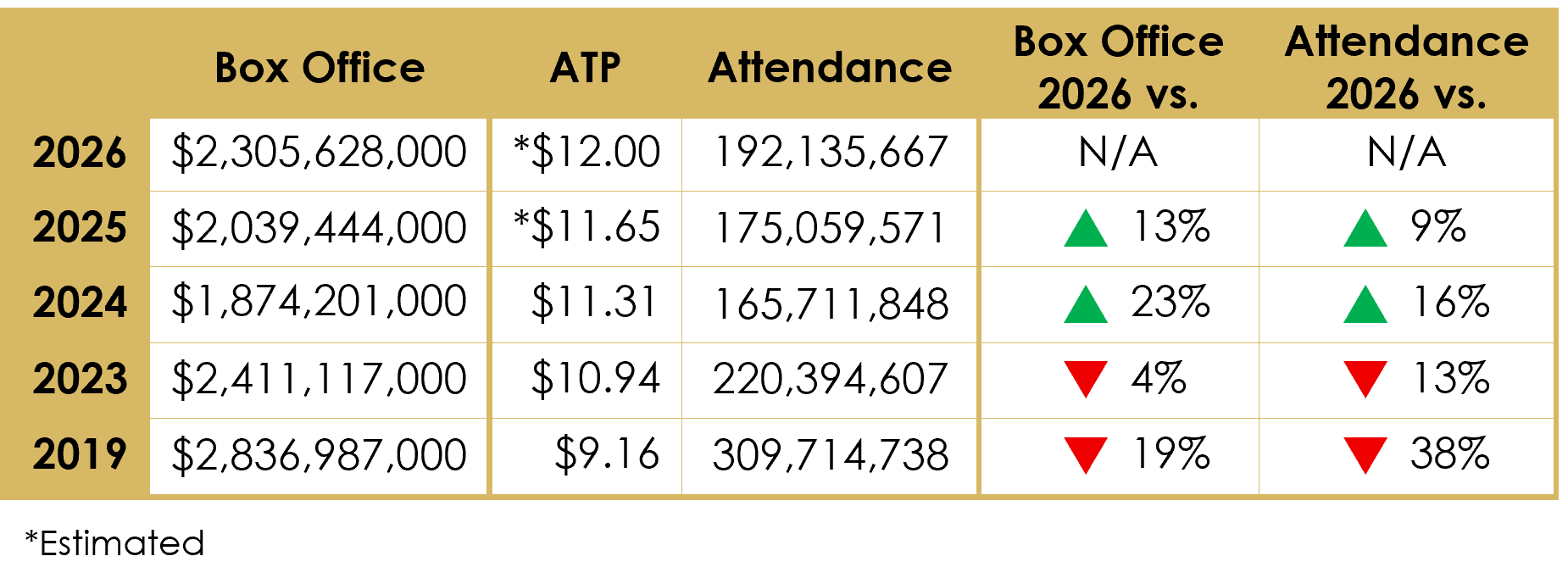
The 2026 box office has cooled off a bit after a thrilling first quarter, which ended 27% higher than Q1 of 2025. The last three weekends finished lower than totals from last year, lowering the year-over-year comparative advantage for 2026 to 13% over last year. However, the reinforcements have arrived, with MICHAEL this weekend and THE DEVIL WEARS PRADA 2 next weekend, followed by STAR WARS: THE MANDALORIAN AND GROGU on May 22nd to kick off the Memorial Day holiday weekend.
If the past four weeks have seemed sluggish, a close look at the numbers confirms it. Box office receipts over the period are -3% compared to the matching 4-week span from last year, with attendance at -6%. However, it’s important to remember that this 4-week period last year included the A MINECRAFT MOVIE in its first four weeks and the debut weekend of SINNERS. These movies became the #1 and #7 top-grossing films of the year, making them challenging competition for the current year. While the recent slowdown is real, we can feel thankful to have weathered the comp pressure from two of last year’s biggest movies without a more severe drop off by comparison.
THE LAST FOUR WEEKS – 2026 vs. 2025

#1 – MICHAEL
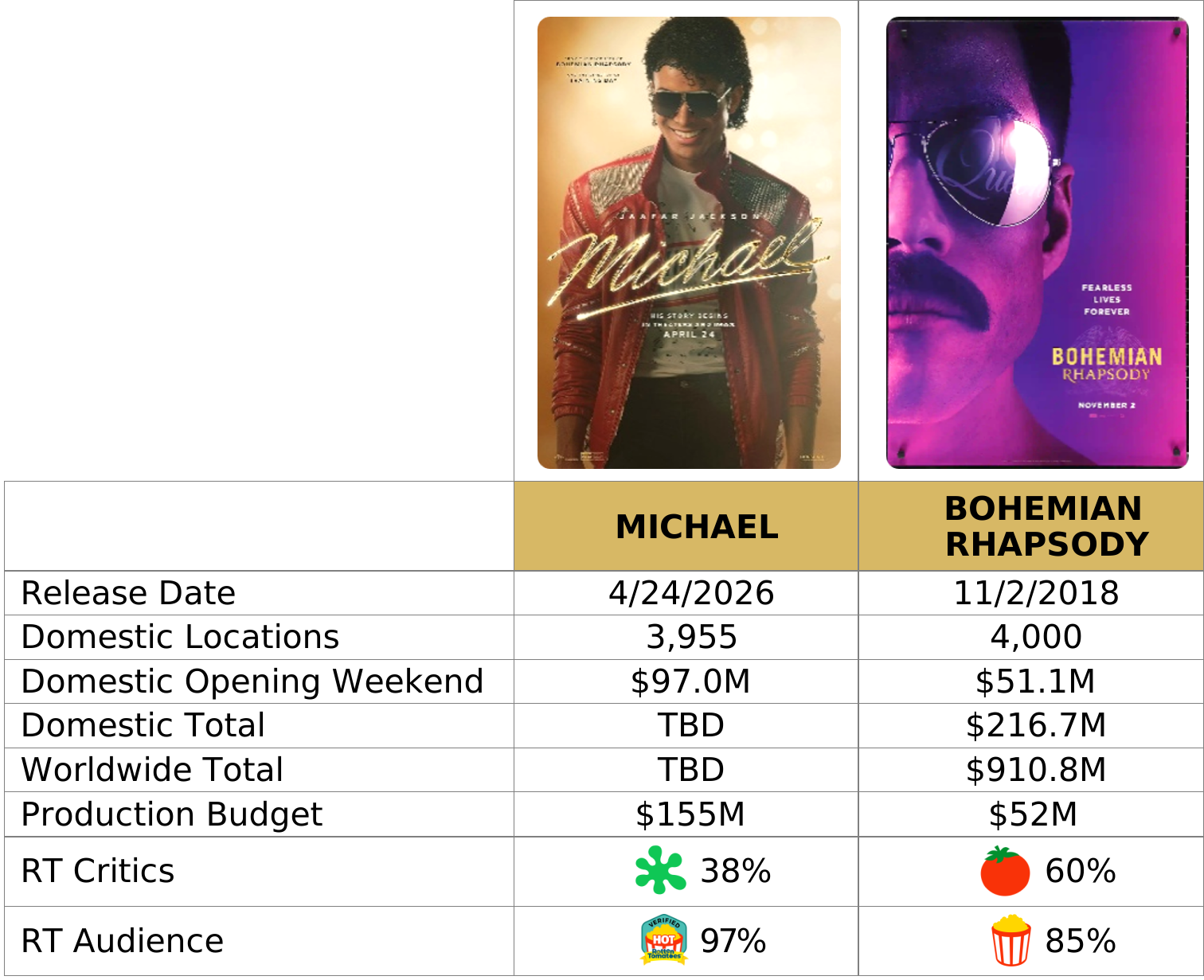
Lionsgate’s MICHAEL jumped above and beyond pre-release expectations by earning $97.0M in its domestic debut and a stunning $217.4M worldwide. The popularity of the movie reflects the enduring appeal of Michael Jackson, known as the “King of Pop.” It has taken many years to make this film. In 2019, producer Graham King (BOHEMIAN RHAPSODY) secured the rights to make a movie about Michael Jackson’s life. He secured the full cooperation of the Jackson estate, allowing the filmmakers to use the singer’s music and likeness, unlike previous movie projects.
From the very beginning, its studio backers at Lionsgate have treated MICHAEL as a prestige, awards-driven biopic. The pedigree of the creative team brought onto the project reflects that ambition. Antoine Fuqua was a somewhat unconventional choice to direct the film, given his action-thriller background on films such as TRAINING DAY. Oscar-nominated writer John Logan (GLADIATOR, THE AVIATOR) was enlisted to shape the narrative. But the defining decision—and the one that has sparked the most discussion —is the choice to have Jaafar Jackson play Michael Jackson.
Jaafar is a real-life nephew of Michael, and this is his first film role. The upside of this choice is obvious: an uncanny physical resemblance and natural dance ability that reduced the need to employ digital trickery. This casting decision appears to have been successful, reinforced by newcomer Juliano Krue Valdi, who plays the young Michael. Meanwhile, Colman Domingo adds his credibility to the role of Joe Jackson, bringing dramatic weight that could support the awards ambitions of the film.
On screen, MICHAEL hits the expected high notes of the singer’s performances, featuring his toe-tapping music and choreography. It tracks Michael’s rise from The Jackson 5 to a solo performer and global superstar. Most of the story focuses on the peak years of his career, presenting 13 of his best-known songs with a particular emphasis on tracks from the THRILLER and BAD albums.
The central problem of the film is what it chose to leave out, with critics pointing out the glaring omission of the controversial aspects of Jackson’s life. Many reviewers complain that MICHAEL presents a highly curated view of its subject, celebrating his artistry while sidestepping the allegations of pedophilia and personal decline that complicated his legacy. San Jose Mercury News said, “Either way, there is no denying that ‘Michael’ only scratches the surface of Michael the troubled person, even though it does a commendable job of showcasing Michael the star performer.”
The Toronto Star felt “Michael occasionally dazzles — the ‘Bad’ tour finale is a genuine showstopper, but it’s frustratingly incomplete, a film made for devoted fans and unquestioning apologists.” The Film Verdict’s take is, “Where Fuqua and his team are allowed to shine is in the evocation of some of the most exciting musical moments from Jackson’s career, but the rest of Michael is utterly empty, even by biopic standards.”
So while the critics are sour on the movie with a 38% Tomatometer score on Rotten Tomatoes, audiences are singing a different tune with a 97% Popcornmeter rating. This is a clear indication that moviegoers who have chosen to see the film are embracing the perspective on the singer that the movie’s makers have chosen to tell. A wide divide between critics and audiences is somewhat common for musical biopics, which are known to celebrate their subjects and the music they created rather than digging deep into their real lives.
What separates MICHAEL from all other musical biopics is the amount of money the studio spent to make the film. At roughly $170M all-in ($155M production plus $15M in reshoots), Lionsgate is making a tentpole-scale wager. The reshoots, reportedly tied to legal sensitivities surrounding past allegations, underscore the complexity of telling this story. By comparison, the genre has historically lived at a much lower price point. BOHEMIAN RHAPSODY was made for $52M, ROCKETMAN for $40M, and even Baz Luhrmann’s ELVIS came in at $85M. Those films worked because they balanced awards aspirations with disciplined budgets. At 2 to 4 times those amounts, MICHAEL is something else entirely—a swing-for-the-fences gamble disguised as a biopic.
Lionsgate has partnered with Universal to handle its international distribution, knowing that the smaller studio does not maintain its own in-house team for worldwide distribution. Michael Jackson’s global appeal is intense, after having existed as a dominant force in global pop culture from the early 1980’s to the mid-1990s. Jackson’s sustained worldwide reach over such a long period is rare, even by today’s standards. If any figure can justify a $170M biopic, it’s Michael Jackson.
And there’s precedent. BOHEMIAN RHAPSODY turned a $52M investment into more than $900M worldwide, with 76% of that number coming from outside the U.S. and Canada. That movie also garnered award recognition, winning four Oscars, including Best Actor for Rami Malek. It became a modern blueprint for how a musical biopic can translate globally. The question for MICHAEL is whether it will follow a similar path or it will be held back by virtue of its selective storytelling.
For now, the opening suggests a solid start. But the real story will be told in the weeks ahead when we see how well the film plays over time. Will there be an audience beyond the core fan base? Will the nostalgia factor and the undeniable strength of its musical performances be enough to outweigh the controversy of its choice to sanitize Jackson’s life story?
The obvious comparison film to measure MICHAEL against is BOHEMIAN RHAPSODY from 2018, which demonstrated an impressive ability to sell tickets and convert that attention into an award recognition. In the end, MICHAEL will be judged on whether it turns a profit, which would be impressive given that $170M was spent to make it.
MICHAEL vs. BOHEMIAN RHAPSODY
#2 – THE SUPER MARIO GALAXY MOVIE
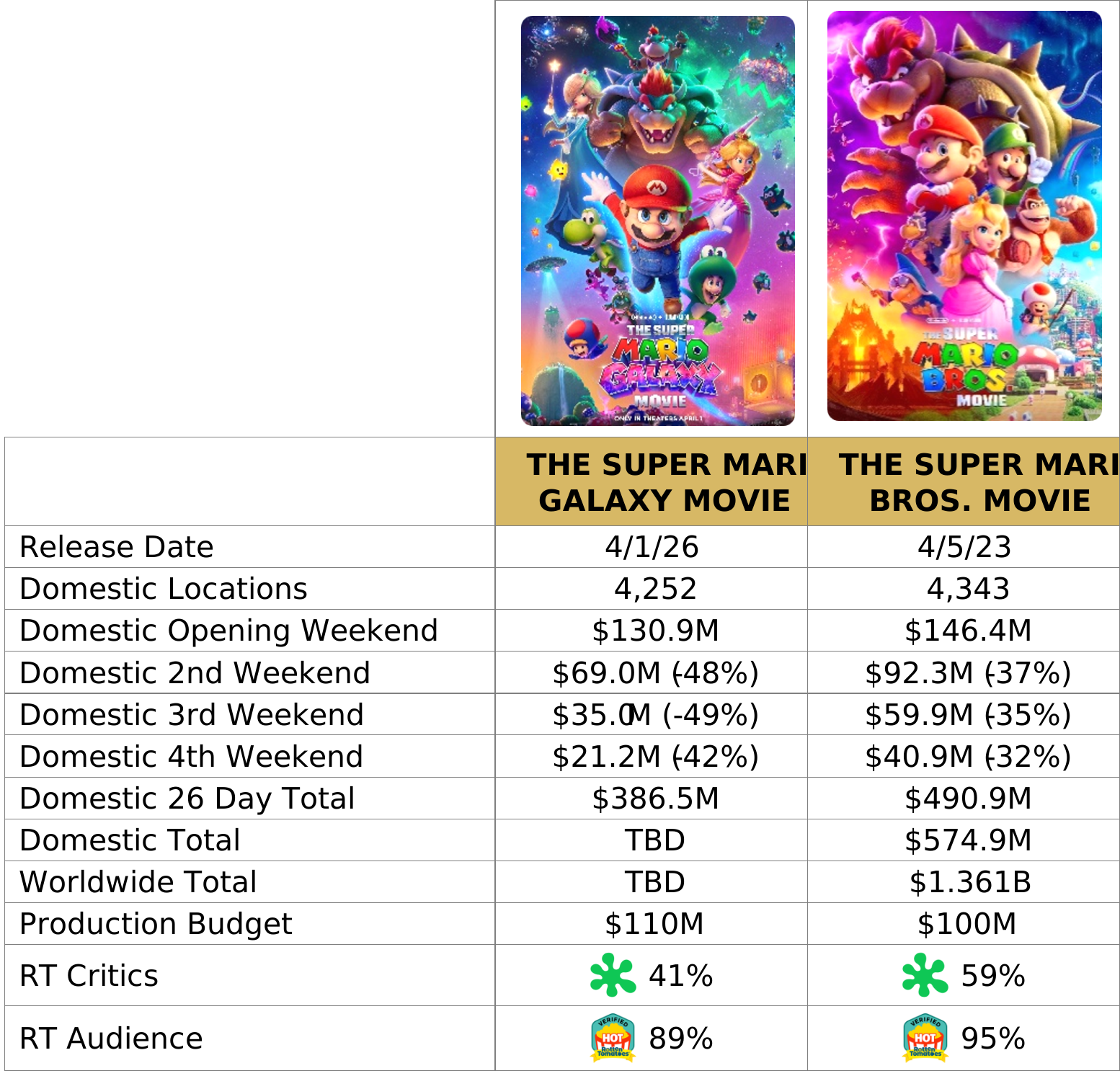
Universal’s THE SUPER MARIO GALAXY MOVIE dropped a level into second place, after having been the top movie for the first three weeks of its run. MARIO GALAXY sold an additional $21.2M this weekend, a decline of 42% from last weekend’s total. After 26 days in theatres, it has earned $386.5M domestically and $831.5M globally. This is a very solid performance, matching the totals of last year’s top-grossing film, A MINECRAFT MOVIE. Currently, MARIO GALAXY’s $386.5M is slightly ahead of MINECRAFT’s $382.5M at this same point in its release.
THE SUPER MARIO GALAXY MOVIE vs. A MINECRAFT MOVIE after 26 Days

By that standard, MARIO GALAXY should be seen as an unqualified success, even though it has not done quite as well as its franchise mate, THE SUPER MARIO BROS. MOVIE. That movie was the second-highest-grossing film of 2023, after BARBIE.
THE SUPER MARIO GALAXY MOVIE vs. THE SUPER MARIO BROS. MOVIE
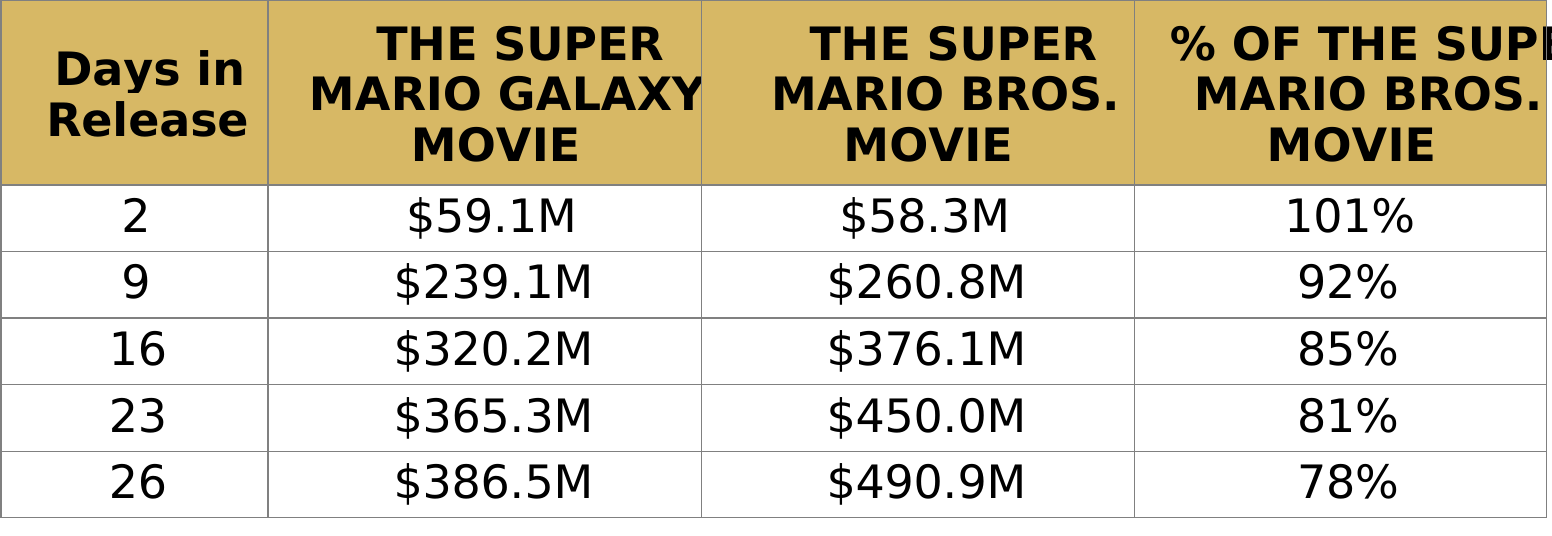
Universal is tracking the performance of its two MARIO movies closely. Last week, we offered up the idea that Universal should consider releasing the next MARIO movie in the summer, when family audiences might be more available to come to the theatre. We still think that this idea is worth considering, given an accelerating fall off in MARIO GALAXY compared to MARIO BROS. The famous plumber is a very important IP for the studio, and it should do everything it can to ensure the future success of the franchise.
THE SUPER MARIO GALAXY MOVIE vs. THE SUPER MARIO BROS. MOVIE after 26 days
#3 – PROJECT HAIL MARY
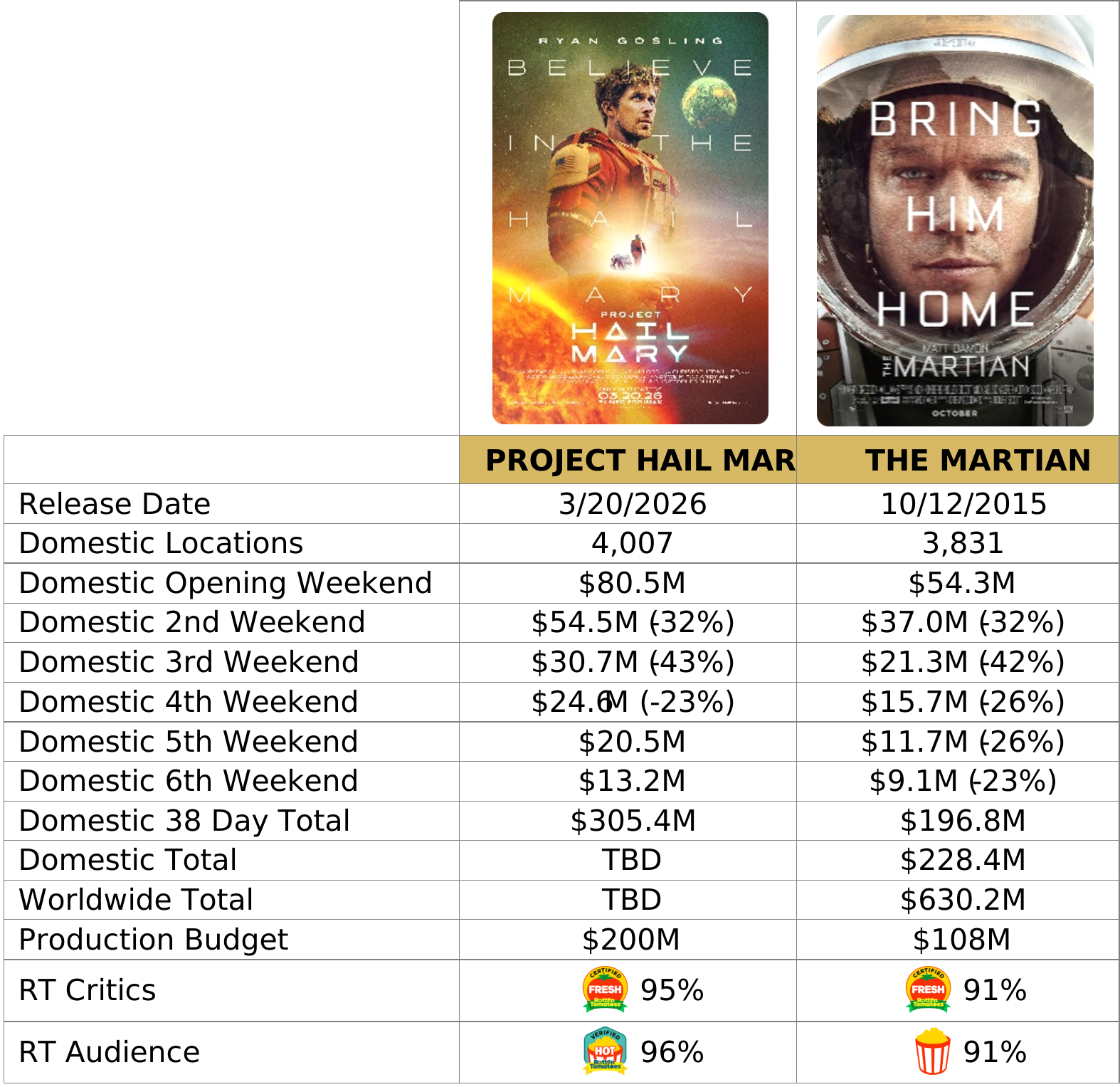
Amazon MGM’s PROJECT HAIL MARY continues to show staying power by finishing in third place with $13.8M in its sixth week, a drop of 36%. After 38 days, the film has grossed $305.4M domestically and $613.3M worldwide. HAIL MARY is the second movie adaptation of an Andy Weir novel to surpass $600M globally, proving the commercial viability of Weir’s brand of detailed, science-forward storytelling. After these two hits, Weir’s third novel, ARTEMIS, is also on track to be made into a feature film.
In fact, ARTEMIS was Weir’s first book to be optioned for a movie, snapped up by 20th Century Fox and New Regency in 2017 before the novel’s publication. However, its development has been stalled along the way. PROJECT HAIL MARY, by contrast, was acquired in 2020 by MGM (now under Amazon MGM) and was quickly turned into a finished product for the big screen. Same author, same pedigree—very different outcomes. Execution, not just IP, is the differentiator.
ARTEMIS presents a unique hurdle to filmmakers that goes beyond development logistics: physics. The story is set in a lunar colony, where gravity is just one-sixth of Earth’s. That’s not a minor visual tweak—it fundamentally alters how humans move, interact, and exist on screen.
Here’s what that means in practical terms:
- Weight reduction: A 180-pound person effectively feels closer to 30 pounds.
- Movement mechanics: Walking becomes inefficient; astronauts naturally shift to a loping, bounding gait, as witnessed during the Apollo program.
- Altered motion: Jumps are 5 to 6 times higher, with longer hang time and slower, more exaggerated arcs.
- Traction challenges: Reduced friction increases slipping risk; tools, dust, and debris behave unpredictably.
All of these physical factors create a major creative question: how do you sustain visual realism for two-plus hours without breaking immersion in the story… or the budget?
With NASA actively advancing its own Artemis program to establish a long-term human presence on the Moon, filmmakers may decide to take their cues from the real-world exploration of the Moon before committing to the movie’s full-scale production. Or, perhaps James Cameron will sign on to the project to figure it out.
PROJECT HAIL MARY vs. THE MARTIAN after 38 Days
#4 – LEE CRONIN’S THE MUMMY
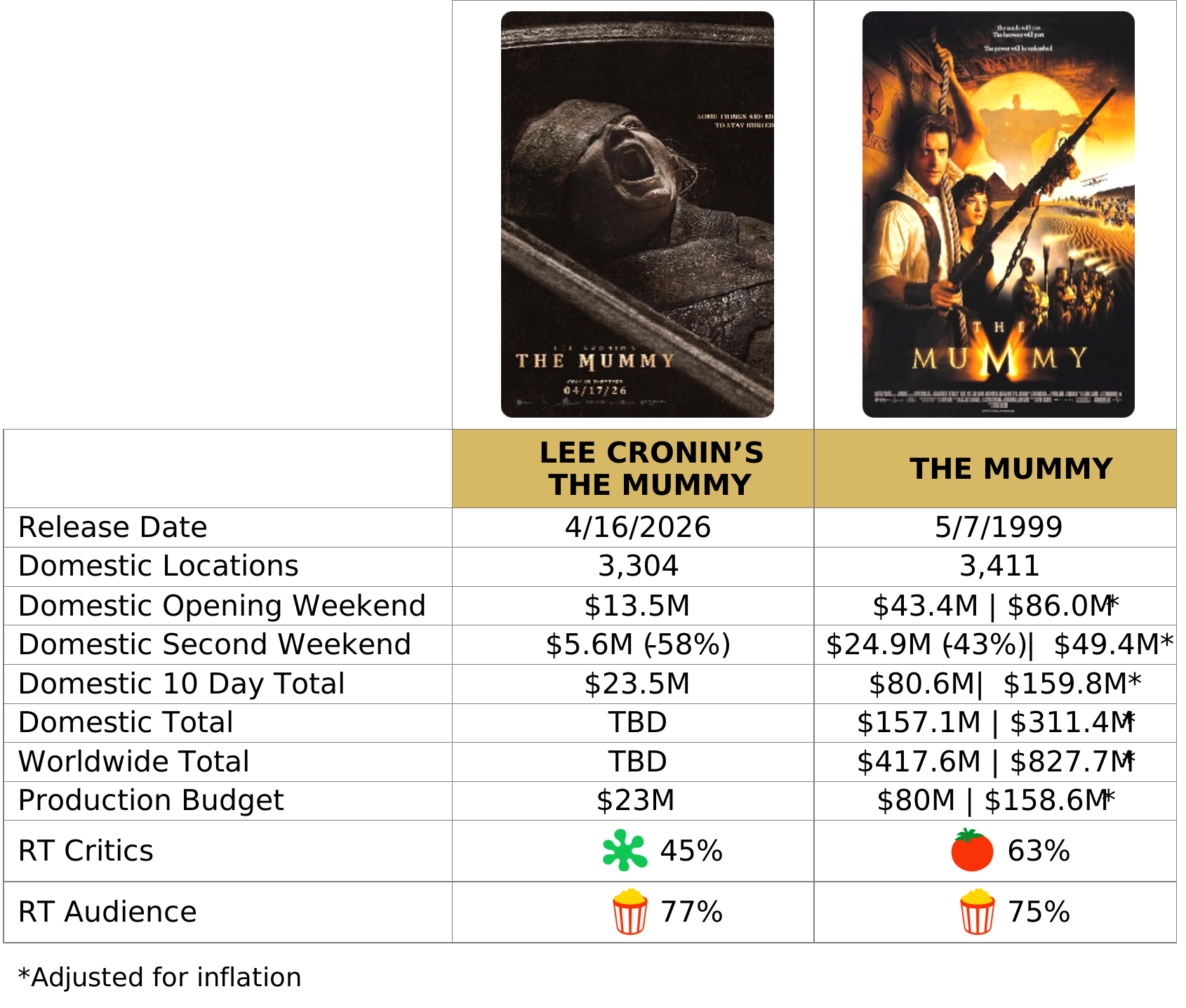
LEE CRONIN’S THE MUMMY from Warner Bros. finished fourth in its second weekend with a 3-day gross of $5.6M, down 58%. That brings its 10-day total to $23.5M domestically and $65.5M worldwide. While the domestic performance has been modest, the international box office has carried the load, accounting for 64% of the film’s global total—an encouraging split that has made the horror film profitable after only 10 days in release.
Produced on a skinny $23M budget, the film was never imagined to be on the same scale as prior Mummy movies. Even with a muted 46% critics’ score on Rotten Tomatoes, writer/director Lee Cronin deserves credit for making a commercially viable reboot of the famous story. The new movie turns away from the globe-trotting spectacle of earlier versions and towards a more contained, horror-driven narrative. This also aligns with the studio’s business objective of spending and earning less but being more profitable.
The contrast with the 1999 version of THE MUMMY is stark. Adjusted for inflation, that film carried a production cost of roughly $158.6M—nearly seven times Cronin’s budget—and went on to generate an inflation-adjusted global total of $827.7M. Replicating that scale in today’s market would likely require a $150M+ investment, a risk Warner Bros. wisely avoided.
Notably, Warner Bros. executives have not publicly touted THE MUMMY’s box office, instead framing it internally as a disciplined, cost-controlled genre play. The result: an effective contributor in a crowded marketplace, without the ambition of reestablishing the Mummy franchise as a major theatrical force.
LEE CRONIN’S THE MUMMY vs. THE MUMMY after 10 Days
#5 – THE DRAMA
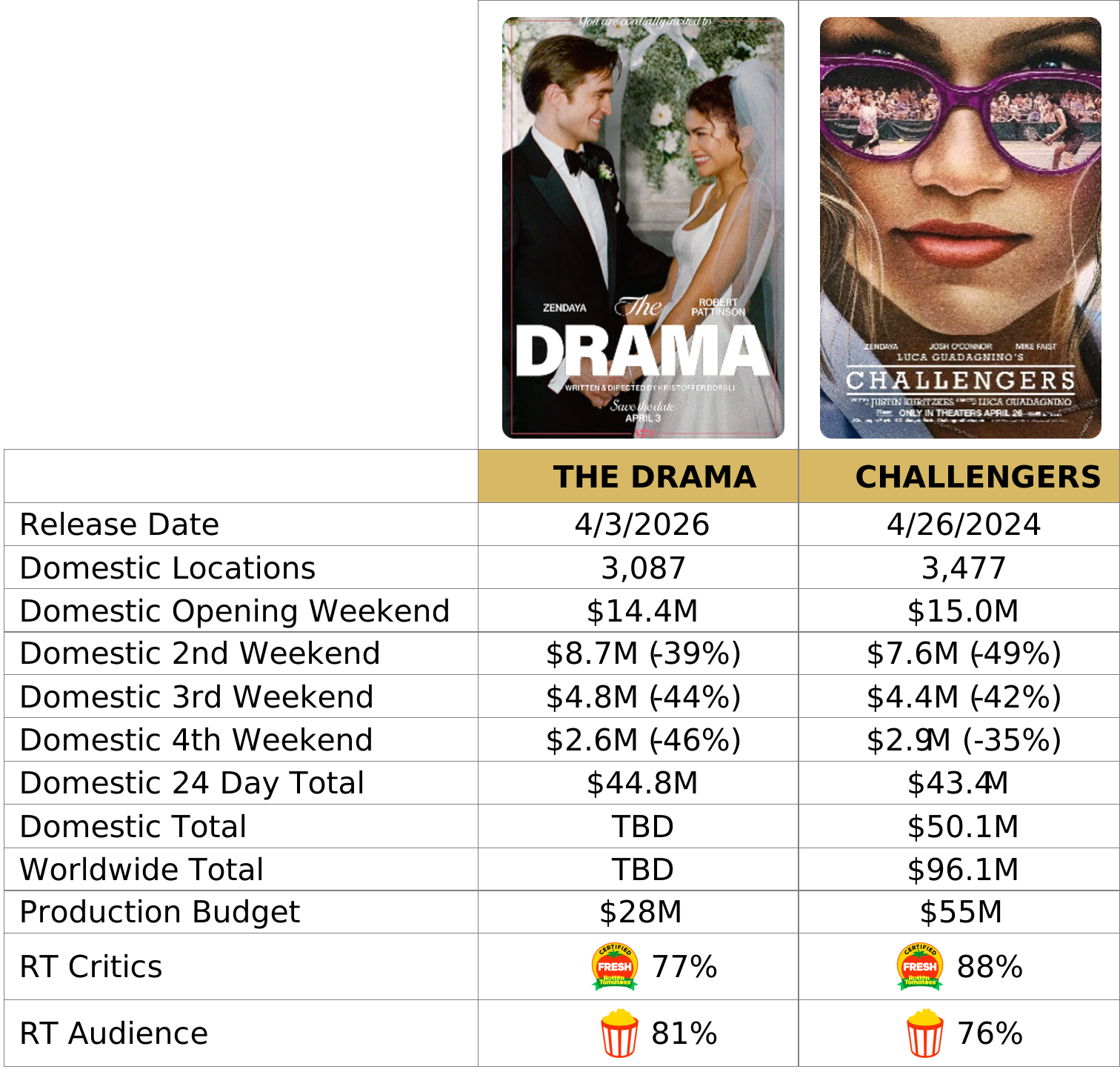
A24’s THE DRAMA has remained in the top five movies for all four weekends since its release, this time earning $2.6M. This brings its 24-day total to $44.8M domestically. THE DRAMA has now surpassed CHALLENGERS to become Zendaya’s highest-grossing film outside of the SPIDER-MAN and DUNE franchises and is on its way to becoming profitable, a feat which CHALLENGERS failed to achieve.
Even though it has grossed over $100M globally, there is no indication that A24 is thinking about a sequel. The studio has positioned this film as a self-contained, auteur-driven story, without another chapter to come. Bringing Zendaya and Robert Pattinson back to make another THE DRAMA movie would entail a bigger budget, placing greater pressure on margins.
A more fruitful path could be for A24 to channel THE DRAMA’s success into future projects with a similar feel, akin to FINAL DESTINATION, where the concept is the franchise, rather than specific characters or storylines.
THE DRAMA vs. CHALLENGERS after 24 Days
Where Are We as of 4/23/2026
Related DICK WALSH's Industry Update

6/19-6/21: TOY STORY 5 Has the Biggest Opening of 2026

Spielberg Scores Another #1 Opening with DISCLOSURE DAY
Scary Movie, Backrooms and Obsession Make Moviegoers Laugh, Scream and Exhibitors Cheer

Low-Budget Backrooms and Obsession Overwhelm Traditional Hollywood Fare

THE MANDALORIAN AND GROGU Shines in STAR WARS’ Return to the Big Screen