
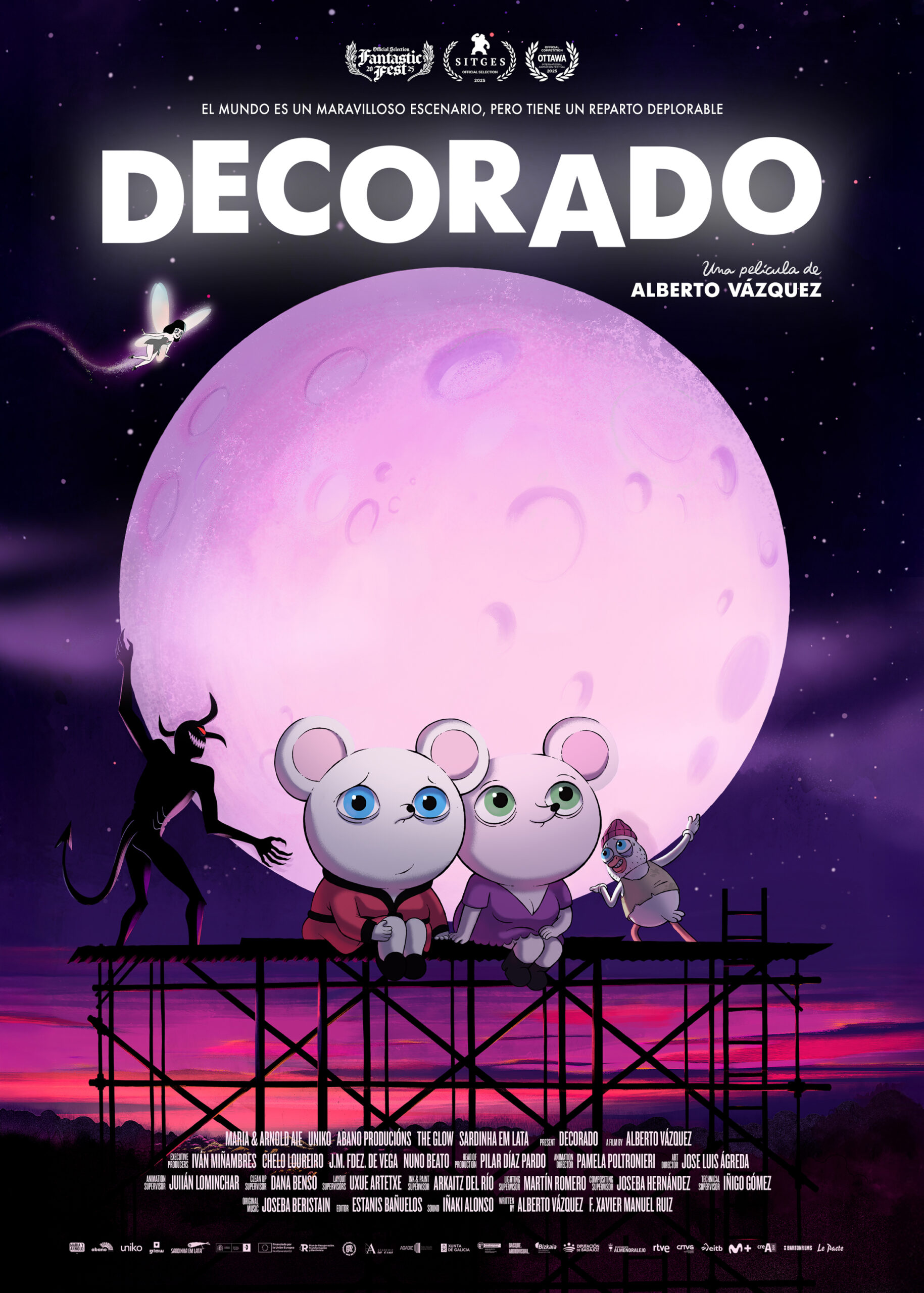
Arnold, a mouse in midlife crisis, sees his world as artificial theater set. As personal troubles mount, his suspicion of living in a fake reality leads him to search for what's authentic.
Arnold, a middle-aged mouse in existential crisis, lives in constant suspicion: unlike his wife María, he has long felt that the world is unreal, a fake, like a SCENERY. Arnold decides to rebel against society by confronting his so-called friends, neighbors, doctors, and even the corporation A.C.M.E. (A Company that Makes Everything), blatantly ruling the whole place. Arnold goes crazy as he realizes that all his suspicions are true and that he can't escape from his nightmarish world. Exhausted, he finally gives up and accepts his fate, becoming a model ACME citizen. Helped by the ghost of his best friend Ramiro and the outcast Mr. Mushroom, Arnold and María hatch a cunning plan to escape their town and leave behind their SCENERY, in order to start a new life, far away from ACME's social and economic control.
Frequently Asked Questions
What is ALMA, and what does it represent in the film?
Is this film suitable for children?
What references did Vázquez cite when developing the film?
What awards has the film received?
When was it released?
Fun Facts
The story began as short comic stories Vázquez drew roughly 15 years earlier, then became a 10-minute Goya-winning short in 2016. Years later, Vázquez and co-writer Xavi Manuel tried to adapt it into an animated series for adults; when that project fell through, they repurposed the ideas into the feature film.
Every frame was animated and lit using Blender — the free, open-source 3D software — while the hand-painted backgrounds were created in Photoshop. This makes it a rare theatrically released animated feature built entirely on open-source tools.
Alberto Vázquez provides the voice for Pato Roni (Roni the Duck), one of the film's supporting animal characters, alongside the professional Basque-Spanish voice cast.
At the 2023 Weird Market, Vázquez described the film as an existentialist fable citing three wildly disparate influences: classic Disney/Mickey Mouse cartoons, The Truman Show, and Bergman's Scenes from a Marriage.