


The 25-Year Gap
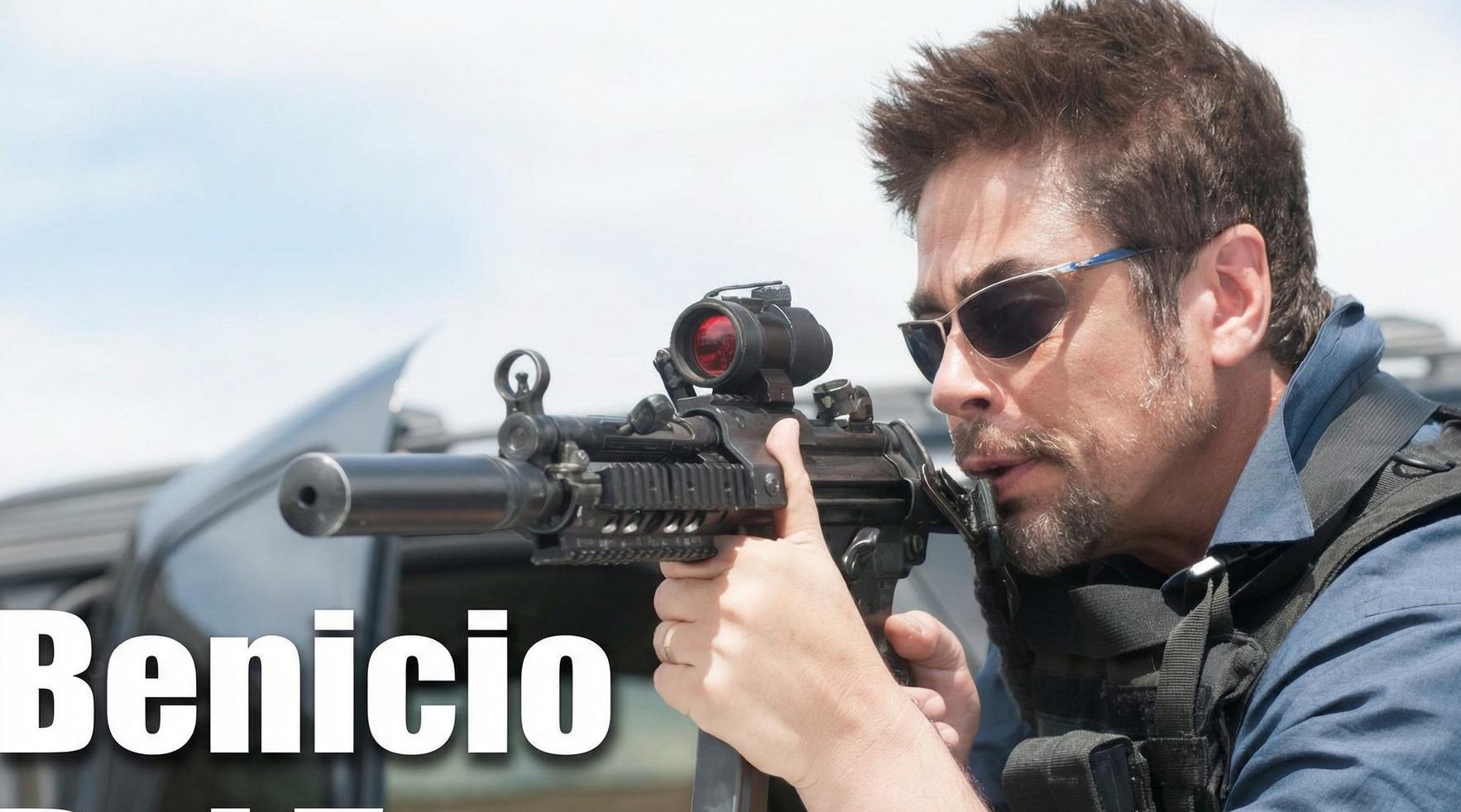
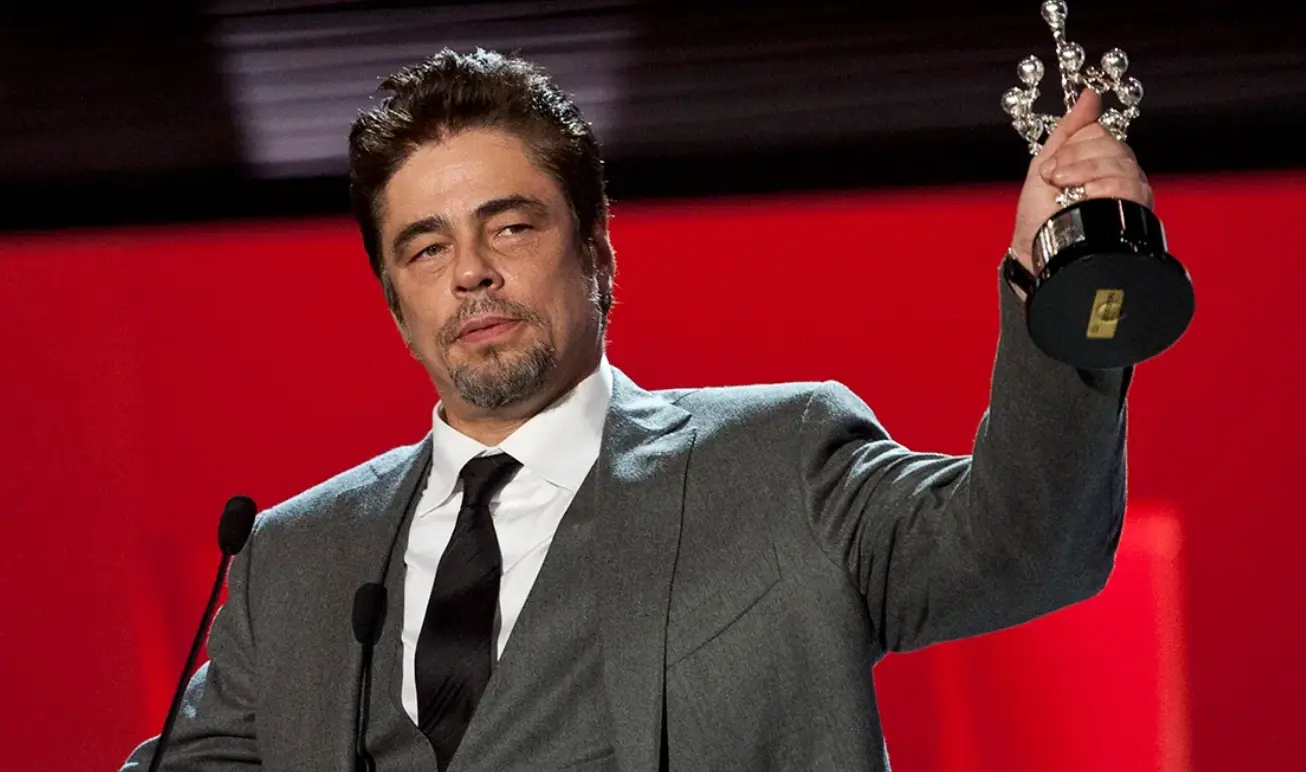
In 2001, a 34-year-old Puerto Rican actor named Benicio Del Toro walked to the podium at the Shrine Auditorium and accepted the Academy Award for Best Supporting Actor for playing a border cop named Javier Rodriguez in Steven Soderbergh's drug-war ensemble Traffic. The speech was short, direct, and gracious. He dedicated the award to the people of Nogales, Arizona, and Nogales, Mexico.
Twenty-five years later, Del Toro was back in the running at the 98th Academy Awards, nominated for the same category for his role as Sergio St. Carlos — a karate dojo owner and community leader in Paul Thomas Anderson's sprawling political thriller One Battle After Another. The film earned 13 Oscar nominations and won six. Del Toro didn't take home the statue this time, that went to co-star Sean Penn, but he walked away with the Golden Globe and the BAFTA, and more importantly, walked back into the centre of a conversation that was always his to have.
The "comeback" framing is tempting but slightly off. Del Toro never went anywhere. He made Sicario, Che, and Inherent Vice. He showed up in Star Wars, in the Avengers universe, and in Wes Anderson films. He worked with some of the best directors alive, consistently. What was missing wasn't the work. It was the recognition. And One Battle After Another, adapted from Thomas Pynchon's 1990 novel Vineland, brought it back.
This is the story of how a 59-year-old Oscar nominee, two-time collaborator of Paul Thomas Anderson, card-carrying member of the Marvel Cinematic Universe, and one of cinema's most instinctively physical actors became the emotional anchor of the biggest film of 2025 — playing a karate instructor with fewer than 15 minutes of screen time.
The First Oscar: Traffic and the Javier Rodriguez Revolution (2000–2001)
The Role That Changed Everything
Traffic arrived in 2000 as something Hollywood didn't often attempt: a genuinely polyhedral look at the drug war. Multiple storylines, multiple countries, multiple moral registers. Steven Soderbergh shot each narrative thread in a different visual style, and the film asked its audience to hold all of it together simultaneously. Within that structure, Javier Rodriguez — an honest Mexican border cop navigating a corrupt system was the most quietly devastating strand.
Del Toro played him as a man who sees everything clearly and acts on it, at great personal risk. He spoke predominantly in Spanish, which was not then (and is still not now) a common choice for a role expected to be awards-competitive. The character's moral clarity stood in contrast to nearly every other figure in the film. He was not naive; he simply refused the available cynicism. Del Toro's performance stripped Rodriguez of any trace of sanctimony and left something warm, watchful, and precise.
The 2001 Awards Sweep
The 73rd Academy Awards took place on March 25, 2001, at the Shrine Auditorium in Los Angeles. Angelina Jolie presented the Best Supporting Actor award. Del Toro won, becoming the fourth living Academy Award Winner whose winning role was primarily in a non-English language, and the third Puerto Rican actor to win an Academy Award, following José Ferrer and Rita Moreno.
His competition that night was formidable: Jeff Bridges for The Contender, Willem Dafoe for Shadow of the Vampire, Albert Finney for Erin Brockovich, and Joaquin Phoenix for Gladiator — the last of whom holds the distinction of being the only other Puerto Rican-born actor nominated in the same category at the same ceremony.
The win at the Academy Awards was part of a full sweep: Del Toro also took the Golden Globe for Best Supporting Actor and the Screen Actors Guild Award for Outstanding Performance by a Cast as part of Traffic's ensemble. His performance had already swept the major critics' awards. For a moment, Javier Rodriguez was everywhere.
The Acceptance Speech
Brief and considered. Del Toro thanked Steven Soderbergh and the production, then dedicated the award to the people of Nogales, Arizona, and Nogales, Mexico — the two border towns where Traffic was partially filmed and whose communities the film was built around. No grandstanding, no mythology-building. Just an acknowledgement of the real people his character was drawn from.
The Interim: 24 Years of Excellence (2001–2024)
The Franchise Villains
After Traffic, Del Toro could have made a straightforward pivot to leading-man territory. Instead, he made interesting choices. Not all of them were headline-grabbing.
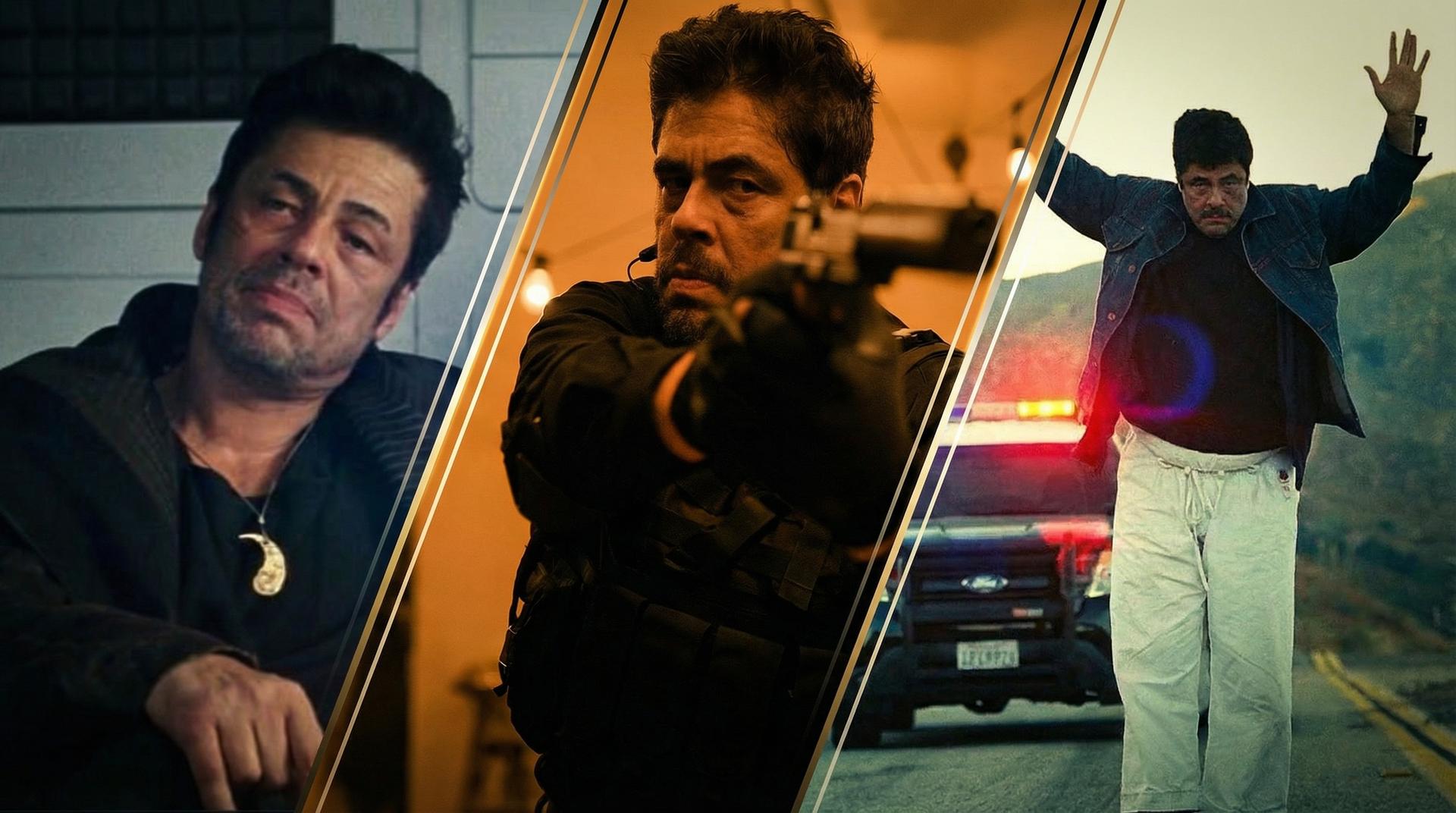
Sicario (2015), directed by Denis Villeneuve, gave him his most complex post-Traffic role: Alejandro Gillick, a former Mexican prosecutor turned CIA-aligned assassin. The character operates without nation, without allegiance, and without much visible feeling — except in the moments it matters most. Del Toro brought a controlled menace to Gillick that made him impossible to classify as hero or villain. He returned for Sicario: Day of the Soldado (2018), this time given even more room to anchor the film.
The franchise work came too. As The Collector (Taneleer Tivan) in the Marvel Cinematic Universe, Del Toro appeared across multiple films beginning with a post-credits scene in Thor: The Dark World (2013), followed by a larger role in Guardians of the Galaxy (2014) and Avengers: Infinity War (2018). As a DJ in Star Wars: The Last Jedi (2017), he played a morally unmoored codebreaker whose betrayal of the Resistance is both shocking and somehow inevitable. These weren't the roles that the awards circuit paid attention to. They were the roles that kept Del Toro visible to the widest possible audiences across two decades.
The Prestige Collaborations
21 Grams (2003), directed by Alejandro González Iñárritu, earned Del Toro his second Oscar nomination—again in the Best Supporting Actor category for playing an ex-convict who causes a fatal hit-and-run accident and is consumed by guilt in its aftermath. The film cast him alongside Sean Penn and Naomi Watts, a pairing that would recur two decades later in One Battle After Another.
Che (2008) was the project that most clearly demonstrated what Del Toro was willing to put into a role. Steven Soderbergh directed the two-part biographical film covering Che Guevara's role in the Cuban Revolution and his final campaign in Bolivia. Del Toro committed fully to both halves: for the Bolivian section, he shed 35 pounds to depict Guevara's physical deterioration in the jungle. The performance earned him the Best Actor prize at the Cannes Film Festival — the Prix d'interprétation masculine — and the Goya Award for Best Actor the following year. It was, by any measure, the kind of performance that should have produced an Oscar nomination. It didn't.
Inherent Vice (2014) began his working relationship with Paul Thomas Anderson. He played Sauncho Smilax, a maritime lawyer who serves as intermittent counsel and comic relief to Joaquin Phoenix's drug-addled private detective. The role is loose, funny, and deliberately underwritten. Del Toro made something of it anyway. More importantly, it established the trust between actor and director that would eventually produce Sergio St. Carlos.
No Sudden Move (2021) brought him back to Soderbergh for a third time, as one of several criminals entangled in a 1950s Detroit heist gone wrong. The film is precise and atmospheric; Del Toro is, as usual, the most watchful person in any room he occupies.
The "Where's He Been?" Perception
The honest answer is: everywhere. But perception is not the same as presence. Del Toro's Independent Spirit Award-winning breakout in The Usual Suspects (1995) — as Fred Fenster, the character famously rendered almost unintelligible through Del Toro's deliberate vocal choices — established him as someone who operates by different rules. Fenster wasn't supposed to be funny. He was profound. That instinct for finding something unexpected in the margins of a script has defined his career.
He was Dr. Gonzo in Fear and Loathing in Las Vegas (1998), Franky Four Fingers in Snatch (2000), and Jackie Boy in Sin City (2005). He played a significant role in Savages (2012). He worked. He was good. He just wasn't being handed the kind of showcase material that turns a career into a narrative.
The gap between the 2004 Oscar nomination (for 21 Grams, at the 76th ceremony) and the 2026 nomination (for One Battle After Another, at the 98th) is twenty-two years. In that time, Del Toro won a Cannes, a Goya, and maintained the loyalty of some of the most demanding directors working. The recognition was selective, not absent. Hollywood just needed one film to remind itself what it had.
The 2025 Resurgence: Two Andersons, Two Distinct Films
https://www.youtube.com/watch?v=aviutKpCQfI
The Phoenician Scheme (May 30, 2025) — The Wes Anderson Comedy
The Phoenician Scheme arrived in cinemas on May 30, 2025, as Wes Anderson's second feature collaboration with Del Toro, after The French Dispatch (2021), where Del Toro played Moses Rosenthaler, a mentally disturbed artist at the centre of one of the film's three segments. In The Phoenician Scheme, he plays Anatole "Zsa-zsa" Korda, a ruthless international industrialist who is, by the film's own description, one of the richest men in Europe. The character is inspired in part by Armenian oil magnate Calouste Gulbenkian.
The film, written by Anderson and Roman Coppola, follows Korda as he attempts to complete an ambitious infrastructure project in Phoenicia while reconciling with his estranged daughter, Sister Liesl, played by Mia Threapleton in her first major feature role. Anderson cast Threapleton after watching over a thousand audition tapes; Del Toro participated in her screen test and endorsed her casting directly. Michael Cera plays Bjørn Lund, a Norwegian entomologist and tutor. The ensemble extends to Riz Ahmed, Tom Hanks, Bryan Cranston, Scarlett Johansson, Benedict Cumberbatch, Jeffrey Wright, Mathieu Amalric, Willem Dafoe, and Bill Murray, among others.
The film earned a 77% rating on Rotten Tomatoes and was seen by many as a return to form for Anderson. Del Toro, for his part, committed to the role based on just twenty pages of script that Anderson sent him — specifically the first sequence involving Korda and his daughter. He described reading those pages as the kind of encounter with a script that doesn't happen often.
One Battle After Another (September 2025) — The Paul Thomas Anderson Epic
https://www.youtube.com/watch?v=feOQFKv2Lw4&t
One Battle After Another premiered at the TCL Chinese Theatre in Los Angeles on September 8, 2025, and was released widely in the United States by Warner Bros. on September 26, 2025. It runs 161 minutes and was shot on VistaVision — a widescreen format that had not been used for a major production since the 1960s.
The film is loosely adapted from Thomas Pynchon's 1990 novel Vineland, which Anderson had wanted to adapt since the early 2000s. The narrative centres on Bob Ferguson (Leonardo DiCaprio), an ex-revolutionary raising his daughter Willa (Chase Infiniti) after being abandoned by her mother, Perfidia Beverly Hills (Teyana Taylor) sixteen years earlier. When Bob's old enemy Colonel Steven J. Lockjaw (Sean Penn) resurfaces and targets Willa, the film becomes something between a chase film, a political comedy, and a meditation on what resistance actually looks like over time.
Del Toro plays Sergio St. Carlos — referred to throughout as Sensei — Willa's karate instructor and the leader of an undocumented community network in a fictional California town called Baktan Cross. Anderson wrote the role specifically for Del Toro and delayed production by three months to accommodate his schedule. In his own words: "There simply wasn't any world where I made the film without him."
Del Toro arrived for production directly from the Berlin set of The Phoenician Scheme, with ten days between projects. He attended his daughter Delilah's sixth-grade graduation, then stepped into a production already running at full speed.
Why One Battle After Another Matters: The Sergio Phenomenon
The Performance
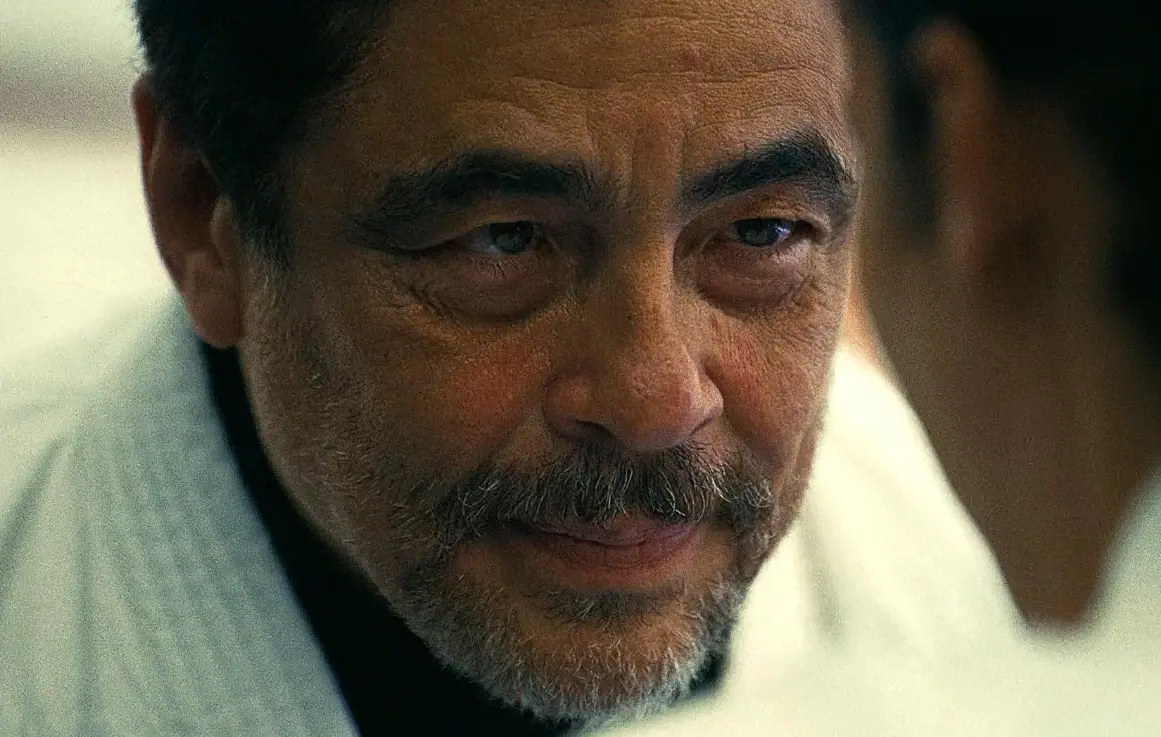
Sergio St. Carlos appears in less than 15 minutes of a 161-minute film. That is not an exaggeration and is worth sitting with. In those minutes, Del Toro establishes a character with enough interiority and warmth that the film's entire emotional framework runs through him. He is not the protagonist. He is the film's conscience.
The character is practical and principled in equal measure. He runs a karate dojo. He also runs an informal underground railroad for undocumented people in the region — quietly, without ceremony, because it is simply what a person with his resources and values does. Del Toro plays him as someone who has already worked out the politics and now just acts on them. There is no speechmaking. There is presence.
To prepare, Del Toro visited migrant processing centres in California. He understood the character not as a symbol but as a specific person who had made specific choices. Anderson's guidance — which included sending Del Toro a photograph of a tiger in a martial arts kimono as early character inspiration — gave the role a physical specificity that Del Toro then inhabited entirely.
The ad-libbed lines that became the film's most quoted moments — "Get back on defense" and "A few small beers" — are both Del Toro's own. Anderson's production style, which he has described as a "next play" philosophy (no dwelling, keep moving), created the conditions for those moments to happen and then protected them in the edit.
The Cultural Weight
One Battle After Another is explicitly political. The film's action unfolds against a backdrop of immigration raids, federal surveillance, and the mechanics of state violence against communities that lack formal protection. Sergio is, in that context, not a metaphor but a model: a person who uses what he has — a dojo, a network, a quiet authority — to shield people the system would otherwise destroy.
Del Toro's own framing of the character was consistent throughout the press cycle: "There's a heart there. I think that's why people are gravitating towards Sensei." That is an understatement. Sergio landed because Del Toro made him specific enough to feel real, and real enough to feel necessary.
The Awards Circuit
One Battle After Another received 13 Academy Award nominations at the 98th Oscars, including Best Picture, Best Director, Best Adapted Screenplay, and acting nominations for Del Toro, DiCaprio, Penn, and Taylor. It won six: Best Picture, Best Director (Anderson), Best Supporting Actor (Penn), Best Adapted Screenplay, Best Film Editing, and the inaugural Best Casting Oscar (Cassandra Kulukundis).
Del Toro's path through the season included wins at the New York Film Critics Circle, the National Society of Film Critics, the National Board of Review, the Golden Globe for Best Supporting Actor, and the BAFTA for Best Supporting Actor. He was nominated alongside his co-star Penn at the Oscars — a dynamic without much precedent — and Penn ultimately won, in absentia, with presenter Kieran Culkin accepting on his behalf.
The other nominees in the category were Stellan Skarsgård (Sentimental Value), Delroy Lindo (Sinners), and Jacob Elordi (Frankenstein). It was, across the board, one of the most competitive Supporting Actor fields in recent Oscar history.
The Comeback Narrative: Why It's Satisfying
| 2001 Win | 2025 Nomination | |
| Character | Javier Rodriguez — Mexican border cop | Sensei Sergio St. Carlos — karate instructor |
| Context | Drug war corruption | Migrant rescue and community protection |
| Age | 34 years old | 59 years old |
| Director | Steven Soderbergh | Paul Thomas Anderson |
| Category | Supporting Actor | Supporting Actor |
| Screen time | Dominant presence throughout | Under 15 minutes |
| Language | Predominantly Spanish | English |
| Public perception | "Latino Brad Pitt" | The best supporting performance of the year |
There is an irony running through both roles that Del Toro has himself acknowledged. In Traffic, he played a law enforcement officer trying to operate with integrity inside a system built on corruption. In One Battle After Another, he plays a man who protects people from that same system. The 25 years between the two roles maps almost exactly onto the distance between those two moral positions.
Both characters are moral centres in chaotic worlds. Neither is naive. Both are quietly, stubbornly committed to something the films around them are not sure is survivable.
The "comeback" label is imprecise because it implies Del Toro was gone. What One Battle After Another did was give the industry a performance so compact and so complete that it was impossible to look away. The heavy-lidded eyes, the physical stillness that somehow reads as coiled attention, the ad-libbed lines that felt written — none of that was new. The platform was.
His trajectory from Fred Fenster in The Usual Suspects — described by his own director as barely intelligible, deliberately so — to "Get back on defense" as Sergio St. Carlos spans thirty years and constitutes one of the more consistent character actor careers in American film. The Oscar nomination, arriving 22 years after his last, is not a resurrection. It is a confirmation.
The 2025–2026 Pipeline
| Project | Status | Role | Director |
| Reenactment | In production in Los Angeles | TBA | Grant Singer |
| Sicario 3 | In development | Alejandro Gillick | TBA |
| The White Van | In development | TBA | Grant Singer |
Reenactment
Del Toro's immediate follow-up to One Battle After Another is Reenactment, an original screenplay written and directed by Grant Singer. The two previously worked together on Reptile (2023), a Netflix crime thriller that debuted at the Toronto Film Festival and topped the platform's streaming charts on release. Cameron Diaz and Ana de Armas also star. Production is based in Los Angeles. Black Label Media — the production company behind both Sicario films — is producing once again. Plot details remain under wraps.
Sicario 3
The third instalment of the Sicario franchise, with Del Toro returning as Alejandro Gillick, has been confirmed as in development. Producers at Black Label Media have described it as "very, very real." Josh Brolin is also expected to return. The project is based on a story by Taylor Sheridan; a director has not yet been announced. The working title Sicario: Capos has been reported but not officially confirmed by the studio. The story is expected to continue from the end of Day of the Soldado, where Gillick survives being shot and forms an unlikely alliance with a young gang member.
The White Van
Grant Singer is also attached to direct The White Van, a separate project in development that Del Toro is involved with. Details remain sparse.
The Del Toro Formula: What Makes Him Distinct
Physical Commitment
The 35-pound weight loss for Che's final act is the most documented version of Del Toro's physical preparation, but it is not unusual for him. For One Battle After Another, he trained in karate to play Sergio St. Carlos convincingly as a dojo instructor. For Fear and Loathing in Las Vegas, he gained more than 40 pounds to play Dr. Gonzo. For Reptile, he worked closely with director and co-writer Grant Singer through an extended pre-production process made possible by the pandemic shutdown.
The preparation is not about transformation for its own sake. It is about specificity. Del Toro's characters tend to feel like people who existed before the film started and will continue after it ends. That requires more than technique. It requires the kind of research and physical grounding that his collaborators consistently describe as total.
The Voice
Fred Fenster in The Usual Suspects was deliberately unintelligible — a choice Del Toro and director Bryan Singer made together that paid off precisely because it was committed to completely. It became a signature not because it was a trick, but because it demonstrated what Del Toro was willing to do with a character that most actors would have played straight.
The most quoted lines of his 2025 work — the ad-libs in One Battle After Another — are notable for the opposite reason. "Get back on defense" is useful. "A few small beers" is both funny and revealing of character. Both work because they feel like things only Sergio would say, in exactly that moment. Del Toro's instinct for the lived-in detail is what makes both the unintelligible and the perfectly articulate feel like the same kind of intelligence.
The Collaborations
The roster of directors who have sought Del Toro out repeatedly tells its own story. Steven Soderbergh worked with him on Traffic, Che, and No Sudden Move — three different genres, three different registers, consistent investment. Paul Thomas Anderson used him in Inherent Vice and then built One Battle After Another around him specifically, delaying a major studio production to ensure his availability. Denis Villeneuve cast him in Sicario, and the resulting collaboration between Del Toro and the director produced what many consider the film's most memorable character. Wes Anderson has now used him twice — in The French Dispatch and The Phoenician Scheme — each time in a role that required him to carry the emotional logic of a story told primarily through style.
That is not a career built on box office leverage or brand positioning. It is a career built on the confidence of directors who know what he brings to a set and are willing to adjust their productions around it.
Conclusion
Benicio Del Toro is 59 years old. He has three Oscar nominations in the Best Supporting Actor category, two wins in the category at the Golden Globes and BAFTA, a Cannes Best Actor, a Goya, a Berlin Silver Bear, and a filmography that spans from playing an unintelligible small-time criminal in 1995 to playing the moral anchor of one of the biggest films of 2025. He did not win the Oscar for Sergio St. Carlos. Sean Penn did. But the performance, the moment, and the broader reckoning with what Del Toro's career has actually amounted to — that belongs entirely to him.
The most telling detail in the One Battle After Another press cycle is Paul Thomas Anderson delaying production by three months, at high cost, so that Del Toro could finish The Phoenician Scheme and be available. Anderson said there was no version of the film without him. That is not a comeback story. That is a career.
Watch One Battle After Another (streaming on HBO Max and JioHotstar). Revisit Traffic. Pay attention to what Sergio St. Carlos does with fifteen minutes of screen time. Then consider what it means that the same actor has been this present, this specific, and this good for thirty years.