

6/26-6/28: TOY STORY 5 and SUPERGIRL Team Up at the Top the Box Office

Disney and Pixar’s TOY STORY 5 claimed the top spot for the second consecutive weekend by adding $70.0M in new sales, followed by Warner Bros. and DC’s SUPERGIRL which opened with $38M. The weekend came in at $153.5M for all movies, easily outpacing the same weekend last year which produced $127.4M, led by a $57.0M opening for F1: THE MOVIE. In three out of the past four weekends 2026 has outpaced 2025, a 30% boost in box office and 27% increase in attendance.
This year’s momentum comes from a steady beat of new studio releases with commercially appeal. Here is a recap of that firepower over the past four weeks.
FIRST PLACE FILMS in the FOUR WEEKS from 5/29 to 6/19
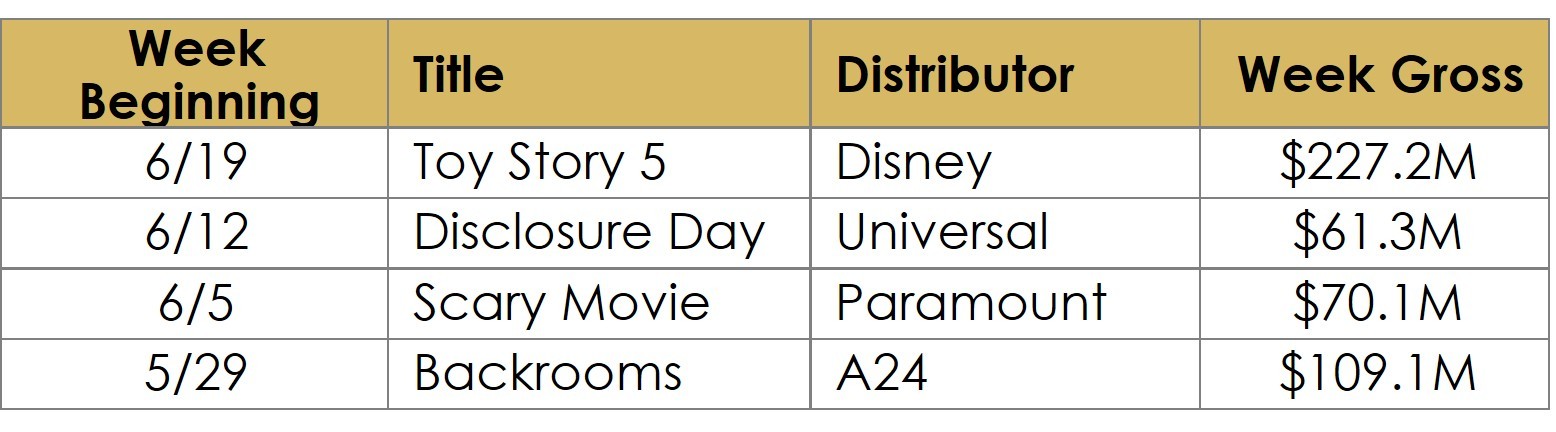
This marks the first time in the last three months that the trailing four-week box office totals have exceeded $1B. We have just entered the thirteenth and final week of Q2, and this weekend’s improvement over the same weekend last year ensures a strong close to the quarter. What’s more, MINIONS & MONSTERS opens in a few days on July 1st and is expected to contribute an additional $40M on Wednesday and Thursday, the last two days of the film quarter.
THE LAST FOUR WEEKS – 2026 vs. 2025

#1 - TOY STORY 5
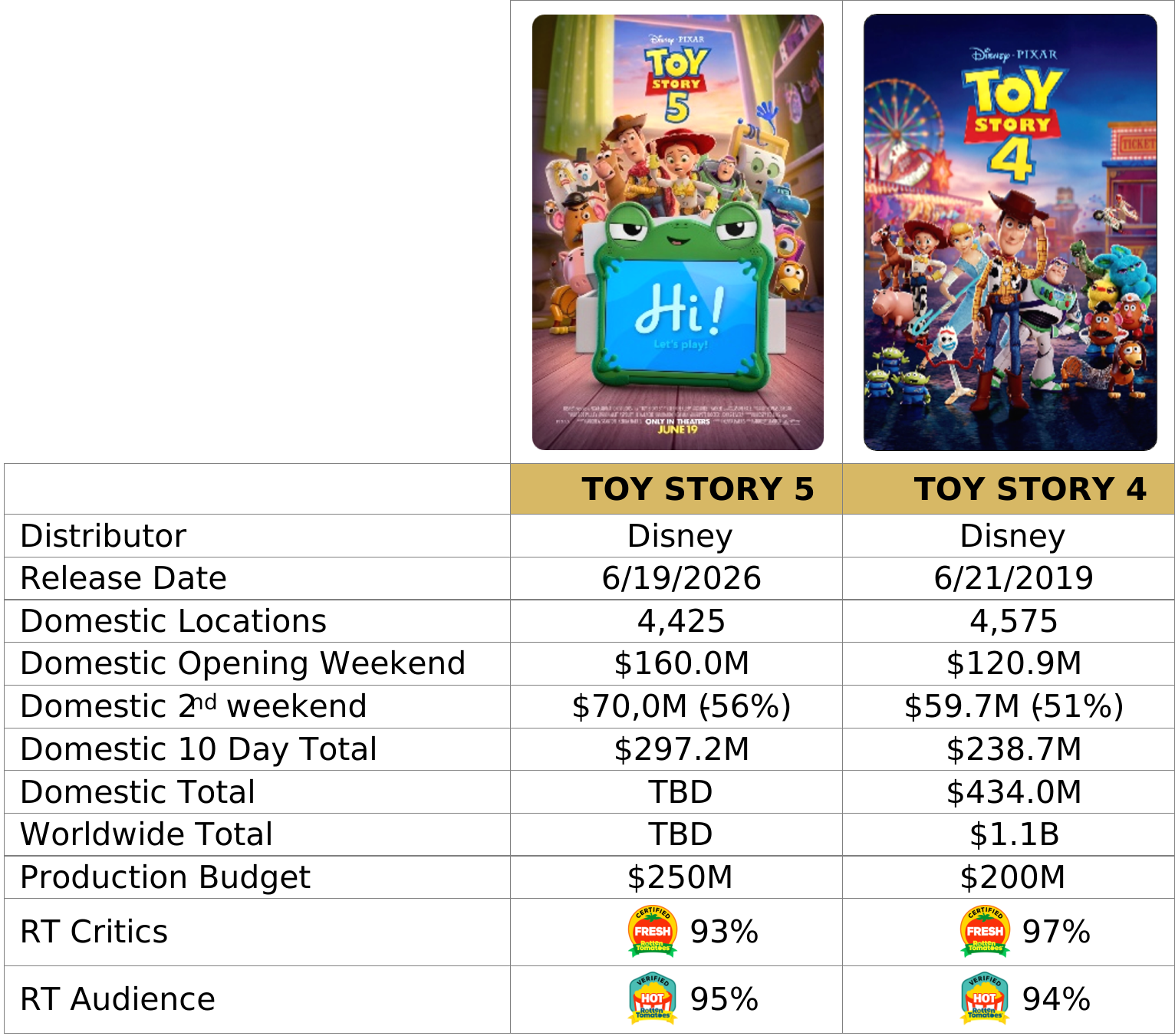
TOY STORY 5 held on to first place for the second weekend in a row with $70.0M, a decline of 56% from last weekend’s opening. This brings its ten-day totals to $297.2M domestically and $585.0M globally. TOY STORY 5’s $159.7M opening (including $17M from Thursday preview screenings) was the highest of the five-film series and this weekend’s $70.0M is the highest second weekend of the bunch. Still, a 56% drop from opening to second weekend is the also the steepest of the TOY STORY franchise.
TOY STORY 5’s high Rotten Tomatoes scores of 93% from critics and 95% from audiences leave no doubt that the film is delivering for its core audience. All four earlier TOY STORY movies had lengthy runs in theatres and we expect TOY STORY 5 to follow suit. That said, it will have to share the “family” audience with Universal’s MINIONS & MONSTERS when it opens in three days. It will be interesting to see the extent to which the two films can expand the family audience, or whether they divide up a finite pie. Disney is projecting confidence that TOY STORY 5’s enthusiastic reviews and wide demographic appeal will sustain interest for many weeks ahead. Of all movie genres, the market for animated family films is the strongest and could lead to both films being successful in parallel.
TOY STORY 5 vs. TOY STORY 4 after 10 Days
#2 - SUPERGIRL
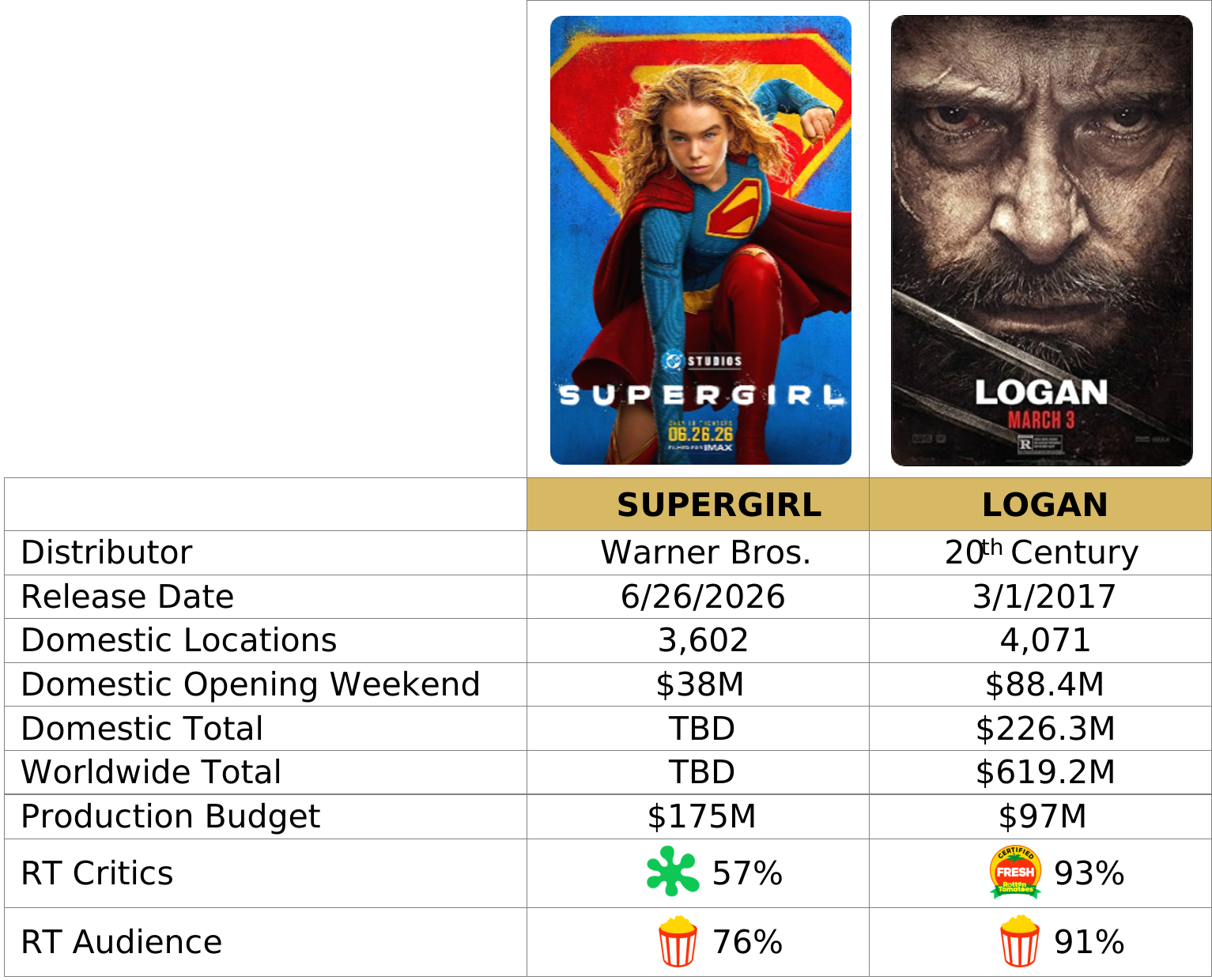
SUPERGIRL from Warner Bros. and DC Studios finished in second place by earning $38M domestically and $68.0M worldwide in its opening weekend. This SUPERGIRL movie is actually the second feature with the title, following TriStar’s SUPERGIRL from 1984 starring Helen Slater as Supergirl with a strong supporting cast including Faye Dunaway, Mia Farrow and Peter O’Toole. The 1984 movie only earned $14.3M at the domestic box office and did not have any international release. Its $35M budget was relatively expensive at the time, making it a financial loser for its studio. Perhaps this explains why it took another 42 years to rework the intellectual property to come out with a new movie.
SUPERGIRL is the second feature film in the rebooted DC Universe under the direction of James Gunn and Peter Safran. The first movie of the new series was last summer’s SUPERMAN, which grossed a respectable $354.2M domestically and $618.7M globally. Rather than retelling the familiar origin story of Supergirl as Superman's cousin, the new film takes its cues from the acclaimed 2021–2022 comic series entitled SUPERGIRL: WOMAN OF TOMORROW, written by Tom King and Bilquis Evely.
The film stars Milly Alcock as Kara Zor-El, a.k.a. Supergirl, and presents a more hardened and emotionally scarred version of the character than audiences may have encountered until now. The film was directed by Craig Gillespie, whose previous directing credits include LARS AND THE REAL GIRL (2007), FRIGHT NIGHT (2011), I, TONYA (2017), CRUELLA (2021), and DUMB MONEY (2023). Gillespie was selected by DC Studios because of his ability to balance character-driven drama with large-scale spectacle.
Milly Alcock is best known for her previous work in the HBO Max series House of the Dragon (2022–2024). Supporting players include Jason Momoa as Lobo, best known for AQUAMAN (2018), AQUAMAN AND THE LOST KINGDOM (2023), DUNE (2021), and FAST X (2023); Matthias Schoenaerts, known for RUST AND BONE (2012), THE OLD GUARD (2020), and THE DANISH GIRL (2015); and Eve Ridley as Ruthye Marye Knoll, the young alien girl whose quest for revenge drives much of the story. Another key supporting role is the dog Krypto, which was received warmly by audiences for his role in last year’s SUPERMAN.
The character of Krypto the Superdog first appeared in DC Comics in 1955. His appearance in last year’s SUPERMAN is his first in a live-action format. While many moviegoers assumed Warner Bros. used a trained dog enhanced with visual effects, director James Gunn explained that Krypto is "fully CGI” in the movie, although the animation was heavily based on a real dog. What makes the visual effects so convincing is that Krypto was modeled after Gunn's real-life rescue dog Ozu, whom he adopted while he was writing SUPERMAN. Ozu’s mischievous personality inspired Krypto's role in the film. Gunn has said that Ozu was so chaotic that it made him wonder what life would be like if a troublesome dog suddenly had superpowers. That idea became Krypto. One reason audiences have responded so strongly is that Krypto doesn't behave like a perfectly trained Hollywood dog. He is hyperactive, disobedient, destructive, and lovable all at once—traits directly borrowed from Ozu. Critics and fans frequently cited Krypto as one of the most memorable elements of SUPERMAN, and his popularity is said to have resulted in a measurable increase in dog adoptions in the weeks after the film's release. Krypto’s scene-stealing antics in SUPERMAN made such an impression that he received a bigger role in SUPERGIRL. For many viewers, the biggest surprise is that Krypto looks so real. The fact that so many people ask whether he is an actual dog is perhaps the highest compliment that its visual-effects creators could receive.
The plot follows Kara Zor-El as she joins Ruthye on an interstellar journey across the galaxy to hunt down the villainous Krem of the Yellow Hills, who murdered Ruthye's father. Along the way, Kara confronts her own trauma, questions of justice versus vengeance, and the burden of being one of Krypton's last survivors. The story has been described as a space-western adventure with emotional themes similar to TRUE GRIT (2010) and LOGAN (2017), rather than a traditional superhero origin film.
Critics have been harsh on the movie, giving it a 56% rating on Rotten Tomatoes. Audiences were slightly more pleased, with a 76% score. Even with the movie receiving relatively poor reviews, its star, Milly Alcock, has received some praise for her performance. Here are a few selected examples of the critics’ reviews. New York Magazine said, “Alcock, with her smirk and her anguished eyes, is a very watchable lead, but this aggressively minor movie doesn’t know what to do with her or her character. And where’s the mystery in that?” The Film Verdict weighed in with, “Milly Alcock makes an energetic addition to the reconstructed DC Universe. What the actress hasn’t been given is a vehicle that deserves her; Craig Gillespie’s Supergirl is a shambolic affair, cursed with underwhelming action and forgettable antagonists.” The San Francisco Chronicle felt that, “Alcock’s Supergirl has to grow into the hero she’s destined to become, and by the time the credits roll, it’s her performance — not the increasingly oversized spectacle surrounding it — that leaves the strongest impression.” Finally, USA Today sounds a more positive tone by calling it, “An intergalactic revenge flick that boldly freshens up familiar tropes with the help of a jaded, self-destructive protagonist who needs to figure a whole lot of stuff out.”
SUPERGIRL had the production budget of a blockbuster, at $170M. Clearly, the new DC Universe is swinging for the fences, since it would need to earn $425M worldwide to break even from its theatrical run. After an opening weekend of $68.0M globally, it seems likely that this milestone will be out of reach. For a comparison film, we first looked at SUPERGIRL from 1984, but that film only did $14.3M at the box office, without any international release. The new SUPERGIRL exceeded that amount by the end of its first day. We also considered SUPERMAN from 2025, but saw quickly that no one expected SUPERGIRL to have anything close to that success. In the end, we chose LOGAN from 2017, since both movies focus on a weary hero protecting a younger companion while traveling through dangerous territory. Both SUPERGIRL and LOGAN also emphasize character development, emotional stakes, and moral ambiguity over conventional superhero tropes.
SUPERGIRL vs. LOGAN
#3 - OBSESSION
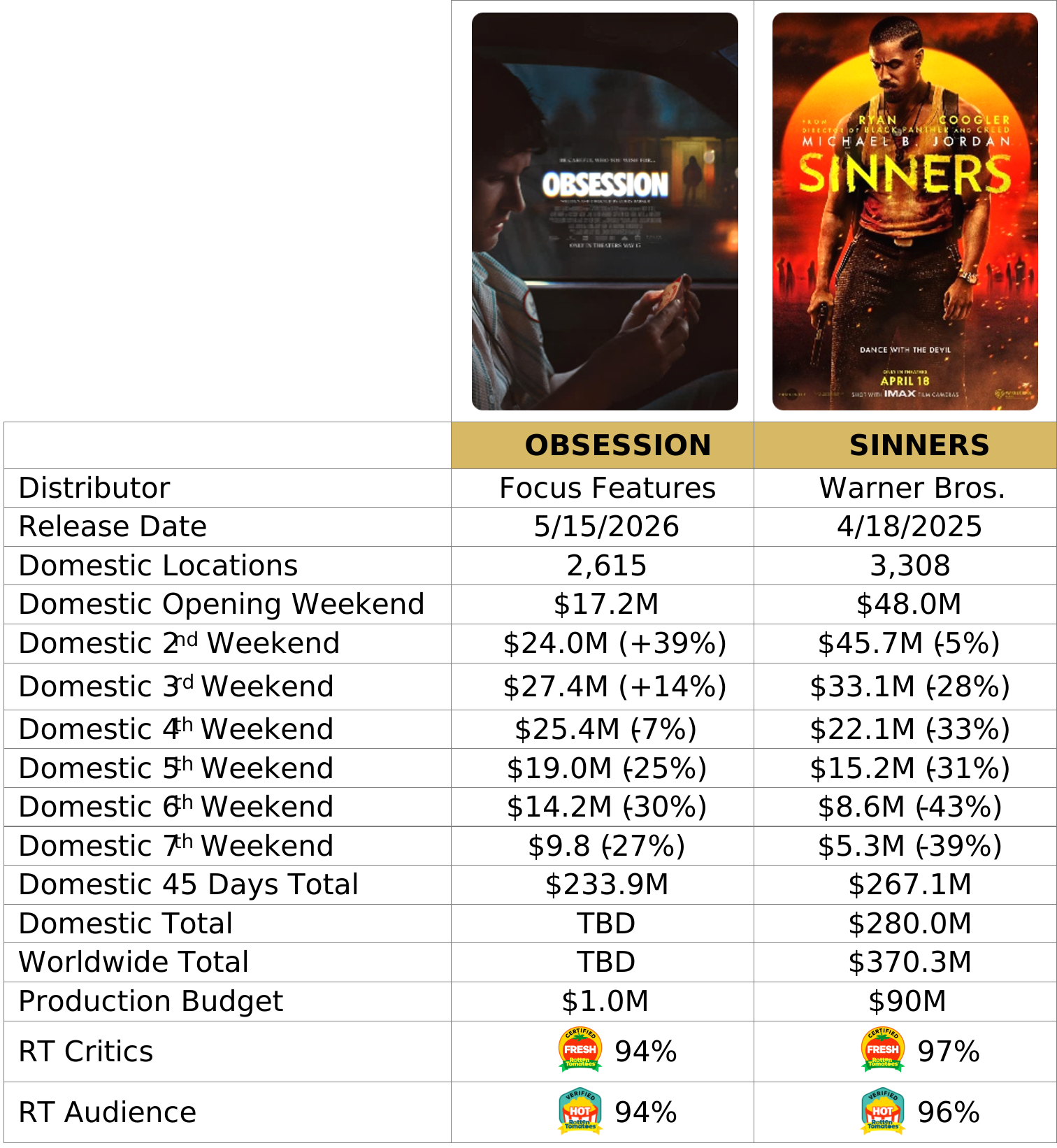
Focus Features’ horror film, OBSESSION, held onto third place in its seventh weekend, bringing in $9.8M and falling by 27%. This brings its incredible box office totals to $233.9M domestically and $370.1M worldwide. We have run out of ways to describe what this picture has accomplished. Its financial performance is in the stratosphere, having been made on a budget of only $1M and now carrying an incredible 370 to 1 ratio of global gross to production cost. The only other film we can find with a higher ratio is THE BLAIR WITCH PROJECT from 1999, which grossed $248.6M globally on a microscopic budget of $60K, an 4,413 to 1 gross to budget ratio.
When OBSESSION opened seven weeks ago, we selected TALK TO ME as a comparison film, with both being low-budget horror titles with successful runs. However, OBSESSION’s unbelievable success has rendered this comparison no longer valid, with OBSESSION having outperformed TALK TO ME by nearly 4 to 1. We now suggest that SINNERS is better suited film for comparison, since it wound up being the highest-grossing horror film in the post-pandemic era. Henceforth, we will measure OBSESSION against a film that received 16 Academy Award nominations (the most for any film in history) and won four, including Best Actor for Michael B. Jordan. While OBSESSION has little chance of stacking up against SINNERS’ awards success, its financial performance qualifies it to play in the same league.
OBSESSION vs. SINNERS after 48 Days
#4 - JACKASS: BEST AND LAST
Paramount’s stunt comedy, JACKASS: BEST AND LAST, finished fourth in its opening weekend with $8.4M domestically and $10.3M worldwide. This movie has been billed as the final theatrical chapter in Paramount’s long-running stunt comedy franchise. The previous five JACKASS films grossed $414.0M domestically and $568.2M worldwide, after spending $61.5M total on production. That makes for a very healthy 9.2 to 1 ratio of worldwide box office to production budget. Here is an overview of the franchise's box office history.
JACKASS Franchise Box Office History
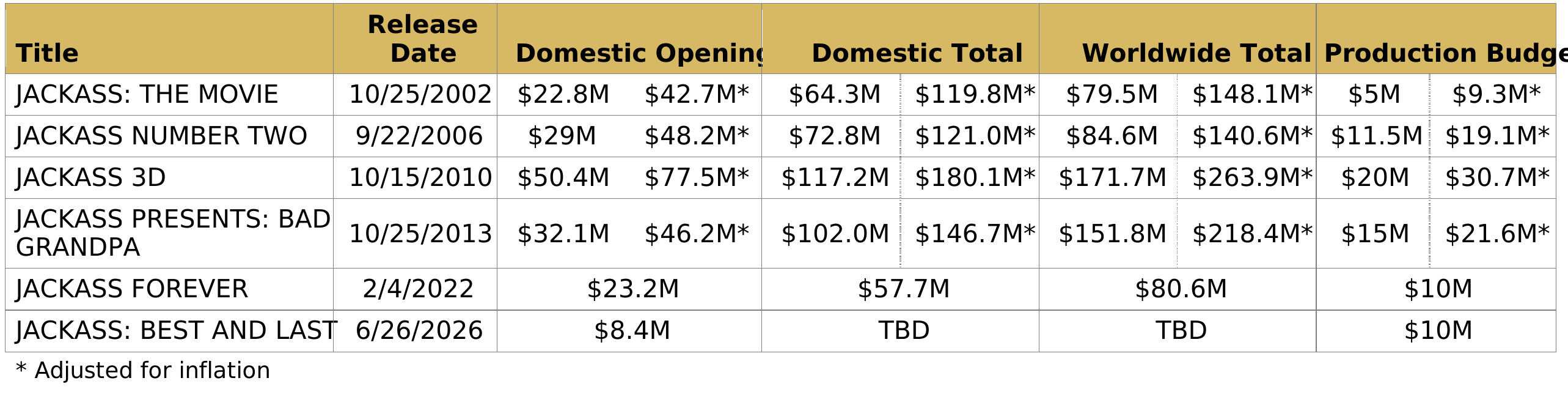
While the series has always been an ensemble effort, Johnny Knoxville has been its creative and commercial ringleader, transforming what began as an MTV stunt show into one of the most successful comedy franchises of the past 25 years. Perhaps Knoxville's greatest contribution has been his understanding that JACKASS was never just about pain. He helped define its unique blend of outrageous stunts, genuine camaraderie, and self-deprecating humor. That combination has proven remarkably durable, allowing the franchise to appeal to multiple generations of fans over the past two decades. Even with dozens of memorable cast members, most regard Johnny Knoxville as the indispensable figure whose personality, leadership, and willingness to take extraordinary physical risks turned JACKASS into a lasting brand.
Jeff Tremaine returns as the new film’s director, after having made all five of the previous films. It is extremely rare for a franchise with this many entries to be directed by the same person. The cast is led by Johnny Knoxville, Steve-O, Chris Pontius, Wee Man, Preston Lacy, Dave England, Danger Ehren, plus newer members including Poopies, Zach Holmes, Jasper Dolphin, and Rachel Wolfson. All these contributors are known exclusively for their roles in the JACKASS movies. The plot, if you can call it that, is less a traditional story than a farewell package: the crew performs one last round of dangerous stunts and pranks while mixing in archival material, unseen footage, and nostalgic reflection on the franchise’s run. Early reviews describe it as a “greatest hits” goodbye with some new material rather than a wall-to-wall new stunts. While established fans may like this approach, newcomers would probably want to see more original pranks.
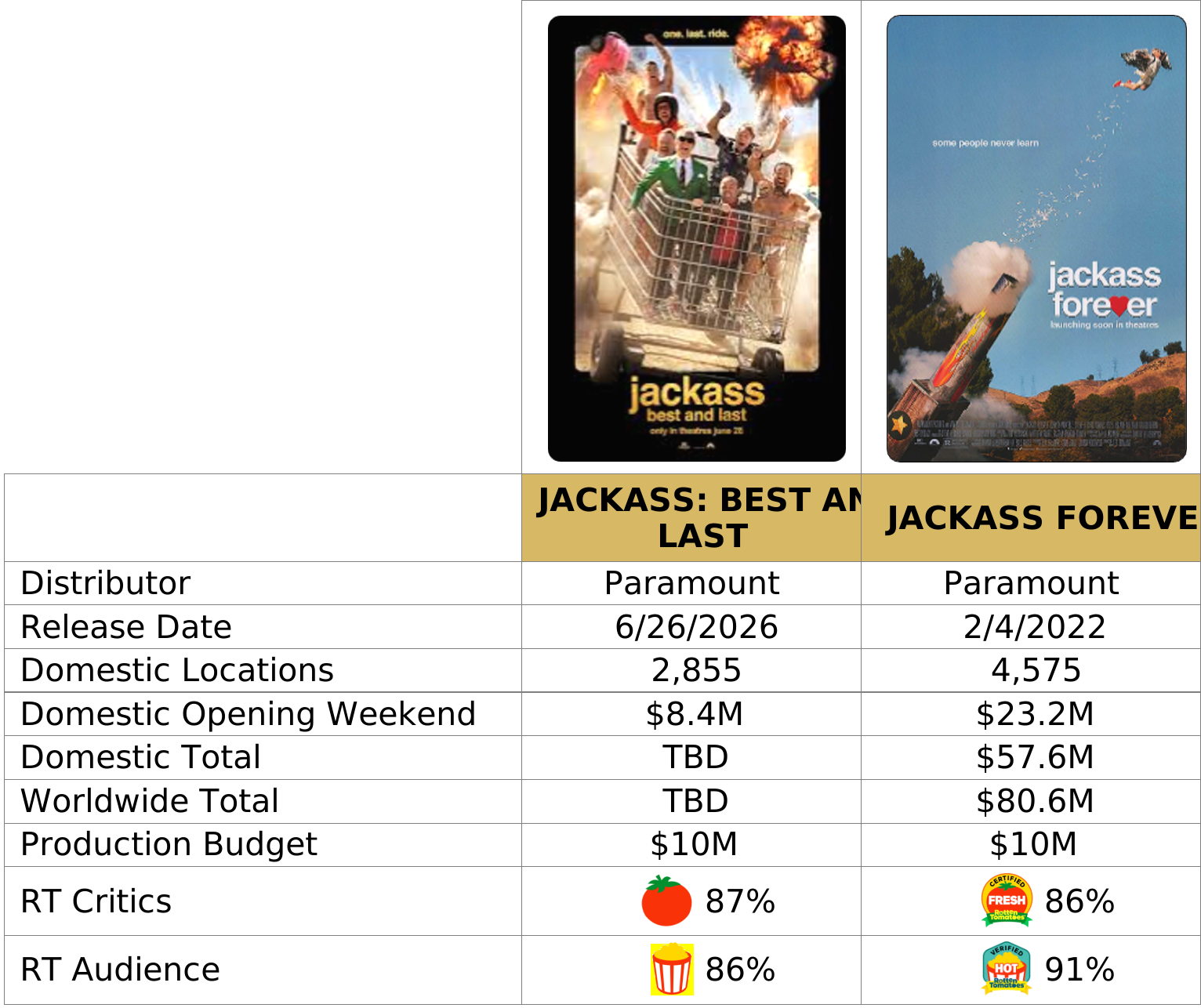
Critics have been surprisingly positive on the franchise's swan song, giving it an 87% fresh rating on Rotten Tomatoes. The audience agrees, with a similar 86% score. The Financial Times praises it by saying, “The purer the gag, the more helpless your laughter. Men being struck between the legs remains the gold standard.” Screenland International said, “The star of the show remains Johnny Knoxville, the charismatic ringmaster whose infectious cackle will get viewers guffawing along with him -- no matter how painful the orchestrated bits clearly are.” The Daily Beast felt the film “Proves that nothing is eternal except the hilarity of seeing others hurt themselves for our amusement.” Taking a more negative tone, The Hollywood Reporter cuts to the heart of the matter by concluding, “While there are occasionally funny moments, these movies are emblematic of the dumbing down of America.”
Continuing to add to the profitability of the series, JACKASS: BEST AND LAST was made for a very economical $10M. The new movie blew past that number in its opening weekend and will surely repeat its profitable formula. If he is to be believed, Knoxville has said this movie is the “natural place to end.” True fans will remember that Knoxville’s JACKASS FOREVER (2022) bull injury helped change what he can safely do. During that production, his bull stunt resulted in a brain hemorrhage, concussion, broken wrist, and broken rib. Since then, Knoxville has repeatedly said that doctors warned him he cannot risk another concussion. He only participates in a few stunts in JACKASS: BEST AND LAST, none dealing with potential head injury. Some have suggested that Knoxville could exclude himself from stunts and focus on being the creator and host of any future JACKASS films. There are an unlimited number of people who would take part in future hijinks for $5,000. The hardest thing to do in Hollywood is turn away from making another movie in a series that has been exceedingly profitable, with little financial risk for its backers. We predict this will not be the end.
For a comparison film, we go back to the most recent JACKASS film, JACKASS FOREVER from 2022.
JACKASS: BEST AND LAST vs. JACKASS FOREVER
#5 - DISCLOSURE DAY
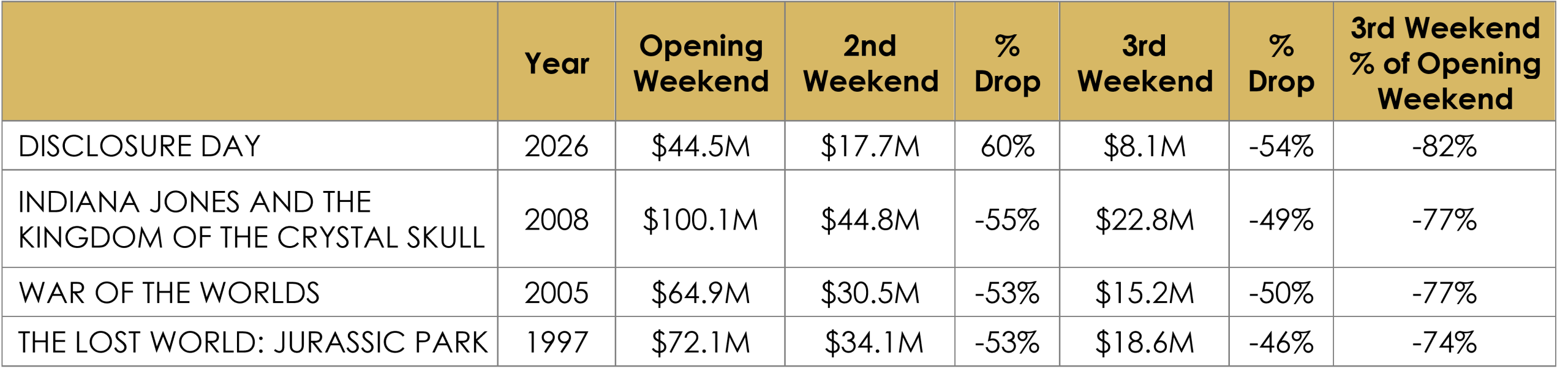
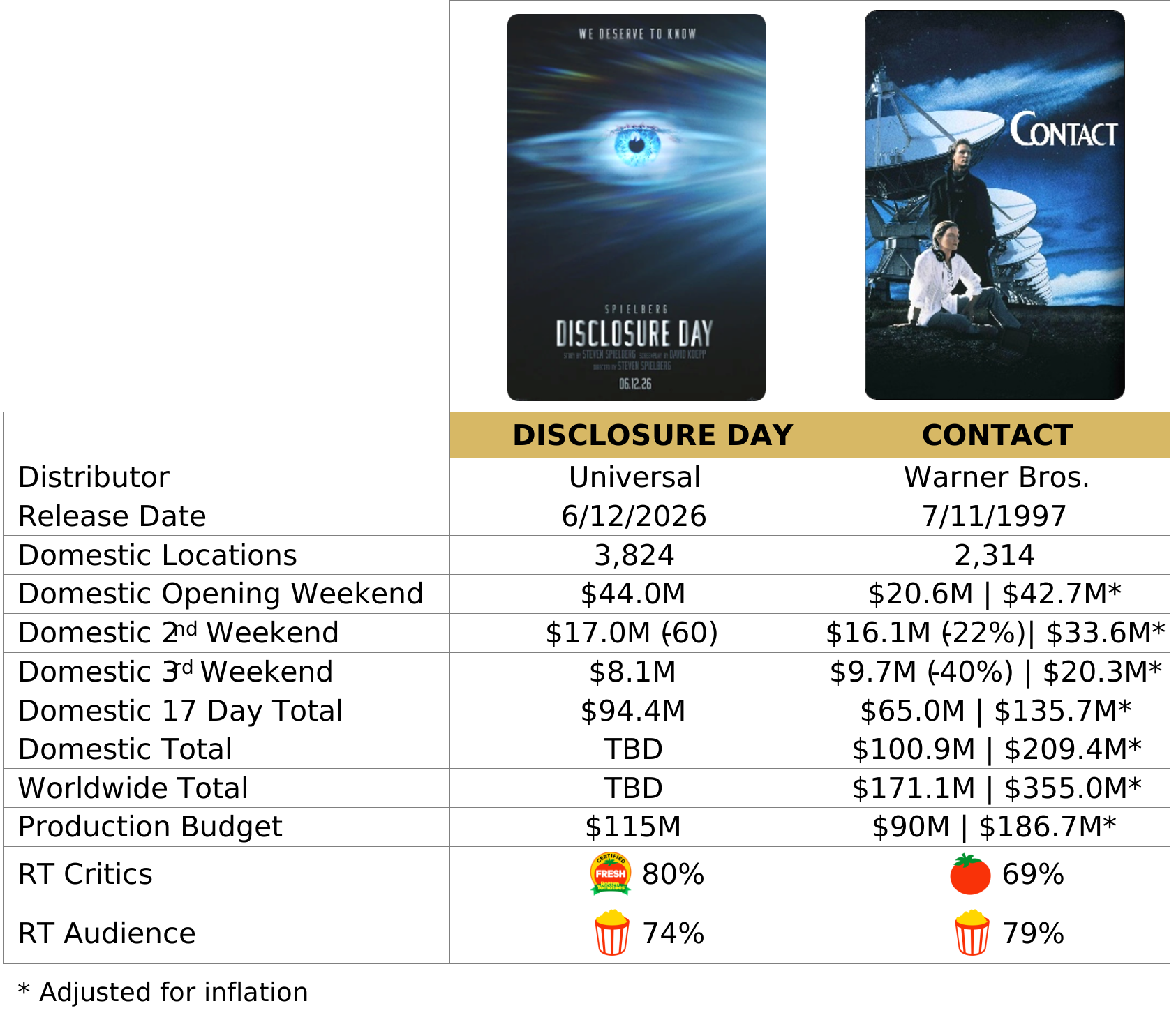
DISCLOSURE DAY, the sci-fi drama from Steven Spielberg and Universal, tumbled from second to fifth place, grossing $8.1M this weekend, a 54% decline from last weekend. After 17 days, it has earned $94.4M domestically and $193.7M worldwide. It stands as the fastest-falling wide release of Spielberg's career among his major studio films. The accompanying chart illustrates just how quickly the film is losing momentum compared with the sharpest second and third weekend declines of his previous releases.
DISCLOSURE DAY DECLINE
The performance is particularly disappointing because DISCLOSURE DAY is a well-crafted film that recreates the tone, scope, and emotional resonance of some of Spielberg’s earlier classics. Critics have been nearly unanimous in praising Spielberg's direction, supporting the case that he remains at the top of his profession. The more difficult question is whether his traditional audience has simply aged past today’s mainstream moviegoing demographic. If you were 10 years old and saw E.T. THE EXTRA-TERRESTRIAL in 1982, you are 54 years old now. Spielberg has built a reputation for being one of the few filmmakers who can deliver a "four-quadrant" movie, with appeal to both men and women, young and old audiences. An extraordinary 41% of DISCLOSURE DAY’s opening weekend audience was age 45 or older, which is an unusually high concentration of older moviegoers. This may have limited the film's ability to sustain its initial box office, including the younger audiences needed for a long, successful run.
Unfortunately, the landscape will become even more challenging in the weeks ahead, as the summer release calendar becomes increasingly crowded. DISCLOSURE DAY will surely surrender locations and its place on premium screens at most theatres, accelerating its box office decline. Based on its current trajectory, we expect it to finish with approximately $110M domestically and $230M worldwide. Measured against a $115M production budget, the film would have needed to earn $288M worldwide to become profitable from the box office, before adding in ancillary revenues.
DISCLOSURE DAY vs. CONTACT after 17 Days
Where Are We as of 6/25/2026
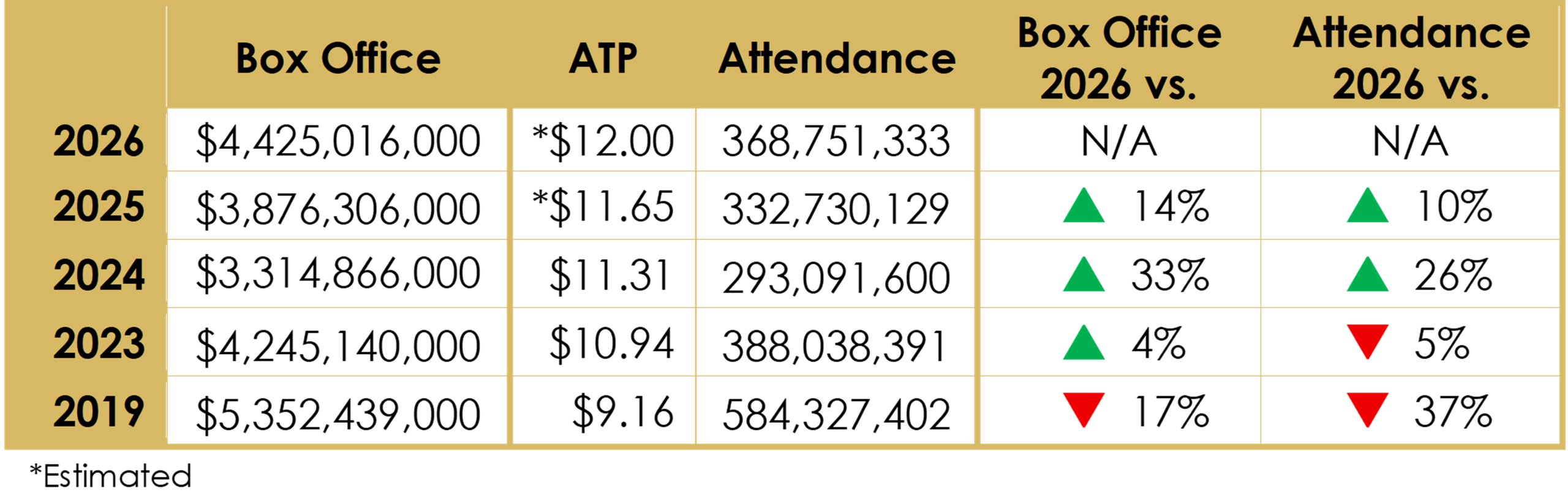
BOX OFFICE AND ATTENDANCE – 25 WEEKS YEAR TO DATE