

CLAYFACE and YOU CAN SEE EVERYTHING Team Up to Lift the Box Office
Warner Bros. and DC’s CLAYFACE was the top movie in theatres this weekend, registering $24.0M in its first three days. This marks the sixth consecutive weekend with a new release claiming the box office crown. A24’s surprise documentary YOU CAN SEE EVERYTHING finished second with $19.5M after expanding this weekend to 2,655 locations after opening last weekend in only 855. Together, the two films powered the weekend gross to $94.9M compared to last year's $75.8M.
The 2026 box office has surpassed 2025 in every one of the last six weekends and eleven of the last thirteen.
2026 vs. 2025 WEEKEND DOMINATION (Weekends 31-43, 7/31-10/25)
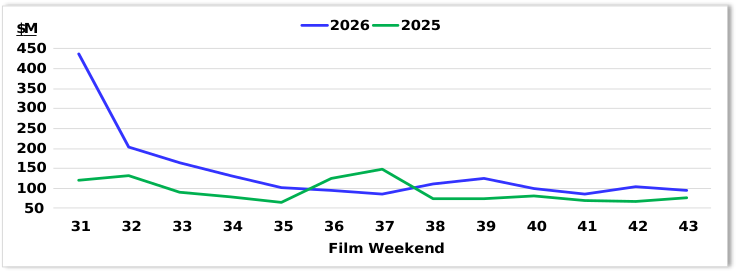
This sustained strength demonstrates how this year’s box office recovery has been built on more than a few high-grossing blockbusters. Every week, moviegoers are finding reasons to go to their local cinema. This “built-in” cushion is keeping 2026 on pace to finish with $10.3B in total box office, a forecast we have held to for the last several weeks.
Next weekend will bring a Halloween dip, with none of the new releases expected to earn over $5M. Keeping the 2026 winning streaks alive will fall to the holdover pictures. Studios have long avoided opening major new films around Halloween, creating something of a self-fulfilling prophecy. Potential audiences make other plans and theatres have limited movie attractions to bring in customers.
With this year’s Halloween falling on a Saturday, trick-or-treating and costume parties will compete directly with prime moviegoing hours. The holiday has become a recurring weak spot on the release calendar. Last year, when Halloween fell on Friday, the entire weekend generated just $57.4M. That leaves a modest hurdle for another year-over-year victory—but little room for error.
This summary of results from the last four weeks shows the year-over-year momentum that has built up during that time.
THE LAST FOUR WEEKS – 2026 vs. 2025

The last four weeks illustrate the current streak of domination in that box office is up 42%, and attendance is up 38%.
#1 - CLAYFACE
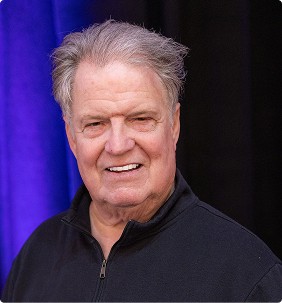
CLAYFACE, the Warner Bros. release from DC Studios, claimed first place in its opening weekend with $24.0M domestically and $43.0M worldwide. The horror thriller explores celebrity, revenge and lost identity through the grotesque transformation of one of Batman’s oldest adversaries. Although less familiar than the Joker, Penguin or Riddler, Clayface has an 86-year comic-book history that stretches back to 1940. His special power is shapeshifting; he can impersonate others, transform his body into weapons, and withstand severe injuries that would normally be fatal blows. Usually an enemy of Batman, he has also pursued rehabilitation and occasionally fought alongside him.
James Watkins directs, bringing experience from EDEN LAKE (2008), THE WOMAN IN BLACK (2012), BASTILLE DAY (2016), also released as THE TAKE, and SPEAK NO EVIL (2024). Mike Flanagan developed the story and shares screenplay credit with Hossein Amini. Matt Reeves, Lynn Harris, James Gunn and Peter Safran produce.
Tom Rhys Harries stars as Matt Hagen, an ambitious actor whose pursuit of restored beauty leads to monstrous consequences. His previous films include SLAUGHTERHOUSE RULEZ (2018), THE GENTLEMEN (2020) and KANDAHAR (2023). Naomi Ackie plays experimental scientist Dr. Caitlyn Corr; audiences know her from WHITNEY HOUSTON: I WANNA DANCE WITH SOMEBODY (2022), BLINK TWICE (2024) and MICKEY 17 (2025). Supporting players include THE SOCIAL NETWORK’s Max Minghella as detective John Borrelli, HAPPY-GO-LUCKY’s Eddie Marsan as Hagen’s manager, and TINKER TAILOR SOLDIER SPY’s David Dencik as gangster Markos Szabo.
Hagen’s promising career collapses after a gangster brutally disfigures his face. Unsuccessful reconstructive surgeries leave him desperate enough to accept Corr’s experimental tissue-repair treatment. At first, the procedure restores his appearance and offers a path back to stardom. But disturbing side effects soon make his features unstable, eventually allowing him to reshape his entire body. His quest to reclaim his career becomes a campaign of revenge, while his relationship with Corr complicates an increasingly desperate struggle to preserve his humanity.
The reception was generally favorable, with Rotten Tomatoes listing a critics’ score of 75% and 94% from audiences. Variety’s movie reviewer explains, “In nearly every department, Clayface exceeds expectations — all without getting ideas above its spiritual B-movie station.” The Hollywood Reporter adds, “Clayface emerges as one of the year’s big surprises.” TheWrap’s take is, ‘‘Clayface is an effective, though hardly brilliant, gross-out horror film.” In The Guardian, critic Benjamin Lee finds the film disappointing but does admit, “What the film does do is successfully gross us out.”
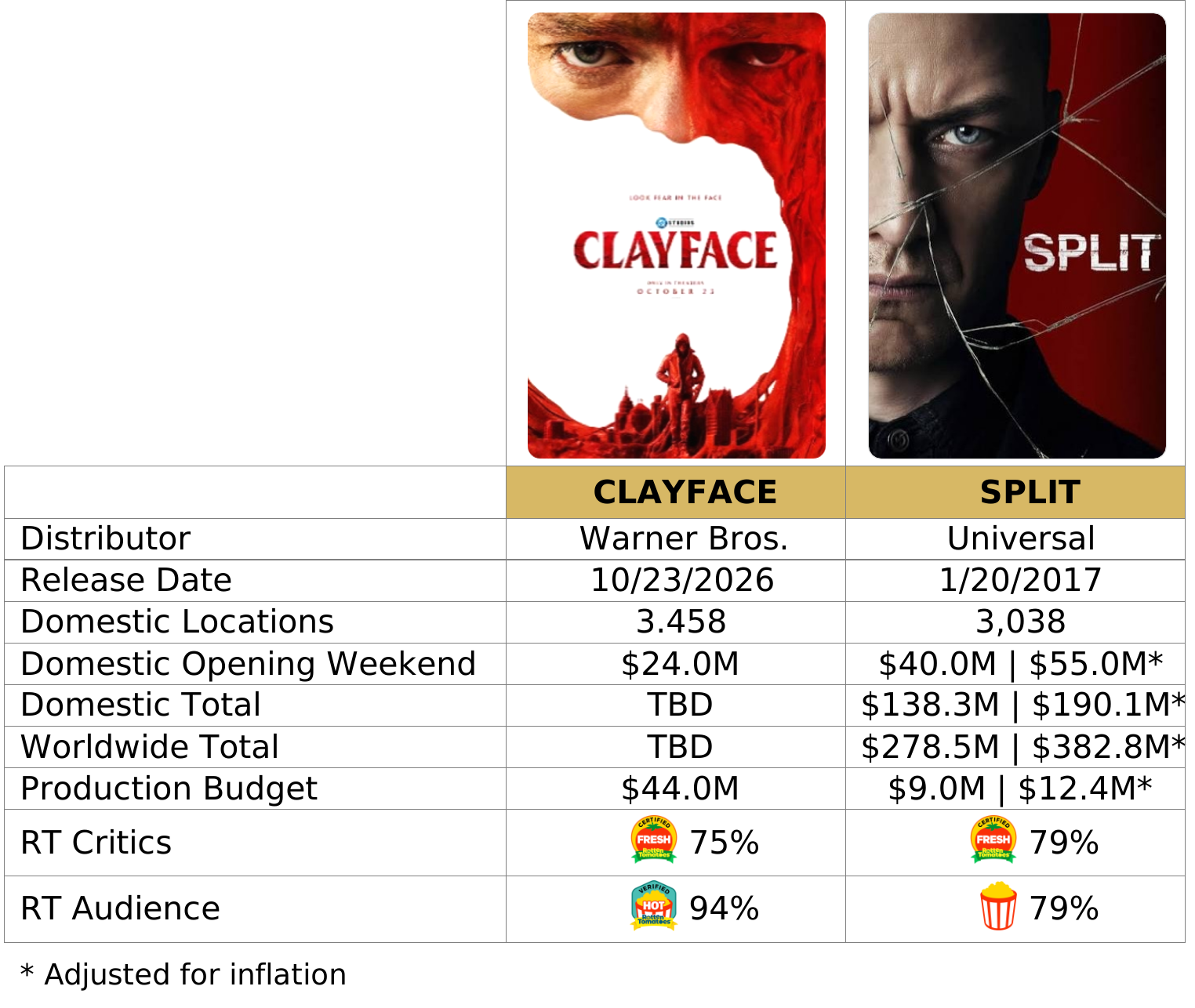
The reported $40M production budget gives CLAYFACE a considerably lower financial hurdle to overcome than DC’s larger superhero releases. The contrast with this year’s SUPERGIRL is particularly striking, which cost a reported $170M to produce and earned only $126.5M worldwide at the box office. CLAYFACE’s lower investment gives Warner Bros. greater room to build a commercially successful release even if it only appeals to a narrower audience of horror fans. The film can get to theatrical profitability with $100.0M in worldwide ticket sales. Its $43.0M opening weekend in theatres globally is a good start, and how it holds up over time will determine its profitability and whether it justifies a sequel.
SPLIT (2017) provides a compelling comparison because both films use psychological horror to introduce a character whose extraordinary physical abilities become terrifying. James McAvoy’s emergence as the Beast gives SPLIT a similar attraction to Hagen’s transformation: the spectacle of a recognizable human becoming something monstrous. SPLIT’s eventual connection to UNBREAKABLE also demonstrates how a largely self-contained horror story can fit into a broader superhero universe. Its $40M opening, $138.3M domestic finish and $278.5M worldwide total illustrate the commercial potential of that combination.
CLAYFACE vs. SPLIT
#2 - YOU CAN SEE EVERYTHING
A24’s YOU CAN SEE EVERYTHING finished in second place, with a strong $19.5M box office in its second weekend, 25% higher than its opening. It has earned $45.1M in U.S. and Canadian theatres in the 10 days since it opened. What began as an unconventional documentary has become a must-see theatrical event, propelled by sold-out screenings, social media debate and enthusiastic word of mouth. The fascination extends beyond Elizabeth Holmes’ methods and the unsettling question of whom audiences should believe. Moviegoers want to see it before its surprises are spoiled—and afterward, they want to discuss what they witnessed.
This box office strength has surpassed even the most optimistic pre-release forecasts. Last weekend’s $15.6M opening from only 855 theatres was twice the consensus projections of $7M–$8M. “This is a giant weekend for the genre,” industry analyst David A. Gross told Variety, noting that wide release documentaries would more typically earn $3M in their first three days. Having only a $7M production budget, the film has a considerable upside and is rapidly climbing the documentary box-office rankings. The highest grossing documentary of all time is TAYLOR SWIFTS: THE ERAS TOUR (2023), which grossed $180.8M domestically and $261.7M worldwide. To be fair, no one competes with Taylor Swift, so the accompanying chart shows the five highest-grossing non-concert documentaries domestically. A24 will work with Sony to distribute the film internationally, starting with Australia and New Zealand on November 12th.
TOP GROSSING DOCUMENTARY FEATURES (NON-CONCERT RELATED)
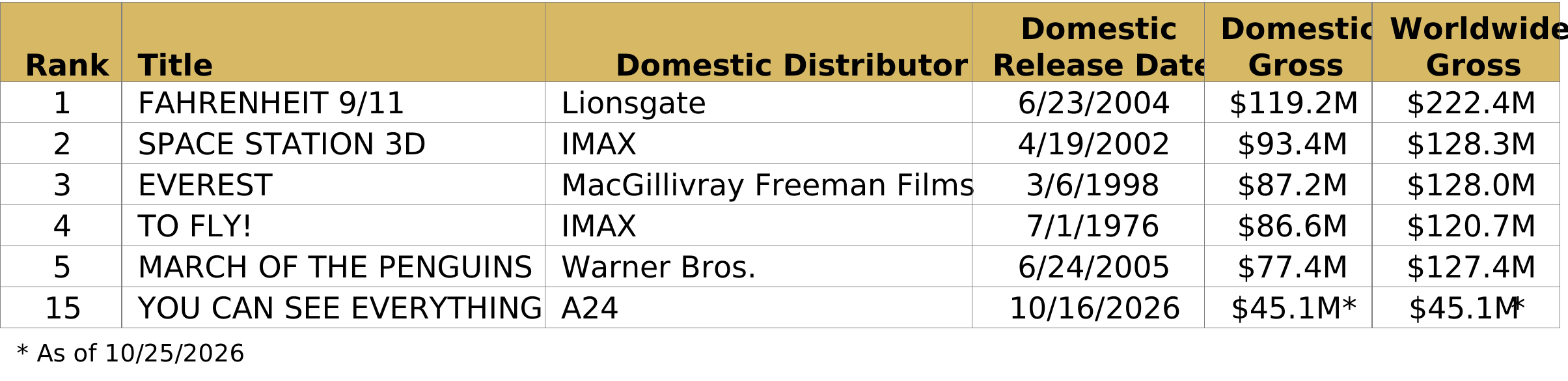
YOU CAN SEE EVERYTHING is already the 15th highest-grossing non-concert documentary. A24 has responded to demand by expanding distribution from last weekend’s moderate opening at only 855 theatres to 2,655 North American venues this weekend. Audience research helps explain that confidence: 70% of opening-weekend patrons were under 35, and the same percentage identified Nathan Fielder as a major reason for attending. Variety reported that 90% would definitely recommend the film and 80% considered it better than expected. Those findings suggest a powerful combination of an established following, satisfied audiences and curiosity spreading beyond the filmmakers’ core fans.
The movie’s commercial success has strengthened its position as a serious Oscar contender. The Academy began awarding documentaries in 1942 when CHURCHILL’S ISLAND (1941) won the first Oscar for the category. Directed by the English documentary filmmaker Stuart Legg and narrated by future Bonanza star Lorne Greene, the Canadian production chronicled Britain’s coordinated military and civilian resistance to Nazi Germany during the Battle of Britain. YOU CAN SEE EVERYTHING shares a Canadian connection, with Nathan Fielder having been born in Vancouver, British Columbia, in 1983.
The award nomination that is now being discussed would be unprecedented, as a possible contender for Best Picture. No documentary has ever been nominated for Best Picture, let alone won the award. A24 is mounting a campaign for YOU CAN SEE EVERYTHING in that category as well as for Best Documentary. Steve Pond, the awards executive editor of TheWrap, offered a measured endorsement by commenting, “Buzz notwithstanding, ‘You Can See Everything’ isn’t a slam-dunk Best Picture nominee. But it’s jaw-dropping enough to stir up real passion.” Joey Magidson of Awards Radar was more optimistic, saying, “I’m currently predicting You Can See Everything for a Best Picture nomination.”
While a Best Picture nomination would already make history, a win would be extraordinary. Whether or not it reaches that pinnacle, the film offers a striking example of how distinctive filmmaking, a carefully managed release and passionate audiences can turn a modestly budgeted production into a major theatrical attraction.
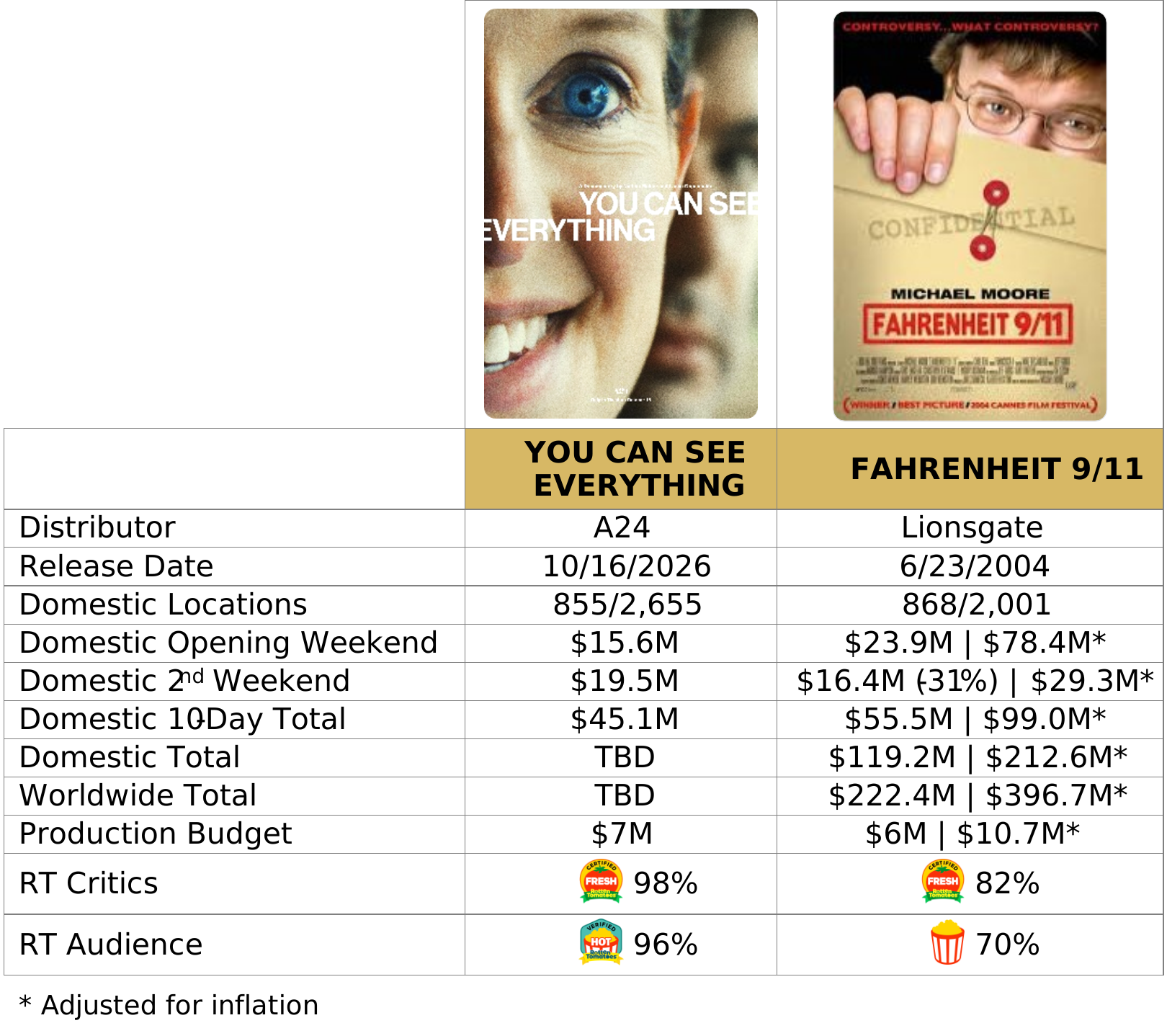
Its performance justifies an upgrade in our choice of a comparison film. Having easily surpassed our initial selection, MELANIA, we’re shifting our focus to FAHRENHEIT 9/11 (2004), whose $119.2M domestic total has stood as the non-concert documentary record for 22 years. That remains a formidable target, but it provides a more meaningful benchmark for a film whose ambitions—and audience—have quickly outgrown its initial expectations.
YOU CAN SEE EVERYTHING vs. FAHRENHEIT 9/11
#3 - WILDWOOD
WILDWOOD, Laika’s stop-motion fantasy adventure released domestically by Fathom Entertainment, opened in third place with $11.8M in its first weekend. Adapted by Chris Butler from Colin Meloy’s 2011 novel, illustrated by Carson Ellis, it is the studio’s first feature since MISSING LINK (2019). Director Travis Knight previously made KUBO AND THE TWO STRINGS (2016), BUMBLEBEE (2018) and MASTERS OF THE UNIVERSE (2026). Combining handcrafted puppets, intricate miniature environments and digital effects, WILDWOOD brings LAIKA’s painstaking animation techniques to an unusually expansive fantasy adventure.
Peyton Elizabeth Lee, whose credits include SECRET SOCIETY OF SECOND-BORN ROYALS (2020) and PROM PACT (2023), voices heroine Prue McKeel. Jacob Tremblay, known for ROOM (2015), WONDER (2017) and LUCA (2021), plays her classmate Curtis. Carey Mulligan, of AN EDUCATION (2009), PROMISING YOUNG WOMAN (2020) and MAESTRO (2023), voices the mysterious Alexandra. Two-time Oscar winner Mahershala Ali plays bandit leader Brendan, while Angela Bassett voices a giant golden eagle named General. The ensemble also includes Awkwafina, Richard E. Grant, Jake Johnson, Charlie Day and Tom Waits.
The story begins in Portland, where a flock of crows abducts Prue’s baby brother, Mac. With Curtis accompanying her, she follows them into the supposedly impassable forest bordering the city. Beyond its boundaries lies a hidden civilization populated by talking animals, bandits, soldiers and competing rulers. Their rescue mission draws them into a larger conflict involving Alexandra, a grieving and dangerous governess whose ambitions threaten the woodland realm. Beneath the fantastical adventure are themes of friendship, loss and children assuming responsibilities that adults have failed to fulfill.
Critical reception has been exceptional, with particular praise for the animation, visual imagination and ambitious storytelling. The Rotten Tomatoes figures show 100% positive reviews from 113 critics and a 97% Popcornmeter audience score. The Hollywood Reporter declares, “Laika’s most ambitious effort to date, Wildwood may also be the company’s masterpiece.” TheWrap calls it “a rapturous experience,” praising the artists’ passion, while The Boston Globe describes it as “a film that will make certain people feel seen.” Time Out applauds its ability to draw on influences ranging from Tolkien and C.S. Lewis to LABYRINTH and STAND BY ME while creating something fresh.
That artistry carries a substantial financial burden. The reported $100M production budget reflects years of development, elaborate puppet fabrication, miniature construction, specialized animation and digital effects. More than 1,000 artists, craftspeople, technicians and filmmakers reportedly contributed, including 49 animators. Approximately 142,000 replacement faces were printed to supply the characters’ expressions, with certain sequences requiring a different face for every frame—24 physical faces for one second of finished animation.
The result may be an artistic triumph, but its theatrical economics are considerably less encouraging. Against a $100M production budget before marketing, the $11.7M opening leaves WILDWOOD facing a steep climb toward profitability. Its PG-13 rating may also narrow its appeal among families with younger children, placing greater importance on older audiences drawn to fantasy and animation. Exceptional reviews could support sustained business over time, but a long run and substantial international receipts will be needed to brighten its long-term financial outlook. Strong word of mouth offers a path to smaller losses; the opening alone does not establish their eventual size.
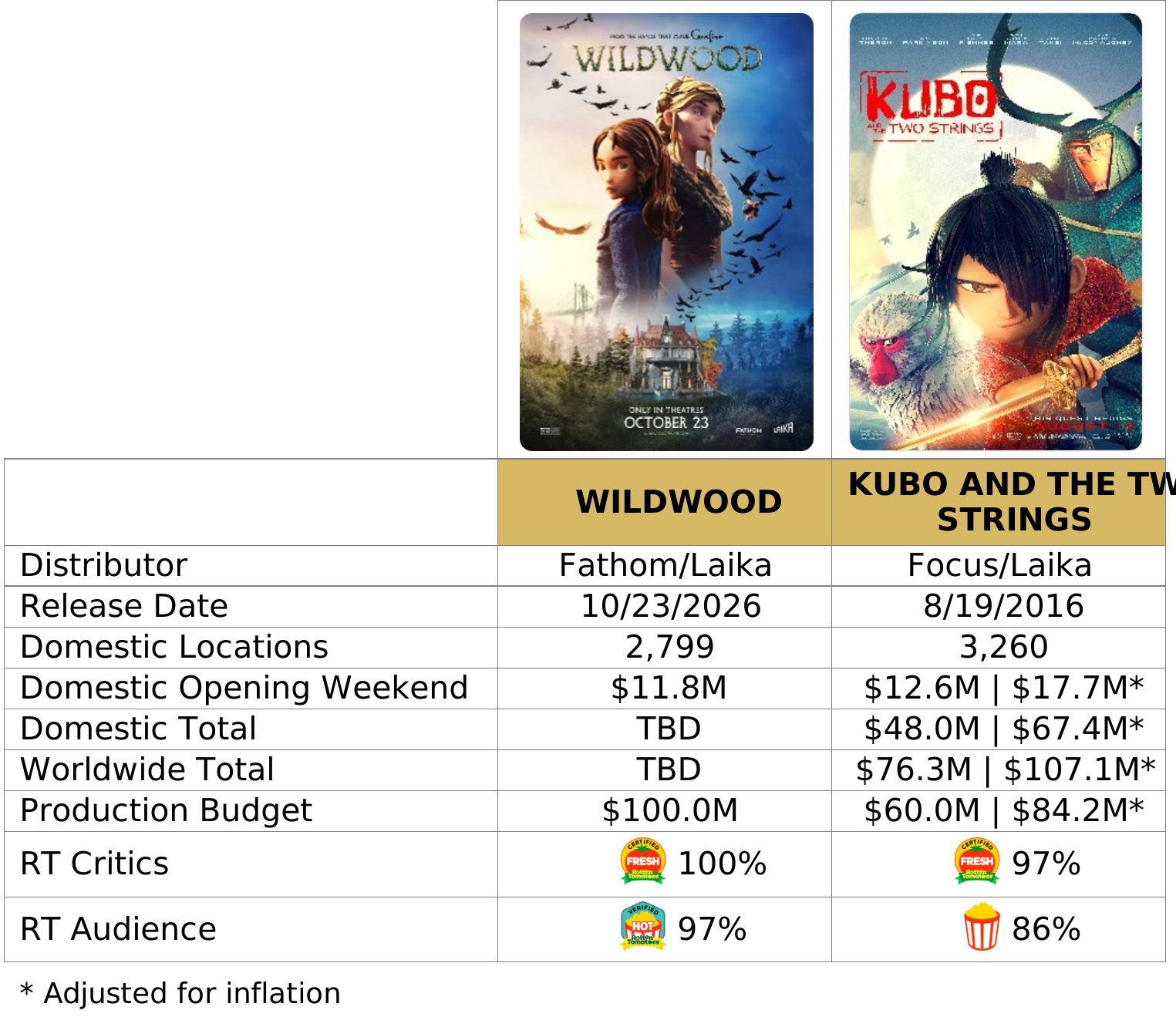
KUBO AND THE TWO STRINGS (2016) is the strongest comparison. Both are Travis Knight-directed Laika adventures that place young protagonists in dangerous supernatural worlds, combining family trauma with elaborate stop-motion action. KUBO opened to $12.6M domestically and finished with $48.0M in North America and $77.5M worldwide. Those results provide a useful benchmark for the audience an acclaimed Laika fantasy can reach—and underscore WILDWOOD’s financial challenge. Matching KUBO’s worldwide business would still leave ticket sales below WILDWOOD’s reported production cost, even before theatres take their share and marketing expenses are considered.
WILDWOOD vs. KUBO AND THE TWO STRINGS
#4 - STREET FIGHTER
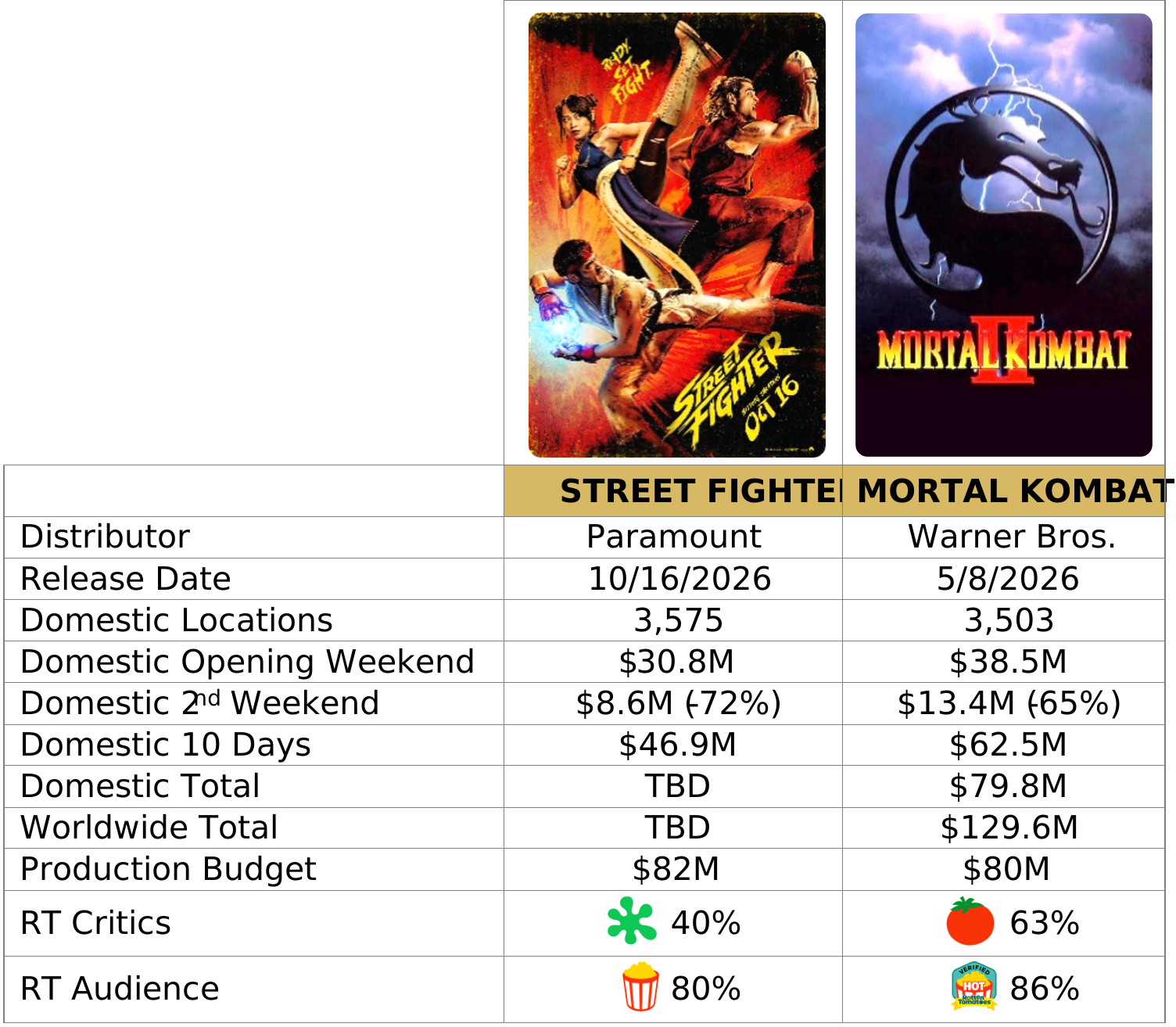
STREET FIGHTER, the video-game-based action movie from Paramount, fell from first to fourth in its second weekend with $8.6M after suffering a horrific 72% drop. Its 10-day totals are $46.9M domestically and $79.6M globally. A steep second weekend drop for films finishing first on their opening weekend has become a trend over the last six weekends. The following chart shows the second weekend misfortunes that have befallen these films.
SECOND WEEKEND DROPS BY FORMER FIRST PLACE FILMS OVER THE LAST SIX WEEKENDS
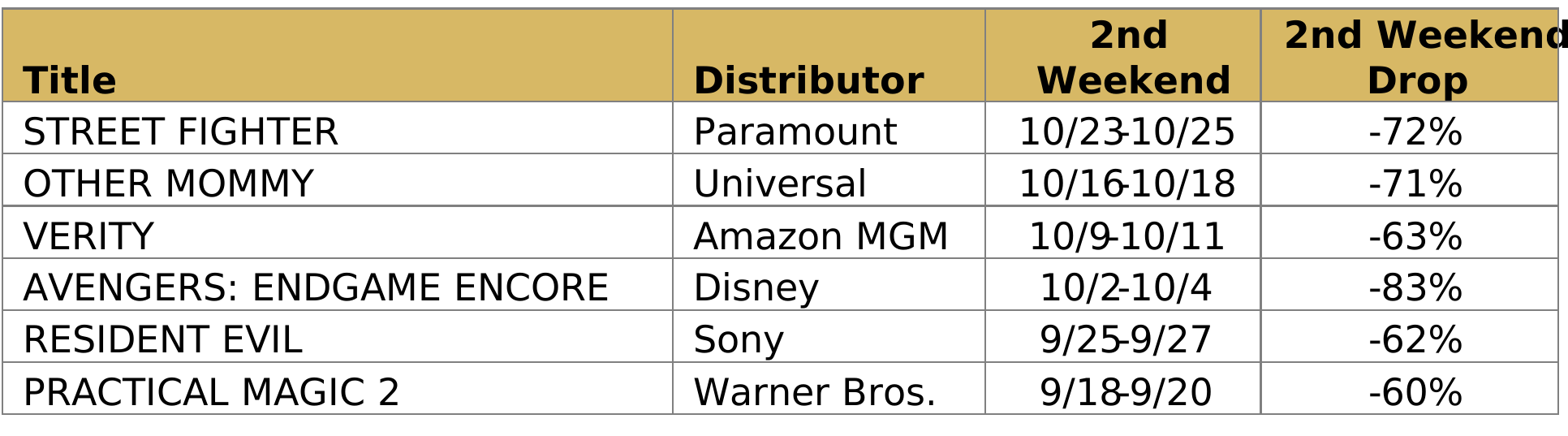
While the initial reaction to STREET FIGHTER’s opening box office had been positive, its second weekend decline has sealed the financial fate of the picture, and not in a good way. It will begin to lose theatres and showtimes next weekend and two weeks from now, on November 6th it will only be playing at large complexes that have the screens to spare. Needing $205M in global sales to break even, the film is now on a trajectory to bring in only $125M worldwide. This will most likely end the possibility of a franchise expansion. As with MORTAL KOMBAT II from earlier this year, the fate of movies based on video games has darkened as audiences seek newer intellectual properties.
STREET FIGHTER vs. MORTAL KOMBAT II after 10 Days
#5 - WICKER
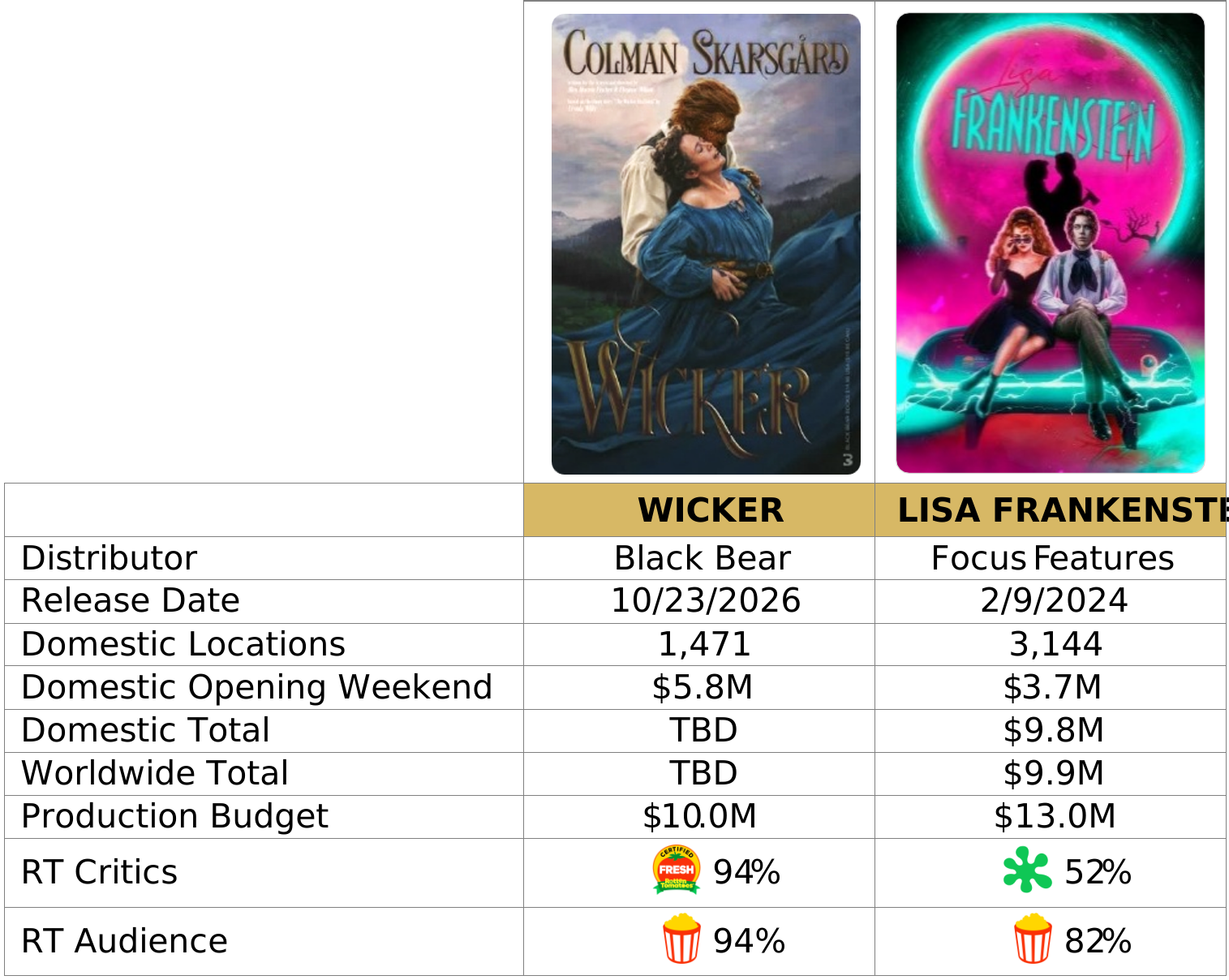
Black Bear’s adult fairy tale WICKER finished fifth in its opening weekend, bringing in $5.8M. The film was written and directed by husband-and-wife filmmakers Alex Huston Fischer and Eleanor Wilson, whose previous feature was the alien-invasion comedy SAVE YOURSELVES! (2020). Adapted from Ursula Wills-Jones’s short story “The Wicker Husband,” it combines an adult fairy tale with bawdy comedy and observations about marriage, conformity and jealousy. The film premiered at the Sundance Film Festival in January 2026.
Olivia Colman plays the Fisherwoman; her best-known films include THE FAVOURITE (2018), which earned her the Best Actress Oscar, THE FATHER (2020) and THE LOST DAUGHTER (2021). Alexander Skarsgård, known for THE LEGEND OF TARZAN (2016), THE NORTHMAN (2022) and INFINITY POOL (2023), plays her wicker husband. Peter Dinklage portrays the Basketmaker; his film credits include THE STATION AGENT (2003), CYRANO (2021) and THE HUNGER GAMES: THE BALLAD OF SONGBIRDS & SNAKES (2023). Elizabeth Debicki, of THE GREAT GATSBY (2013), TENET (2020) and MAXXXINE (2024), plays a village woman threatened by the unconventional couple.
The story revolves around a lonely fisherwoman who lives on the outskirts of a conservative seaside village, supporting herself through hard work while enduring constant ridicule for her appearance, her smell and her unmarried status. Tired of being treated as someone unworthy of love, she approaches the local basket maker with an extraordinary request: weave her a husband. The resulting creation comes to life as a handsome, gentle companion whose devotion transforms her daily existence. For a woman accustomed to insults and isolation, his kindness, desire, and willingness to share her work offer an unfamiliar sense of belonging.
Their happiness soon becomes a source of fascination and resentment. The village women begin comparing this attentive newcomer with their own disappointing husbands, while the men feel threatened by the expectations he inspires. Neighbors who once dismissed the fisherwoman now scrutinize her marriage, turning her private joy into a public controversy. As jealousy and interference strain the relationship, her years of rejection leave her vulnerable to doubts about whether such happiness can last. The fairy tale becomes an exploration of love, independence and the temptation to control the very person whose freely given affection makes a relationship meaningful.
Reception for the film has been convincingly favorable, with Rotten Tomatoes scores of 94% from critics and 94% from audiences. A sample of critics' reviews reveals the following. The Hollywood Reporter called it, “A warming, sometimes poignant pleasure, a film full of lively personality.” The Times (UK) wrote, “Colman is so good that she single-handedly elevates this ‘quirky medieval romp’ into unexpected, even undeserved, places.” Awards Radar said, “Elizabeth Debicki makes cruelty and petty jealousy an art form, leading to some of the darker moments in the film, but also some of the funniest.” The Wall Street Journal offered a dissenting view by saying, “Far from being a daring allegory, the only risk ‘Wicker’ faces is that of suffering wrist and elbow strain from patting itself on the back.”
WICKER’s reported $10M budget reflects an independent production built around a contained story and actors enthusiastic about participating in the project. However, the cast’s salaries have not been disclosed, so there is no verified basis for saying they took specific pay cuts or deferred compensation. Olivia Colman, also a producer, told The Playlist the screenplay ranked among her favorites; Alexander Skarsgård said he immediately called his agent after reading it. That enthusiasm helps explain how the filmmakers attracted such distinguished actors.
Several production choices helped stretch the money. Filming used existing medieval backlots at Hungary’s NFI and Korda studios, supported by local crews, giving the village setting substantial production value. The story’s concentration on one community also limits the need for numerous locations and large action sequences—an inference from its scope. Wētā Workshop created Skarsgård’s character as a practical costume and prosthetics, avoiding the need to digitally animate the central character throughout the film. The team reduced his daily transformation to about 90 minutes specifically to accommodate a demanding shooting schedule. The film only needs to make $25M in worldwide ticket sales to get to theatrical profitability. With such strong Rotten Tomatoes scores, it should be able to get there.
LISA FRANKENSTEIN (2024) is a solid comparison film for WICKER because both build an unconventional love story around a lonely, socially marginalized woman whose ideal companion is brought to life. In LISA FRANKENSTEIN, a misunderstood teenager finds romance with a reanimated corpse; in WICKER, a ridiculed fisherwoman commissions a husband woven from wicker. Both combine romantic wish fulfillment, dark comedy and fantasy, asking audiences to embrace a relationship that the surrounding community considers unnatural.
WICKER vs. LISA FRANKENSTEIN
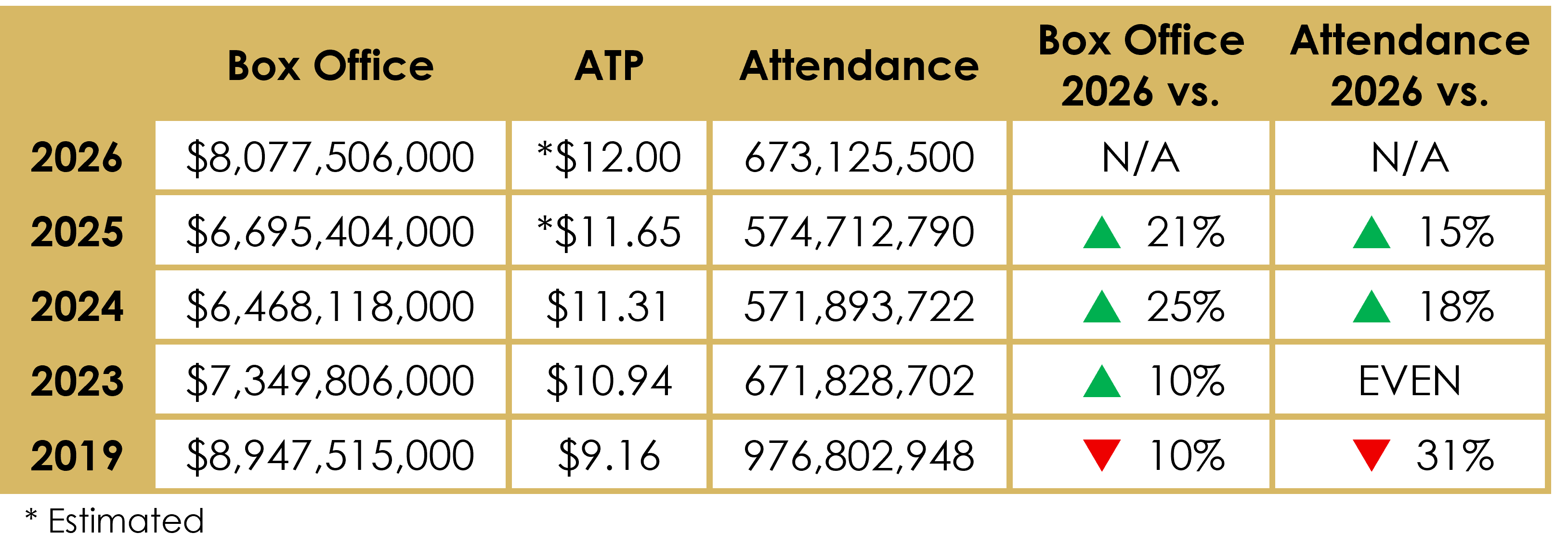
Where Are We as of 10/22/2026
BOX OFFICE AND ATTENDANCE – 42 WEEKS YEAR-TO-DATE