

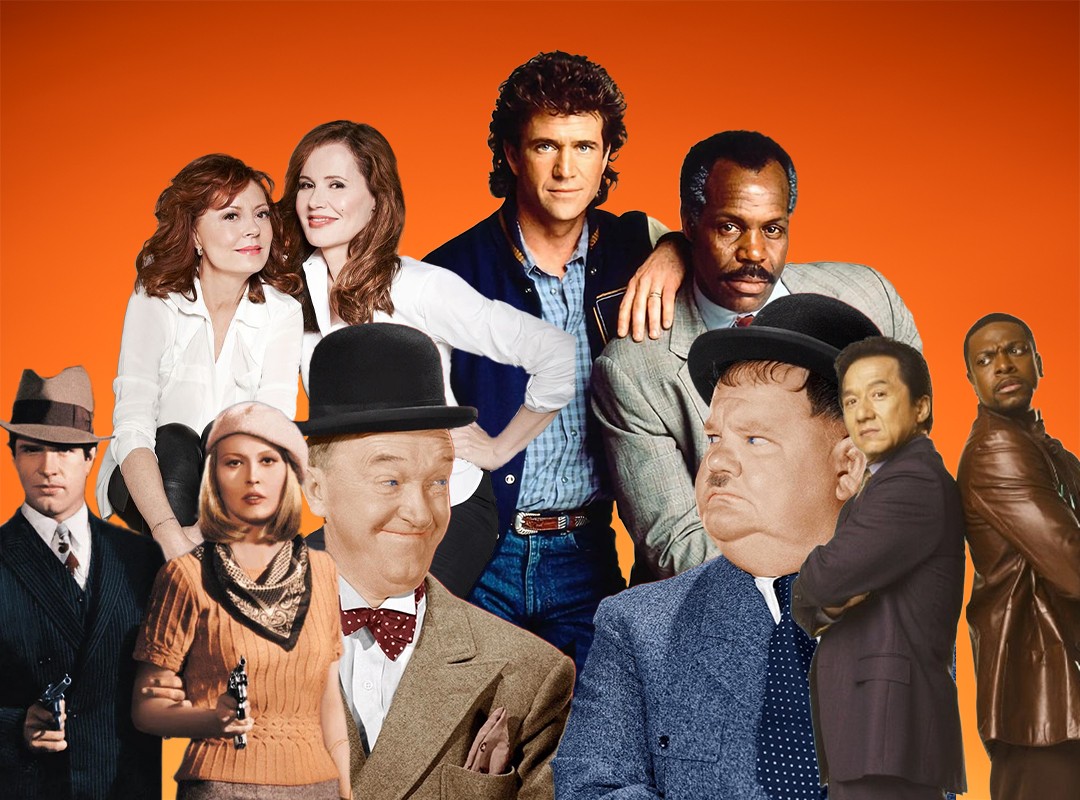
Sometimes, some of the greatest movie partnerships have become more famous than the films themselves. From comedy legends who invented entire genres to action heroes who redefined what it means to be cops on screen, these duos created templates that Hollywood still follows today.
This is the story of how the most unforgettable on-screen partnerships became the gold standard for movie magic.
The Foundation for Partnerships: Comedy
Comedy partnerships laid the groundwork for every successful movie duo that followed, establishing the fundamental dynamics that would be recycled, refined, and revolutionized across genres for decades to come.
Stan Laurel and Oliver Hardy: The Original Template
Stan Laurel and Oliver Hardy, who starred together in classics like Sons of the Desert, Way Out West, and The Music Box, weren’t just funny — they were revolutionary. Working together for over three decades, they created comedy’s first international franchise, making over 100 films that earned them global recognition. What most people don’t know is that Hardy originally wanted to be a dramatic actor and only stumbled into comedy by accident. Their partnership worked because Laurel was the creative mastermind behind their routines, while Hardy was the natural performer who could sell any gag with just a look.
The duo’s influence extended far beyond their era, establishing the “thin man, fat man” dynamic that would inspire everyone from The Odd Couple (1968) to Dumb and Dumber (1994). Their meticulous timing and physical comedy created a template that proved laughter could transcend language barriers, making them international stars when Hollywood was still finding its voice.
Abbott and Costello: Multi-Media Pioneers
Building on Laurel and Hardy’s foundation, Abbott and Costello, who made audiences laugh in films like Buck Privates and Hold That Ghost, dominated the 1940s by doing something no comedy team had attempted: they made their routines work in multiple media simultaneously. While performing their “Who’s on First?” sketch live on the radio, they were also starring in Universal monster movies like Abbott and Costello Meet Frankenstein, which combined horror with comedy. This genre blend wouldn’t become mainstream again until decades later. Bud Abbott was actually a former carnival barker, which explains his perfect timing for setting up Lou Costello’s punchlines.
Their success proved that comedy partnerships could anchor entire film franchises, paving the way for the modern blockbuster approach of building multiple movies around successful character dynamics.
Simon Pegg and Nick Frost: Contemporary Masters
Modern comedy partnerships like Simon Pegg and Nick Frost prove that the classic template still works, but with contemporary twists that reflect changing audience expectations. Their Cornetto Trilogy (Shaun of the Dead, Hot Fuzz, The World’s End) was written specifically around their real-life friendship, with Edgar Wright crafting each script to highlight their natural dynamic. Pegg has revealed that many of their best improvised moments came from actual conversations they’d had years before filming.
Seth Rogen and James Franco: The Stoner Comedy Evolution
Seth Rogen and James Franco’s partnership represents the evolution of stoner comedy from the Cheech and Chong era into something more sophisticated and cinematically ambitious. Their collaboration began on the cult TV series Freaks and Geeks, where they played high school friends with completely different approaches to teenage rebellion. This early dynamic would become the foundation for their film partnership.
What makes Rogen and Franco’s collaboration unique is how they’ve elevated stoner comedy beyond simple drug humor into legitimate filmmaking. Pineapple Express transformed the typically low-budget stoner genre into a high-concept action comedy, with Franco playing a drug dealer whose paranoia actually proves justified when real danger arrives. Franco approached his role as Saul Silver with the same intensity he brought to dramatic work, creating a character who was both hilarious and genuinely unpredictable.
Their partnership reached its creative peak with This Is the End, a meta-comedy where they played exaggerated versions of themselves during the apocalypse. The film worked because their real friendship provided the foundation for exploring how celebrity friendships might survive under extreme circumstances. Rogen has revealed that many of the film’s conflicts were based on actual tensions within their friend group, transformed through comedy into something both personal and universal.
The Interview proved that their partnership could tackle serious subjects while maintaining their comedic chemistry. Franco’s manic energy as talk show host Dave Skylark perfectly complemented Rogen’s deadpan sensibility as his producer Aaron Rapaport. Their dynamic drove the political satire while grounding the film’s more outrageous moments in a believable friendship.
What distinguishes Rogen and Franco from previous comedy partnerships is their willingness to examine male friendship with unusual honesty. Their films often explore themes of arrested development, creative ambition, and the ways childhood friendships must evolve to survive adulthood – topics that previous stoner comedies typically avoided in favor of simple laughs.
Action Partnerships: The Buddy Cop Revolution
The 1980s transformed movie partnerships by introducing high-stakes action to the relationship dynamics that comedy had perfected, creating a new genre that would dominate Hollywood for decades.
Mel Gibson and Danny Glover: Defining the Genre
Mel Gibson and Danny Glover’s Lethal Weapon partnership rarely happened. Gibson was originally considered too young for the role, while Glover was known primarily for dramatic work. Director Richard Donner paired them together because he wanted actors who would genuinely challenge each other rather than simply following a script. Their improvised dialogue became so integral to the films that later sequels were written around their natural banter.
The buddy cop genre exploded because it solved Hollywood’s biggest action movie problem: how to create emotional stakes in explosion-heavy films. By focusing on partnership dynamics between Martin Riggs and Roger Murtaugh, filmmakers could develop character relationships that made audiences care about the outcomes of elaborate chase sequences and shootouts.
Jackie Chan and Chris Tucker: East Meets West
The success of the Lethal Weapon formula opened doors for international variations, with Jackie Chan and Chris Tucker’s Rush Hour trilogy succeeding globally because it combined two completely different comedy styles. Chan’s physical comedy came from Hong Kong’s stunt tradition, where performers did their own dangerous work. Tucker’s rapid-fire delivery was rooted in American stand-up comedy. Director Brett Ratner encouraged them to play off each other’s strengths rather than trying to match each other’s energy.
The partnership between Lee and Carter proved that the buddy cop template could cross cultural boundaries while maintaining its emotional effectiveness, setting the stage for increasingly diverse action partnerships.
The Outlaw Legends: Crime as Character Study
While action films were perfecting the partnership formula, another genre was using criminal duos to explore deeper themes about society, loyalty, and the price of choosing freedom over conformity.
Warren Beatty and Faye Dunaway: Revolutionary Romance
Warren Beatty and Faye Dunaway’s Bonnie and Clyde changed American cinema by making audiences sympathize with criminals. The film was based on extensive research into the real Bonnie Parker and Clyde Barrow, including interviews with surviving gang members. Dunaway spent months studying Parker’s photographs and personal letters, discovering that the real Bonnie was far more intelligent and calculating than popular legend suggested.
This approach to criminal partnerships influenced countless subsequent films by proving that audiences would embrace morally ambiguous characters if their relationships felt authentic and their motivations were understandable.
Geena Davis and Susan Sarandon: Feminist Icons
Building on the outlaw romance tradition, Geena Davis and Susan Sarandon’s Thelma & Louise became a cultural phenomenon partly because of what happened behind the cameras. The actresses insisted on doing many of their own driving stunts, including the final cliff scene (which was achieved through careful editing and stunt work). Their real friendship translated to screen chemistry that felt authentic because it was built on genuine mutual respect and shared commitment to the story.
The evolution from Bonnie and Clyde to Thelma and Louise showed how criminal partnerships could be reimagined to address contemporary social issues while maintaining the emotional power of the original template.
Robert De Niro and Al Pacino: The Ultimate Adversaries
Robert De Niro and Al Pacino’s Heat represented the culmination of both actors’ careers up to that point, taking the criminal partnership concept in a new direction by making the protagonists adversaries who respect each other. Director Michael Mann spent three years developing their characters before filming began, creating detailed backstories that informed every scene. The famous coffee shop conversation between Neil McCauley and Vincent Hanna was improvised based on their understanding of these deeper character motivations.
Sci-Fi and Fantasy: Partnerships Beyond Reality
Science fiction and fantasy genres provided unique opportunities to explore partnership dynamics freed from realistic constraints, allowing filmmakers to examine fundamental human relationships through extraordinary circumstances.
Anthony Daniels and Kenny Baker: The Droid Dynamic
The Star Wars saga’s most successful partnership wasn’t Luke Skywalker and Han Solo — it was C-3PO and R2-D2. Anthony Daniels (C-3PO) has appeared in every Star Wars film since 1977, making him the franchise’s most consistent performer. The droids’ relationship was modeled after the comedy team of Laurel and Hardy, with C-3PO as the pompous straight man and R2-D2 as the mischievous troublemaker.
This non-human partnership proved that successful movie duos didn’t require traditional character development or dialogue to create emotional connections with audiences.
Keanu Reeves and Laurence Fishburne: Mentor and Student
The Matrix partnership between Neo and Morpheus worked because Laurence Fishburne brought Shakespearean gravitas to science fiction action. Fishburne insisted on understanding the philosophical underpinnings of the story, leading to extensive discussions with the Wachowski sisters about the nature of reality and consciousness. These conversations influenced the final script and elevated what could have been simple mentor-student dynamics.
The success of this partnership demonstrated how science fiction could use extraordinary circumstances to explore fundamental questions about human potential and the nature of reality.
Looking Ahead: What Makes Partnerships Endure
The most successful movie partnerships share common elements: complementary skills, genuine chemistry between performers, and stories that give both characters equal importance. Modern audiences expect more sophisticated relationship dynamics than previous generations, leading to partnerships that feel more authentic and less formulaic.
Streaming platforms are creating new opportunities for long-form partnership development, allowing characters to evolve across multiple seasons rather than single films.
Conclusion
The greatest movie partnerships prove that cinema’s most powerful moments come from human connections rather than special effects or elaborate plots. From Laurel and Hardy’s perfectly timed pratfalls to the latest superhero team-ups, successful duos tap into something universal about friendship, loyalty, and the ways people can bring out the best in each other. These partnerships don’t just entertain — they remind us why we go to movies in the first place: to see ourselves reflected in stories about people who are better together than apart.