
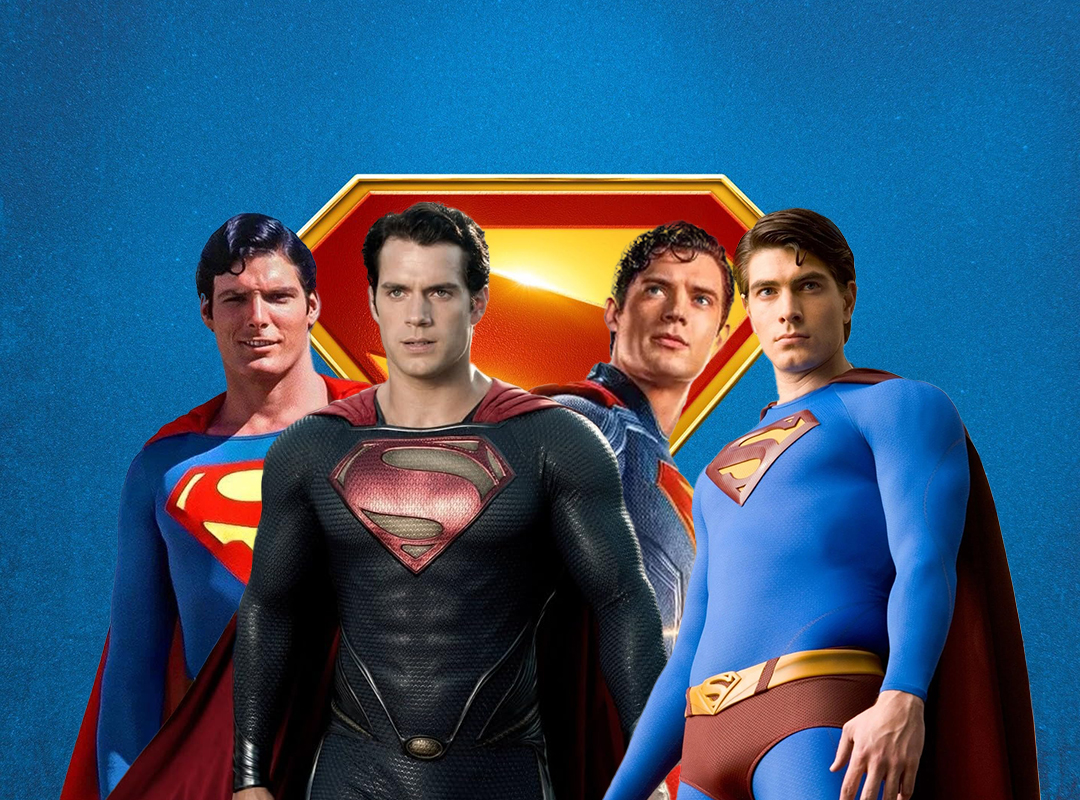

Superman has soared through cinema since the 1950s, evolving in tandem with our cultural landscape. From George Reeves’s hopeful origins, through Christopher Reeve’s iconic classic era, to Henry Cavill’s brooding take and now David Corenswet’s fresh, post-“Man of Steel” portrayal—each iteration reflects its time.
In 2025, James Gunn’s Superman launched the new DC Universe (DCU), offering a heartfelt, socially aware hero primed for modern audiences. We at Screendollars dive into every live-action Superman movie, their cultural significance, and how the latest Superman movie reshapes the myth.
1. Superman and the Mole Men (1951)
Actor: George Reeves
Supporting Cast: Phyllis Coates (Lois Lane), Alan Napier (Professor Graham)
Director: Lee Sholem
Runtime: 58 minutes | Format: Theatrical Feature
Streaming: Tubi (free), Apple TV (rent)
Plot Summary
In his first theatrical outing, Superman investigates strange happenings at an oil well in a small Texas town—only to find that humanoid “Mole Men” have emerged from underground. As panic spreads, a violent mob forms. While Clark Kent reports on the events, Superman must become the moral compass, protecting the innocent and defusing hate.
Why It Mattered
Though modest in scope and budget, Mole Men planted the seeds for Superman’s cinematic identity as a symbol of tolerance, logic, and peace. Released in the shadow of McCarthyism and Cold War paranoia, it’s a bold allegory about xenophobia and mob mentality. More than punching bad guys, this Superman stands up for the misunderstood, cementing him as a true protector of all.
This film also directly launched the Adventures of Superman TV series, introducing the tone of socially conscious storytelling that the franchise would return to with modern entries like Man of Steel and Superman (2025).
2. Superman: The Movie (1978)
Actor: Christopher Reeve
Supporting Cast: Margot Kidder (Lois Lane), Gene Hackman (Lex Luthor), Marlon Brando (Jor-El), Glenn Ford (Jonathan Kent), Ned Beatty (Otis)
Director: Richard Donner
Runtime: 143 minutes
Streaming: Max, Apple TV, Amazon Prime (rent)
Plot Summary
The film that made audiences believe a man could fly. Superman: The Movie delivers a sweeping origin story, from the fall of Krypton to Clark Kent’s coming-of-age in Smallville and eventual rise as Metropolis’s hero. He faces off against criminal mastermind Lex Luthor, who plans to trigger a catastrophic earthquake. Alongside the iconic romance between Superman and Lois Lane, the film is packed with heart, humor, and heroism.
Why It Mattered
This was the true birth of superhero cinema as a genre. Christopher Reeve became the gold standard for the character, balancing sincerity, strength, and awkward charm with effortless grace. Marlon Brando’s Jor-El and Glenn Ford’s Jonathan Kent provided a dual morality—one cosmic, one human—that has shaped every Superman interpretation since. Richard Donner’s direction emphasized hope, idealism, and mythic grandeur, establishing Superman as a Christ-like figure for the silver screen.
With a then-unprecedented budget, groundbreaking effects, and John Williams’ soaring theme, this remains one of the best Superman movies of all time—and a cultural cornerstone that every modern superhero movie still owes a debt to.
3. Superman II (1980)
Actor: Christopher Reeve
Supporting Cast: Margot Kidder (Lois Lane), Terence Stamp (General Zod), Sarah Douglas (Ursa), Jack O’Halloran (Non)
Director: Richard Lester (with substantial original footage by Richard Donner)
Runtime: 127 minutes (Theatrical), 116 minutes (Donner Cut)
Streaming: Max, Apple TV, Amazon Prime (rent)
Plot Summary
As Superman saves the world from nuclear disaster, a Kryptonian missile unknowingly releases three Phantom Zone prisoners—Zod, Ursa, and Non—who descend upon Earth, craving domination. Meanwhile, Clark Kent considers surrendering his powers for a life with Lois Lane. But when the world needs saving, Superman must choose duty over desire.
The film culminates in an epic showdown across Metropolis and the Fortress of Solitude, balancing action, romance, and moral conflict. The alternate Donner Cut, released in 2006, restores the original darker tone and emotional beats left on the cutting room floor.
Why It Mattered
Superman II is often hailed as the best Superman sequel, and for good reason. Terence Stamp’s Zod became a pop-culture icon (“Kneel before Zod!”), and the film deepened Superman’s emotional complexity, forcing him to weigh love against responsibility. It also mirrored a shift in Reagan-era individualism vs. duty. Clark’s willingness to sacrifice personal happiness reflected Cold War anxieties and superhero ethics. The tension between power and purpose became a blueprint for future comic book films.
Whether you watch the campier theatrical version or the more cohesive Donner Cut, Superman II solidified the idea that a superhero movie could be both thrilling and thoughtful.
4. Superman III (1983)
Actor: Christopher Reeve
Supporting Cast: Richard Pryor (Gus Gorman), Annette O’Toole (Lana Lang), Robert Vaughn (Ross Webster), Margot Kidder (Lois Lane)
Director: Richard Lester
Runtime: 125 minutes
Streaming: Max, Apple TV, Amazon Prime (rent)
Plot Summary
Superman III swings into satire as the Man of Steel faces a new kind of threat: 1980s tech bros. When bumbling programmer Gus Gorman (Richard Pryor) is hired by megalomaniac Ross Webster, he creates synthetic Kryptonite that corrupts Superman’s moral compass. The result? A split between heroic Superman and his darker alter ego, culminating in an infamous junkyard brawl—Superman vs. Clark Kent.
Meanwhile, Clark returns to Smallville and rekindles his bond with high school flame Lana Lang, adding a layer of introspection and small-town charm.
Why It Mattered
Often criticized for its tonal shift, Superman III is nevertheless a fascinating time capsule. It reflects early ’80s anxieties around computers, corporate power, and moral ambiguity. Richard Pryor’s inclusion added slapstick flair—divisive, but undeniably bold.
The corrupted Superman subplot, however, remains a standout moment in the Superman movie series, exploring what happens when hope falters and power turns inward. It’s not the franchise’s finest hour, but it dared to experiment—and gave us a glimpse of Superman’s internal struggles years before Zack Snyder made it mainstream.
5. Superman IV: The Quest for Peace (1987)
Actor: Christopher Reeve
Supporting Cast: Margot Kidder (Lois Lane), Gene Hackman (Lex Luthor), Jon Cryer (Lenny Luthor), Mark Pillow (Nuclear Man)
Director: Sidney J. Furie
Runtime: 90 minutes
Streaming: Apple TV, Amazon Prime (rent), Tubi (free with ads)
Plot Summary
Superman takes on the Cold War—literally. After receiving a heartfelt plea from a schoolchild, Superman vows to rid the world of nuclear weapons. But Lex Luthor, recently escaped from prison (with the help of his nephew Lenny), responds by creating Nuclear Man—a solar-powered supervillain made from Superman’s DNA.
As the two clash in space and on Earth, Clark also contemplates hanging up the cape, navigating a love triangle with Lois and a new Daily Planet owner’s daughter.
Why It Mattered
Superman IV had noble intentions but was kneecapped by severe budget cuts and studio interference. Despite Christopher Reeve’s passion—he co-wrote the story and pushed for its anti-nuclear message—the final product felt rushed and underwhelming, with uneven pacing, dated effects, and narrative shortcuts.
Still, it stands as a cultural snapshot of late-‘80s anxieties around arms control and environmentalism. It’s also the last of the classic Superman movies in order, featuring Reeve, cementing his legacy even as the franchise faltered.
6. Superman Returns (2006)
Actor: Brandon Routh
Supporting Cast: Kate Bosworth (Lois Lane), Kevin Spacey (Lex Luthor), James Marsden (Richard White), Parker Posey (Kitty Kowalski), Frank Langella (Perry White)
Director: Bryan Singer
Runtime: 154 minutes
Streaming: Max, Apple TV, Amazon Prime (rent)
Plot Summary
After a mysterious five-year absence, Superman returns to Earth—only to find that the world has moved on without him. Lois Lane has a child and a new fiancé, Lex Luthor is out of prison and back to his old land-grabbing schemes (this time with crystals from the Fortress of Solitude), and Superman himself is questioning his place in a world that doesn’t seem to need him anymore.
Why It Mattered
Positioned as a spiritual sequel to Superman II, this film aimed to channel the emotional and cinematic DNA of the Reeve-era films while introducing a new generation to the character. Brandon Routh delivered a performance laced with vulnerability and reverence, while Kevin Spacey’s Luthor leaned theatrical and menacing.
Although Superman Returns was visually elegant and emotionally resonant, its lack of large-scale action and nostalgic pacing divided audiences. Still, it tackled heavy themes—loss, legacy, and relevance—with a maturity that stood out amid the post-9/11 superhero boom. In retrospect, it feels like a love letter to Donner’s Superman and a bold experiment before the genre fully embraced reboot culture.
7. Man of Steel (2013)
Actor: Henry Cavill
Supporting Cast: Amy Adams (Lois Lane), Michael Shannon (General Zod), Diane Lane (Martha Kent), Kevin Costner (Jonathan Kent), Russell Crowe (Jor-El)
Director: Zack Snyder
Runtime: 143 minutes
Streaming: Max, Apple TV, Amazon Prime (rent)
Plot Summary
A radical reboot for a post-Nolan superhero era, Man of Steel retells Superman’s origin with mythic grandeur. Clark Kent is raised in Kansas by loving but cautious adoptive parents who fear what the world will do when it discovers his powers. When General Zod arrives on Earth demanding Kal-El surrender or face annihilation, Clark must choose between his Kryptonian heritage and human upbringing—becoming Superman in the process.
Why It Mattered
Zack Snyder’s vision recast Superman not as a Boy Scout, but as a conflicted god learning how to be human. The film leaned heavily into sci-fi aesthetics, philosophical dilemmas, and explosive action, especially the controversial final battle in Metropolis that drew both awe and criticism for its collateral damage.
Man of Steel marked the birth of the modern DC Extended Universe (DCEU), setting a tone of epic scale and moral ambiguity. Henry Cavill’s brooding yet stoic take on Superman polarized audiences, but his physicality and sincerity anchored the film’s emotional weight. Snyder’s signature visual storytelling—paired with Hans Zimmer’s soaring score—redefined Superman for a generation raised on The Dark Knight and The Avengers.
8. Batman v Superman: Dawn of Justice (2016)
Actor: Henry Cavill
Supporting Cast: Ben Affleck (Batman), Gal Gadot (Wonder Woman), Jesse Eisenberg (Lex Luthor), Amy Adams (Lois Lane), Jeremy Irons (Alfred)
Director: Zack Snyder
Runtime: 151 minutes (Theatrical), 183 minutes (Ultimate Edition)
Streaming: Max, Apple TV, Amazon Prime (rent)
Plot Summary
Set 18 months after the destruction of Metropolis, the world is torn over whether Superman is a guardian angel or an unchecked alien threat. Bruce Wayne, having witnessed the devastation firsthand, decides to stop Superman before he becomes a danger. Meanwhile, Lex Luthor manipulates both heroes into confrontation—and sets the stage for something even darker.
Why It Mattered
This isn’t just a superhero showdown—it’s an operatic clash of ideologies. Snyder crafts a world where Superman is worshipped and feared, and Batman is a haunted, brutal counterforce. The Ultimate Edition restores key plot threads, enriching Clark Kent’s character arc and clarifying Lex’s sinister manipulations.
Culturally, Batman v Superman marked a turning point: DC’s bold attempt to pivot from Marvel’s levity to mythic seriousness. It introduced the DCEU’s Trinity (Batman, Superman, Wonder Woman) and laid the groundwork for the Justice League. While divisive upon release, the film has since gained cult appreciation for its ambition, visual symbolism, and willingness to interrogate what power means in a post-9/11, surveillance-heavy world.
9. Justice League (2017)
Actor: Henry Cavill
Supporting Cast: Ben Affleck (Batman), Gal Gadot (Wonder Woman), Jason Momoa (Aquaman), Ezra Miller (Flash), Ray Fisher (Cyborg), Amy Adams (Lois Lane)
Directors: Zack Snyder (credited), Joss Whedon (reshoots)
Runtime: 120 minutes
Streaming: Max, Apple TV, Amazon Prime (rent)
Plot Summary
Following Superman’s death in Batman v Superman, Bruce Wayne and Diana Prince rally a team of metahumans to stop the alien warlord Steppenwolf from uniting the powerful Mother Boxes and terraforming Earth. With the world in peril and the team outmatched, their only hope is to resurrect Superman.
Why It Mattered
Justice League (2017) was meant to be the DCEU’s answer to The Avengers—a grand unification of heroes and tones. But creative clashes, Zack Snyder’s mid-production departure, and extensive reshoots under Joss Whedon led to a film that struggled with identity. The tonal whiplash between Snyder’s operatic weight and Whedon’s quippy rewrites left audiences polarized.
Still, it was pivotal in the Superman movie timeline. Clark Kent’s resurrection symbolized hope and marked a tonal shift toward a more traditionally heroic Superman. While the theatrical cut underperformed critically and commercially, it spurred massive fan demand for Snyder’s original vision—a movement that would eventually reshape Warner Bros.’ release strategy.
10. Zack Snyder’s Justice League (2021)
Actor: Henry Cavill
Supporting Cast: Ben Affleck (Batman), Gal Gadot (Wonder Woman), Jason Momoa (Aquaman), Ezra Miller (Flash), Ray Fisher (Cyborg), Amy Adams (Lois Lane)
Director: Zack Snyder
Runtime: 242 minutes (4-hour Director’s Cut)
Streaming: HBO Max
Plot Summary
This isn’t just a director’s cut—it’s a reimagining. After the divisive 2017 theatrical release (Justice League), Zack Snyder returned to complete his original vision following fan outcry and the #ReleaseTheSnyderCut campaign. The story follows Bruce Wayne and Diana Prince as they gather a team of metahumans—Barry Allen (Flash), Arthur Curry (Aquaman), and Victor Stone (Cyborg)—to protect Earth from the alien warlord Steppenwolf. With Superman still dead, the stakes are cosmic. Eventually, the team risks everything to resurrect Kal-El and unite against an even larger threat: the looming presence of Darkseid.
Why It Mattered
Snyder’s version deepens nearly every character arc, especially Cyborg, who emerges as the film’s emotional core. The film restores key Kryptonian lore, expands the DCEU’s mythological reach, and embraces darker, operatic storytelling with grandeur and patience. Henry Cavill’s Superman, resurrected in a black suit, finally feels like the powerful, conflicted figure Snyder had always intended.
The release also marked a rare instance where fan-driven demand tangibly reshaped Hollywood. Critics praised it for coherence, improved visuals, and emotional resonance, with many dubbing it the “real” Justice League. It reframed the film from an awkward studio compromise into a grand, ambitious superhero epic—and proved that alternate cuts can carry real cinematic weight.
11. Superman (2025)
Actor: David Corenswet
Supporting Cast: Rachel Brosnahan (Lois Lane), Nicholas Hoult (Lex Luthor), Nathan Fillion (Guy Gardner/Green Lantern), Anthony Carrigan (Metamorpho), Edi Gathegi (Mister Terrific), Isabela Merced (Hawkgirl)
Director: James Gunn
Runtime: 129 minutes
Theatrical Release: July 11, 2025 (China premiere July 7)
Streaming: Expected on HBO Max around October 2025
Plot Summary
Set three years into Superman’s public career, James Gunn’s Superman skips the traditional origin tale and dives headfirst into a world where Clark Kent is already balancing journalism, justice, and the weight of being Earth’s greatest hope. The story centers on Superman navigating a politically fractured world, a dangerously manipulative Lex Luthor, and an emerging clone threat—Ultraman—who challenges Clark’s ideals in ways no Kryptonian warlord ever has.
The Fortress of Solitude expands Krypton’s legacy, teasing artifacts, AI, and emotional reckonings with Superman’s identity. At the same time, Metropolis bustles with new characters like Jimmy Olsen and an ambitious, no-nonsense Lois Lane. Global crises—ranging from rising authoritarianism to unchecked AI—mirror real-world anxieties, while a grounded Superman tries to inspire, not dominate, humanity’s future.
Why It Mattered
After years of dark, brooding Superman portrayals under Zack Snyder, James Gunn’s version reclaims the character’s innate optimism without losing narrative weight. Critics and fans are calling it a “soft reboot with a soul.” Gunn’s Superman embraces emotion, humor, and world-building in equal measure—complete with robot assistants, geopolitical chess games, and a dog named Krypto who’s already won the internet.
Early buzz is electric:
- Rotten Tomatoes (preview score): 88%
- Box office tracking: $318M projected global opening weekend
- Audience chatter: Reddit threads are filled with love for Mr. Terrific’s screen time and Krypto’s comedic timing.
- Critic consensus: “Hopeful, heartfelt, and heroic—a true rebirth for the Man of Tomorrow.”
Legacy Notes:
- Launches the DCU under Gunn and Safran’s leadership
- First official entry in the Gods and Monsters chapter
- Designed as a long-term anchor for a new interconnected universe
- Blends Silver Age comic charm with modern political urgency
Up, up, and AWAY!
From Cold War metaphors and campy nuclear warnings to AI-powered threats and journalistic love stories, Superman has always reflected the times—and the tensions—of the world around him. Watching all Superman movies in order isn’t just a superhero binge. It’s a cinematic time capsule of how we’ve defined strength, sacrifice, and hope across 70+ years of film history.
And with the latest Superman movie finally here and Supergirl’s DCU debut on the horizon, now’s the perfect moment to revisit (or start) the Superman film series. Whether you’re a cape-curious newbie or a Kryptonian lifer, there’s never been a better time to see how this icon has evolved—and what the House of El means to every generation.
FAQ
Q: What’s the best way to watch all Superman movies in order?
A: For new viewers, we recommend release order—you’ll appreciate how the character evolves with cultural and cinematic trends. For DC superfans or those revisiting, chronological order gives insight into Superman’s shifting role in shared universes like the DCEU.
Q: Are all Superman films connected?
A: Not entirely. Think of them as chapters in different eras. The Reeve films (1978–1987) form one arc. Superman Returns is a spiritual sequel. Man of Steel begins the DCEU timeline. James Gunn’s Superman (2025) kicks off a fresh DCU.
Q: What about the new Supergirl movie?
A: Supergirl: Woman of Tomorrow is set to release in June 2026 and stars Milly Alcock as Kara Zor-El. Inspired by Tom King’s graphic novel, it promises a more cosmic and gritty tone compared to traditional Superman stories. It’s considered canon in the DCU and directly follows Gunn’s Superman (2025).
Q: Which Superman movie should I skip if I’m short on time?
A: While every film has its place, Superman IV: The Quest for Peace and Superman III are widely regarded as the least essential. But if you’re here for the full evolution of the Superman movie series, even the oddballs have cultural value.
Q: Where can I stream all Superman films?
A: Most of the classic Superman movies (1951–1987) are available via Tubi, Apple TV, and Prime Video.
The DCEU era (Man of Steel onward) is available on Max, with some titles rotating on Netflix or Prime.
James Gunn’s Superman (2025) is expected to hit Max in October 2025, after its theatrical run.