


Disney and 20th Century’s sci-fi actioner PREDATOR: BADLANDS plugged exhibitors into a much-needed recharge this weekend by grossing $40.0M in its debut, significantly higher than expected going into the weekend. All films earned $83.1M, which compares very favorably to the same early-November frame in 2024, when the total box office was $68.8M, led by Sony’s VENOM: THE LAST DANCE with $15.9M in its third weekend.
Business should continue to build throughout the month, culminating in an eagerly anticipated Thanksgiving weekend from November 28-30. A similar pattern played out last year, with the box office expanding each week throughout the month until a record-setting Thanksgiving weekend, which netted $276.8M from November 29-December 1.
Disney’s RUNNING MAN and Lionsgate’s NOW YOU SEE ME: NOW YOU DON’T should open strong next weekend, followed by Universal’s WICKED: FOR GOOD on November 21. Five days later, on the Wednesday before Thanksgiving, Disney’s ZOOTOPIA 2 will open on 11/26 to set the table for Thanksgiving weekend.
All of these films will have to perform at or above expectations to make up for a disappointing September and October. Even if this year’s November does not quite match last year’s record-setting pace, it could combine with an equally strong December to allow the annual domestic box office total to reach $9.0B. Of course, we will keep you updated on the progress each week.
FIRST PLACE
PREDATOR: BADLANDS from Disney’s 20th Century Studios opened to $40M in North America, and matched that number in global markets to make for an opening weekend of $80M worldwide. The film is the fifth theatrical release in the history of the PREDATOR franchise.
It began in 1987 when Arnold Schwarzenegger starred in the original PREDATOR movie, which became a blockbuster financial success with $98.3M in worldwide sales on a production budget of only $15M. That movie laid the foundation for a 38-year journey that has included five theatrical releases. One film, PREY from 2022, went directly to Hulu, the Disney-owned streaming service, and there have been two crossover films combining the Alien and Predator characters.
The total worldwide box office generated by PREDATOR films is $750M, including the two ALIEN VS. PREDATOR movies in 2004 and 2007. Even though PREY was a straight-to-streaming movie in 2022, it played a key role in Disney’s decision to greenlight this weekend’s PREDATOR: BADLANDS. PREY wound up becoming the biggest movie in Hulu’s history, with strong interest across all of Disney’s global streaming platforms. It demonstrated to Disney that the sci-fi franchise still had plenty of life left in it.
PREDATOR: BADLANDS is directed and co-written by Dan Trachtenberg, who also directed PREY. The director made it clear that he wanted to treat the Predator not as a monster but as the hero of the story. He said, “We wanted to go to emotional places that have never happened in previous films.” The filmmaker also stated, “Practical effects are a hill I’ll die on and be buried under” when describing his choice to put his actors into real creature suits and prosthetics and use camera rigs rather than relying on CGI after the filming.
An example of this approach is with the character of Thia, played by Elle Fanning. Thia is a damaged synthetic/android from the Weyland-Yutani corporation (tying into the Alien franchise), and she spent much of the film legless. She was rigged into a harness and had blue “leggings” covering her legs during filming to simulate the missing lower body. What might have been easier to film using CGI became an FX challenge for both actor and director. Filming took place in New Zealand, beginning on August 27, 2024, under the working title Backpack.
Production wrapped in late October 2024. At Comic-Con 2025 in San Diego, the team showed 15 minutes of exclusive footage that created a buzz about the PREDATOR franchise coming back in a big way. A key decision from the filmmakers was that, despite the fact that all previous PREDATOR films carried an R rating, BADLANDS would be released as a PG-13 film, in an effort to expand its reach.
While in the past critics have been lukewarm to PREDATOR movies, this time reviewers have shown much more interest by giving it an 85% score on Rotten Tomatoes, which is quite impressive for a mainstream sci-fi sequel. Audiences are even more impressed, giving it an extraordinary 95% score. Here are some examples of comments from the critics.
The San Francisco Chronicle describes the film as “remarkably engaging” and one of the most innovative entries in the franchise, combining action with emotional storytelling. They note that despite the PG-13 rating, the film still delivers visceral violence. The Wall Street Journal says, “A date-night movie posing as a sci-fi killing jamboree… a lesson in cooperation.” The Associated Press calls it a “chaotic mix of operatic brutality and bizarre humor,” while saying Elle Fanning’s bifurcated android “steals the show.” Fangoria describes it as, “A valiant and violent addition… the unlikely return of the buddy-action flick.”
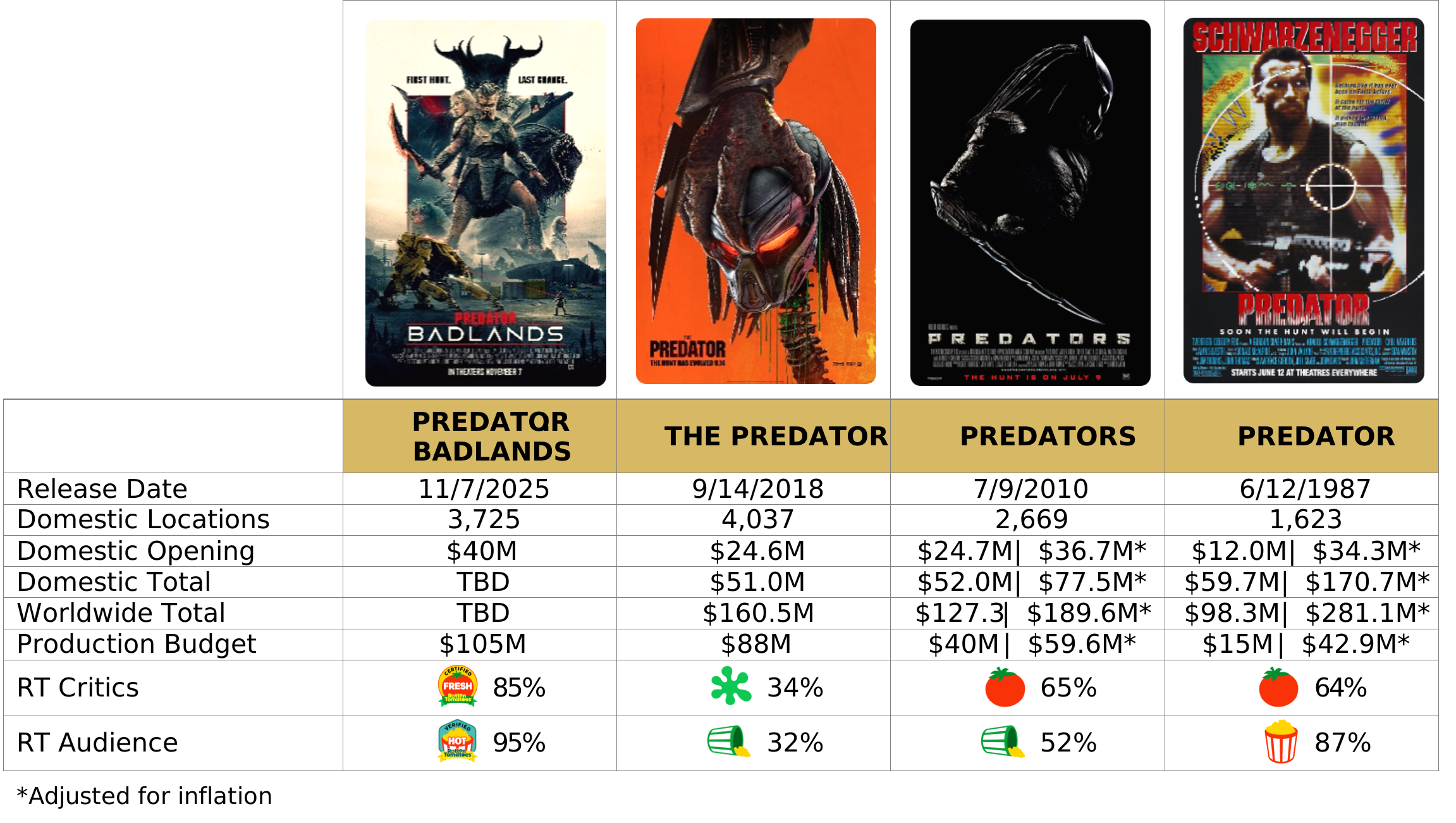
Disney placed a huge bet that the franchise has a bright future when it spent $105M to produce the film, setting the bar to reach profitability at $263M in global ticket sales. It’s worth noting that the highest-grossing Predator movie to date is THE PREDATOR from 2018, which earned only $160.5M worldwide, and the very successful ALIEN VS. PREDATOR in 2004 earned $177.4M ($305.0M after adjusting for 21 years of inflation).
After opening weekend sales of $40M domestica and $80 worldwide, the PREDATOR: BADLANDS has a long way to go. However, there are a number of factors that could sustain it in the weeks ahead, including its excellent Rotten Tomatoes scores, having a PG-13 rating, which expands its potential audience, and still maintaining enough mayhem and violence to satisfy the franchise’s core fan base. We have chosen to compare it with the three highest-grossing PREDATOR films to date.
PREDATOR: BADLANDS vs. Highest-Grossing PREDATOR Films To-Date
SECOND PLACE
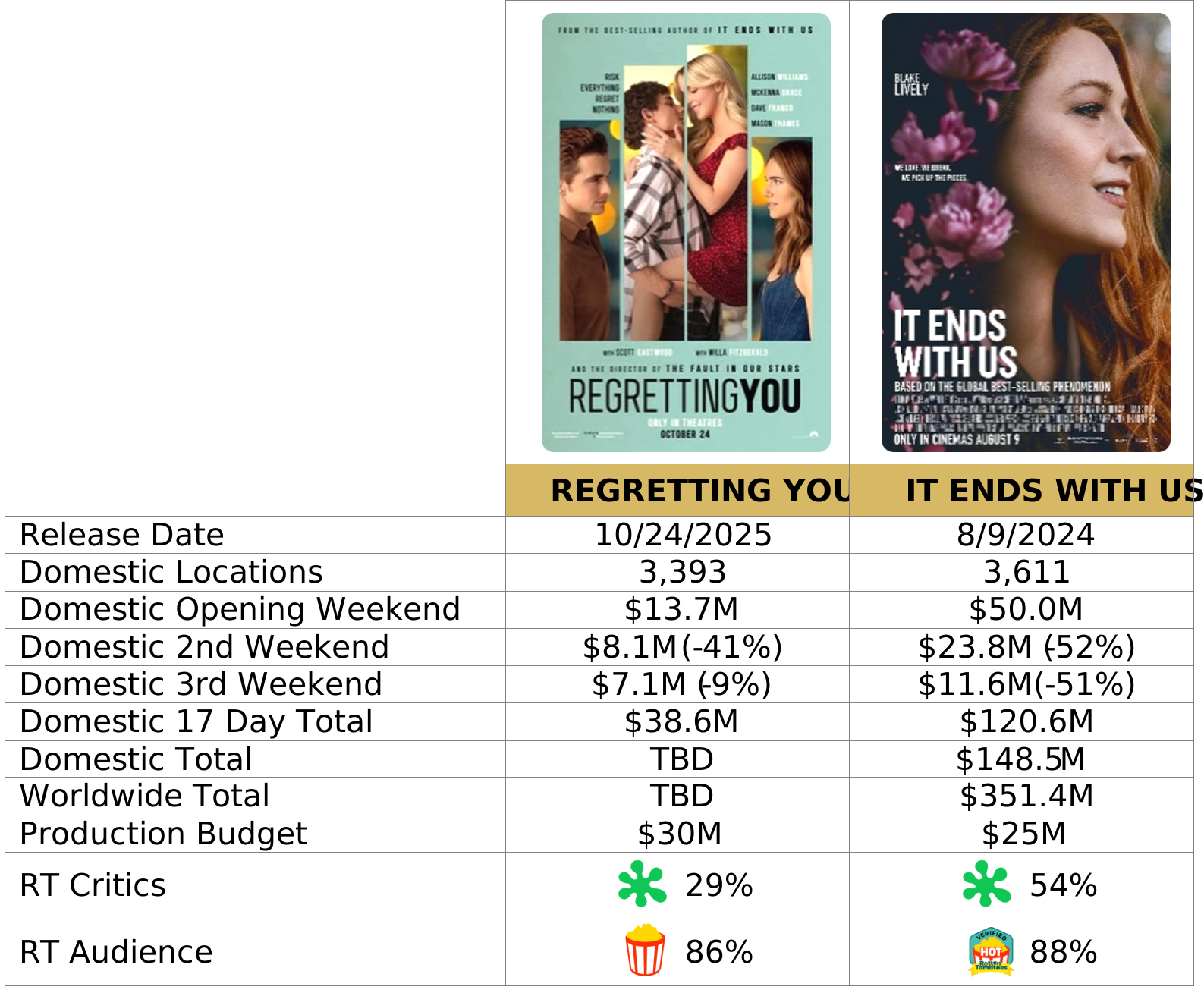
Sony’s romance drama REGRETTING YOU grossed $7.1M to take second place, a drop of only 9% from last weekend. This brings the movie’s 17-day total to $38.6M domestically and $71.0M worldwide. After what was widely considered to be a disappointing opening of only $13.7M, the film has held up well in its second and third weekends and now has a shot at being profitable from its box office earnings.
Its small 9% drop this weekend is encouraging, and will likely justify its place on screen for at least a few more weekends. Despite terrible reviews from the professionals, audiences are satisfied with an 86% score on Rotten Tomatoes. Fans of Collen Hoover, the novelist who wrote the book that the movie is based on, are showing their support, even if it has taken some a few weeks to get there. Here is a look at how the new film compares with IT ENDS WITH US, another successful movie based on a Hoover novel.
REGRETTING YOU vs. IT ENDS WITH US after 17 Days
THIRD PLACE
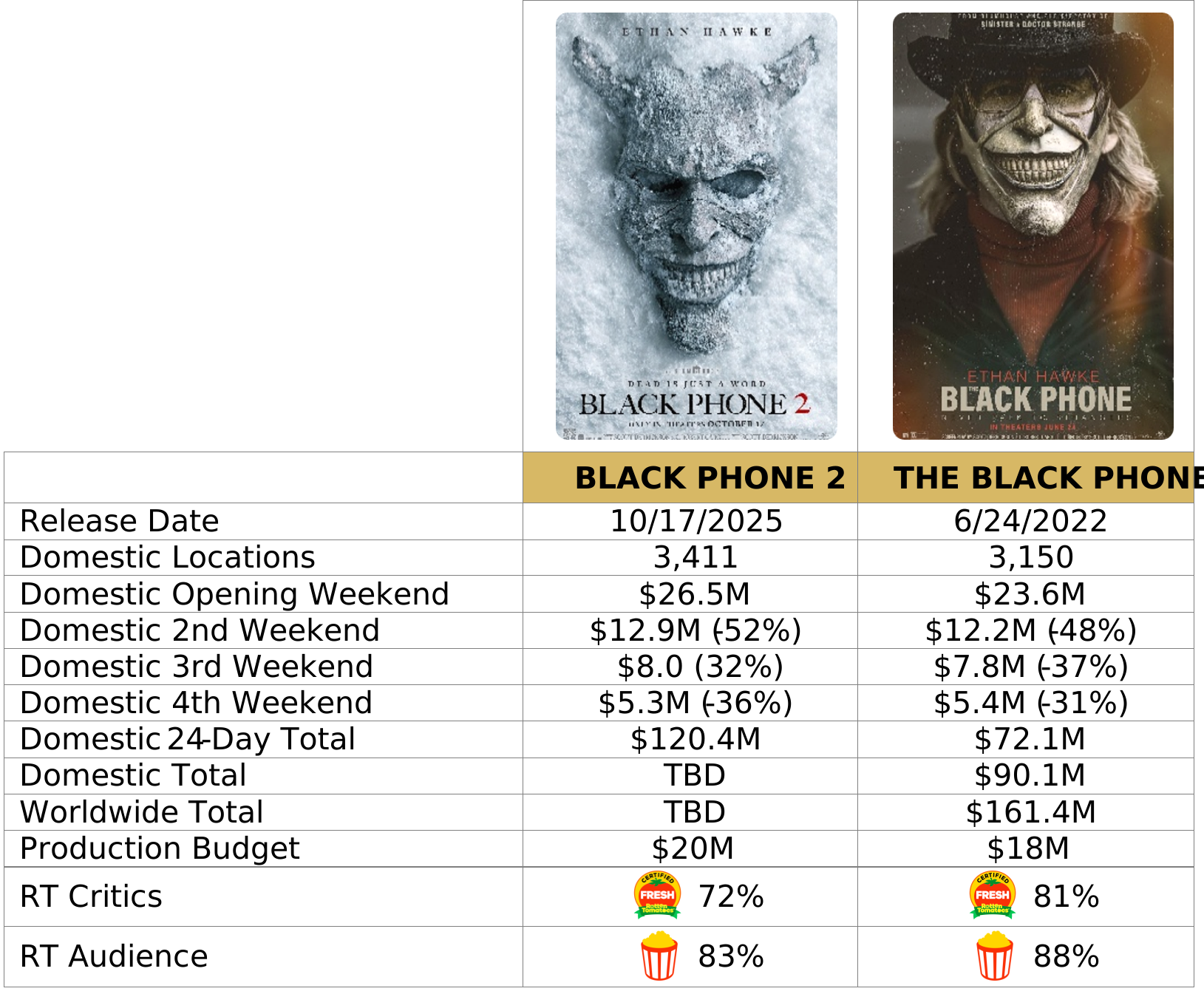
BLACK PHONE 2, the horror sequel from Universal and Blumhouse Productions, finished in third place in its fourth weekend with $5.3M, a drop of 36%. Its 24-day totals are now $70.1M domestically and $120.4M globally. We consider this movie to be the only success to emerge from the dull days of October.
The film is adding to its profitability each week, now with a 6 to 1 ratio of worldwide gross to production cost. The original THE BLACK PHONE produced a healthy 9 to 1 ratio, and BLACK PHONE 2 should come close to that meeting that number. We still believe that BLACK PHONE 2 would have done better if it had had a summer release date, similar to the original. Here is how the two movies compare after four weekends.
BLACK PHONE 2 vs. THE BLACK PHONE after 24 Days
FOURTH PLACE
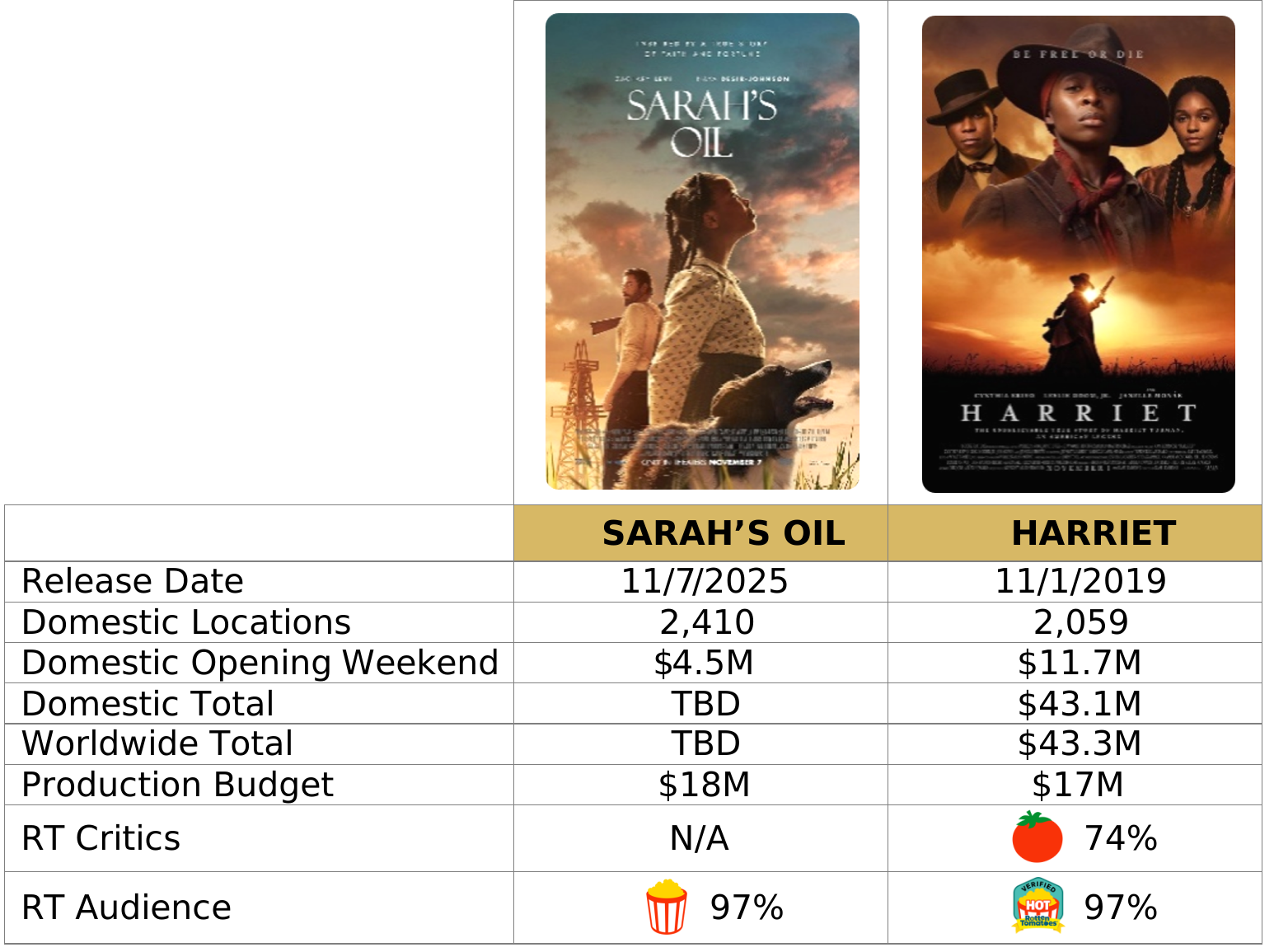
SARAH’S OIL from Amazon MGM Studios opened in fourth place by taking in $4.5M. The studio made this film in partnership with the faith-focused production teams at Kingdom Story Company and Wonder Project. It tells the true story of Sarah Rector, an 11-year-old African American girl living in Oklahoma in the early 1900s.
Sarah was allotted 160 acres of Indian Territory land that most assumed was worthless, but which turned out to have a fortune in underground oil deposits. The story told in the movie comes from a 2014 book, “Searching for Sarah Rector: The Richest Black Girl in America” by Tonya Bolden. The filmmakers were motivated by their feeling that Sarah’s unlikely story had been forgotten, the “lost history” of a Black/Native American girl millionaire at age 11.
One dramatic element of the film is that it shows that many other children who also received allotments of oil-rich land were murdered by greedy, evil-doers. Even though Sarah profited from her land, she still faced the harsh realities of the widespread racial discrimination in the period. The film takes up those systemic issues, drawing from actual historical events.
In real life, Sarah was born in the Indian Territory (now Oklahoma) in 1902, descended from the Creek Nation (Freedmen) and African American heritage, which adds layers of cultural/tribal identity to her story. The film is directed and co-written by Cyrus Nowrasteh (THE YOUNG MESSIAH from 2016) and stars first-time actress Naya Desir-Johnson as Sarah and Zachary Levi (SHAZAM: FURY OF THE GODS from 2023) as Bert, whom Sarah hires to get the oil out of the ground. Its realistic feel is enhanced by having been filmed in Okmulgee, Oklahoma.
While not enough critics have reviewed the movie to give it a grade on Rotten Tomatoes, audiences who have seen it are raving with a 97% score. We did find two individual reviews. Variety’s review calls the film a “Family-Friendly Drama Persuasively Depicts a Battle for Oil-Rich Land” and says that “Naya Desir-Johnson offers a star-making performance as a precocious Black youngster determined to strike it rich in 1913 Oklahoma.”
The New York Times describes the film as “a David and Goliath story with big feelings, edifying speeches, and a swelling score.” The film was produced on a budget of only $18M, which multiplies out to a target box office of $45M to reach profitability. For a comparison film, we have chosen HARRIET from 2019, a historical drama about Harriet Tubman. Both films delve into the life of a powerful heroine overcoming huge odds.
SARAH’S OIL vs. HARRIET
FIFTH PLACE
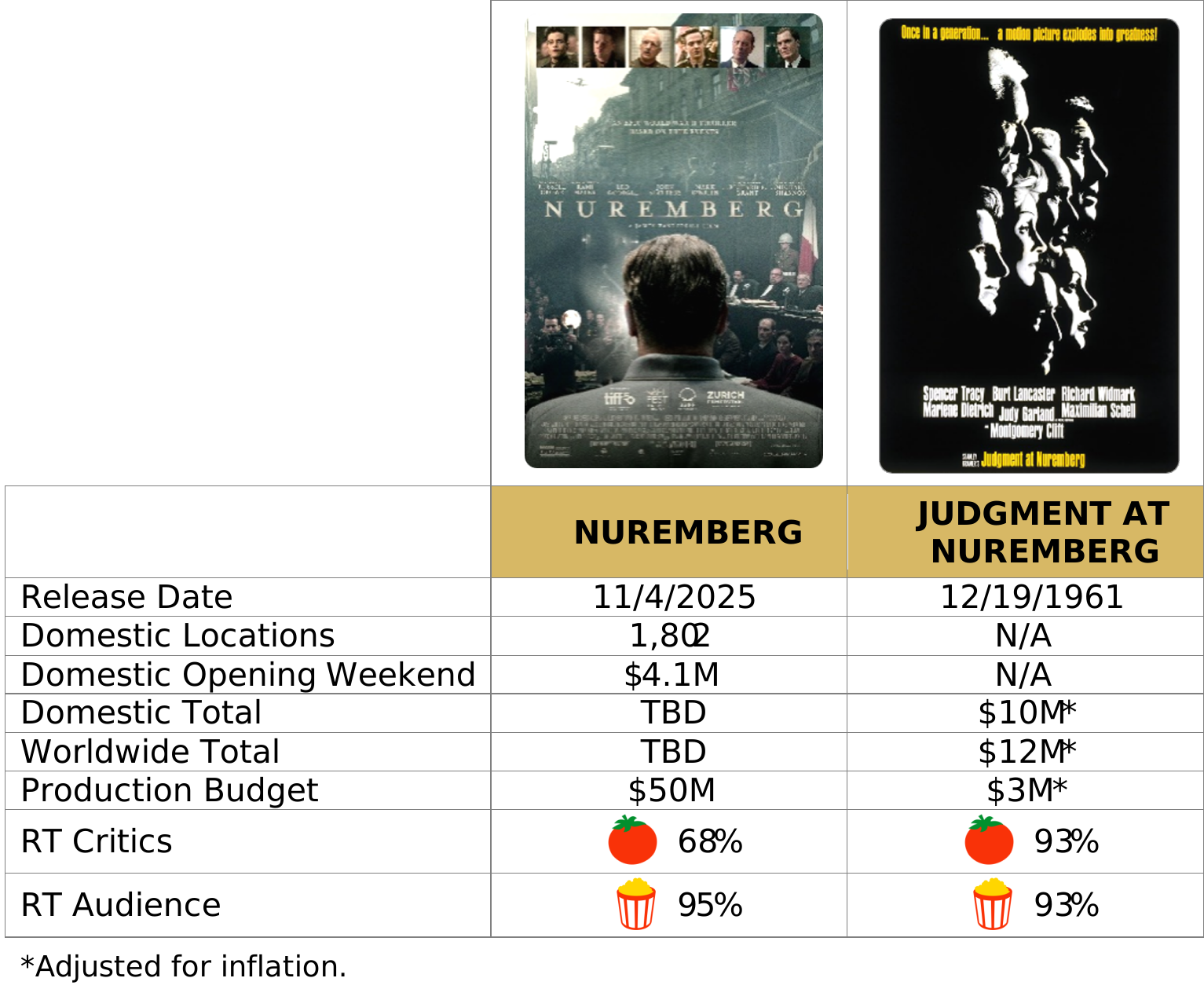
NUREMBERG, a WWII historical drama from Sony Pictures Classics, grossed $4.1M in its opening weekend. The film is based on the 2013 non-fiction book “The Nazi and the Psychiatrist” by Jack El‑Hai, which tells the true story of U.S. Army psychiatrist Douglas Kelley evaluating Nazi war criminals in the immediate aftermath of the war. For film buffs, it recalls Stanley Kramer’s classic 1961 movie JUDGEMENT AT NUREMBERG starring Spencer Tracy, Burt Lancaster, Maximilian Schell, and Marlene Dietrich.
It received 11 Academy Award nominations, including Best Picture, and went on to win tw,o with Schell taking home Best Actor and its screenwriter, Abby Man, winning for Best Adapted Screenplay. Made on a production budget of $3M ($32.6M in today’s dollars), it was considered a gamble for United Artists, since it was a courtroom drama that depended on heavy dialogue, was based on a very serious topic had a running time of 2 hours and 59 minutes.
It was also released only 16 years after the end of WWII, at a time when many were still weary from the human toll of the war, and caught up in the global Cold War. With that background, we also must remember that the average ticket price for movie-going in the U.S. in 1961 was only seventy cents. The film proved to be a financial success when it did $10M in the U.S. and $12M worldwide, with Germany as one of its strongest foreign markets. More than six decades later, it remains a towering cinematic exploration of law, morality, and complicity.
In this year’s NUREMBERG, the psychiatrist Kelley is played by Rami Malek, tasked with determining whether top Nazi officials are mentally fit to stand trial at the post-war Nuremberg Trials. The character of the charismatic Nazi leader Hermann Göring is portrayed by Russell Crowe. The film concentrates on the psychological duel between Kelly and Göring.
Rather than focusing on the courtroom drama, the storyline of this film plays out in interrogation rooms and prison cells, focusing on the mind games between Kelley and Göring. Its director, James Vanderbilt, is better known for his writing, such as the screenplay for ZODIAC. This is among Vanderbilt’s more limited attempts at directing, using his interest in subjects with historical or legal content.
While many of the Nazi high command’s crimes are depicted via implications and flashbacks rather than with large‐scale battle scenes, the film places strong emphasis on the psychological aftermath of war. Russell Crowe has publicly referred to his role as Göring as one of the most challenging of his career, acknowledging the moral complexity in portraying someone so charismatic yet monstrously evil. Critics have been somewhat favorable about the film, giving it a 68% rating on Rotten Tomatoes. Audiences have been extremely positive, however, with a 95% score. Here are some critics’ thoughts.
The Hollywood Reporter has a positive take, saying “Potent performances by Russell Crowe and Rami Malek ignite a bracingly relevant historical drama.” Variety weighs in with, “What Kelley [the psychiatrist protagonist] seeks to explore — and what the audience wants him to explore — is the nature of evil … and on that score, neither he nor the movie gets very far.” The LA Times review called the film a “mixed bag,” acknowledging that the subject matter is important and the performances (especially by Russell Crowe and Michael Shannon) are “towering,” but criticizing the film’s tone and execution.
The film is estimated to have cost $50M, which would mean that it will need to earn $125M to be profitable. Based on an opening weekend domestic box office of $4.1M, it will certainly need to stick around a while to get there. The comparison film must be JUDGEMENT AT NUREMBERG, with a heavy reliance on our calculation to adjust 1961 box office numbers for inflation.
NUREMBERG vs. JUDGEMENT AT NUREMBERG
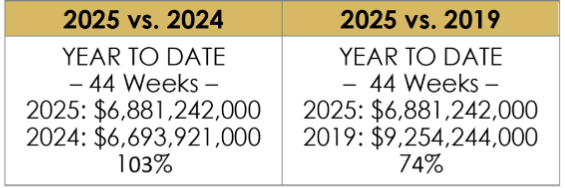
Where Are We as of 11/6/2025
After 44 weeks, the 2025 domestic box office stands at 103% compared to the same point in 2024 and 74% compared to 2019.