

There are actors you grow up watching, and then there are actors you grow up with.
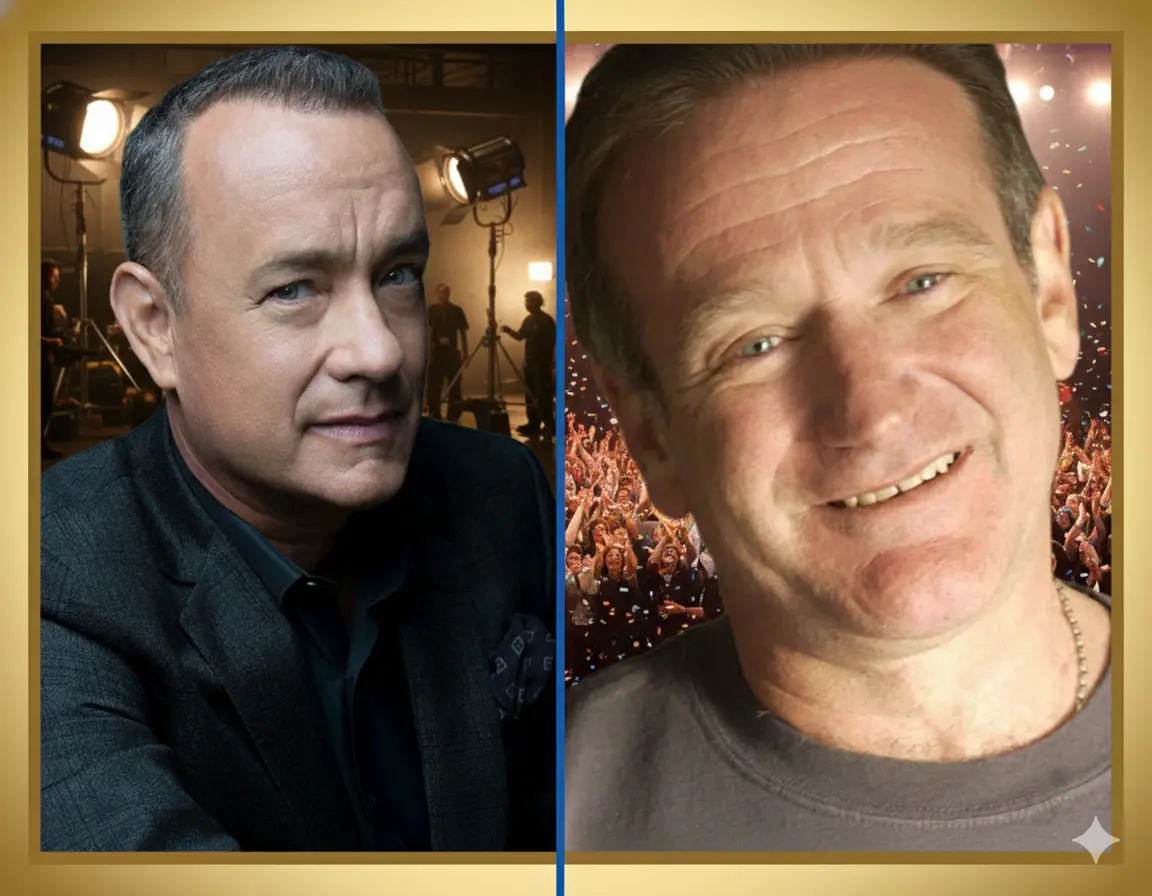
Tom Hanks and Robin Williams belong to the second category of two cultural constants who feel like they’ve always been part of the background noise of our lives.
They’re both funny and dramatic and surely made you cry unexpectedly on random weekday nights.
But they got there in completely different ways.
This is a comparison not about “who’s better?” (there’s no winner), but about how two of Hollywood’s most trusted men built careers that shaped generations, defined genres, and basically raised half the planet’s millennials.
Let’s break it down!
WHO Are Tom Hanks and Robin Williams, Really?
Tom Hanks – Hollywood’s Nice GuyTM
If you’re about to watch a Hollywood movie and see Tom Hanks’ name attached to it, you instantly know it’s a good pick – he’s the one actor everyone automatically trusts. He works because he feels familiar – you know this man, or you know someone like him. His entire career is based on playing everyday people who somehow end up in extraordinary situations. A castaway. A lawyer fighting discrimination. A guy who just keeps running across America.
Hanks built a career on:
- decency
- warmth
- quiet heroism
- and the kind of sincerity that makes cynics believe
Robin Williams – The Human Lightning Bolt
Williams was the opposite kind of familiar: he reminded you of the funniest, kindest, most chaotic person in your life. The one who makes every room louder but also softer.
He built a career on –
- unstoppable improvisation
- characters that feel like they’re running on pure electricity
- and a deep, unexpected emotional truth beneath the joke.
Robin Williams was the kind of actor who could play completely different people and still feel utterly believable each time. In Aladdin, he was the hyperactive, hilarious Genie who moved fast. In Good Will Hunting, he slowed down into a quiet, thoughtful therapist who guided a troubled young man toward healing. And in Mrs. Doubtfire, he became a dad who disguises himself as a nanny just to spend time with his children – switching between comedy and heartbreak in the same breath.
Williams never stuck to one kind of role. He lived and loved comedy, drama, family films, and animation, and brought the same emotional honesty to every character.
Hanks and Williams have two completely different styles, but both are unforgettable in their own way.
WHAT Made Their Careers Different?
Let’s look at the types of roles they took, the kind of stories they anchored, and what made each of them explode into the culture the way they did.
Tom Hanks: The Everyman Hero
Hanks’ sweet spot is roles where the character is thrown into chaos and must rise to the occasion.
Think:
- Forrest Gump (1994) – A man with a gentle heart and a simple mind, unwittingly moves through some of America’s biggest historical moments, shaping people’s lives along the way, even though he never tries to.
- Cast Away (2000) – After a plane crash, a man is stranded alone on an island for years and must figure out how to survive with nothing but his instincts, hope, and a volleyball for company.
- Saving Private Ryan (1998) – A schoolteacher-turned-soldier leads a small group of men through World War II to find and bring home a missing soldier whose brothers have all died in combat.
- Sully (2016) – Based on the true story of the pilot who landed a damaged plane on the Hudson River, saving everyone on board, and then had to prove he made the right decision.
- Captain Phillips (2013) – A cargo ship captain faces a life-or-death situation when Somali pirates take over his ship, forcing him to stay calm under impossible pressure.
- Big (1998) – A young boy makes a wish to become “big” and wakes up the next morning as an adult, trying to navigate the grown-up world with a kid’s brain and heart.
In Summary: Why Audiences Love Hanks
Hanks’ characters rarely try to be interesting – they simply are. He represents a kind of emotional safety net in cinema: characters who remind the audience that kindness, responsibility, and decency still matter.
He simply grounds every scene he’s in.
Recommended reading:
9 Best Directors Behind Tom Hanks’ Iconic Roles
Robin Williams: The Controlled Chaos
Williams thrived playing characters who either didn’t fit in or refused to fit in.
His filmography is a buffet of genres:
- Good Will Hunting (1997) – Williams plays a therapist who helps a brilliant but troubled young man face his emotions, confront his trauma, and finally believe he deserves a better life.
- Dead Poets Society (1989) – He’s an English teacher who encourages his students to think freely, challenge authority, and discover their own voices in a strict boarding school.
- Aladdin (2019) – Williams voices the fast-talking, shape-shifting Genie who helps a young man win love and freedom, delivering jokes, songs, and energy nonstop.
- Mrs. Doubtfire (1993) – After a divorce, a father disguises himself as an elderly female nanny to stay close to his kids, leading to hilarious situations mixed with real emotional depth.
- Jumanji (1995) – He plays a man who has been trapped inside a magical board game for decades and escapes only to help two kids finish the game before it destroys their world.
- Good Morning, Vietnam (1987) – Williams plays a radio DJ sent to Vietnam during the war to boost soldiers’ morale, using humor to push against authority and bring joy into a dark time.
In Summary: Why Audiences Love Hanks
Williams didn’t act characters; he inhabits the characters that he plays. His performances feel like controlled chaos; it is fast, emotional, unpredictable, and painfully human.
Audiences love him because he brings the full range of what it feels like to be alive: joy, sadness, restlessness, imagination, loss, and hope.
He understands people.
WHEN Did Their Biggest Career Shifts Happen?
Hanks’ Shift: The Great 1993–2000 Golden Run
There was a point where Hanks was basically unbeatable. He went from comedy star to dramatic icon to the voice of Pixar to the American institution within seven years. After that, he stopped trying to reinvent himself. He didn’t need to. His brand became: reliably excellent grown-man acting.
1993–2000:
- Philadelphia (Oscar)
- Forrest Gump (Oscar)
- Toy Story
- Apollo 13
- Saving Private Ryan
- The Green Mile
- Cast Away
Williams’ Shift: When Hollywood Finally Took Him Seriously
For Williams, the turning point was 1987’s Good Morning, Vietnam – the moment the industry realized the comedy beast could deliver heavy drama too. Then came the knockout punch:
Good Will Hunting (1997), which got him the Oscar.
Williams could’ve coasted on comedy forever. Instead, he kept mixing his roles from comedies, thrillers, fantasies, and tragedies, because one lane was never enough for him.
WHERE Did They Leave Their Impact?
Tom Hanks’ Award Recognition
- Academy Awards (Oscars)
6 nominations total, 2 Oscar wins — both for Best Actor
- Philadelphia (1993) — Best Actor
- Forrest Gump (1994) — Best Actor
-
Golden Globe Awards
5 Golden Globe wins, including:
- Best Actor – Drama for Philadelphia
- Best Actor – Drama for Forrest Gump
- Best Actor – Comedy/Musical for Big
- Best Actor – Comedy/Musical for Cast Away
- Cecil B. DeMille Award (lifetime achievement)
Hanks is one of the few actors to win in both Comedy and Drama categories
-
Primetime Emmy Awards
7 Emmy wins — all for producing, not acting, including:
- From the Earth to the Moon (Outstanding Miniseries)
- Band of Brothers (Outstanding Miniseries)
- John Adams (Outstanding Miniseries)
- Plus additional wins for producing documentary and series work.
Hanks is one of the most awarded producers in TV history.
-
Screen Actors Guild Awards
2 SAG Award wins:
- Outstanding Male Actor for Forrest Gump
- Outstanding Cast in a Motion Picture for Apollo 13
Robin Williams’ Award Recognition
- Academy Awards (Oscars)
4 Oscar nominations total, 1 Oscar win
- Good Will Hunting (1997) — Best Supporting Actor
This was the performance that cemented him as more than a comedy legend
-
Golden Globe Awards
Robin Williams won 6 Golden Globes, across comedy, drama, and even voice acting — a rare achievement.
- Best Actor – Musical/Comedy for Good Morning, Vietnam (1987)
- Best Actor – Musical/Comedy for The Fisher King (1991)
- Best Actor – Musical/Comedy for Mrs. Doubtfire (1993)
- Special Achievement Award for Aladdin (1993). One of the only times the Globes gave a special award for a voice performance.
- Best Supporting Actor for Good Will Hunting (1997)
- Cecil B. DeMille Award (2005) (Lifetime Achievement Award)
Primetime Emmy Awards
Williams won 2 Emmy Awards, both for his television and variety work:
- Outstanding Individual Performance in a Variety of Music Programs (1987)
- Outstanding Individual Performance in a Variety of Music Programs (1988)
His stand-up and TV specials were so good that they won back-to-back Emmys
-
Grammy Awards
Robin Williams also won 5 Grammy Awards — mostly for his comedy albums.
- Best Comedy Recording for Reality… What a Concept (1980)
- Best Children’s Recording for Pecos Bill (1988)
- Best Comedy Album for Live at the Met (1988)
- Best Spoken Comedy Album for Robin Williams – Weapons of Self-Destruction (2003)
- Best Spoken Word Album (shared) for The Last King of Scotland audiobook (2009)
He’s one of the few performers with awards across film, TV, and music.
Tom Hanks vs. Robin Williams: Award Recognition (At a Glance)
| Category | Tom Hanks | Robin Williams |
| Oscars | 6 nominations2 wins (Best Actor)• Philadelphia (1993)• Forrest Gump (1994) | 4 nominations win (Best Supporting Actor)• Good Will Hunting (1997) |
| Golden Globes | 5 wins, including:• Best Actor – Drama (Philadelphia)• Best Actor – Drama (Forrest Gump)• Best Actor – Comedy (Big)• Best Actor – Comedy (Cast Away)• Cecil B. DeMille Lifetime Award | 6 wins, including:• Best Actor – Comedy (Good Morning, Vietnam)• Best Actor – Comedy (The Fisher King)• Best Actor – Comedy (Mrs. Doubtfire)• Special Achievement Award (Aladdin)• Best Supporting Actor (Good Will Hunting)• Cecil B. DeMille Lifetime Award |
| Emmy Awards | 7 wins — all for producing:• From the Earth to the Moon• Band of Brothers• John Adams+ other documentary/miniseries wins | 2 wins — both for TV/variety performances:• Outstanding Individual Performance (1987)• Outstanding Individual Performance (1988) |
| Grammy Awards | — (No Grammy wins) | 5 wins, including:• Best Comedy Recording• Best Children’s Recording• Best Comedy Album• Best Spoken Comedy Album• Best Spoken Word Album |
| SAG Awards | 2 wins:• Outstanding Male Actor (Forrest Gump)• Best Cast Ensemble (Apollo 13) | 0 wins (2 nominations) |
| Strength of Legacy | Consistency, emotional steadiness, grounded performances | Versatility, range, fearless experimentation |
| Mediums Dominated | Film + Producing (TV) | Film + Voice Acting + Stand-up + TV + Audio |
In Summary: The Awards Spoke!
Robin Williams’ awards don’t just recognise the talent he had; they also speak about the sheer range of what he could do. While most actors shine in one space, Williams shone in all of them: comedy, drama, voice acting, stand-up, television, and even children’s recordings.
Where Tom Hanks built his acclaim on consistency and emotional steadiness, Williams built his on versatility and fearless experimentation. He was never confined to a single medium or genre, and his awards reflect that.
WHY Do These Two Get Compared So Much?
They worked in different genres and expressed emotion in completely different ways, but the funny thing is – they’re far more similar than people assume. Both built careers on sincerity, on making audiences feel safe, seen, and understood. Both balanced comedy and drama in a way that felt honest, not forced. And both became the kind of actors people turn to when they want heart, comfort, and a story that means something. That’s why they get compared so often:
- They defined 90s–2000s cinema.
- They both balanced comedy and drama.
- They both mastered sincerity.
- They both parented a generation emotionally.
Tom Hanks’ Cultural Legacy
Hanks is embedded in American cinematic DNA. His impact lies in:
- Defining contemporary American heroism
- Humanizing historical figures
- Voice of childhood, Woody from Toy Story is forever.
- America’s Dad
Tom Hanks is embedded in American cinematic DNA in a way that few actors ever achieve. His impact comes from defining contemporary American heroism, showing that courage can look quiet, steady, and deeply human. He has a gift for humanising historical figures, turning famous names into relatable people with flaws and warmth. And of course, he became the voice of childhood as Woody in Toy Story, a character that feels timeless. Over the years, Hanks has also settled into the role of America’s Dad, the one actor audiences instinctively trust to guide them through any story with honesty and heart.
Robin Williams’ Cultural Legacy
Williams left an entirely different spiritual imprint:
- Champion of empathy
- Comic inspiration
- Childhood imagination
- Mental health conversations
Robin Williams left an entirely different kind of imprint. He became a universal champion of empathy, playing characters who understood pain as deeply as joy. His work remains a huge source of comic inspiration, showing how humour can be both chaotic and healing. For millions of people, he shaped childhood imagination, bringing magic, speed, and wonder to roles like the Genie in Aladdin. And perhaps most importantly, his life and loss opened the door to mental health conversations, reminding the world that vulnerability and humour often exist side by side.
HOW Did Their Roles Shape How We See Them Today?
Hanks Today: The Steady Builder
Modern Hanks films are less culturally seismic, but he’s still the reliable storyteller—
- News of the World
- A Man Called Otto
- Finch
- Elvis (playing the villain for once)
He works selectively, often with themes of duty, kindness, and personal integrity.
He’s still America’s emotional safe space.
Williams Today: The Eternal Presence
Williams passed in 2014, but he somehow feels more present every year.
His interviews circulate on TikTok. His monologues get shared during bad days, good days, and mental health days. Clips from Good Will Hunting become therapy moments for millions of strangers online.
His voice outlived him. His energy outlived him. His impact outlived him.
So Who “Wins”?
Neither. Both.
It depends on what part of yourself you’re asking.
- If you need steadiness. It is Hanks.
- If you need a release. It is Williams.
- If you want inspiration and comfort. It is both.
This comparison isn’t about competition. It’s about appreciating how two wildly different men somehow ended up shaping the same generation.