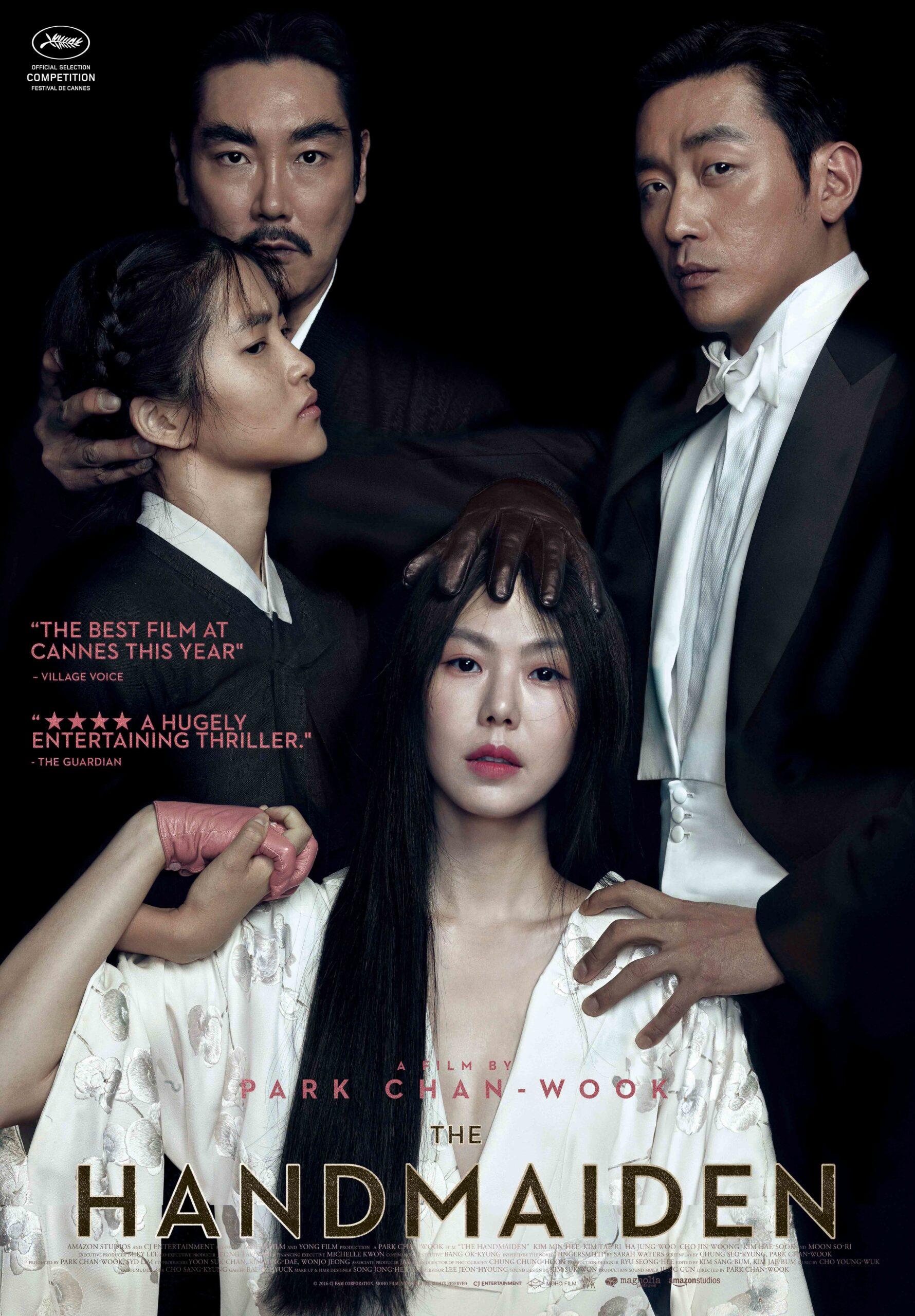

In 1930s Korea under Japanese occupation, a skilled pickpocket is hired as a handmaiden to a wealthy Japanese heiress as part of a con to steal her fortune. What begins as deception and manipulation soon becomes entangled with desire, power, and betrayal, pulling all involved into an intricate web of secrets, passion, and shifting alliances.
The Handmaiden is a 2016 South Korean historical psychological thriller drama directed by Park Chan-wook with a screenplay by Jeong Seo-kyeong, adapted from the 2002 novel Fingersmith by Sarah Waters. The film stars Kim Min-hee as Lady Hideko, the reclusive and wealthy heiress living in a remote estate, and Kim Tae-ri as Sook-hee, the young woman brought in as her maid and unwitting instrument in an elaborate scheme by a conman posing as Count Fujiwara (played by Ha Jung-woo). Set against the backdrop of Japanese-occupied Korea and Japan in the 1930s, the story unfolds in shifting perspectives that reveal layers of truth, deception, and desire. The con’s original aim is to convince Hideko to marry the Count so he can seize her inheritance, but unexpected emotional connections and deepening complexity blur the lines between manipulation and affection. The film’s narrative structure is both sophisticated and surprising, charting a course through romance, revenge, and psychological subtlety. Premiering at the Cannes Film Festival in 2016, where it competed for the Palme d’Or, The Handmaiden earned widespread critical acclaim for its lush visuals, complex storytelling, and fearless performances. It went on to win several awards, including the BAFTA Award for Best Film Not in the English Language and honors for production and costume design.
Frequently Asked Questions
Who stars in The Handmaiden?
Who directed and wrote the movie?
What is the movie about?
When was it released?
What genre is it?
How was The Handmaiden received?
Has The Handmaiden received any awards or recognition?
Has the film been submitted for major awards or international recognition?
What themes does the film explore?
Fun Facts
Park Chan-wook and cinematographer Chung-hoon Chung meticulously planned every frame's color palette to reflect character emotions—cool blues for Sook-hee's scheming phase shift to warm ambers during her romance with Hideko—achieved through custom lighting gels and production design symbiosis rarely seen in Korean cinema.
Kim Tae-ri beat 1,500 auditionees for Sook-hee after just one screen test, her pickpocket physicality discovered during an improv scene; principal photography spanned four months across Japan and Korea, wrapping in October 2015 with authentic 1930s costumes hand-stitched from historical references.
The film's notorious octopus-tentacle sex scene drew from Hokusai's "The Dream of the Fisherman's Wife" print, featuring prominently in Hideko's library; Park integrated real period erotica like "Jin Ping Mei" as plot devices, with intimate scenes choreographed over weeks for emotional authenticity over explicitness.
Lady Hideko's nightly reading performances to perverse audiences were rehearsed with live Japanese porn actors for realism, Kim Min-hee performing 20+ takes per monologue; the script's three-act twist inversion—Sook-hee and Hideko double-crossing the Count—was locked early to build Palme d'Or-competing tension.