
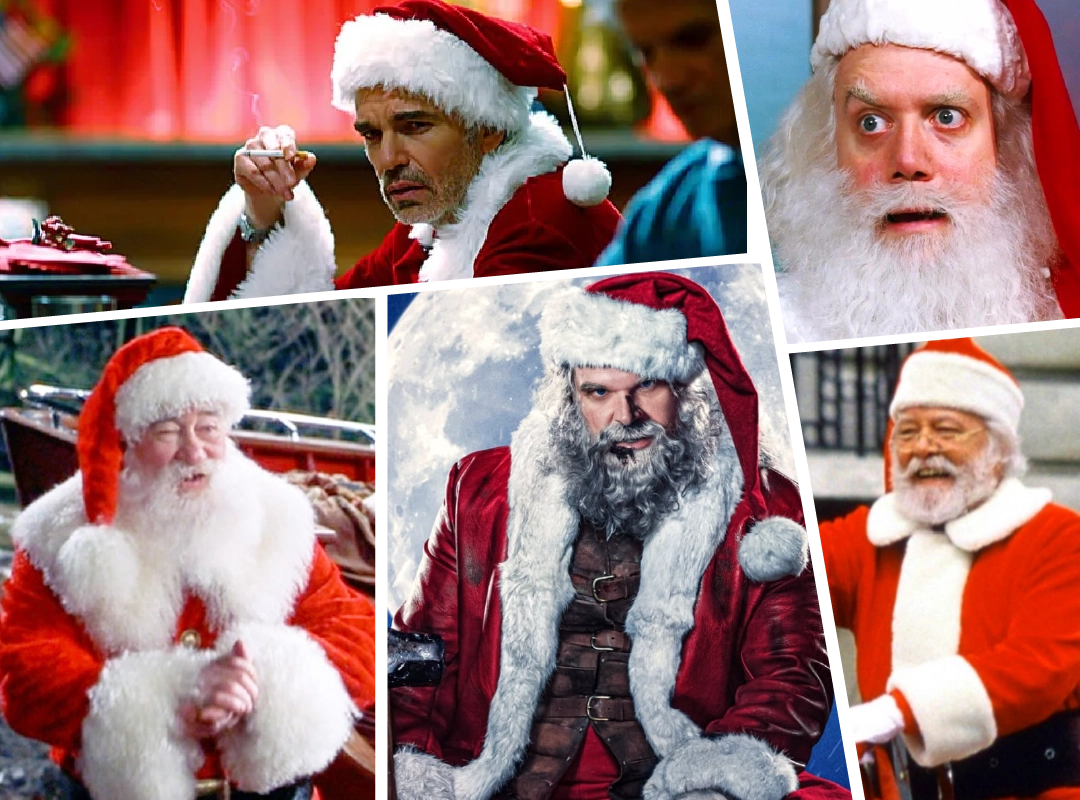

From Oscar-winner Edmund Gwenn to modern reinventions by Kurt Russell and David Harbour, these are the 12 definitive Santa Claus performances in movie history, ranked using cultural impact, authenticity, emotional weight, and how convincingly each actor embodied the legend of St. Nick.
For nearly a century, Santa Claus has been one of cinema’s most enduring characters—reimagined as a gentle believer, a reluctant dad, a stressed executive, and even a battle-hardened warrior.
This list ranks the 12 best Santa Clauses in movies, not by popularity alone, but by how each performance shaped the myth, reflected its era, and left a lasting mark on audiences.
Methodology – How We Ranked the 12 Best Movie Santas
Each Santa was evaluated using the following criteria:
-
- Authenticity — Does he feel like Santa, or just an actor in a suit?
- Magic Factor — Is the supernatural side convincing?
- Heart & Spirit — Does he embody generosity, belief, and hope?
- Performance Nuance — Is there depth beyond “ho ho ho”?
- Cultural Impact — Did this portrayal define Santa for a generation?
Countdown — The 12 Best Santa Clauses in Movies
#12. Jim Broadbent as Santa Claus (Arthur Christmas, 2011)
Key Insight:
Broadbent plays Santa as a warm, slightly worn-down patriarch caught between eras. He’s defined as “the gentle traditionalist bewildered by a North Pole that upgraded faster than he did.”
Narrative Context:
In Aardman’s hyper-inventive take on Christmas operations, Broadbent’s Santa is the emotional anchor of a tradition-vs-technology conflict. Surrounded by Steve Claus’ militarized efficiency and the North Pole’s data-driven upgrades, he becomes the embodiment of the old guard struggling to stay relevant.
Directors Sarah Smith and Peter Baynham use him to ground the film’s spectacle in real generational conflict, playing him not as incompetent but as a man transitioning into obsolescence with humility and heart.
#11. Mel Gibson as Kris Kringle (Fatman, 2020)
Key Insight:
Gibson leans hard into the film’s gritty, cynical reimagining of Santa, becoming “a battered, booze-numbed Santa just trying to survive a world that stopped believing in him.”
Narrative Context:
In the Nelms brothers’ dark satire, Santa is financially collapsing, negotiating government contracts, and navigating a society whose moral decay has eroded his power. Gibson’s Santa trudges through the snow like a blue-collar worker whose magic has rusted from disuse.
When a vengeful child hires Walton Goggins’ assassin, the story shifts into a bleak comedy about crumbling faith in goodness. Gibson’s performance blends world-weary realism with hints of lingering idealism, making this Santa one of film’s most surprisingly morally bruised interpretations.
#10. Billy Bob Thornton as Willie Soke (Bad Santa, 2003)
Key Insight :
Thornton gives us cinema’s ultimate anti-hero Santa, a figure built on filth, fury, and utter indifference – “the profane, cynical mall con artist who redefined the boundaries of the Christmas comedy genre.”
Narrative Context:
Director Terry Zwigoff constructs a world of black comedy and holiday nihilism, and Thornton steps in as the perfect corrosive force. His Willie Soke isn’t Santa at all, yet his disgust for Christmas, his volatile partnership with Tony Cox, and his confrontations with Bernie Mac create a portrait of subversive humor pushed to its limit.
By committing to Willie’s emotional emptiness, Thornton turns the holiday film inside out—and somehow still finds a crooked little sliver of redemption at the end.
#9. James Cosmo as Father Christmas (The Chronicles of Narnia, 2005)
Key Insight:
Cosmo embodies a mythological, battle-ready Santa, fulfilling “the powerful, non-commercial Santa who delivered hope and the means to fight evil, not just presents.”
Narrative Context:
Director Andrew Adamson introduces Father Christmas as a symbol of ancient power, not holiday cheer. Appearing at the turning point when Aslan’s influence begins thawing Narnia, he arms the Pevensies—including Susan’s bow with tools of responsibility and courage, not toys. In a world of swords-and-sorcery fantasy, Cosmo’s rugged Santa becomes a mythological ally, anchoring the moment the story shifts from innocence to purpose.
#8. Richard Attenborough as Kris Kringle (Miracle on 34th Street, 1994)
Key Insight:
Attenborough plays Kris with warmth and dignity—“a perfectly gentle and dignified portrayal that preserved the heart of the original story for the 90s.”
Narrative Context:
In Les Mayfield’s respectful remake, Attenborough reimagines Santa for a more media-saturated era. His patient rapport with Mara Wilson and his calm poise in the film’s courtroom identity battle give this version a timeless, generational appeal. Attenborough leans into non-denominational magic and understated joy, honoring the original while making Kringle feel emotionally accessible to a new decade.
#7. Paul Giamatti as Nick Claus (Fred Claus, 2007)
Key Insight:
Giamatti plays Santa as a compassionate yet exhausted administrator—“the perpetually stressed Saint Nick who proved that even the magic of Christmas can’t cure sibling rivalry.”
Narrative Context:
Director David Dobkin frames Santa’s world as a site of holiday stress and overwhelming commercial pressure, complete with a looming Christmas audit. Giamatti’s Nick Claus struggles not only with global gift-giving but with his resentful brother, played by Vince Vaughn. This version of Santa becomes a deeply human figure—frazzled, loving, overburdened—revealing how even mythical icons crack under the pressure of sibling rivalry and unrealistic expectations.
#6. J.K. Simmons (Voice) as Klaus (Klaus, 2019)
Key Insight:
Simmons gives Klaus soulful gravitas as “the deep-voiced, empathetic toymaker who showed that genuine kindness is the real engine of the legend.”
Narrative Context:
In Sergio Pablos’ hand-drawn animation revival, Klaus is not a mythical figure but a grieving recluse whose Schwartzman, Jesper, played by friendship with Jason Schwartzman’s Jesper sparks the town’s transformation. This animated origin story becomes a meditation on emotional depth and the quiet power of generosity. By framing Santa as an empathetic toymaker, the film becomes a non-Disney classic, rooted in the idea that kindness—not magic—is what reshapes Smeerensburg.
#5. Ed Asner as Santa Claus (Elf, 2003)
Key Insight:
Asner’s Santa is a seasoned, practical leader. He was “the gruff, no-nonsense manager whose patience and honesty make the North Pole feel legitimately run.”
Narrative Context:
In Jon Favreau’s modern classic, Santa is less a mythic icon and more a workplace manager balancing North Pole logistics with the chaos Buddy brings. Asner’s grounded, pragmatic approach contrasts beautifully with Will Ferrell’s boundless optimism. The result is a Santa who makes the magic feel real through patience, structure, and the power of belief.
#4. Tim Allen as Scott Calvin (The Santa Clause, 1994)
Key Insight:
Allen nails the comedic transformation from cynic to Santa. He played “the reluctant dad who accidentally killed Santa, proving that great power comes with great corpulence.”
Narrative Context:
Disney’s fantasy-comedy recasts Santa through legal loopholes and forced succession, turning Scott Calvin into a reluctant hero who undergoes the now-iconic holiday body transformation. His dynamic with Judge Reinhold and his evolving bond with Charlie keep the story grounded as the corporate North Pole mythology unfolds. Allen’s mix of sarcasm and sincerity made this Santa definitive for an entire generation.
#3. David Harbour as Santa Claus (Violent Night, 2022)
Key Insight:
Harbour becomes an action-movie icon—“the Santa who traded milk and cookies for blood and bandages—yet still squeezed down the chimney with a heart.”
Narrative Context:
Tommy Wirkola fuses Christmas horror-comedy with an explosive Die Hard homage, and Harbour steps in as a bruised, Viking-rooted Santa rediscovering purpose. Armed with his Skullcrusher hammer, he plows through mercenaries led by John Leguizamo, surviving gore-tinsel violence and chaotic Home-Alone traps. Beneath the carnage, Harbour grounds the film with earnest warmth, making this Santa both ferocious and unexpectedly tender.
#2. Kurt Russell as Santa Claus (The Christmas Chronicles, 2018)
Key Insight:
Russell reinvents Santa with swagger and sparkle—“the swaggering, charismatic Santa who proved St. Nick could be both magical and genuinely cool.”
Narrative Context:
Produced by Chris Columbus for the streaming era, Russell’s Santa oozes confidence, charm, and a mischievous sense of humor. His modern mythology is grounded in kinetic family adventure, topped off by the now-iconic musical jail scene. With Goldie Hawn as Mrs. Claus, this becomes the blueprint for a new-age, franchise-ready Santa—one who flies fast, talks smooth, and makes belief feel stylish again.
#1. Edmund Gwenn as Kris Kringle (Miracle on 34th Street, 1947)
Key Insight:
Gwenn remains the definitive screen Santa. He set “the gold standard of sincerity; the only Santa whose conviction earned an Academy Award.”
Narrative Context:
Under George Seaton’s direction, Gwenn’s Kris Kringle radiates Golden Age Hollywood sincerity, grounding the film’s themes of required belief and moral clarity. His gentle rapport with Natalie Wood, his quiet dignity beside Maureen O’Hara, and his poised courtroom defense create a portrayal so iconic that it became the blueprint for every Santa since. No performance has matched this blend of warmth, conviction, and mythic believability.
Conclusion
Across decades, genres, and tones, Santa Claus has evolved alongside cinema itself. From courtroom sincerity to action-hero reinvention, these performances prove the legend’s flexibility—and its enduring power.