
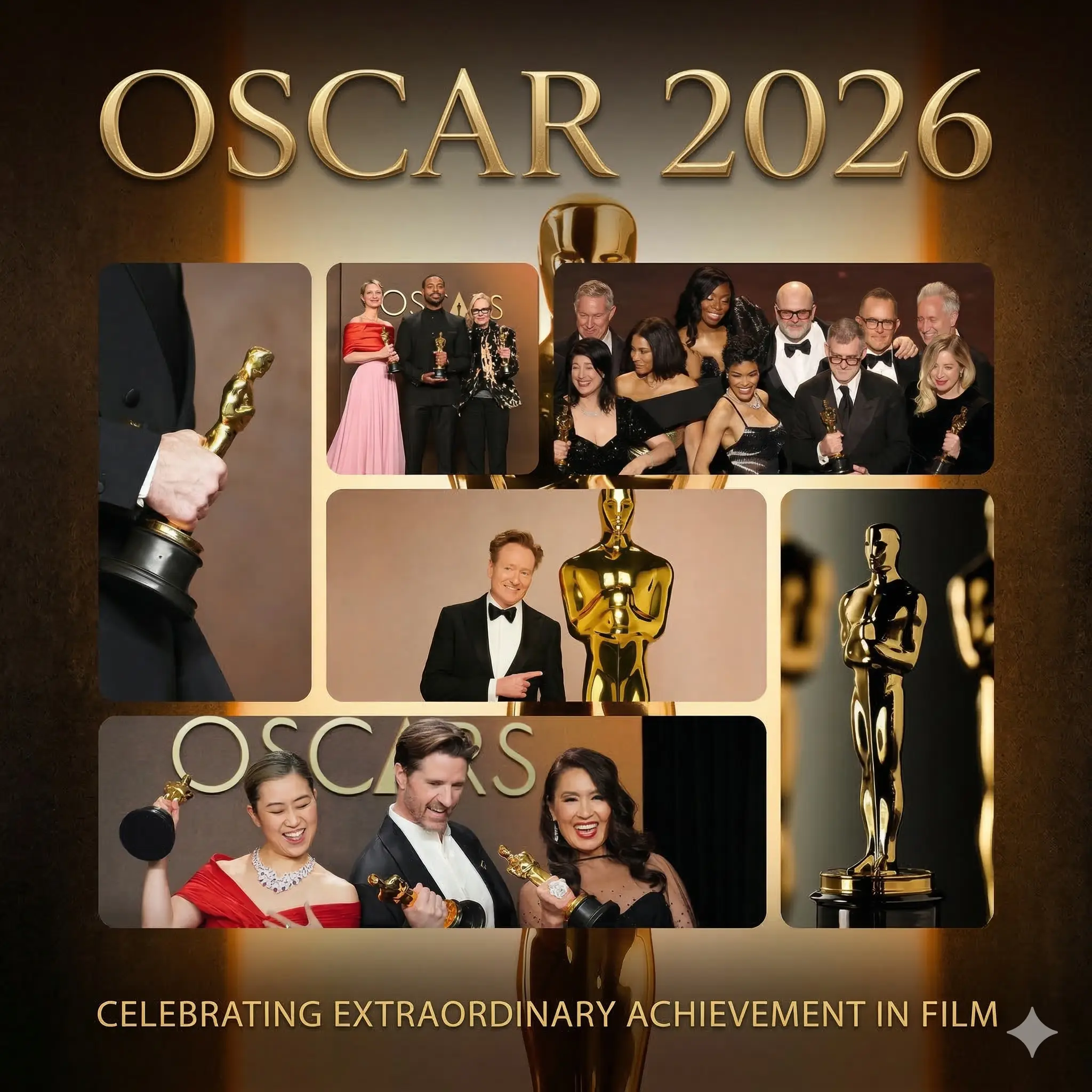

A Night Defined by Conviction, Not Consensus
Every Oscar ceremony claims to reflect the year in cinema. The 98th Academy Awards revealed something more. It exposed what the Academy is now willing to stand behind.
The 2026 winners list does not read like a cautious compromise. It reads like an argument. Auteurs dominated the evening. Genre filmmaking claimed technical legitimacy without apology. Performances were rewarded for psychological precision rather than theatrical transformation.
At the center of the ceremony stood Paul Thomas Anderson’s One Battle After Another. Its sweep across major categories, including Best Picture and Best Director, positioned it not merely as a critical success but as the institutional choice of the moment. The film’s victory signals a renewed Academy comfort with morally complex storytelling and structural ambition.
Alongside it, Ryan Coogler’s Sinners emerged as the ceremony’s creative counterforce. Its wins in acting and writing, combined with major craft recognition, revealed how the Academy’s branches can rally around films that challenge tone and genre expectations. Meanwhile, Guillermo del Toro’s Frankenstein quietly dominated the design awards, reinforcing the continued influence of craft-driven filmmaking within Oscar voting patterns.
The result was a ceremony that felt less predictable than recent years. Instead of a single narrative absorbing all momentum, multiple visions of cinema coexisted and competed for legitimacy. The 2026 Oscars did not simply reward films. They clarified Hollywood’s direction.
Best Picture: Why One Battle After Another Defined the Night

If the Oscars function as a statement of institutional confidence, this year’s Best Picture result delivered one of the clearest messages in recent memory. One Battle After Another did not win on sentiment alone. It won because it represented a convergence of craft authority, ensemble precision, and directorial control that the Academy rarely overlooks.
Paul Thomas Anderson’s film constructs its power through accumulation rather than spectacle. The narrative unfolds as a layered exploration of moral fatigue, ambition, and generational consequence. By the time the Best Picture envelope was opened, the outcome felt less like a surprise and more like a culmination of momentum built across categories. Wins for Best Director, Best Adapted Screenplay, Supporting Actor, Film Editing, and Achievement in Casting created an unmistakable pattern of support across branches.
This kind of cross-category dominance often reveals how the Academy perceives structural completeness in a film. Editing recognition suggested confidence in narrative rhythm. Casting acknowledgment highlighted the strength of ensemble design. Director and screenplay wins reinforced authorship as a defining metric. Together, these signals positioned the Best Picture victory as both logical and symbolic.
The film’s success also clarified the competitive landscape. Sinners, despite strong recognition in cinematography, score, writing, and lead acting, ultimately represented a different philosophical path. Where Anderson’s film emphasizes controlled narrative architecture, Coogler’s work leans into emotional confrontation and thematic immediacy. That tension defined much of the season’s discourse.
Other contenders, such as Hamnet and Sentimental Value, demonstrated the Academy’s continued appreciation for literary adaptation and international storytelling. Their presence in the race reinforced the breadth of cinematic voices acknowledged this year, even as the final result consolidated around a single prestige frontrunner.
Best Picture in 2026 was not awarded to the loudest film or the most commercially dominant one. It went to the film that voters appeared to trust most as a complete artistic system. In doing so, the Academy signaled that conviction, not consensus, remains the decisive currency of Oscar success.
Best Director: Paul Thomas Anderson’s Authority Becomes Institutional Recognition
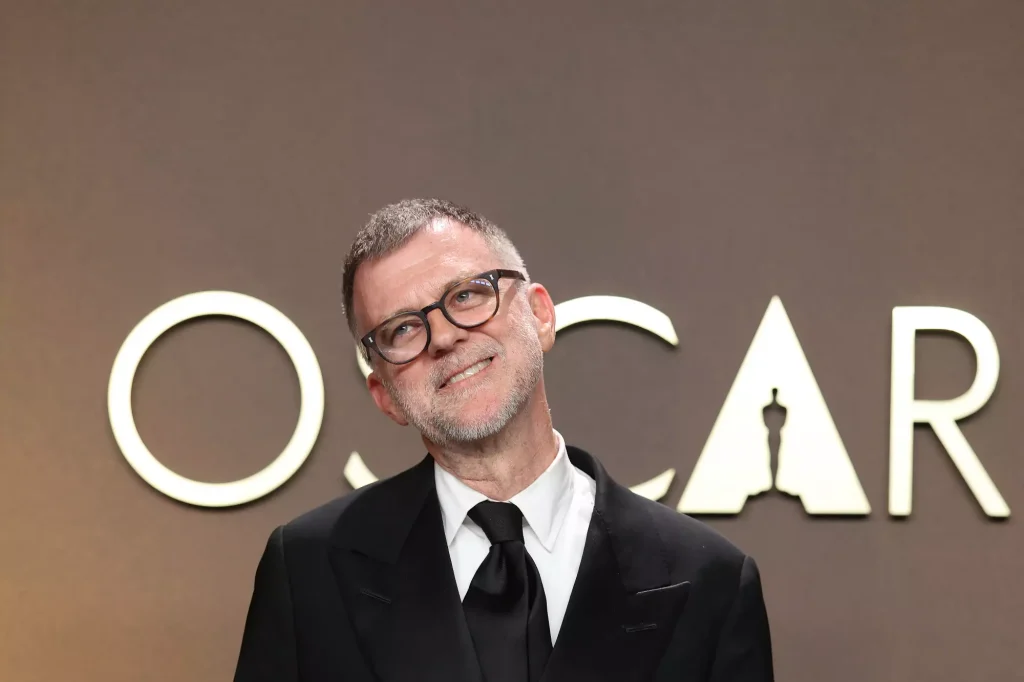
Few Oscar wins feel like a culmination of decades of artistic positioning. Paul Thomas Anderson’s victory for One Battle After Another carried precisely that weight. The Academy was not simply rewarding a single film. It was formalizing the influence of one of contemporary cinema’s most exacting auteurs.
Anderson’s direction in the film is defined less by visual ostentation and more by orchestration. The narrative moves with deliberate structural precision, allowing performances, editing rhythms, and tonal shifts to interlock into a cohesive cinematic language. Large ensemble sequences unfold with the clarity of chamber drama, while moments of moral confrontation retain an unsettling intimacy. This balance between scale and psychological detail became central to the campaign narrative surrounding the film.
The directing branch has historically gravitated toward filmmakers who demonstrate both command and restraint. Anderson’s work here reflects a confidence in storytelling architecture rather than stylistic exhibitionism. The win also signals an institutional acknowledgment that his influence has shaped a generation of filmmakers who followed his model of auteur-driven prestige cinema.
Competition in the category reflected the broader thematic tensions of the season. Ryan Coogler’s Sinners represented a bold tonal experiment, merging genre energy with socially conscious storytelling. Chloé Zhao’s Hamnet offered an intimate, emotionally restrained approach rooted in literary adaptation. Meanwhile, Joachim Trier’s Sentimental Value continued to build international momentum through festival acclaim and critical advocacy.
Ultimately, Anderson’s victory suggests that the Academy remains deeply responsive to films that present directing as structural authorship rather than stylistic signature alone. The award did not simply honor vision. It recognized the ability to construct a cinematic world in which every element operates with intentional cohesion.
Best Actor — Michael B. Jordan (Sinners)
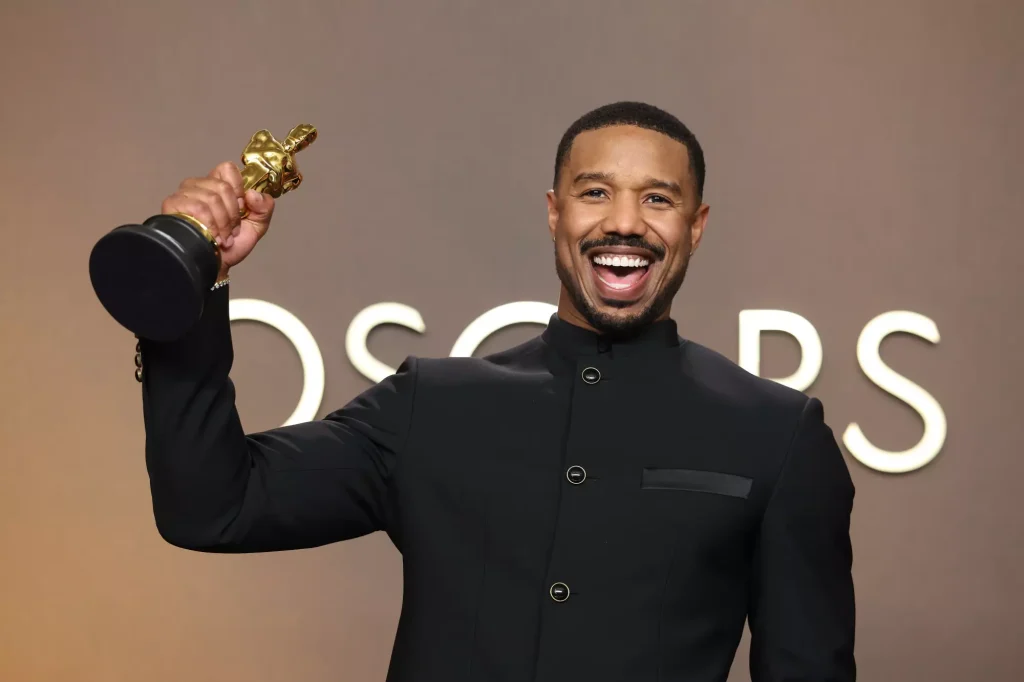
Some Oscar wins feel like career rewards. Others feel like turning points in how the Academy defines leading-man authority. Michael B. Jordan’s victory for Sinners belongs firmly to the latter.
Jordan’s performance anchors a film built on moral ambiguity and psychological erosion rather than conventional heroism. His character moves through the narrative with controlled intensity, allowing vulnerability to surface in fragments rather than declarations. This restraint becomes the performance’s defining strength. Instead of dominating scenes through volume or spectacle, Jordan shapes tension through stillness, eye-line shifts, and measured dialogue rhythms. The result is a portrayal that feels internally driven — a study of conviction slowly destabilizing under pressure.
Historically, Best Actor winners often emerge from films that position performance as emotional access points for complex thematic material. Sinners fits that pattern. The role demanded both physical presence and philosophical weight, requiring Jordan to embody a character whose moral certainty fractures across the film’s runtime. The Academy’s recognition signals an ongoing shift toward performances that prioritize psychological credibility over traditional star charisma.
The win also reflects a broader trajectory in Jordan’s career. Long associated with charismatic intensity in franchise and prestige-adjacent projects, he uses Sinners to recalibrate his screen identity. Here, performance becomes architecture rather than propulsion. He is not simply moving the plot forward; he is shaping how the audience interprets its ethical stakes.
Other Notable Contenders
Leonardo DiCaprio — One Battle After Another
DiCaprio delivered a commanding ensemble performance in the eventual Best Picture winner, balancing veteran gravitas with moments of surprising fragility. His work functioned as a stabilizing force within a film defined by shifting narrative perspectives.
Timothée Chalamet — Marty Supreme
Chalamet’s turn offered a charismatic and stylistically daring interpretation of ambition and self-mythologizing. The performance generated significant industry discussion for its tonal risk-taking, even as the film itself remained a more divisive contender.
Wagner Moura — The Secret Agent
Moura brought international dramatic intensity to a tightly constructed character study rooted in surveillance culture and political paranoia. His nomination underscored the Academy’s continued openness to globally resonant performances.
Jordan’s win ultimately crystallizes a defining theme of the 2026 ceremony: genre storytelling can produce performances with the same psychological authority traditionally associated with prestige cinema.
Best Actress — Jessie Buckley (Hamnet)
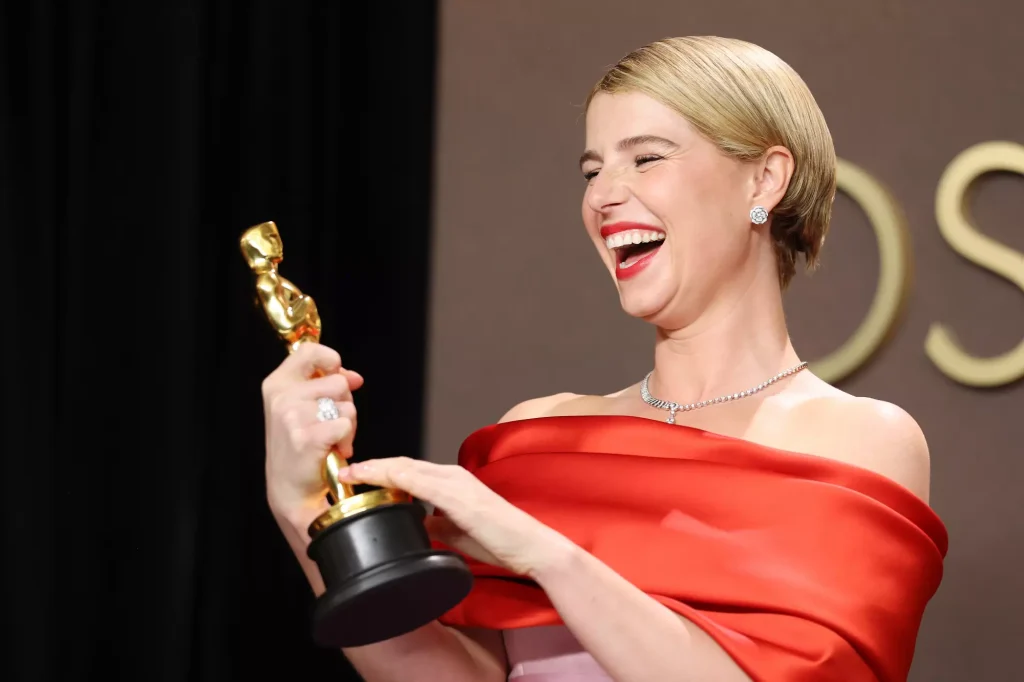
Some Oscar victories feel inevitable long before the envelope is opened. Jessie Buckley’s win for Hamnet belonged to that category — a performance whose emotional authority became the quiet center of the awards season conversation.
Buckley anchors the film through an approach that prioritizes interiority over display. Rather than dramatizing grief through overt breakdowns, she allows loss to manifest in gesture, rhythm, and stillness. The performance unfolds like a sustained emotional echo, reinforcing the film’s meditation on memory, authorship, and maternal absence. This kind of restraint has historically resonated with the Academy’s acting branch, particularly in literary adaptations where psychological texture becomes narrative propulsion.
Her victory also reflects a broader evaluative shift visible across the 2026 ceremony. The Academy appears increasingly drawn to performances that integrate seamlessly into a film’s tonal architecture. In Hamnet, Buckley does not dominate the frame as much as she calibrates it. Her work establishes the film’s emotional temperature, allowing surrounding performances and visual language to orbit a carefully maintained center of gravity.
The win positions Buckley within a lineage of Best Actress recipients whose impact derives from precision rather than transformation. The performance becomes less about spectacle and more about narrative necessity — a portrayal that feels inseparable from the film’s thematic identity.
Other Notable Contenders
Emma Stone — Bugonia
Stone delivered one of the season’s most stylistically adventurous lead performances, navigating tonal shifts between satire and psychological drama. Her work generated sustained industry discussion for its willingness to destabilize audience expectations.
Renate Reinsve — Sentimental Value
Reinsve’s nomination reflected continued international critical momentum following festival acclaim. Her performance emphasized emotional opacity and observational realism, reinforcing the Academy’s growing receptiveness to European acting traditions.
Rose Byrne — If I Had Legs I’d Kick You
Byrne offered a sharply calibrated tragicomic turn that blended absurdist humor with existential unease. The performance expanded her reputation as a performer capable of balancing tonal risk with character authenticity.
Buckley’s win ultimately reinforces a defining pattern of the 2026 Oscars. Performances were not rewarded for their scale, but for their capacity to sustain thematic coherence. In a ceremony shaped by auteur confidence and psychological storytelling, her portrayal in Hamnet exemplified how emotional precision can become the most powerful cinematic instrument.
Best Supporting Actor — Sean Penn (One Battle After Another)

Some Oscar categories reward transformation. Supporting Actor often rewards authority. Sean Penn’s win for One Battle After Another reflects the Academy’s enduring respect for performances that stabilize large, ambitious films from within.
Penn does not dominate the narrative through theatrical force. Instead, he functions as a moral counterweight inside Paul Thomas Anderson’s sprawling ensemble. His performance is defined by control, allowing emotional gravity to build through silence, timing, and measured confrontation. In a film structured around shifting perspectives and ideological tension, Penn becomes a point of clarity. His presence sharpens the stakes without overwhelming the film’s carefully calibrated rhythm.
The Academy’s supporting categories have historically recognized veteran performers who bring structural credibility to prestige cinema. Penn’s work fits squarely within that lineage. His character operates as both witness and participant, grounding Anderson’s thematic exploration of ambition and consequence in recognizable human vulnerability. The result is a performance that feels less like a showcase and more like a stabilizing architecture within the film’s design.
The win also reinforces the broader momentum surrounding One Battle After Another. Recognition across acting, writing, editing, and directing created a pattern of institutional confidence that ultimately carried the film to Best Picture. Supporting Actor became another signal that voters viewed the film not just as a narrative achievement, but as a complete cinematic system.
Other Notable Contenders
Benicio Del Toro — One Battle After Another
Del Toro delivered a volatile and unpredictable turn that contrasted sharply with Penn’s restraint. His performance injected instability into the ensemble dynamic, highlighting how Anderson constructed tension through opposing acting energies.
Delroy Lindo — Sinners
Lindo’s nomination represented a different acting tradition rooted in emotional transparency and thematic urgency. His performance added a moral dimension to Ryan Coogler’s genre-inflected storytelling, reinforcing the film’s resonance across multiple Academy branches.
Stellan Skarsgård — Sentimental Value
Skarsgård brought international gravitas to a performance built on introspection and cultural nuance. His inclusion reflected the Academy’s growing openness to quieter supporting roles that prioritize psychological texture over dramatic exhibition.
Penn’s victory ultimately underscores one of the defining truths of the 2026 ceremony. Even in an era increasingly receptive to genre innovation and stylistic experimentation, the Academy continues to reward performances that provide structural authority to ambitious auteur cinema.
Best Supporting Actress — Amy Madigan (Weapons)
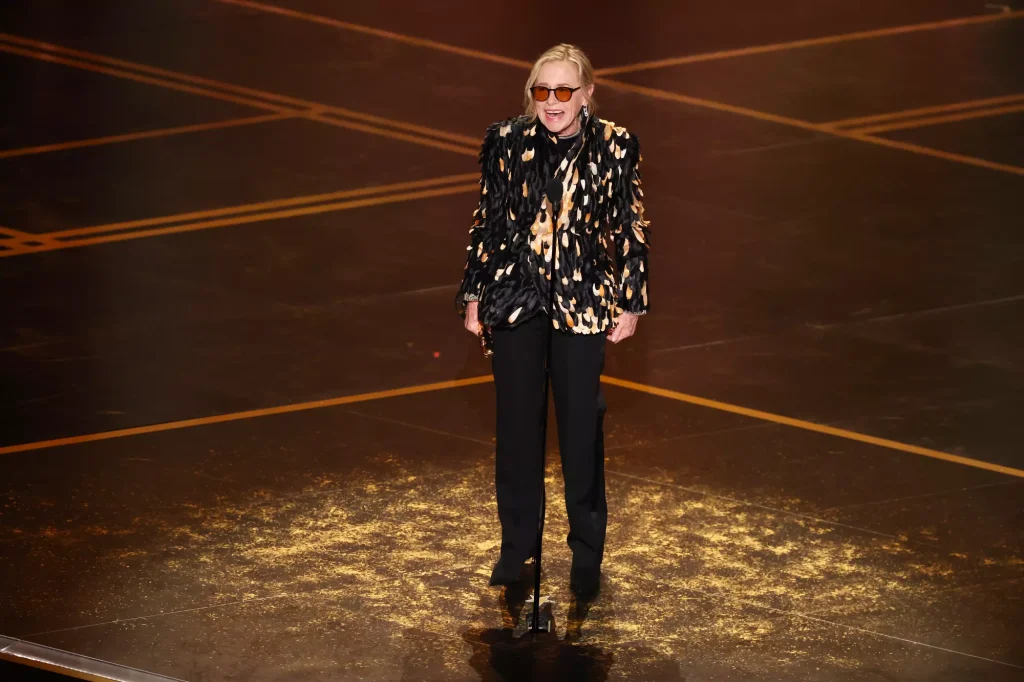
Supporting Actress has long been the category where emotional precision can eclipse scale. Amy Madigan’s victory for Weapons reflects that enduring Oscar instinct.
Madigan delivers a performance rooted in lived-in authenticity rather than overt dramatic exhibition. Her character exists at the emotional fault line of the film’s narrative, functioning as both observer and catalyst. Instead of commanding attention through transformative gestures, she shapes the film’s tone through behavioral detail. Small pauses, conversational rhythms, and moments of controlled fragility create a performance that feels deeply integrated into the story’s moral landscape.
The Academy has historically responded to supporting performances that carry thematic responsibility without narrative dominance. Madigan’s work follows that tradition. In Weapons, she becomes the audience’s ethical anchor, grounding the film’s escalating tension in recognizable human stakes. Her scenes rarely announce their importance, yet they linger in memory precisely because of their restraint. This kind of calibrated subtlety often resonates strongly with voters who view supporting roles as essential structural components rather than secondary showcases.
Her win also reflects a broader pattern across the 2026 ceremony. Veteran actors delivering psychologically precise work were consistently recognized alongside high-profile auteur films and genre-driven contenders. The result is a supporting race that feels less about star power and more about narrative alignment.
Other Notable Contenders
Elle Fanning — Sentimental Value
Fanning brought luminous vulnerability to a role defined by emotional displacement and cultural transition. Her performance contributed to the film’s international critical momentum and reinforced the Academy’s growing receptivity to understated dramatic textures.
Wunmi Mosaku — Sinners
Mosaku’s nomination reflected the film’s wider acting branch support. Her work combined quiet strength with moral urgency, helping anchor Ryan Coogler’s genre-inflected storytelling in human consequence rather than spectacle.
Teyana Taylor — One Battle After Another
Taylor delivered one of the film’s most dynamically expressive supporting turns. Her performance introduced volatility and emotional immediacy into Paul Thomas Anderson’s carefully orchestrated ensemble, highlighting the range of acting styles that coexisted within the Best Picture winner.
Madigan’s victory ultimately reinforces a defining theme of the 98th Academy Awards. Supporting categories remain spaces where emotional truth and narrative necessity can outweigh visibility. In a ceremony shaped by auteur authority and technical ambition, her performance stands as a reminder that the most lasting cinematic impact often emerges from the quietest moments.
Best Original Screenplay — Ryan Coogler (Sinners)
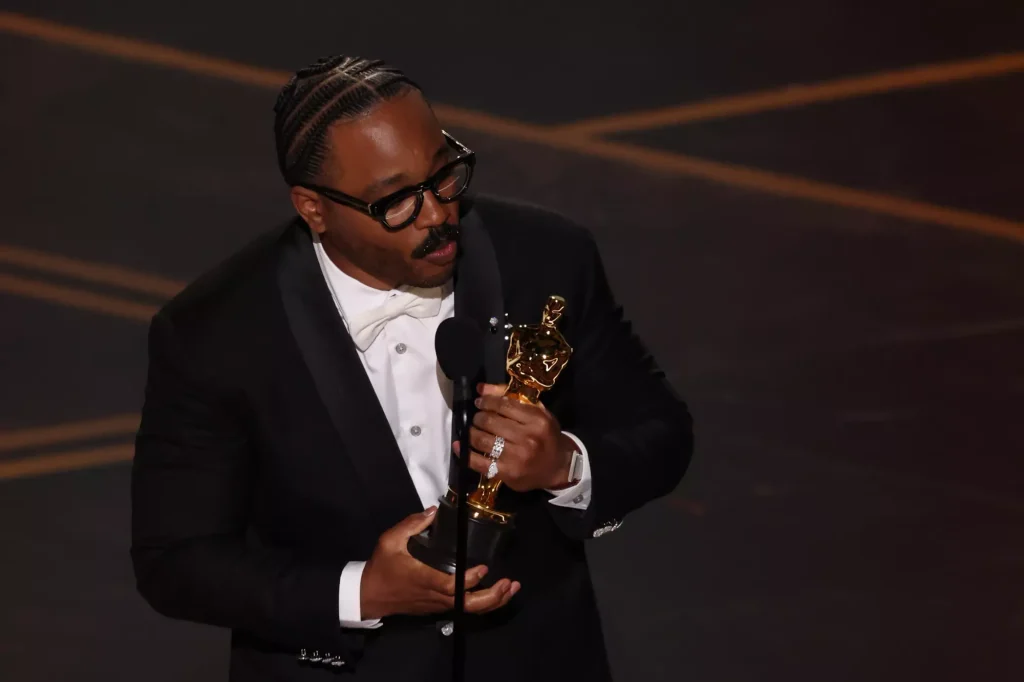
Screenplay categories often reveal the Academy’s deepest ideological preferences. Ryan Coogler’s win for Sinners confirms how strongly voters responded to writing that fused genre propulsion with thematic urgency.
Coogler’s script operates as both a narrative engine and a moral framework. Rather than treating social commentary as subtext, Sinners places it at the center of character motivation and structural tension. Dialogue is sparse but purposeful. Conflict escalates through ethical confrontation rather than plot mechanics alone. This approach allows the film to sustain suspense while continuously expanding its philosophical scope.
Original Screenplay recognition frequently signals institutional respect for narrative risk. In this case, the award acknowledges how Coogler reshaped familiar genre conventions into a vehicle for contemporary reflection. The screenplay balances accessibility with intellectual ambition, creating a story that engages audiences emotionally while inviting broader cultural interpretation. That duality became a defining talking point throughout the awards season.
The victory also reinforces the ceremony’s larger narrative. While One Battle After Another dominated in categories associated with structural authorship and ensemble orchestration, Sinners emerged as the film most clearly identified with conceptual boldness. Coogler’s writing functions as the connective tissue between performance intensity and technical craft recognition. By honoring the screenplay, the Academy effectively validated the film’s creative thesis.
Historically, Original Screenplay winners often shape the memory of an Oscar year more than box office outcomes or campaign narratives. They signal which ideas resonated most deeply with voters as reflections of the cultural moment. Coogler’s win places Sinners within that lineage of films whose writing becomes inseparable from their legacy.
Other Notable Contenders
Sentimental Value — Joachim Trier and Eskil Vogt
The screenplay’s introspective character design and elliptical storytelling attracted sustained critical advocacy. Its nomination underscored the Academy’s continued engagement with internationally driven narrative voices.
Marty Supreme — Writers Team
A structurally unconventional script built around ambition and performative identity. Industry reactions highlighted its tonal risk-taking even as the film remained a more divisive presence in the race.
Blue Moon — Richard Linklater
Dialogue-driven and observational in rhythm, the screenplay reflected Linklater’s long-standing commitment to character-led storytelling. Its inclusion reinforced the branch’s openness to quieter narrative approaches.
Coogler’s victory ultimately clarifies one of the central tensions of the 2026 Oscars. Original storytelling grounded in genre can achieve the same institutional validation once reserved primarily for traditional prestige drama.
Best Adapted Screenplay — Paul Thomas Anderson (One Battle After Another)
Adapted Screenplay often becomes a referendum on how successfully filmmakers translate complexity into cinematic clarity. Paul Thomas Anderson’s win for One Battle After Another reflects the Writers Branch’s long-standing admiration for scripts that prioritize structural control without sacrificing thematic depth.
Anderson’s adaptation reshapes dense literary material into a film that feels expansive yet rigorously organized. The screenplay treats dialogue less as a vehicle for exposition and more as a site of ideological confrontation. Characters articulate competing moral positions that gradually intensify the film’s internal tension. This approach allows narrative momentum to emerge organically from perspective shifts rather than conventional plot escalation. The result is a work that sustains intellectual pressure while remaining dramatically engaging.
Historically, the Academy has favored adaptations that demonstrate interpretive authorship rather than decorative fidelity to source material. Anderson’s script follows that tradition. It reconfigures narrative emphasis to foreground questions of generational consequence, institutional authority, and personal compromise. Scenes unfold through controlled escalation of thematic stakes, creating a sense of continuity that anchors the film’s broader visual and performative ambitions.
This recognition also reinforces the ceremony’s overarching narrative. One Battle After Another did not dominate the evening solely through directorial presence or ensemble strength. Its screenplay provided the architectural framework that allowed those elements to operate cohesively. By honoring the adaptation, voters effectively acknowledged the film’s systemic coherence — the sense that every artistic choice served a unified conceptual design.
Adapted Screenplay winners often help define how an Oscar year is remembered. They signal which works successfully transformed literary or historical complexity into cinematic language that feels both precise and resonant. Anderson’s victory positions One Battle After Another within that lineage of structurally assured films whose narrative construction becomes central to their long-term reputation.
Other Notable Contenders
Chloé Zhao — Hamnet
Zhao’s restrained adaptation translated historical material into an intimate study of grief and memory. Its nomination reflected sustained critical advocacy for emotionally controlled storytelling grounded in visual expression.
Guillermo del Toro — Frankenstein
Del Toro’s script reframed a canonical narrative through existential vulnerability and moral ambiguity. The nomination reinforced the branch’s continued openness to adaptations that reinterpret familiar mythologies through contemporary philosophical lenses.
Clint Bentley and Greg Kwedar — Train Dreams
This contemplative screenplay drew attention for its deliberate pacing and commitment to interior character experience. Its presence in the lineup signaled respect for narrative minimalism as a valid form of cinematic adaptation.
By awarding Anderson, the Academy reaffirmed a consistent evaluative pattern. Adaptations are most likely to prevail when they transform narrative density into controlled cinematic momentum while preserving thematic ambition. The category’s outcome further strengthened the perception that One Battle After Another represented the night’s most structurally confident film.
Additional Notable Winners
While the major acting and writing categories shaped the intellectual narrative of the evening, several craft and specialty awards helped clarify the broader aesthetic direction of contemporary cinema. These wins demonstrated how the Academy continues to balance institutional prestige with recognition of evolving audience tastes and global storytelling momentum.
Best Animated Feature — K-Pop Demon Hunters
Animation categories often function as indicators of generational taste within the industry. The victory of K-Pop Demon Hunters reflects the Academy’s increasing openness to stylistic hybridity and cross-cultural narrative influence. Blending music-driven spectacle with genre storytelling, the film resonated strongly with younger voters and international branches. Its win suggests that animated cinema is no longer evaluated solely through the lens of family accessibility, but also through visual innovation and tonal ambition.
Best International Feature — Sentimental Value
Joachim Trier’s film extended its festival momentum into Oscar recognition, reinforcing the Academy’s sustained engagement with European auteur cinema. The award acknowledged a storytelling approach rooted in emotional opacity and observational realism. By honoring Sentimental Value, voters signaled continued appreciation for films that privilege psychological nuance over narrative immediacy. The win also strengthened the ceremony’s overarching theme of introspective filmmaking, gaining institutional legitimacy.
Best Visual Effects — Avatar: Fire and Ash
Technical categories frequently reflect the industry’s ongoing negotiation between spectacle and narrative immersion. The recognition of Avatar: Fire and Ash confirms that large-scale technological innovation still holds significant influence within the Academy’s craft branches. Rather than rewarding visual scale alone, the award acknowledged how digital environments and performance capture were integrated into the film’s emotional architecture. The win illustrates how blockbuster filmmaking can achieve technical validation when spectacle serves experiential storytelling rather than overshadowing it.
Collectively, these victories helped shape the ceremony’s tonal balance. If the major awards emphasized structural authorship and psychological performance, the craft categories highlighted the Academy’s willingness to recognize global perspectives and technological experimentation. Together, they reinforced the perception that contemporary Oscar recognition is increasingly defined by coexistence rather than hierarchy.
Conclusion: A Ceremony Balancing Prestige and Innovation
The 98th Academy Awards ultimately presented a portrait of an industry negotiating its identity. Prestige filmmaking retained institutional authority through the sweeping success of One Battle After Another, while ambitious genre storytelling found validation through the creative impact of Sinners and the craft dominance of Frankenstein.
Rather than consolidating around a single aesthetic philosophy, the ceremony revealed multiple pathways to artistic legitimacy. Auteur-driven narrative control, psychologically precise acting, literary adaptation, and technological spectacle all coexisted within the same awards landscape. This convergence suggests that the Academy is less concerned with defining a singular cinematic standard and more invested in acknowledging the evolving plurality of film language.
In doing so, the 2026 Oscars clarified a central industry truth. Contemporary success is no longer measured solely by box office performance or critical consensus. It is determined by a film’s ability to demonstrate structural confidence, thematic relevance, and craft integration. The night’s winners collectively illustrate how modern cinema continues to expand its vocabulary while remaining anchored in the enduring pursuit of artistic conviction.