
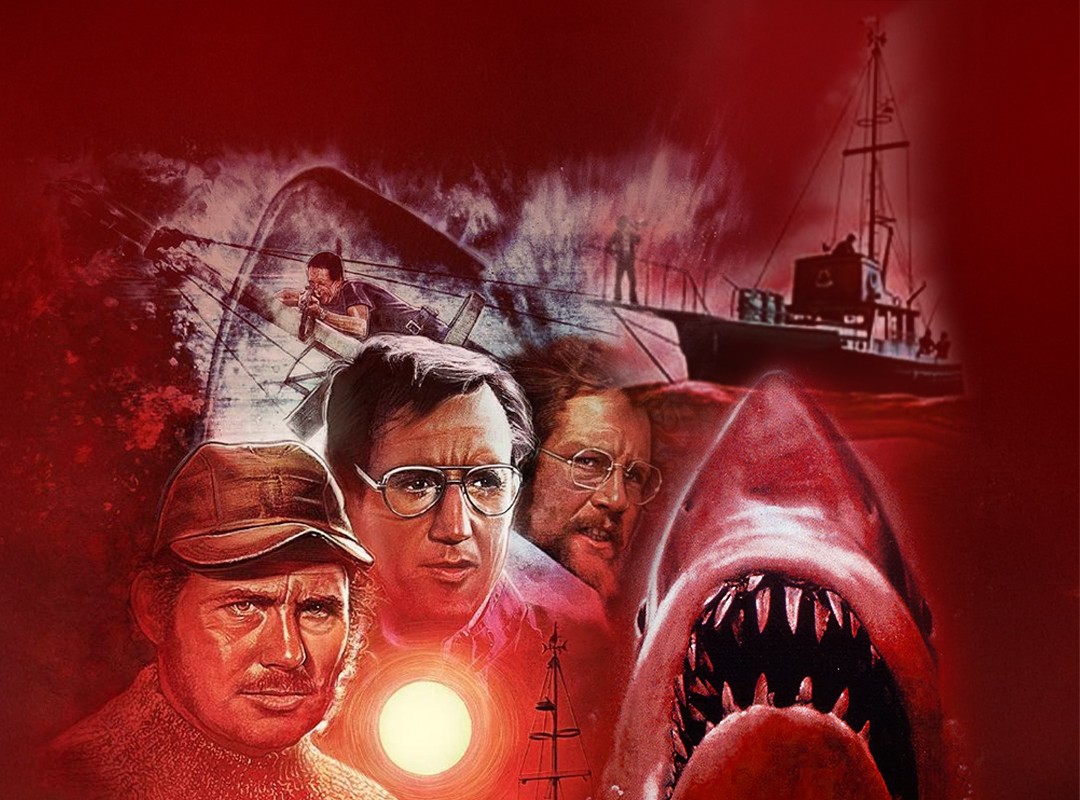

Fifty years ago, on June 20, 1975, Steven Spielberg’s Jaws (1975) swam into theaters and quietly changed the way we watch movies, the way we look at the ocean, and even the way we think about fear itself. At its simplest, it is a story about a shark that terrorizes a New England beach town. But beneath the surface, Jaws is also a story about human frailty, political compromise, ecological misunderstanding, and the strange relationship we share with predators that can never be tamed.
The Jaws 50th anniversary reminds us that the shark was never just the shark. It was a cultural event, a reflection of human vulnerability, and the birth of a new era in cinema — a Jaws movie analysis that still resonates today.
Why is Jaws still scary after 50 years?
Jaws remains terrifying 50 years later because it combines the fear of the unseen predator with deep human vulnerability themes. The malfunctioning mechanical shark forced Spielberg to show less, creating more psychological terror, while John Williams’ two-note score turned simple music into pure dread.
How Jaws Changed Movies Forever in 1975
The most enduring truth about Jaws is that it should not have worked. Steven Spielberg’s Jaws (1975), directed when he was just 27, was plagued with a malfunctioning mechanical shark, a ballooning budget, and a schedule that stretched far beyond its limits.
Yet it is precisely because the shark didn’t work that the movie did. Spielberg was forced into restraint. We do not see the animal for long stretches. Instead, we see a fin, a ripple, or the terror in the eyes of Chief Brody as he scans the waves. Fear, as every biologist knows, thrives in the unseen.
Steven Spielberg’s Jaws and the Power of the Unseen
Spielberg turned limitations into strengths. The shark remained hidden for much of the runtime, forcing audiences to imagine the terror. The ocean became a screen of anticipation, each wave suggesting something lurking beneath.
The Jaws John Williams Score: Two Notes That Made History
The Jaws John Williams score — two notes, nothing more — became the heartbeat of this unseen threat. It is astonishing how such simplicity could create such dread. Those two notes became the shark’s pulse, its breathing, its intention. When the shark itself looked too stiff or too fake, the music made it real. Williams turned steel and rubber into sinew and instinct.
Brody, Quint, and Hooper: The Human Core of Jaws

What separates Jaws from its many imitators is not just craft. It is character. Horror only works if we care who is in danger, and Spielberg gave us people we still care about fifty years later. Brody, the aquaphobic police chief, is not a man of action but a man of conscience, balancing civic duty with paternal fear. Hooper, the oceanographer, serves as a bridge between science and society, armed with knowledge but often overlooked due to political necessity. Quint, the shark hunter, embodies a primal masculinity, forged in war and driven by trauma.
Their arguments, laughter, and silences on the deck of the Orca form the beating heart of the film.
As a biologist, you’d know sharks are not villains. They are apex predators, crucial to marine ecosystems. However, as a storyteller, Spielberg understood that an apex predator becomes even more terrifying when juxtaposed with fragile, fallible humans. The film works because we do not just fear the shark — we fear for Brody, Hooper, and Quint.
The Hidden Themes in Jaws: Fear, Politics, and Economics
On the surface, Jaws is about a shark attack. Beneath it, the movie is about economics. The mayor of Amity Island insists the beaches remain open because tourism is the town’s lifeblood. Even after a child dies, he pleads that closing the beaches will ruin the summer economy. That tension between safety and profit has never stopped being relevant.
Whether it is public health, climate change, or environmental regulation, the battle between short-term profit and long-term survival is a universal story. In Jaws, the shark is not only a biological predator but also a metaphor for the costs of denial. When nature asserts itself, all the economics in the world cannot negotiate it away.
Filming Jaws on Martha’s Vineyard: The Ocean as a Character
Spielberg filmed on the open ocean off Martha’s Vineyard. This was a choice as reckless as it was inspired. Shooting at sea was costly, unpredictable, and punishing for cast and crew. But it gave the movie its texture. The ocean is not a backdrop; it is a character. It shifts moods, light, and scale in ways no studio tank could replicate.
It is fitting that the sea is both the source of life and of terror in this film. The same waves that carry Brody’s family to the beach also carry death. The sea is never tamed, only endured. The shark, far from being an anomaly, is a reminder that the ocean operates by its own rules. For all our boats and harpoons, we are visitors here.
Jaws and the Birth of the Summer Blockbuster
Culturally, Jaws did more than terrify audiences. It changed Hollywood itself. Released in June 1975, it introduced the idea of the “summer blockbuster” — a film designed for mass audiences, wide release, and relentless marketing.
It proved that spectacle could dominate the cultural conversation. In doing so, it shaped the very business of cinema for decades to come. Few films embody the true Jaws blockbuster impact that defined modern Hollywood.
But unlike many of its descendants, Jaws balanced spectacle with substance. It was not merely about bigger teeth or higher body counts. It was about tension, patience, and character. That balance has been elusive ever since. Films like Sharknado or The Meg may be fun diversions, but they never pierce the cultural consciousness the way Steven Spielberg’s Jaws did.
Why Jaws Still Scares Us 50 Years Later
So why is Jaws (1975) still scary after fifty years? It is not just the shark. It is not just the score. It is not just the craft. It is the way all those elements converge into a story about human vulnerability in the face of nature. The unseen predator reminds us of our own smallness. The politics of Amity Island remind us of our own compromises. The arguments aboard the Orca remind us that courage often begins in disagreement. The final explosion of the shark reminds us that survival is always uncertain, always fragile.
Jaws 50th Anniversary Re-Release: When and Where to Watch
From August 29 through September 4, the Jaws movie 50 years re-release will bring the film back to theaters across the U.S. and U.K. in stunning 4K, IMAX, RealD 3D, 4DX, and D-BOX formats. Audiences will gather once again, listening as those two notes creep through the dark and hush the room. Half a century later, Jaws: 50th Anniversary (2025) still has the power to keep us on the edge of our seats.
2025 Re-Release Details:
- Dates: August 29, 2025
- Formats: 4K, IMAX, RealD 3D, 4DX, D-BOX
- Regions: U.S. and U.K.
Jaws Legacy: How Spielberg’s Shark Changed Cinema
Every time I return to Jaws, I find myself both terrified and grateful. Terrified because the film still makes me lift my feet off the floor when John Williams’ music begins. Grateful because it connects me to the sea in all its danger and mystery. As a fan, it remains one of the most thrilling movies I have ever seen. As a critic, it remains one of the most influential. As someone who cares about the ocean, it remains a reminder that fear and respect are two sides of the same wave. Above all, the Jaws Spielberg anniversary reminds us that cinema has the rare power to shape what we fear, what we revere, and how we see the world around us.