

Horror films don’t exist in a vacuum. They draw power from collective fears, anxieties, and cultural undercurrents. But when real-world tragedies strike—assassinations, mass shootings, terrorist attacks, or pandemics—those fears stop being hypothetical. Suddenly, what once felt thrilling can feel too close to home.
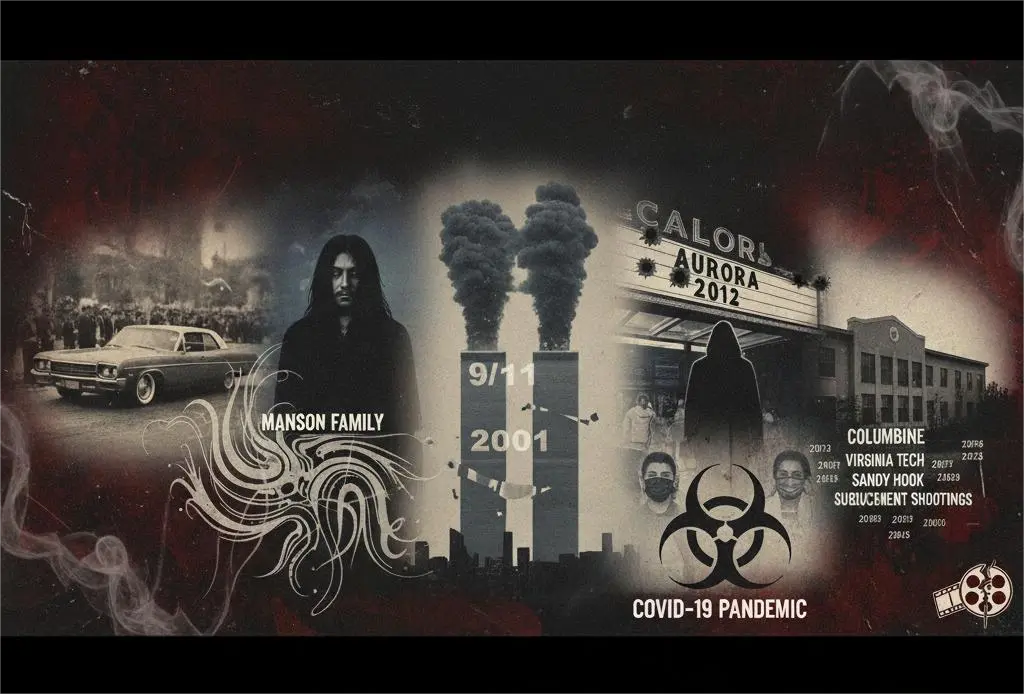
This article explores how major real-life events from 1963 to 2020 reshaped horror cinema: delaying releases, forcing edits, shifting entire subgenres, and sometimes changing the tone of popular culture itself. From the assassination of John F. Kennedy to the 9/11 terrorist attacks, the Aurora theater shooting, and the COVID-19 pandemic, each event had ripple effects that went beyond the headlines.
We’ll break down how and why horror films are particularly vulnerable to real-world tragedy: their mimicry of real fear, their dependence on audience sensitivity, and studios’ caution in times of cultural shock. These events didn’t just alter single films—they reshaped the entire horror landscape.
Quick Scan: Real Tragedies That Changed Horror Film Releases
| Historical Event | Year | Impacted Film(s) | Studio Response | Outcome |
| Assassination of John F. Kennedy | 1963 | Dr. Strangelove or: How I Learned to Stop Worrying and Love the Bomb | Delayed release by 3 months; scene cut | Reshoot & edit |
| Manson Family murders | 1969 | Cultural shift across horror, Eg, Once Upon A Time In Hollywood | No direct delays, but a shift in tone | Rise of slasher & cynicism |
| September 11 attacks | 2001 | Big Trouble, Collateral Damage | Delayed, edited, or restructured | Urban destruction toned down |
| 2012 Aurora, Colorado shooting | 2012 | The Dark Knight Rises | Promo paused, donations issued | Heightened theater security |
| COVID-19 pandemic | 2020 | Host, Alone (trend) | Productions delayed, subgenres born | “Isolation horror” boom |
| Columbine High School massacre + subsequent shootings | 1999– | Multiple horror releases | Scenes reshot, violence cut | Ongoing edits & sensitivity |
List Of Real Tragedies That Changed Horror Film Releases
The JFK Assassination and the Delay of Dr. Strangelove or: How I Learned to Stop Worrying and Love the Bomb (1964)
- Event: President John F. Kennedy was assassinated, November 22, 1963
- Film Impact: Stanley Kubrick’s satirical nuclear-war horror-comedy was delayed by three months.
- Reason: The film featured a character named “President Merkin Muffley” and a plot involving accidental nuclear war—too close to national grief and fear.
- Legacy: Kubrick cut a climactic scene where the President is assassinated in the War Room, altering the tone forever.
The Manson Murders and the End of 1960s Optimism in Horror
- Event: Manson Family murders, August 8–9, 1969
- Film Impact: The cultural shock of the murders helped usher in a darker, more brutal wave of American horror in the early 1970s, influencing both tone and subject matter.
- Reason: The shocking home-invasion killings of actress Sharon Tate and others by members of the Manson Family shattered the “peace and love” façade of the late 1960s. The idea that horrific violence could strike at the heart of Hollywood made on-screen brutality feel uncomfortably real.
- Legacy: Filmmakers began embracing a new cynicism and fear of random, senseless violence. This shift paved the way for the gritty realism of The Texas Chain Saw Massacre (1974) and the suburban paranoia of Halloween (1978). Decades later, Once Upon a Time in Hollywood (2019) revisited this cultural trauma through an alternate-history lens, underscoring how deeply the murders remain embedded in Hollywood’s collective psyche.
9/11 and the Postponement of Horror Releases
- Event: September 11 attacks, September 11, 2001
- Film Impact: In the wake of the attacks, several films featuring scenes of large-scale urban destruction, terrorism, or aircraft were delayed, reshot, or reimagined. Horror and action projects like Big Trouble (2002) and Collateral Damage (2002) were postponed, while trailers and posters that included the World Trade Center were pulled overnight. Even Spider-Man (2002) underwent marketing changes to remove imagery of the Twin Towers.
- Reason: Images of collapsing skyscrapers, urban chaos, and terrorist threats mirrored real trauma too closely. The national mood shifted sharply—suddenly, fictional terror plots were no longer thrilling; they were triggering. Horror’s speculative fears collided with real pain.
- Legacy: Hollywood recalibrated its tone for years. Supernatural and psychological horror—such as The Ring (2002) and The Others (2001)—rose in prominence, while terrorism-centered narratives were sidelined or reframed as political thrillers. Urban disaster imagery became a creative minefield, treated with extreme sensitivity. The event also marked the beginning of a more cautious, emotionally attuned marketing era, where studios weighed national mood as heavily as box-office projections.
The Aurora Theater Shooting and The Dark Knight Rises (2012)
- Event: 2012 Aurora, Colorado shooting, July 20, 2012
- Film Impact: On the night of the film’s highly anticipated midnight premiere, a gunman opened fire inside a packed theater, killing 12 people and injuring dozens more. In response, Warner Bros. immediately canceled promotional events, red carpet appearances, and press junkets. Statements of condolence were released, and donations were made to the victims’ funds. While The Dark Knight Rises remained in theaters, its box office run unfolded under intense public and media scrutiny. News coverage blurred the line between the film and the tragedy, creating one of the most emotionally charged release environments in modern cinema history.
- Reason: The shooting took place during a screening of the very film being promoted, making it impossible to separate the fictional darkness of Gotham from the real-life horror of the attack. The incident reignited debates over the portrayal of violence in blockbuster films, security at public entertainment venues, and the cultural responsibility of studios during moments of national grief.
- Legacy: The shooting became a turning point for theatrical security and marketing practices. Metal detectors, bag checks, and heightened police presence became more common at high-profile screenings. Studios grew more cautious about promoting violence-heavy content during sensitive periods. It also intensified the broader cultural conversation about gun violence in America—forcing the entertainment industry to confront how fiction and reality can collide in devastating ways.
The Pandemic and the Rise of Isolation Horror
- Event: COVID-19 pandemic, March 2020 (global emergency)
- Film Impact: The pandemic caused one of the most significant disruptions in film history. Productions across the world were abruptly halted, release schedules were upended, and theaters shut their doors for months. In this vacuum, filmmakers turned to smaller, nimbler productions, leading to a surge in low-budget, contained horror films like Host (2020) and Alone (2020). These films, often shot remotely or in minimal locations, captured the claustrophobia of the lockdown experience in real time. Major releases like A Quiet Place Part II and The New Mutants were delayed repeatedly, reflecting the industry-wide uncertainty.
- Reason: With audiences physically isolated, narratives centered around confinement, fear of infection, and paranoia felt eerily familiar. Horror became a mirror for collective psychological states—quarantine, contagion, and the unknown. The format of Host, entirely filmed on a video call platform, exemplified how horror could thrive creatively even when traditional production was impossible.
- Legacy: “Isolation horror” and “pandemic horror” became defining subgenres of the early 2020s. Streaming platforms emerged as the dominant distribution channel, democratizing access and creating massive viewership for smaller titles. The success of these intimate, stripped-down films shifted industry priorities, proving that horror can adapt faster than most genres to real-world crises. The pandemic didn’t just change what horror films looked like—it changed how and where audiences experienced them.
Mass Shootings and the Editing of Horror Violence
- Event: Recurring mass shootings in the United States, notably the Columbine High School massacre (1999) and subsequent incidents such as the Sandy Hook Elementary School shooting (2012) and the Parkland school shooting (2018).
- Film Impact: In the aftermath of these tragedies, studios across Hollywood reassessed how gun violence and mass attacks were depicted on screen. Numerous films and TV shows underwent last-minute edits to remove scenes depicting shootings in schools, malls, or theaters. Certain releases, such as The Watcher (2012) and The Hunt (2020), were delayed or rebranded entirely because their plots involved mass violence. Marketing campaigns with heavy weapon imagery were either softened or scrapped altogether. Even unrelated projects became entangled with the emotional weight of real-world violence, forcing studios to make swift, sometimes expensive, changes.
- Reason: When real violence mirrors fictional narratives, the emotional boundary between horror as entertainment and horror as lived trauma collapses. Studios feared backlash, protests, and, most importantly, causing additional harm to survivors and communities still in mourning. Public sensitivity to depictions of shootings increased dramatically, particularly when children or schools were involved. Even the tone of promotional materials was scrutinized in the wake of mass violence.
- Legacy: Trigger warnings, sensitivity edits, and delayed releases became standard practice in the industry. Scenes once considered routine were re-evaluated through a social and ethical lens. The ripple effect extended beyond horror to thrillers, superhero films, and even teen dramas, setting a new cultural baseline for how violence is marketed and consumed. The ongoing frequency of mass shootings in the U.S. has made this a continuing rather than one-time recalibration—shaping the aesthetics and ethics of modern horror storytelling in profound ways.
Why Horror Films Are Especially Vulnerable to Real Tragedies
As film scholar Carol J. Clover observes in Men, Women, and Chain Saws:
“Horror trades in the uncanny—the familiar made strange. When real life becomes stranger than fiction, horror must recalibrate.”
- Mimetic danger: Horror mirrors collective fears. When those fears become real, horror risks exploiting trauma rather than fictionalizing it. This is why films depicting terrorism post-9/11 or mass shootings post-Columbine often had to be shelved or reworked.
- Audience sensitivity: After national or global tragedies, audiences are less willing to engage with fiction that feels too raw. Horror depends on the gap between “safe scares” and reality—when that gap closes, the genre falters.
- Studio caution: Studios often delay or censor releases out of fear of backlash, boycotts, or public outrage. This isn’t just corporate PR; it reflects a recalibration of how stories are told during collective grief.
Conclusion
Horror has always thrived on reflecting cultural anxieties—but when real life intrudes too violently, the genre must adapt. Whether it’s the delayed release of Dr. Strangelove after the JFK assassination, the tonal shift following the Manson murders, or the birth of “isolation horror” during the COVID-19 pandemic, real tragedies act as pressure points that reshape not just individual films, but the entire tone of horror storytelling.
These moments reveal how sensitive and reactive the genre is to public sentiment. Unlike other genres, horror doesn’t just entertain; it excavates fear. And when fear is no longer fictional, the industry must find new ways to tell its stories.
Frequently Asked Questions (FAQ)
Q: Did 9/11 change horror movies?
A: Yes. Studios avoided urban destruction and terrorism themes; supernatural horror rose as a safer alternative.
Q: Was The Dark Knight Rises pulled from theaters after the Aurora shooting?
A: No—but Warner Bros. canceled promotional events and donated to victims’ funds. The film remained in theaters.
Q: Have horror films ever been canceled due to real tragedies?
A: Rarely canceled, but often delayed or edited—e.g., Big Trouble (2002) was shelved for over a year.
Q: Did the pandemic inspire new horror subgenres?
A: Yes. “Quarantine horror” (Host, Alone) and “plague horror” (The Sadness) became dominant trends.
Q: Why do studios edit horror films after mass shootings?
A: To avoid public backlash and show social responsibility—especially when gun violence appears gratuitous.