
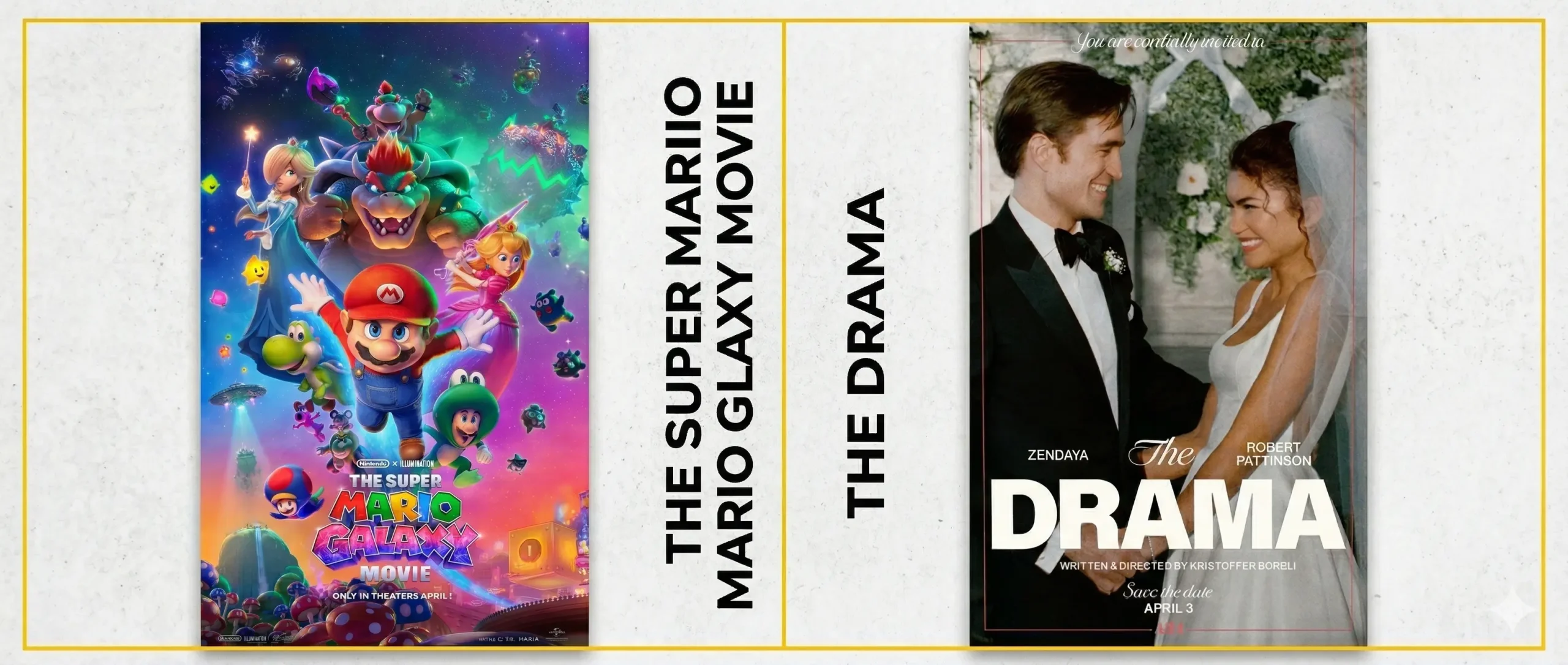

$190 million versus $14 million. Same weekend. Same cinemas. Two completely different theories about what people go to the movies for in 2026.
That gap is not a failure story. It is a cultural document. And if you read it carefully, it tells you something about the current state of cinema that no single film could communicate on its own.
The Numbers First
Super Mario Galaxy Movie (2026) opened on Wednesday, pulling in $130.9 million over its first three days and $190.1 million across its five-day Easter window. Globally, it has already cleared $372.5 million. Against a $110 million production budget, it crossed profitability before most people had finished their Easter weekend. Universal and Illumination repeated the exact playbook from the first Mario film in 2023: same writers, same directors, same producer in Nintendo’s Shigeru Miyamoto, same release window. The strategy worked again.
The Drama (2026) opened on the same weekend with $14.4 million domestically and $28 million globally. Against a $28 million production budget, it needs $70 million worldwide to break even. The opening is, by A24’s own standards, modest. Challengers (2024), the closest comparison film starring Zendaya, opened to $6.5 million in 2024 before building to $29 million domestic on word of mouth alone. The Drama is not in crisis. But it needs that same patience from audiences that A24 has historically earned.
Critics gave Mario Galaxy a 41% on Rotten Tomatoes. Audiences gave it 89%. Critics gave The Drama 77%. Audiences gave it 81%. That spread is its own story.
Two Theories of Cinema, One Weekend
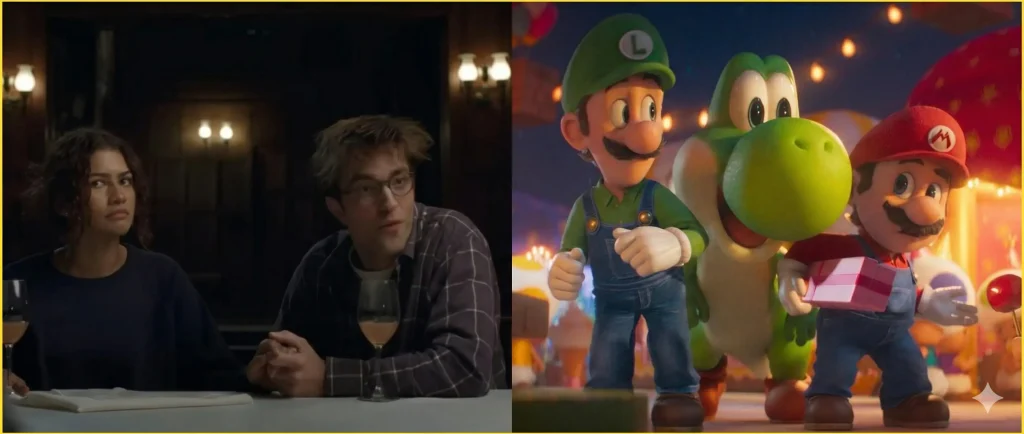
Here is what the weekend actually represents: two completely different answers to the question of why people leave their homes and pay for a cinema ticket in 2026.
Mario Galaxy is the answer built on certainty. Nintendo has sold an estimated $30 billion in Mario-related products since 1985. The brand is not a film franchise. It is a civilisational institution. When Universal opens a Mario film, they are not asking audiences to take a chance on something unfamiliar. They are offering a reunion with something people already love. The 89% audience score for a film that critics describe as having “no center” tells you everything: the audience was not there for narrative sophistication. They were there for the experience of being inside a world they have inhabited since childhood. That is a legitimate and powerful reason to go to the cinema.
The Drama is the opposite answer. Kristoffer Borgli, coming off Dream Scenario, has made a film that deliberately unsettles rather than reassures. A24 marketed it as a romantic drama and then delivered something that uses the romantic drama framework to explore psychological discomfort, moral ambiguity, and the question of whether love can survive complete honesty. The 77% critics score and 81% audience score suggest the film is working on people who encounter it. The $14 million opening suggests fewer people chose to encounter it than A24 might have hoped.
Neither of these outcomes is surprising. What is worth examining is what the gap between them means.
The Screendollars Take
This weekend did not pit good cinema against bad cinema. It pitted two different kinds of cultural function against each other, and the larger function won by a predictable margin.
Mario Galaxy is comfort infrastructure. It operates the way theme parks operate: immersive, familiar, emotionally safe, designed to generate shared experience across age groups. The critical consensus that it has “no center” is structurally correct and completely beside the point. The center is the franchise. The center is forty years of accumulated affection for a plumber in red overalls. No screenplay needs to carry that weight because the IP already does.
The Drama is asking something harder. Borgli wants audiences to sit with discomfort, to watch a relationship fracture in real time, to leave the cinema uncertain rather than satisfied. Zendaya gets, as one critic noted, a fully adult role to stretch out in — and stretching out in discomfort is not the same transaction as stretching out in a beanbag at a Mario theme park. Both have value. Only one of them is easy to say yes to on an Easter weekend.
What this weekend confirms is something that has been true for a decade and is becoming truer: the theatrical window is increasingly bifurcated. Massive IP events and intimate prestige dramas both have a place in it. The middle, the mid-budget studio film that is neither franchise nor art-house, continues to disappear. Mario Galaxy and The Drama did not compete. They served different audiences entirely, on the same weekend, in the same buildings.
The Pattern Behind the Numbers
This bifurcation is not new and it is not going away. The history of theatrical exhibition is a history of the same tension recurring in different forms.
In the 1970s, the blockbuster era began when Jaws and Star Wars demonstrated that event cinema could generate returns that no prestige drama could match. Studios responded by tilting their output toward spectacle. The 1980s produced a generation of franchise-first filmmaking. The 1990s saw the independent film movement push back, with Miramax and later A24 finding audiences for difficult, adult-oriented cinema that studios had abandoned.
What 2026 looks like is the maturation of that dynamic into something more settled. The major studios have largely ceded difficult adult drama to specialist labels. Universal makes Mario. A24 makes The Drama. Both are profitable business models when executed correctly. The difference is scale: Universal’s floor is A24’s ceiling.
The theatrical window still accommodates both. What it no longer accommodates comfortably is the $80 to $120 million studio drama that is neither franchise-driven nor sufficiently distinct to find a niche audience. Those films, which defined American prestige cinema from the 1980s through the 2000s, are the ones that have migrated to streaming. What remains in cinemas are the extremes: the enormous and the intimate. This weekend had one of each.
What Comes Next for Both Films
Mario Galaxy will run. The first film grossed $574.9 million domestically and $1.36 billion worldwide from a $100 million budget, a 13-to-1 return. Galaxy will not match those numbers — the 41% critics score and slightly lower audience enthusiasm suggest diminishing returns — but it will be profitable by a significant margin. Multiple Mario films will follow. Nintendo’s creative control, exercised through Miyamoto’s producer role, means the brand will not be diluted by studio interference. That is a durable model.
The Drama needs word of mouth and it has the ingredients to generate it. Challengers opened smaller than this and built steadily. The Drama is more challenging material than Challengers, which may limit its ceiling, but Borgli has made a film that generates conversation — the Tribune News Service called it a film about what secrets we can reveal and still be loved — and conversation is A24’s most reliable marketing tool. Awards season positioning, which A24 began at the DGA premiere, will extend its relevance into the autumn.
Both films will be fine. The more interesting question is what the next ten years of this bifurcation look like when the generation that grew up on streaming, rather than on multiplexes, becomes the primary cinema audience. Mario Galaxy can count on forty years of brand equity. The Drama needs to build its audience from scratch, one uncomfortable conversation at a time.
That is harder. It is also, arguably, more important.
Box office data sourced from opening weekend reports. The Drama and Super Mario Galaxy Movie are both in cinemas now.