
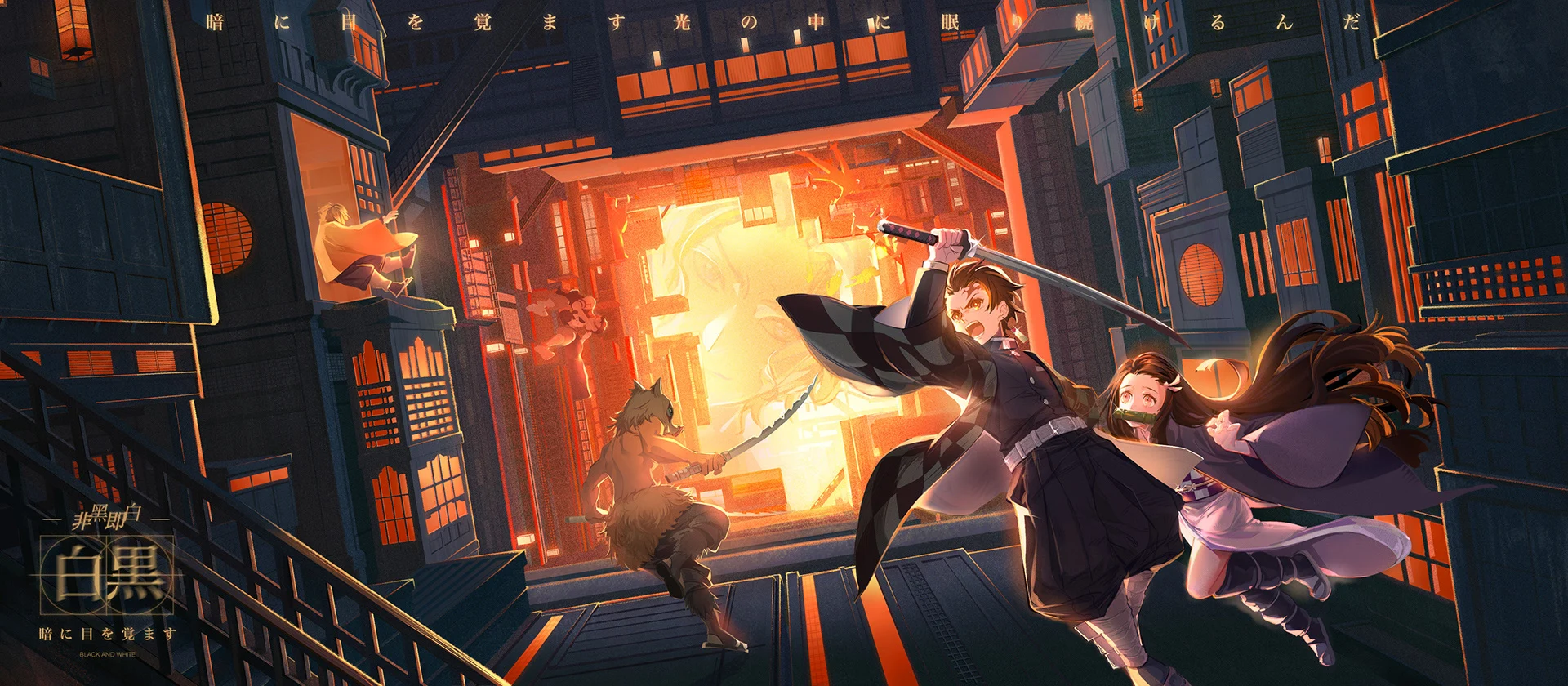

Sony and Crunchyroll’s DEMON SLAYER: KIMETSU NO YAIBA – INFINITY CASTLE brought the mid-September box office to life with a firm weekend total of $70.0M domestic and $132.1M worldwide. This stunning amount sets a new bar for the domestic opening of an anime feature, more than doubling the previous record holder, POKEMON: THE FIRST MOVIE, which earned $31.1M in its opening 26 years ago from November 10-12, 1999.
With additional support from the other new openers, Focus Features’ historical drama DOWNTON ABBEY: THE GRAND FINALE and Lionsgate’s dystopian thriller THE LONG WALK, the total domestic box office this weekend was $148M. This compares very favorably to the $93.7M earned last year on this same weekend, led by $51.4M from BEETLEJUICE BEETLEJUICE in its second weekend. This breaks an eight-frame losing streak, comparing 2025 weekend results to the matching weekends in 2024.
2025 should win again next weekend, as the current crop of new openers should have strong second weekends, and two new wide releases will also arrive, Sony’s fantasy romance A BIG BOLD BEAUTIFUL JOURNEY and Universal’s sports-themed horror film HIM.
The full title of this weekend’s anime sensation is DEMON: SLAYER: KIMETSU NO YAIBA – THE MOVIE: INFINITY CASTLE – PART 1: AKAZA RETURNS. Say that three times straight! The movie was released in Japan on July 18th by its domestic distributor Toho. In August, Sony and Crunchyroll brought it to other Asian countries before taking it to North America on September 12th.
DEMON SLAYER: INFINITY CASTLE has already set box office records by earning $294M worldwide over its first 38 days, making it the highest-grossing film in Japan this year and the third highest-grossing film in the country’s history.
This dark fantasy story is based on the “Infinity Castle” arc of the 2016 – 2020 manga series Demon Slayer: Kimetsu no Yaiba by Koyoharu Gotouge. Manga is a quintessentially Japanese form of storytelling that combines illustrated art with written dialogue and narration, usually represented as a comic book or graphic novel.
Manga is one of the most popular forms of entertainment in Japan, and has built a passionate global fan base as well. This movie is a direct sequel to the fourth season of an anime television series and the prior film adaptations MUGEN TRAIN (2020), TO THE SWORDSMITH VILLAGE (2023), and TO THE HASHIRA TRAINING (2024). It was directed by Haruo Sotozaki and written by the staff of the Japanese animation studio Ufotable.
While the worldwide audience for anime has been growing, no other movie has taken off like DEMON SLAYER: INFINITY CASTLE. Interest is surging based on widespread interest in the underlying franchise, with this movie promising a climactic final arc and the movie’s exceptional animation quality.
It has become a cultural event for anime fans, motivating them to go to theatres where they can experience it on the big screen. As of early September, AMC, Regal, and Cinemark had already taken in $20M in advance ticket sales, the highest ever for an anime film.
DEMON: SLAYER: INFINITY CASTLE follows Tanjiro, Nezuko, Zenitsu, and Inosuke as they join the Hashira in a final battle against Muzan Kibutsuji, the Demon King. The group is pulled into the Infinity Castle, a shifting fortress where Muzan’s strongest Upper Rank demons await.
One by one, the Demon Slayers face brutal, high-stakes battles that test their strength, resolve, and bonds with each other. Amid devastating losses and emotional confrontations, Tanjiro and his allies fight to bring an end to Muzan’s reign of terror, setting the stage for the climactic showdown between humanity and demons.
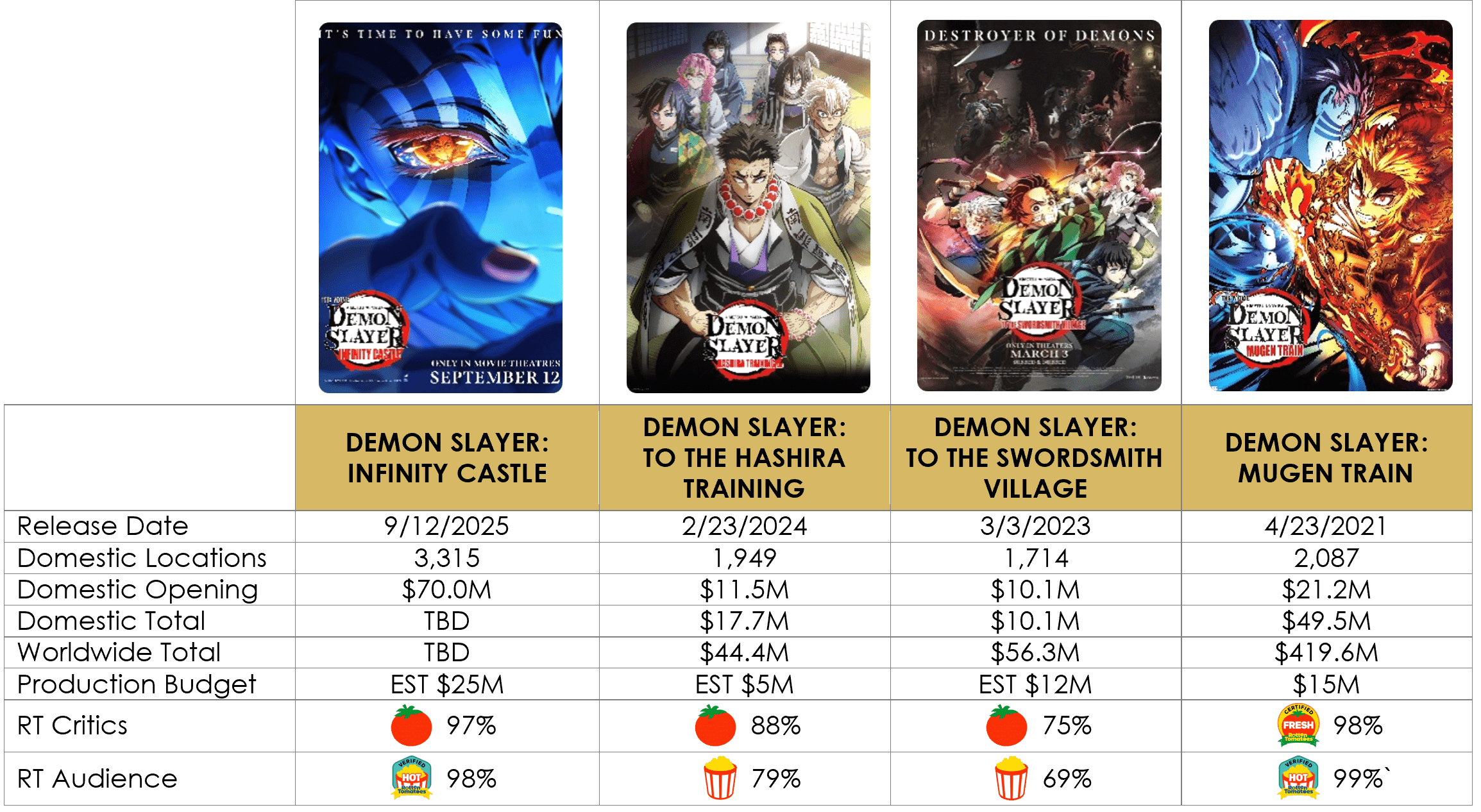
Virtually everyone who has seen it is exceptionally positive about the movie, with Rotten Tomatoes scores of 97% from critics and 98% from audiences. The Guardian called the film “a visually striking and emotionally resonant cinematic experience,” praising its vivid animation and emotional weight, while noting that flashback sequences sometimes slow the pacing. Variety said: “Beyond the sheer inventiveness of the movie’s made-up martial arts, which leaves the tragic elements, which can be disarmingly effective in giving audiences reason to feel invested in the battles, battles that have only just begun.” The San Francisco Chronicle points out that while “the plot is simple, the visual imagery and the emotions are complex.”
Here is how INFINITY CASTLE compares to the previous DEMON SLAYER movies.
Comparing the Four DEMON SLAYER Movies
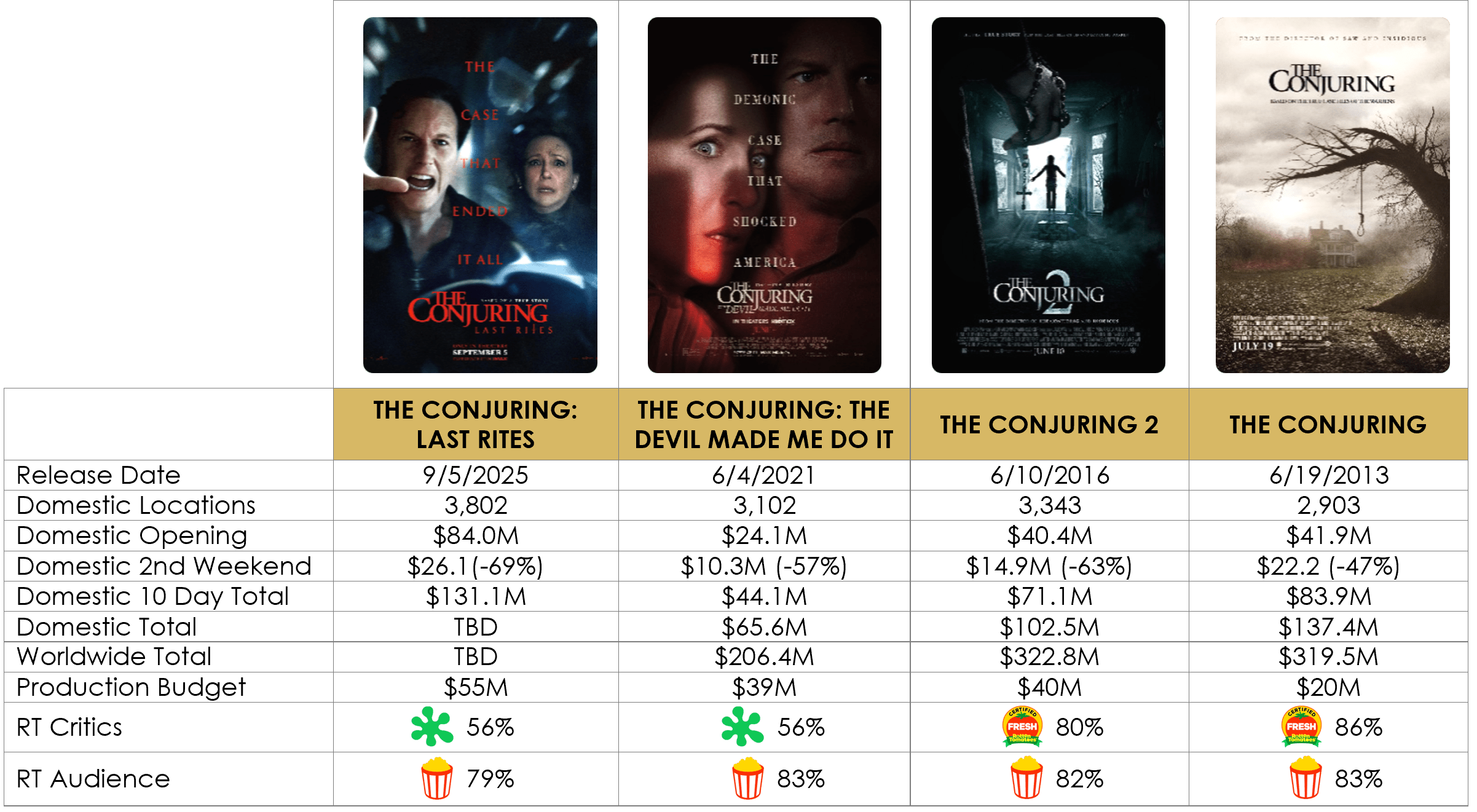
Last weekend’s first-place finisher, THE CONJURING: LAST RITES, ended up in second place this weekend with $26.1M, a steep drop of 69%. This brings its ten-day total to $131.1M domestic and $365.7M worldwide, almost three times higher than the $138M in worldwide sales it needed to make a profit. LAST RITES’s $55M production budget was the highest of all ten movies in THE CONJURING Universe of films, which have all been well-received and profitable.
LAST RITES will become the new box office champ of the series, surpassing the $322.8M earned by THE CONJURING 2 in 2016. It has been billed as the final movie in THE CONJURING’s “phase one,” but there are plans to continue the fun in a follow-on “phase two.” No studio ends a franchise when its last chapter sets a new box office record.
While the characters of Lorraine and Ed Warren may have made their final appearances in LAST RITES, other characters and storylines have been positioned in ways to allow for something new. Their daughter Judy was cleverly more involved in LAST RITES than in the past films, which suggests the potential for a “passing of the torch.” While Richard Brener, the Chief Creative Officer of Warner Bros.’ New Line Cinema studio, acknowledges that LAST RITES is the end of phase one, he expects that there will be more ahead.
Why it makes sense to divide a long-running movie franchise into phases is a question that only super fans and studio execs can answer. Here is how LAST RITES compares to the other CONJURING films after ten days in theatres.
THE CONJURING: LAST RITES vs. Other THE CONJURING Movies after 10 Days
Focus Features’ historical drama DOWNTON ABBEY: THE GRAND FINALE finished third by bringing in $18.1M in its first three days domestic and $30.4M worldwide. This is the third and final installment of the DOWNTON ABBEY trilogy, based on the British television series of the same name that ran for six seasons and 52 episodes from 2010 to 2015.
The series was created by Julian Fellows and was widely acclaimed, in the UK and internationally, particularly in the U.S, where it aired on PBS. At the height of its popularity, episodes would commonly draw audiences of 8–10 million. It was acclaimed for having high production standards, intricate storytelling, and compelling performances. The show received numerous awards, including 15 Primetime Emmy Awards and three Golden Globes. Maggie Smith’s portrayal of the Dowager Countess Violet Crawley became iconic and earned her multiple Emmys and BAFTA awards.
The series also received nominations for Screen Actors Guild Awards, Critics’ Choice Awards, and more, making it one of the most decorated British dramas of the decade. Its success prompted three major feature films: DOWNTON ABBEY (2019), DOWNTON ABBEY: A NEW ERA (2022), and the current DOWNTON ABBEY: THE GRAND FINALE (2025).
Set in the early 20th century, the TV show chronicled the lives of the aristocratic Crawley family and their domestic servants at their Yorkshire estate. The story begins at the time of the sinking of the Titanic on April 15, 1912. That event prompts a crisis in family inheritance.
The heir to the estate, Crawley’s cousin Matthew, survives the tragedy, reshaping family dynamics. The series explores the social status and relationships among the aristocratic family who live in the “upstairs” suites at the residence and the domestic workers who occupy the “downstairs” quarters. Key storylines integrate other historical events, including World War I, the Spanish flu, women’s suffrage, and the rise of modern ways that impact the characters.
The series emphasizes tradition vs. change, class distinctions, and family loyalty through marriages, scandals, and tragedies. The show’s final episode concludes in the year 1926 when relationships are resolved, secrets are revealed, and Downton’s legacy is secured.
The first film, DOWNTON ABBEY (2019), picks right up in 1927 as the Crawley family prepares for a royal visit by King George V and Queen Mary. The successful royal visit has the effect of securing the estate’s longevity and reinforcing the bonds between upstairs and downstairs characters. The second movie, DOWNTON ABBEY: A NEW ERA (2022), is set in 1928-1929, when there is increased financial strain following the stock market crash and subsequent economic crisis.
When Lady Mary takes over running the estate from her father Robert, the Crawleys try to preserve Downton Abbey’s heritage and family bonds while modernizing their ways. DOWNTON ABBEY: THE GRAND FINALE is set in 1930, with Lady Mary managing the estate through the scandal that surrounds her divorce from Henry Talbot. Robert and Cora prepare for retirement at the Dower House, while staff members take on leadership roles.
Themes of transition, class, and family endurance dominate, culminating in poignant farewells, honoring departed characters, and offering closure. THE GRAND FINALE provides a definitive conclusion to the beloved series, having followed the lives of its characters from 1912 to 1930.
Julian Fellowes has been central to Downton Abbey’s success, serving as the creator, writer, and executive producer of both the TV series and all three movies. In addition, many of the central cast members have been consistent throughout, from Hugh Bonneville as Robert Crawley, the Earl of Grantham, Elizabeth McGovern as his wife Cora Crawley, the Countess of Grantham, Michelle Dockery as Lady Mary Crawley, Laura Carmichael as Lady Edith Crawley, Allen Leech as Tom Branson, the family chauffeur, and Jim Carter as butler Carson.
The only missing member of the original cast from the new movie was Maggie Smith, who passed away in 2024. She had played Violet Crawley, Dowager Countess of Grantham, the matriarch of the family. Even without her presence in THE GRAND FINALE, her presence is recalled through references, remembrances, and flashbacks that use previously filmed footage. In a fitting homage, the closing credits feature a dedication to Maggie Smith, acknowledging her central role in the story.
Critics and audiences have always been highly complimentary of both the TV series and the previous two movies. The tradition continues with THE GRAND FINALE having Rotten Tomatoes scores of 91% from critics and 96% from audiences. The Los Angeles Times explains that the key to THE GRAND FINALE is that Fellowes doesn’t venture into unfamiliar territory… he keeps us grounded in the smaller social and familial dramas.” RogerEbert.com says, “It confidently cashes out the considerable emotional capital that the series has accrued.”
Alonso Duralde of The Film Verdict offers a thoughtful critique, noting that the film “blends MCU levels of fan service with British baking-competition levels of coziness.” He appreciates how the film brings the Crawley family and their staff into the 1930s, providing a satisfying conclusion to their stories. He also points to the film’s success in balancing emotional depth with light-hearted moments, making it a fitting end to the beloved series.
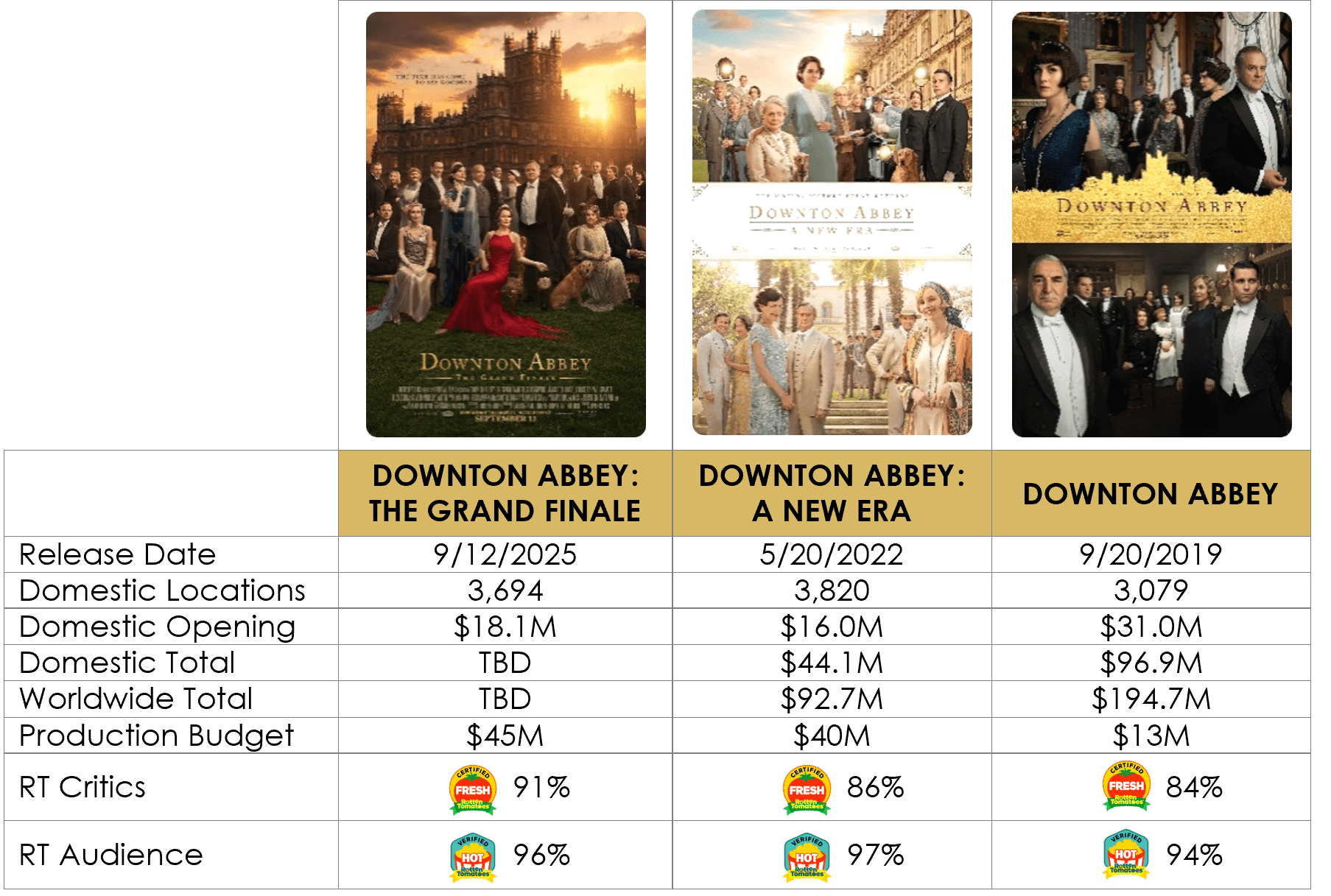
With an estimated production budget of $45M, THE GRAND FINALE will have to reach $113M in worldwide ticket sales to be profitable. Its opening weekend of $18.1M slightly higher than the $16.0M DOWNTON ABBEY: A NEW ERA earned in its start in 2022.
That film wound up grossing $92.7M worldwide, which provides some indication of how THE GRAND FINALE may do. These films appeal to an older audience that is somewhat less likely than other demographics to see them on their opening weekend, and their positive word of mouth could help them draw well in subsequent weeks. Here is how THE GRAND FINALE compares to the two previous DOWNTOWN ABBEY films.
DOWNTON ABBEY: THE GRAND FINALE vs. Earlier DOWNTON ABBEY Films
Lionsgate’s THE LONG WALK finished fourth in its opening weekend by bringing in $11.5M. The movie is based on Stephen King’s novel of the same name, published in 1979, long before King became a household name. In fact, King began writing the story that became ‘The Long Walk’ in 1966, while he was an 18-year-old college student studying at the University of Maine.
At that time, he was writing under the pseudonym Richard Bachman. Of course, King has become one of the most prolific and well-known writers of our time, having authored 83 full-length novels, 19 novellas, and 200 short stories. Over 350 million copies of his works have been sold to date, with an additional 7-10 million new copies selling each year.
King has also had a profound effect on movies and moviegoing. Including THE LONG WALK, 39 works from King have been turned into movies that have graced cinemas for nearly 50 years, generating $3B in ticket sales. His movies began in 1976 with CARRIE from United Artists. The adolescent horror story was a critical success and a box office smash, grossing over $33M on a tiny $1.8M production budget.
King’s long relationship with Hollywood continues to this day, with THE LONG WALK veering off into science fiction because of its setting in a dystopian future America. It also contains a sentiment of psychological thriller because of its focus on mental strain, endurance, and survival. King fans will also see its foundation in horror, because the emotion of the film flows from the cruelty of the situation.
Interestingly, this novel from almost 60 years ago has the same eerie feel as stories he has written throughout his career. The plot of THE LONG WALK takes place in a future America and revolves around 50 teenage boys, each from a different state, who participate in an annual walking contest where they must maintain a speed of at least three miles per hour or face execution.
The last remaining walker wins a cash prize and a wish. The film follows Ray Garraty (Cooper Hoffman) and his evolving friendship with fellow contestant Peter McVries (David Jonsson), providing an emotional core amidst the brutal competition. The film is directed by Francis Lawrence, who was a perfect selection after directing all four of THE HUNGER GAMES films, whose stories all revolve around an annual competition that forces teenagers into direct combat for survival.
In a role that has him playing against type, Mark Hamill plays the Major, a stern and authoritarian figure overseeing the brutal death march. His character embodies the oppressive regime, serving as the public face of the totalitarian state. Hamill’s portrayal is described as gruff and gung-ho, capturing the chilling nature of the regime’s enforcer. Hamill has explained that his primary motivation for taking on this role was the opportunity to portray a villain, saying, “If I do my job correctly, everyone will hate my guts”.
Stephen King played a significant role in the making of THE LONG WALK. He provided final approval for the casting choices, ensuring that the film’s portrayal aligned with his vision. King emphasized the importance of depicting brutal violence in the film authentically, stating that if such violence isn’t shown explicitly, then the filmmakers shouldn’t bother adapting the story.
Over the years, critics have landed all over the board on Stephen King films, but they seem to have embraced THE LONG WALK with a 90% score on Rotten Tomatoes. Audiences have weighed in with a solid 85% score. Total Film said “THE LONG WALK is not for the faint of heart, but it is one of the best Stephen King adaptations ever made, and one of the best dystopian sci-fi movies to hit the big screen in a really long time.” Collider says, “Exceeds even optimistic expectations to easily become one of the best Stephen King adaptations.” New York Magazine adds, “Jonsson, despite some worrying initial forays into a twangy accent, is the stand-out as Peter, with his crumpled smile and his insistence on solidarity, however much it goes against the spirit of the competition.”
Of course, not everyone was positive. The Verge opines that the film is a “dystopian slog,” noting that while it remains faithful to Stephen King’s original novel, it falters in exploring deeper emotional and political themes. The review criticizes the film for prioritizing grim pacing and shock value over nuanced storytelling.
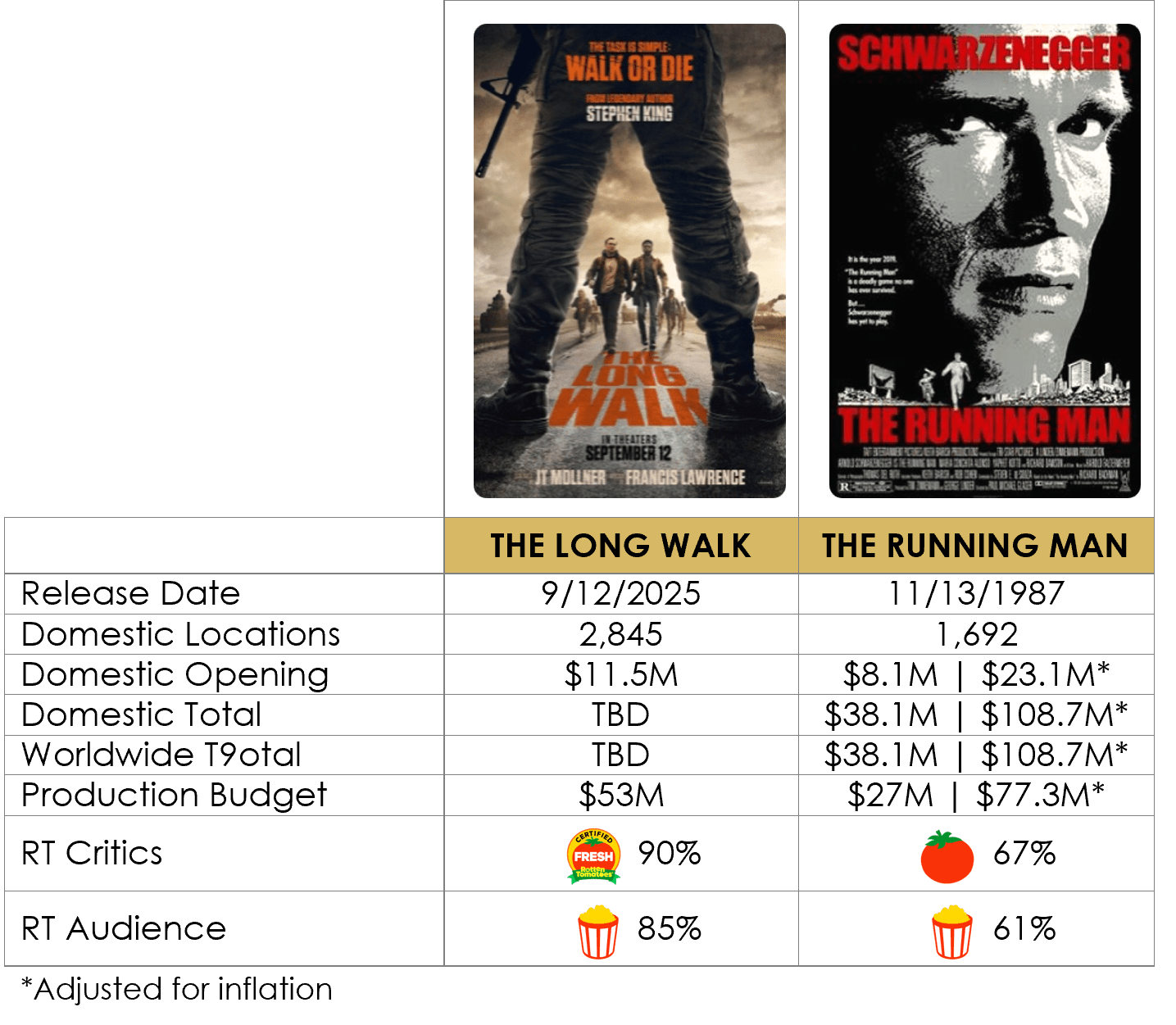
With a production budget of $53M, the film will need to gross $133M to be profitable. With the $11.5M in its first weekend, it will need to hold up well for several weeks to reach that goal. For King book-to-film aficionados, we have chosen to compare THE LONG WALK with another King movie adaptation, THE RUNNING MAN from 1987, starring Arnold Schwarzenegger.
Its premise was a televised, deadly game where contestants are hunted by state authorities, in another tale of a government-run, life-or-death competition. Both films explore themes of societal violence and authoritarianism. If you liked THE RUNNING MAN, Paramount is making an updated version of the 1987 film, starring Glen Powell in Arnold’s role and scheduled for release in two months on November 14th.
THE LONG WALK (2025) vs. THE RUNNING MAN (1987)
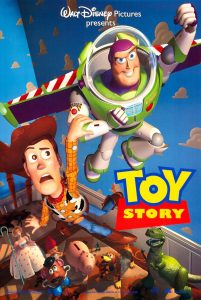
In fifth place is Disney’s 30th Anniversary re-release of the 1995 animated classic TOY STORY. Fans supported it to the tune of $3.5M domestic and $5.2M worldwide. The original release grossed $373M globally on a production budget of only $30M, giving it a phenomenal 12.4 to 1 ratio of worldwide gross to production budget. This film established Pixar as a key player in the world of animation.
It was the first movie to be created entirely using computer-based effects, which made its stingy $30M budget possible. The success of the original has led to three additional films: TOY STORY 2 (1999), TOY STORY 3 (2010), and TOY STORY 4 (2019). Those four films combined have a box office of $1.3B domestics and $3.0B worldwide, making it one of the top animated film series of all time.
As a reminder, TOY STORY is set in a world where toys come to life secretly when their human owners are away. The lead character is Woody, a pull-string cowboy doll who is the favorite toy of his owner, Andy, and the leader among the collection of toy characters. When Andy receives a new, flashy action figure named Buzz Lightyear, Woody is jealous and feels threatened that he could lose his place as Andy’s favorite.
Buzz is unaware that he is a toy, instead believing that he is an actual space ranger on a mission. Their rivalry leads to conflict, but when they become lost together outside the safety of Andy’s room, they join forces to get back before Andy’s family moves to a new house. In the end, Woody and Buzz overcome their differences to become genuine friends and restore peace and harmony among the toys.
Disney is using this 30th anniversary re-release of TOY STORY to remind fans of the beloved franchise in the lead-up to the planned release of the next chapter, TOY STORY 5, scheduled to open in theatres on June 19, 2026.
Comparing the Four TOY STORY Movies To-Date
Where Are We as of 9/11/2025
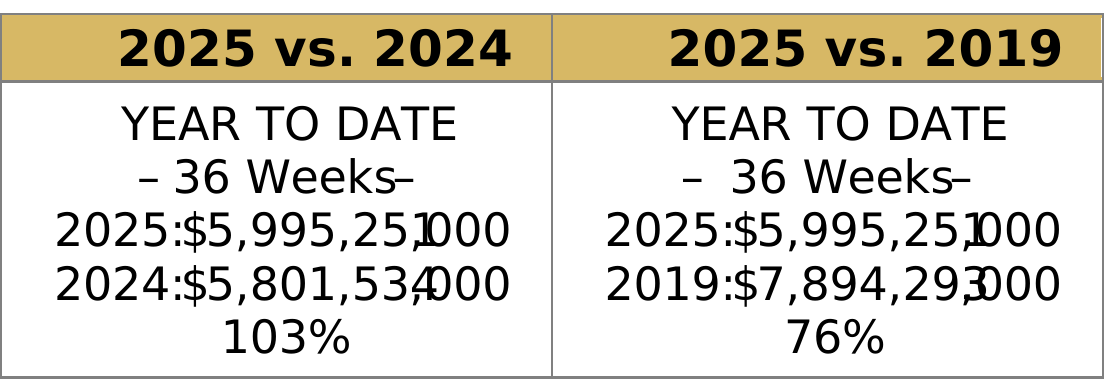
After 36 weeks, the 2025 domestic box office stands at 103% compared to the same point in 2024 and 76% compared to 2019.