
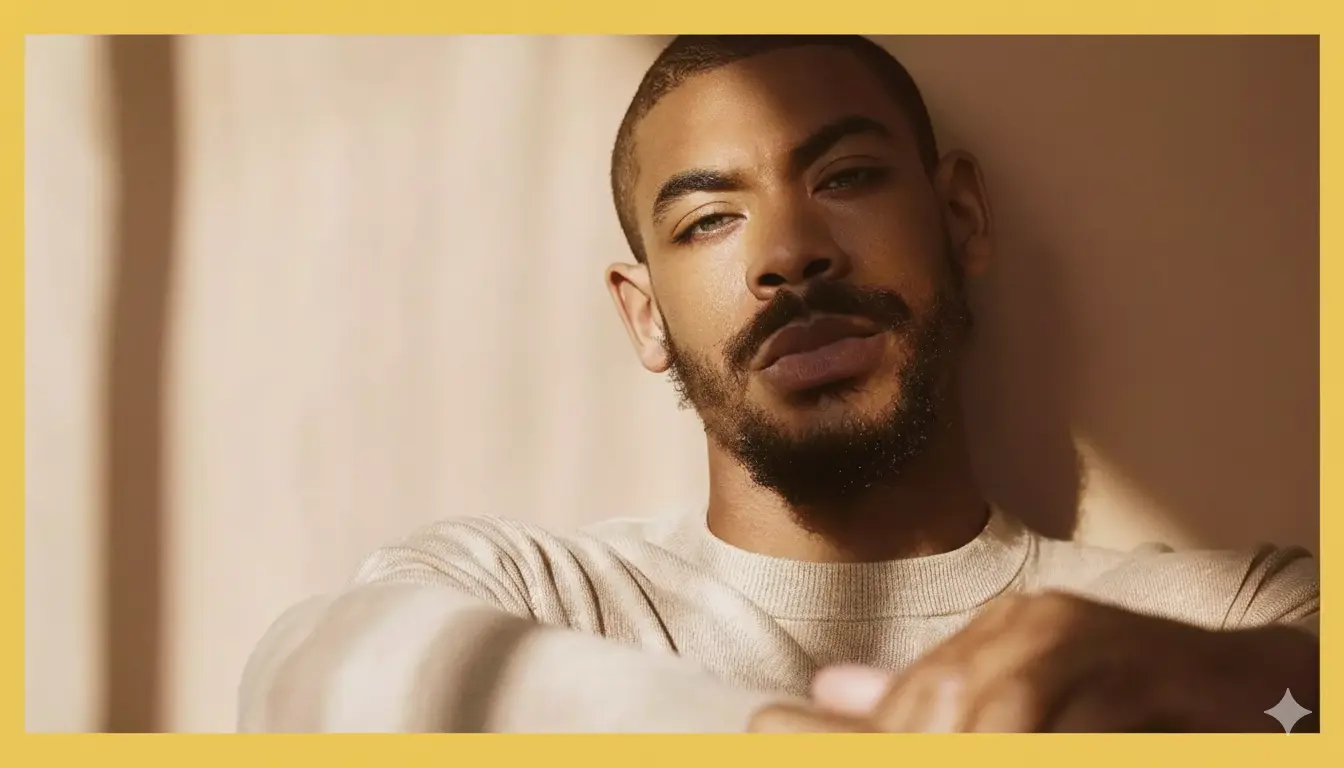

Aaron Pierre, born in 1994 in London, is no overnight success. He trained at LAMDA (London Academy of Music and Dramatic Art) and quietly built his way through roles that paid attention to nuance. Before Rebel Ridge, he appeared in The Underground Railroad, voiced roles in Mufasa: The Lion King, and played Malcolm X in Genius: MLK/X. He has always struck me as the kind of actor who listens to characters, to context, and lets his presence unfold slowly.
Physically imposing, quiet in demeanor, but with an intellectual interiority, Pierre defies easy categorisation. So when Rebel Ridge needed a hero, he was not a random replacement. He was, in many ways, the perfect fit.
Rebel Ridge: The Film (and the Trouble)
Rebel Ridge is written, directed, edited (yes, all three) by Jeremy Saulnier — the filmmaker behind Blue Ruin and Green Room. The film leans into tension, moral ambiguity, and systemic rot.
The story follows Aaron Pierre as Terry Richmond, a former Marine who drives into Shelby Springs, Louisiana, to bail out his cousin. What should be a routine errand turns into a nightmare. Local police seize his bail money through civil asset forfeiture, an actual legal loophole that lets law enforcement grab people’s cash on suspicion alone. From there, Terry finds himself in the crosshairs of a corrupt system that wants to make him disappear quietly. Instead, he pushes back.
Unlike many action thrillers, the film is slow and takes its time building the tension. It builds momentum with long, quiet stretches before erupting into full-blown violence. The humid Louisiana setting adds to the look and feel’s slowness; the air itself seems to sweat.
And overall, Aaron Pierre gives the film its spine: calm, coiled, and effortless.
John Boyega’s Exit — And a Hole in the Set
Originally, John Boyega was earmarked to play the lead. His name carried weight; audiences would come. But in June 2021, just after filming began, Boyega left the project, citing “family reasons.” His agent echoed that; Netflix issued statements to the same effect.
Behind the scenes, however, rumours swirled. Some insiders suggested dissatisfaction with the script or even his accommodations on set. Others claimed the production only realised he had left when hotel staff found his room vacated.
Whatever the truth, and Boyega denied many of the claims, the effect was the same: the film was halted. Saulnier and Netflix had to regroup and recast.
Into that mess stepped Aaron Pierre.
How Aaron Pierre “Landed” the Lead (Rather: Earned It)
“Landing” is misleading. More accurately, Aaron Pierre was chosen. When Saulnier met him (via Zoom) after receiving his audition, that was it. He told the actor, “The dude vibes superhero.” (Men’s Health)
Pierre read the script in about 90 minutes, he says — swept in by its urgency. He embodied what the director needed: a mix of restraint and latent power, stillness and explosion.
Once cast, he threw himself into the role: training, stunts, choreography in Louisiana’s cruel summer. Many of his fight scenes are his own work.
For Pierre, this wasn’t just a performance; it was a full-body experience. In an interview with the Guardian, he said, “During Rebel Ridge, there wasn’t one day that I didn’t have at least a bruise or a cut, or a mark or feeling sore,” he said later. “And I loved that. I relished how physical this role was, and I’m all for doing that more and more.”
He also had to carry the weight of the production’s gambit. Aaron Pierre’s Rebel Ridge casting came with a lot of questions — can the film survive losing its star? He and the crew bet yes, and the film found its heart in a different voice.
Where It Stands Now, and What’s Next
The gamble largely paid off. Rebel Ridge dropped on Netflix in September 2024. It has been well received — critics generally speaking of it as a robust genre piece that occasionally overreaches but often lands. In fact, it won the Critics’ Choice Television Award for Best Movie Made for Television and the Emmy for Outstanding Television Movie.
Pierre, as a result, experienced a breakthrough year. He is one of AP’s Breakthrough Entertainers of 202, and is now attached to HBO’s Lanterns as John Stewart / Green Lantern.
What Gabriel Garcia Márquez once said of writers — that to read a book is to live someone else’s life — feels fitting here: Pierre is making known the weight of inhabiting others, becoming central rather than marginal.
Still, the shadow of Boyega’s exit lingers. Some will always ask: would the film have been different had Boyega stayed? But that question risks turning Rebel Ridge into a hypothetical. The real film exists as it is, with Pierre at its centre, owning that space.
Now, the question turns to the future. Can Aaron Pierre build an action-star trajectory? Can he navigate broader roles without losing the authenticity he brings? Can he hold fast to that Croydon self in a Hollywood tide pulling him outward? So far, signs are encouraging.
In Conclusion
When John Boyega left Rebel Ridge, the project could have seemed broken. But in stepping into that breach, Aaron Pierre reshaped the narrative. The film that followed, anchored by his energy, is not the Boyega version (that version is forever lost), but it is its own thing — rawer, more tightly focused, more a vessel for a different kind of hero.
In that sense, Aaron Pierre in Rebel Ridge becomes not just a credit line but an argument: that sometimes, the unexpected turn is the one that brings you closer to what you needed all along.